Mice are sociable & playful. This lovely drawing (birthday present from my wife Claudia) captures the fun of what we call the ‘mouse circus’, a large open pen where they get to play with the equipment (yes, they really do go upside down in the wheel!), with each other, & with us!
@SynBio1 Or, as they used to say in the UK: “You Might as Well Be Hanged for a Sheep as for a Lamb”
The context is that the same Draconian punishment was handed out regardless of the animal’s value, so it made sense to steal the more valuable animal.
https://t.co/NY3kB8LKDK
Please join me and the rest of this great panel, discussing how we as a community should not oversell research outputs whilst at the same time demonstrating societal relevance. Lots to cover!
@angus_barrett ‘Ignorant learnedness’ might be seen as a pathology that has always menaced the academic enterprise. It’s when knowledge (or what passes for it) becomes disconnected from reality. Ungrounded, if you like. This also afflicts AI. Big-time.
An analogy is getting the skills to build cathedrals. At the start, much about physics & properties of stone was poorly understood.
Result:
-Some cathedrals collapsed (e.g. Beauvais ⬇️)
-Architects & masons learned
-Learning took *centuries*
-“Stay humble, biodesigners”
@SynBio1
do think discourse on engineering biology would benefit from fewer platitudes about the complexity of living systems and more informed optimism about our inevitable path to break down, understand and rebuild organisms
By flipping an evolutionarily disabled genetic switch involved in Vitamin A metabolism, researchers in Science have enabled ear tissue regeneration in mice.
Learn more: https://t.co/zxLoqAzgLc
@ProfTomEllis This piece reports an interesting initiative but really doesn’t answer its question. Is a straightforward answer at this point “Because in principle we can & the technology might one day be useful”?
Also, this passage ⬇️ is boilerplate 🌱 hype, of which we have enough already.
Excellent, critical🧵 @MariosGeorgakis! BetaineS (there are various natural ones) have major benefits in plants. This has been clear for decades e.g. https://t.co/Ao3i85V8kZ
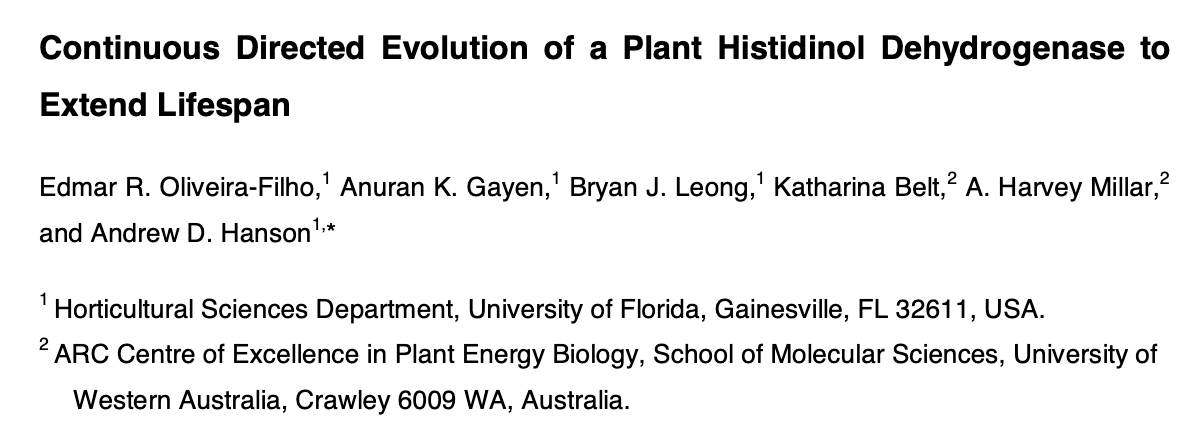
Excited to share the Hanson Lab’s @ADHansonLab new preprint! We used OrthoRep to evolve Arabidopsis HDH, a short-lived enzyme, selecting variants with up to 20× higher abundance. Mutations boosted lifespan, catalytic efficiency, or inhibitor resistance.
🔗https://t.co/XKEZDKA0KR
@thisischristina@SynBio1 I would be tempted to add “…yet” to your last sentence :)
Be that as it may, this is a good opportunity to say that I thought the ‘resurrection of a fossil scent’ idea from a few years back was brilliant pro-GMO messaging! I have used it as an example in teaching.
@Manning4USCong@IsaacKing314@KevinWilsonROC 💯Ice made by refrigeration technology is chemically & physically essentially the same as ice formed during cold weather.
Whereas animal muscle tissue & lab-grown ‘meat’ are chemically & physically different & probably always will be.
@TomKnightSynBio@srikosuri A key difference btwn CS & biology is that in biology there are far more ‘unknown unknowns’ (let alone ‘known unknowns’. We’ve had big-time biochemistry & mol biol only since WWII. Think of what we now know that we didn’t in e.g. 1960. Were not much nearer full understanding now.
See this opening statement for the prosecution ⬇️ (should read “There is a dire need for solutions….” BTW)
💯 some improvements in N use etc are possible. But another big energy use in ag is diesel. How to replace this? Animal traction? Which takes land..
https://t.co/WW72YwjbDL