Using ISRIB, we reversed this effect—offering insights into how stress pathways and inflammation intersect in neurological disease. Congratulations to the team! Collaboration continues to be the cornerstone of scientific advancement and shared achievement.
#TeamScience#SciCollab
We uncover how ER stress and TNF-α synergistically amplify inflammatory responses in astrocytes via a PERK/eIF2α/JAK1 signaling axis. This mechanism delays negative feedback regulators, intensifying cytokine-driven gene expression.
https://t.co/OdWKyn1c2a
My interview w/ Manu Prakash @PrakashLab, a hero of mine, who I think is one the great innovators of our era. With global impact for frugal, ingenious inventions as you'll see in this thread https://t.co/iVcjBc0Lf6 @Medscape w/ transcript @TeamFoldscope@StanfordEng@Stanford
The 2023 Nobel Prize in Physiology or Medicine awarded jointly to Katalin Karikó and Drew Weissman for their discoveries concerning nucleoside base modifications that enabled the development of effective mRNA vaccines against COVID-19. https://t.co/45QUjBBdvI
“The true promise was not that the stem cells would do this, but that they were the starting point for the cells you wanted. And that is never simple. That is painstaking and slow. That is science—it’s laborious and takes time.” https://t.co/9JkUHWHcZM
“..(the report) It identified a culture where Tessier-Lavigne “tended to reward the ‘winners’ (that is, postdocs who could generate favorable results) and marginalize or diminish the ‘losers’ (that is, postdocs who were unable to generate such data).” https://t.co/nxGW4ivbrN
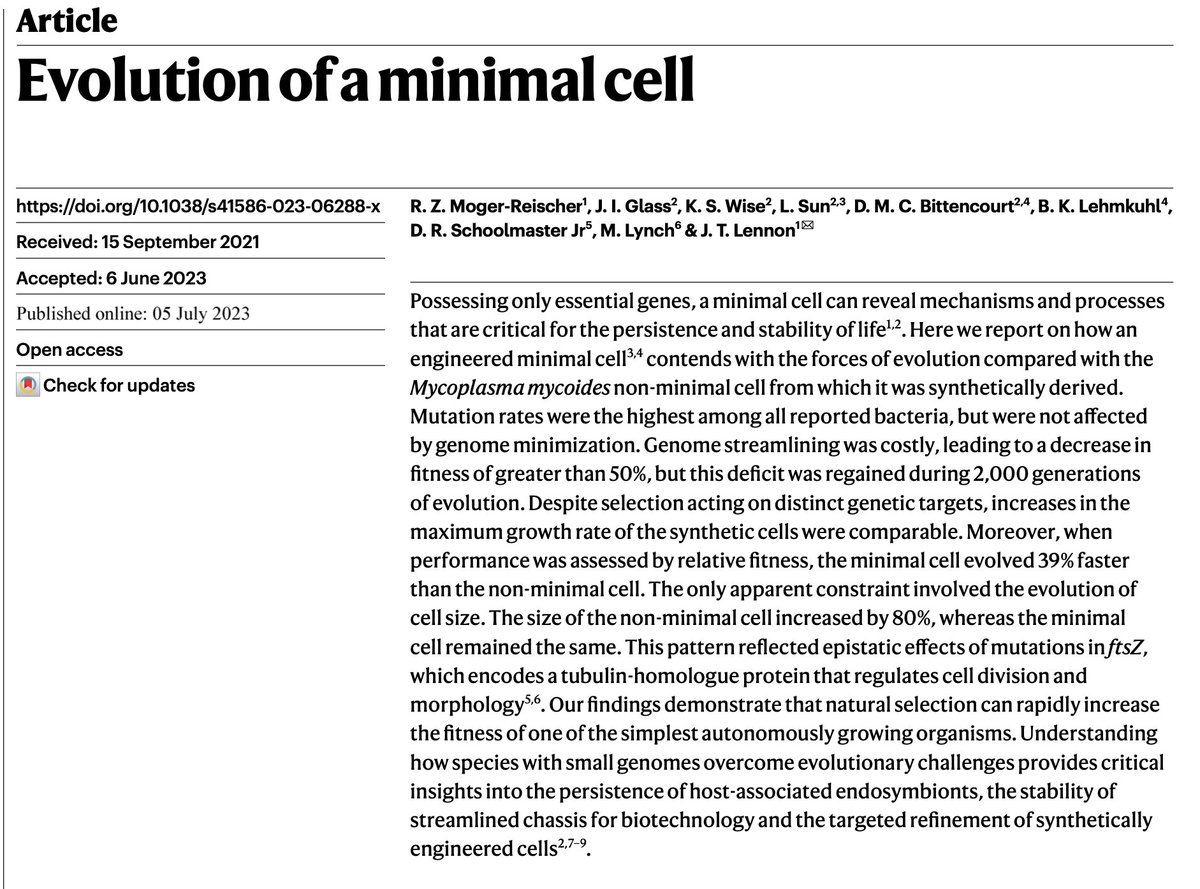
A mind-blowing paper has come out today in @Nature
In 2016, JC Venter Institute scientists trimmed a bacterial genome to its barest minimum required for life to synthesize what they called a "minimal genome" (https://t.co/Rk8oZJ0bUj).
Today, a group of scientists from Indiana University reports how that minimal genome evolved over 2000 generations in comparison to the non-minimal genome.
The authors found that even when you reduce a bacterial genome to its absolute minimum where every nucleotide matters, the genome undergoes mutational events generation after generation as much as the non-minimal genome. One simply cannot stop the evolution.
Just over 300 days of evolution (equivalent to 40,000 years in humans) the minimal cell has gained everything it lacked in fitness on day one in comparison to the non-minimal cell.
When comparing the evolved traits between the minimal and non-minimal cells, the scientists found something striking. The evolutionary process increased the cell size of non-minimal cells but not that of the minimal cell. But that is not the striking part.
The scientists were able to identify the key mutation that resulted in cell size evolution. And it turned out that the mutation that helped the non-minimal cells to grow bigger is the same that helped the minimal cells to stay smaller. Growing bigger had a survival advantage for non-minimal cells and not growing bigger had a survival advantage for minimal cells. So, the mutation had a context-dependent effect. This just demonstrates that the evolutionary effects on traits have no absolute direction. All that matter is what is beneficial for the organism's survival.
The conclusion of the paper is metaphorically a quote from the Jurassic Park movie:
“Listen, if there’s one thing the history of evolution has taught us is that life will not be contained. Life breaks free. It expands to new territories, and it crashes through barriers painfully, maybe even dangerously, but . . . life finds a way". (https://t.co/UlxRlb86CT)
https://t.co/zA9OAqSoAu
BlueRock’s neuronal stem cell therapy for Parkinson’s disease is first to show positive results in Phase I clinical study - BlueRock Therapeutics LP https://t.co/inqmsI3vSy