OpenAI's Joy Jiao on building a Codex for scientists:
"One of the biggest things that we see with the models today is that there's what we call a capability overhang, and this means that there's a lot of things the models can do, but no one knows about it, and so no one has access to that."
"What we really wanna do is bring something that is as good as Codex for coders, for scientists and to biotechs and pharma."
"When we are training GPT-Rosalind, we have all these interesting capabilities in the model in both chemistry and structural biology. We see that the models are doing really well on the benchmarks."
"But one repeated theme we've seen is that people don't know how to use the models. They don't know even what prompts to use, what questions to ask. And I think this is really where you need an exceptionally good product or a good harness around the model to really make that capability accessible to people."
@joyjiao12
all our agents at langchain (internal GTM & content agents, LangSmith Engine) have a learning loop with similar pieces
wrote about what we think makes up a "knowledge factory" https://t.co/xaAZb5i79q
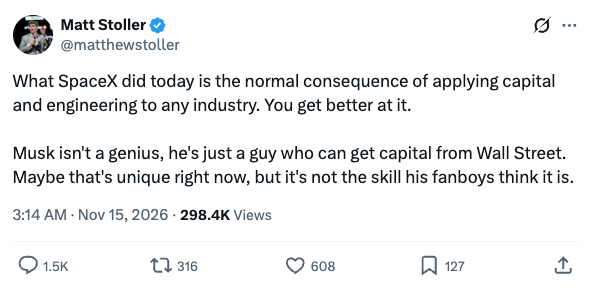
You work your ass off solving really hard problems day after day for decades, and this is what you get: anyone could have done it.
As an investor, I can tell you the limiting factor isn't investment. It's founder ability.
@ATinyGreenCell What would you accept as evidence that any part of it is solved? Personally, I'd settle for a end-to-end pipeline involving constructs that works first try in a new cell line.
@KevinKaichuang@sesameandrea@KotaroTsuboyama Beautiful. One question- Does it hold for fusion constructs? Most things I see fail to express are a native sequence plus a tag and a linker, which is what the natural variants don't cover.
@wardbradt@GoogleDeepMind@GamowLabs What does it do when a step fails halfway through? Noticing that a plate is bad is the part I'd want to see, more than the happy path.