Imagine you own a plot where you want to build your dream house. You hire a reputed contractor who is well-known for building houses overnight.
“ I just gave a brief description and got a beautiful house beyond my wildest dreams. It’s just like the genie from the lamp”, says Mr. Joe, an early customer of the contractor.
Excited by the glorious testimonials, you ask the contractor to build a house with abundant natural light, generous open spaces, and seamless connections to gardens and outdoor living that evokes a sense of calm sophistication.
The contractor agrees at once. No questions asked.
The next day the house is ready. It is glorious, more than you pictured, and you move your family in without a second thought. Then the floor cracks under the weight of your sofa. There is no plumbing. There are no electrical lines. You are living inside a beautiful cave.
You confront the contractor. "I built exactly what you asked for. Light, open space, greenery. I can redo any of it.", said the contractor. And he is right. That is the problem.
What you needed was not a contractor but an architect. Someone who treats your intent as something to be understood before it is built, who questions and verifies and closes every gap between what you said and what you meant, and only then lays a single brick.
TypMo is your product architect. Everything else, a contractor.
Incomplete specs result in coding agents filling the gaps with inference, often with sweeping assumptions that later result in substantial money loss, both in terms of human hours and tokens.
TypMo prevents it. You get comprehensive, connected, and validated specs that your agents consume like a contract rather than prose. Everything from personas and roles to product states, journey, and even agents.
That becomes the difference between blind tokenmaxxxxing and smart token optimising.
#ai #typmo #development
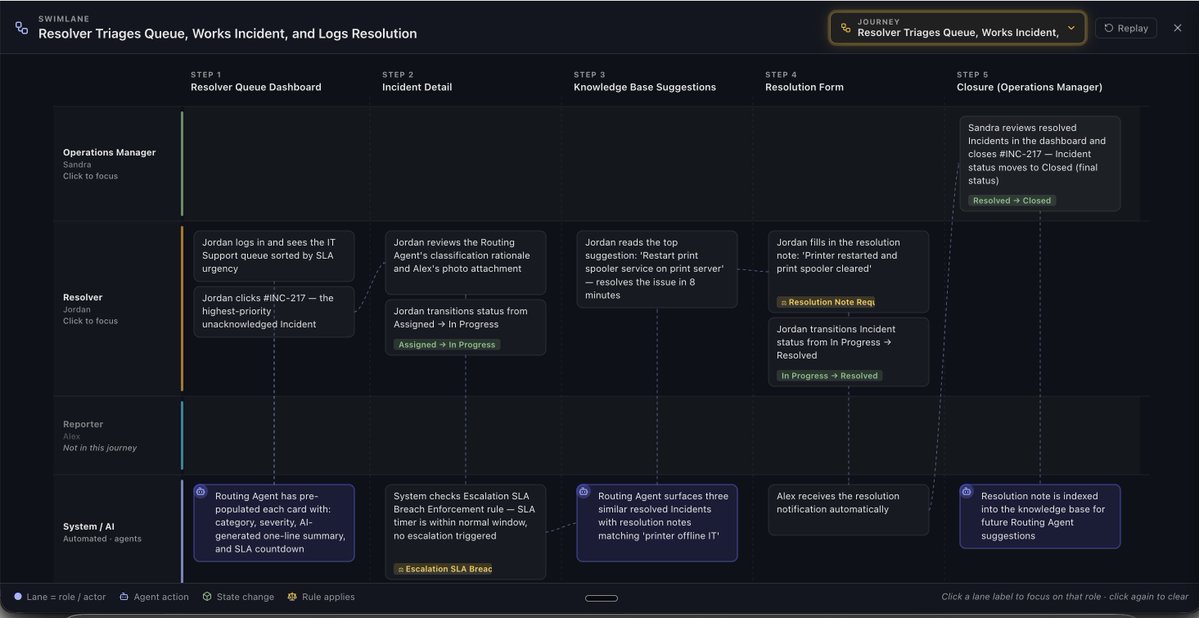
Look at this screen.
Every role, every agent, and every state change is visible in a single view.
You can see exactly how an incident moves from queue to closure. Who triages. Who resolves. Where the AI agent pre-populates, checks SLA rules, surfaces similar past incidents, and indexes the resolution for next time.
This is what TypMo generates from your spec. A living swimlane that shows how information passes through people and agents, how they act on it, and where the system enforces rules.
Build systems, not screens.
In a world where execution is table stakes, Before the Prompt is my attempt to appreciate deep thinking and what it takes to build robust, scalable products with AI rather than screens.
The hard part is knowing what to build before you build it. The thinking that happens before the first prompt. The structure that determines whether what you ship actually holds.
Before the Prompt is not a newsletter about AI tools. It is a primer on systems thinking for people building complex products with AI. How to reason about what you are building before you ask an agent to build it.
No tips and tricks. No listicles. Just rigorous thinking, written to be worth your time.
If that resonates, subscribe to the newsletter.
https://t.co/QKn6ZJ80Au
I’ll say the thing no one is saying: design culture is broken in lots of companies.
Often design teams & designers are the most resistant to change org in the EPD triad, with highly vocal AI opponents, and little skill or interest in the art of campaigning for influence or resources. Won’t hold a number like a PM, not yelled at about timelines like engineering. While I have brought design topics to the board convo, not a single board has pressed me our design talent, strategy, or velocity. Most teams treat design like a tax they don’t want to pay, and those that *do* take a deep interest and want to invest in design get back big “get out of my figma” energy. And if you’re too precious about craft to dirty your hands with the dark art of corporate politics, good luck getting more headcount. If a PM or engineer can get 85% there with tailwind and a dream, you better come to the table with more than “I represent the user.”
Great designers are worth more than almost anyone on the team, and I’ve worked with lots of gems, but this is 0% surprising to me.
@rishikagupta__ TypMo - Two purpose-built languages (DSLs) compile your product thinking into structured specs that coding agents consume directly via MCP.
https://t.co/QTXHXG5zDK
Here's a free 2-minute quiz that tells you the real complexity hiding in your application.
Most PMs think their app has 20-30 decisions to make. The real number is usually 150-250.
Roles that each see different data. Entities that move through states with rules at every transition. Business logic that cascades when one thing changes. Agent behaviors that need guardrails and fallbacks.
If these aren't in your spec, they'll show up as rework, bugs, and production incidents.
https://t.co/BbyHYk0j2S
MercadoLibre is training 20,000 developers on Spec Driven Development. They identified the frontier: spec-as-source, where you edit the spec and code regenerates to match. TypMo is already there. PMs write the spec. Coding agents read it via MCP. The spec is live, queryable, and verified against the build.