Pakistan Air Force bombardment in Souraab Giddar last night killed 27 innocent civilians. Families demand answers and accountability from @DGPR_PAF and @OfficialDGISPR over these fatal airstrikes in civilian areas. #HumanRights#Surab
Paank strongly condemns the continuing pattern of enforced disappearances, custodial torture, and extrajudicial killings in Balochistan carried out by Pakistani security forces, intelligence agencies, and state-backed death squads. The recovery of the bodies of Inayat Ullah, Salman Bangulzai, Attahullah Baloch, and Haibatan demonstrates the grave consequences faced by Baloch families whose loved ones are forcibly disappeared and held outside the protection of the law.
According to information received by Paank, the four cases reflect a disturbing pattern in which Baloch men are taken into custody or forcibly disappeared, kept beyond judicial oversight, and later found dead, leaving their families without answers or access to justice.
Inayat Ullah, son of Allah Dina, a 70-year-old retired government teacher and the father of Asma Jattak, was killed on 4 August 2026 in Shehzad City, Khuzdar. Inayat Ullah was targeted by state-backed death squads operating in the area. His killing came after his daughter, Asma Jattak, had publicly raised concerns regarding threats and harassment directed against her and had appealed to the authorities for protection.
The killing of an elderly retired teacher in this context is deeply alarming. It raises serious concerns regarding reprisals against families of victims who speak publicly about enforced disappearances and human rights violations. The case must be investigated in connection with the threats directed at Asma Jattak and her family, as well as her previous enforced disappearance and detention in February 2025.
Salman Bangulzai, son of Abdul Nabi Bangulzai, a 33-year-old shopkeeper and resident of Khudabadan, Panjgur, was forcibly disappeared shortly after Eid in 2026. He remained missing until 31 July 2026, when his body was recovered from the Newan Koor area of Panjgur.
Salman's body was returned to his family instead of the son and breadwinner they had been waiting for. His killing represents another devastating case in which enforced disappearance was followed by death. The prolonged uncertainty imposed on his family, followed by the recovery of his body, highlights the severe human cost of secret detention and impunity in Balochistan.
Attahullah Baloch, son of Faqeer Jan Baloch, a 35-year-old resident of Kodask, Khuzdar, was forcibly disappeared on 24 March 2026 from Panjgur by personnel of the ISI, CTD, and MI. He remained in illegal detention and torture cells for nearly three months before being extrajudicially killed on 21 June 2026 in Panjgur.
The case represents a grave violation of the right to life, liberty, and due process. Attahullah was denied access to an independent court, legal representation, and judicial protection. His family endured months of uncertainty before learning that he had been killed.
Paank considers the killing of Attahullah a serious example of the deadly cycle of enforced disappearance, secret detention, torture, and extrajudicial execution in Balochistan. Those responsible for taking him into custody and subsequently killing him must be identified and held accountable through an independent judicial process.
Haibatan, son of Malo Marri and a resident of Bela, was taken from Bela Cross on 9 July 2026 and remained missing. His body was subsequently recovered from a roadside near Gharibabad on the Hub-Sakran Road in Lasbela.
The body bore signs of torture and gunshot wounds, raising grave concerns over the circumstances of his death and the treatment he endured after being taken away. His case adds to the growing number of Baloch men who disappear and are later found dead, leaving their families demanding answers, justice, and accountability.
These four cases cannot be viewed in isolation. They form part of a broader and deeply disturbing pattern of enforced disappearances, secret detention, torture, extrajudicial killings, and the use of state-backed death squads against Baloch civilians in #Balochistan.
Paank strongly condemns the enforced disappearances of three Baloch individuals in Balochistan and expresses grave concern over the continuing pattern of arbitrary deprivation of liberty and the involvement of state authorities. These incidents reflect an ongoing human rights crisis that demands immediate attention of the international community.
Dilshad Baloch, son of Nazar Muhammad, 27 years old, a vaccinator at BHU and resident of Jannat Ali, Kohlu, was reportedly abducted on 17 July 2026 at approximately 1:00 AM from Baiker, Dera Bugti. He was taken by Aman Force personnel and subsequently handed over to Pakistan's Counter Terrorism Department (CTD). His whereabouts remain unknown.
Azam Baloch, son of Ahmed, 80 years old, a farmer and resident of Panwan, Jiwani, Gwadar, was reportedly forcibly disappeared from his home on 11 July 2026 at approximately 4:00 PM. According to reports received by Paank Pakistan Army personnel were responsible for his detention. His family has received no official information regarding his fate or whereabouts.
Zahid Baloch, son of Haji Abdul Kareem, a student and resident of Killi Kariz Kamal, Mastung, was abducted on 5 July 2026 at approximately 7:00 PM from Choungi Cross, Mastung. Reports indicate that personnel of the Frontier Corps (FC) were involved. His whereabouts remain unknown.
Paank calls on the Pakistani authorities to immediately disclose the fate and whereabouts of Dilshad Baloch, Azam Baloch, and Zahid Baloch. They must be afforded all legal safeguards, including prompt access to their families, lawyers, and necessary medical care, and either be charged with a recognizable criminal offence and brought before an independent court, or released immediately and unconditionally if they are being held solely in violation of their fundamental rights.
Paank further urges the authorities to conduct prompt, impartial, independent, and effective investigations into these enforced disappearances, ensure accountability for those responsible, and end the persistent practice of enforced disappearance in accordance with Pakistan's obligations under international human rights law.
BNM Delegation Meets MEPs, Urges Suspension of Pakistan’s GSP+ Status
A BNM delegation, led by Chairman Dr. Naseem Baloch, met with Members of the European Parliament (MEPs) in Brussels to raise concerns over human rights violations in Balochistan, including enforced disappearances, extrajudicial killings, and arbitrary arrests.
The delegation also discussed the reported life imprisonment of BYC leaders Dr. Mahrang Baloch and Sibgatullah Shaji, and urged the European Union to suspend Pakistan’s GSP+ status.
#ReleaseBYCLeader
#EndUnfairTrialOfBYCLeaders
#EndEnforcedDisappearances
🚨🚨#BREAKING: @EUPakistan GSP+ monitoring mission express “grave concerns remain as significant systemic challenges persisted in the implementation of human rights conventions, with a deterioration of the situation relating in particular to enforced disappearances, minority rights'', freedom of media and freedom of expression and peaceful assembly. Impunity for human rights violations continues to be of major concern.”
A delegation from BNM @BNMovement_ attended the European Parliament in Brussels, Belgium, today to engage with Members of the European Parliament (MEPs) and raise serious concerns regarding Pakistan's compliance with its obligations under the GSP+ (Generalised Scheme of Preferences Plus) framework.
During the meetings, the delegation highlighted the grave human rights violations in Balochistan and emphasized that these abuses are inconsistent with the human rights commitments required under the GSP+ agreement. The delegation urged the European Union to conduct a thorough review of Pakistan's compliance with its GSP+ obligations and recommended that the GSP+ status should be revoked as Pakistan is found to be in persistent violation of its commitments.
#Pakistan: UN experts condemn life sentence against Baloch #humanrights defender Dr. Mahrang Baloch as grave injustice. “These convictions risk silencing independent voices in #Balochistan and further shrinking civic space.”
https://t.co/0F2GhgyJDY
Dr. Naseem Baloch, Vorsitzender der Baloch National Movement (BNM), erklärte vor den Vereinten Nationen, dass die Krise in Belutschistan nicht nur eine Menschenrechtsfrage, sondern eine grundlegende „nationale Frage“ sei. Bei einer Veranstaltung am Rande der 62. Sitzung des UN-Menschenrechtsrats betonte er, dass Themen wie Zwangskonversionen über Religion hinausgehen und eng mit Macht, Kontrolle und Unterdrückung verbunden sind.
Er beschrieb, dass Frauen – insbesondere aus Minderheiten – häufig zum Ziel von Gewalt werden, wobei ihre Körper als Mittel politischer und sozialer Kontrolle genutzt würden. In Belutschistan seien Frauen zusätzlich mit Militarisierung, Zwangsverschleppungen, kollektiver Bestrafung und staatlicher Repression konfrontiert.
Ein zentrales Thema seiner Rede war das Verschwindenlassen von Personen. Baloch erklärte, dass Frauen oft die Hauptakteurinnen im öffentlichen Kampf um Gerechtigkeit seien, indem sie jahrelang nach ihren verschwundenen Angehörigen suchen. Gleichzeitig würden Familien gezielt unter Druck gesetzt. Er schilderte auch einen persönlichen Fall, in dem seine Schwester gezwungen worden sei, öffentlich gegen ihn aufzutreten, was er als Beispiel staatlichen Zwangs bezeichnete.
Baloch stellte eine Verbindung zwischen Zwangskonversionen, erzwungenen Aussagen und politischer Unterdrückung her und bezeichnete dies als Ausdruck eines Systems, das auf Macht statt Freiheit basiert. Zudem verurteilte er die lebenslange Haftstrafe gegen die Aktivistin Dr. Mahrang Baloch und andere politische Gefangene und bezeichnete dies als Versuch, kritische Stimmen zum Schweigen zu bringen.
Er hob hervor, dass Belutschistan historisch für religiöse Toleranz bekannt gewesen sei, während Religion in Pakistan zunehmend als politisches Instrument eingesetzt werde, was Diskriminierung und Gewalt gegen Minderheiten fördere. Beispiele wie Angriffe auf religiöse Gemeinschaften in Sindh und Punjab unterstrichen laut ihm eine Kultur der Straflosigkeit.
Abschließend forderte Baloch die internationale Gemeinschaft auf, diese miteinander verbundenen Menschenrechtsverletzungen ernst zu nehmen. Er verlangte ein Ende von Zwangskonversionen, Zwangsehen, Zwangsverschleppungen und militärischer Repression, die Freilassung politischer Gefangener sowie Schutz für Frauen und Minderheiten. Zudem betonte er, dass belutschische Frauen nicht nur als Opfer, sondern als zentrale Führungspersönlichkeiten im Widerstand anerkannt werden sollten.
Er schloss mit der Vision eines freien und gerechten Belutschistans, in dem Menschen unabhängig von Religion, Geschlecht oder Herkunft gleich behandelt werden und Angst nicht als Mittel der Herrschaft dient.
#Belutschistan #Menschenrechte #UNHRC #Frauenrechte #Religionsfreiheit #Zwangskonversion #Zwangsehen #Menschenwürde #Balochistan #HumanRights #FreeMahrangBaloch #StopEnforcedDisappearances
Mahra Baloch eröffnet als Moderatorin der Sitzung die Veranstaltung und markiert damit den Beginn der 11. Internationalen Konferenz, die von der Baluch National Movement (BNM) in Genf organisiert wird. Die Konferenz findet parallel zur 61. Sitzung des UN-Menschenrechtsrats (UNHRC) statt.
#BNM
#BNMGlobalCampaign
#StopBalochGenocide
#EndEnforcedDisappearances
#HRC61
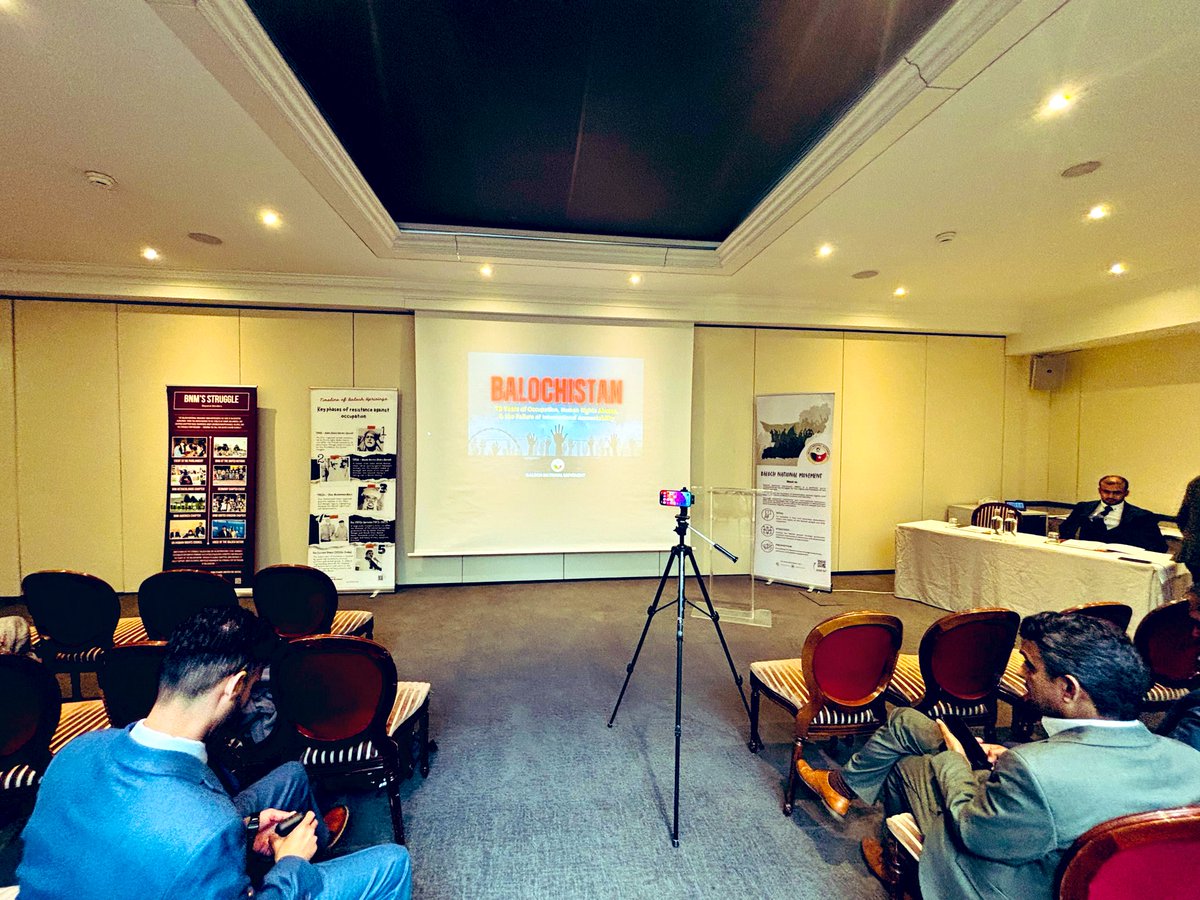
The Baloch National Movement’s 11th international conference is about to begin in Geneva, titled “Balochistan: 78 Years of Occupation, Human Rights Abuses, and the International Failure of Accountability.”
A diverse panel of speakers—including political leaders, journalists, and scholars—will provide insights into the grim human rights situation in Balochistan, as well as the historical significance of 27 March in the Baloch liberation struggle.
#BNMGlobalCampaign
#27MarchBlackDay
BNM Seminar zum Gedenktag der Baloch-Märtyrer in Berlin | Samstag, 8. November 2025
Zum Gedenken an den 13. November Baloch Martyrs’ Day
📅 Datum: Samstag, 8. November 2025
🕚 Uhrzeit: 11:00 Uhr
📍 Ort: Akazienstraße 3a, 10823 Berlin, Deutschland
Begleiten Sie uns zu einem Seminar, das dem Andenken an die mutigen Märtyrer gewidmet ist, die ihr Leben für die Freiheit und Würde Belutschistans geopfert haben.
🎙️ Referentinnen und Referenten
• Dr. Naseem Baloch – Vorsitzender der Baloch National Movement (BNM)
• Dr. Naseer Dashti – Schriftsteller mit Sitz in London und Exekutivpräsident des Baloch Human Rights Council
• Dr. Lakhu Luhana – Generalsekretär des World Sindhi Congress
• Shar Hassan – Präsident des BNM Deutschland-Kapitels
• Xezal Ismail – Leitendes Vorstandsmitglied von Dest-Dan Hevi e.V.
• Nivethan Nanthakumar – Tamilischer Aktivist und Forscher, Mitglied von LOTTA, einer schweizerischen kommunistischen Gruppe
🎤 Moderation
• Shali Baloch – Stellvertretende Generalsekretärin, BNM Deutschland-Kapitel
• Nadeem Saleem – Mitglied, BNM Deutschland-Kapitel
#BNMAnkündigungen
#13NovBalochMartyrsDay
#BNMinDeutschland
It has been more than three months since Mahrang Baloch and other leaders of the Baloch Yakjehti Committee (BYC) were detained under the controversial 3MPO law. For the families of those arrested, the wait for justice has been unending, marked by legal hurdles and official silence.
Read details: https://t.co/6hAzPF2uJx
@NadiaBaloch99@MahrangBaloch_@BalochYakjehtiC @NadeemKhanJourn