@gluk64 Even for EVM-equivalent rollups you could probably send efficiently encoded transactions to a contract inside the rollup which decompresses the transaction before performing the swap.
@BlakeMScurr@toghrulmaharram What's stopping the centralized sequencer from requiring users to reveal their identity to them? This is why decentralized sequencers are necessary.
@ViktorBunin It should be called the withdrawal contract, and withdrawals should be called depositing. This would make it consistent with rollup terminology, i.e. you are depositing to a higher layer and withdrawing to a lower layer.
@vdWijden Is the idea to keep the blob size the same (128kb) and have a target of 1 blob (max 2), or to decrease the blob size? I would guess the former is better for future compatibility?
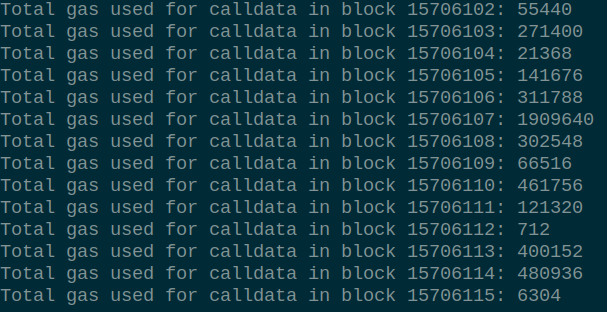
@HodlModel@jessepollak@TimBeiko@protolambda Do you mean block size is 80kb in average? This is gas used for calldata, which is 16 gas per nonzero byte and 4 gas per zero byte. Seems consistent to me.
@TimBeiko@jessepollak@protolambda Not sure I understand. If all transactions today were to use blobs instead of calldata, the data gas used would be less than the target in every block I have seen, driving the data gas price down until the demand equals the supply at an unknown price point.
@jessepollak@TimBeiko@protolambda I guess so. Also, that is not the only unknown variable. There is also a question of how the variance of data usage will be under EIP-4844. My first guess is that the separate gas market would make the variance decrease, but I'm not sure by how much.
@jessepollak@TimBeiko@protolambda Interesting project. Here is what I have so far after some quick hacking. Next step is reading through the EIP4844 pricing mechanism.
@VitalikButerin Would it be a good idea (after zk-EVMs are mature) to simplify layer 1 by removing the EVM completely from layer 1, and replace it by the batching mechanism described here? The current execution layer could be moved on top of the batching layer as a zk-EVM alongside other L2s.
@udiWertheimer@DZack23 How do you know which opcodes you will need for second layers though? To accommodate any possible layer 2, I guess you would need a turing complete base layer.
@apolynya I'm wondering how different from the EVM it could be. E.g. it should still be turing-complete to accommodate all possible rollup designs. And to accommodate EVM optimistic rollups, you would need to be able to interpret EVM-code anyway to verify fraud proofs.