Welcome to AI Conversations! 👋 Diving into PH's AI landscape (leading/lagging?), BPO disruption, & crucial AI safety risks (from Intl Panel w/ PH rep!). Get insights on trends affecting us & society. Stay tuned! #AI#Philippines#AISafety
We Don’t Have an AI Problem. We Have a Policy Problem
Most AI policy is written from the top down. AI itself is not.
People are already using it, students, workers, small businesses, and communities. The challenge is no longer adoption. It is whether policy reflects real life.
That is why we chose a bottom-up approach, built on four pillars: Education, Engineering, Enforcement, and Ethics.
Read our report: https://t.co/f7Tk53IuRO
Education matters because people are using AI faster than they are being taught how it works. Teachers need training. Families need inclusion. Literacy must be practical and shared early.
Engineering reminds us that AI depends on power, data, and connectivity. Without strong foundations, communities stay dependent on systems they do not control. Engineering policy is about building capacity, not just tools.
Enforcement showed us that fear-based rules fail. When laws are slow or overly punitive, AI use simply goes underground. Smart enforcement guides, adapts, and builds trust.
Ethics ties it all together. Ethics is protection. Without it, AI can spread misinformation, deepen inequality, and harm the most vulnerable. Ethics must live inside institutions, not just words.
The message is clear: policy must meet practice.
If AI is being built from the ground up, governance must follow. It is time to finally marry policy with practicality.
Download the report: https://t.co/PWSxJZKJd0
In the early days of GenAI, I had a Midjourney prompt I used in my presentations to illustrate image generation:
"Imagine a photo with a Canon R5, 50 mm, DSLR of a young Filipina CEO, sitting on a chair by the swimming pool, wearing business casual, colourful, enjoying, slightly smiling, summer"
The earlier images look clean and staged. The smile is perfect. The posture is careful. They feel like stock photos meant to signal success. Real enough, but a little stiff.
I tried the same prompt again using current tools: Mistral, Grok, Meta, Gemini, ChatGPT, Leonardo.
The newer images feel more relaxed. The lighting is softer. The pose looks natural, like someone paused mid-conversation. These images don’t feel like AI. They feel like photos you’d see online and never question.
Other tools bring different moods. Some feel warm. Some feel corporate. Some feel casual and human. None of them feel fake, and that’s the strange part.
Realistic image generation is now normal.
That changes everything.
For most of my life, a photo meant proof. If there was an image, it happened. Now we live in a world where a convincing photo can come from nothing. A person who never existed. A moment that never happened.
That makes trust harder.
Images like these have good uses. They help people create faster. They make visuals cheaper and more accessible. They can show leaders and stories that weren’t always visible before. Representation still matters, even when it’s artificial.
But images can also lie. They can fake events and emotions. The image doesn’t know the difference between truth and fiction. Humans do.
Gen Z grew up never knowing the world before the internet. Gen Alpha and Gen Beta will grow up never knowing the world before AI. To them, images like these won’t feel shocking. They’ll feel normal.
Reality still exists. But now, we have to work a little harder to recognize it.
What do you think of AI image generation now?
Your Child’s Homework Isn’t Theirs Anymore, And That Changes Everything
I think a lot about what AI means for kids today, especially here in the Philippines. As a teacher and a creative, I don’t see AI as good or bad. I see it as powerful. And whenever something is powerful, we have to be careful with how we use it.
Let’s be honest. Your child’s essay will probably be written by AI. It already happens every day. AI can finish homework in seconds. Banning it won’t work. Kids are smart. Instead of pretending this tool doesn’t exist, schools need to change how learning works. If students use AI, they should explain the ideas in their own words. They should question it, fix it, and even argue with it. That’s how real thinking grows.
For creatives, the fear is real. AI learns from art, music, and writing made by people who spent years shaping their style. Even if AI doesn’t copy a piece exactly, it can copy the feeling of it. Many artists feel used and unseen. I get that. We need rules that protect creators, pay them fairly, and still allow new ideas to grow.
Music shows this problem clearly. AI can now make songs that sound like famous singers. Some tracks are so close they get taken down. That’s a warning sign. Artists deserve systems that share credit and income, not silence.
The scariest part is deepfakes. AI can copy faces and voices. People have lost money because they trusted a familiar voice. This isn’t the future. It’s already here.
AI isn’t going away. What matters is whether we guide it with care, fairness, and courage, or let it shape us instead.
I Expected Fear of AI, What I Found Among Bishops Was Curiosity
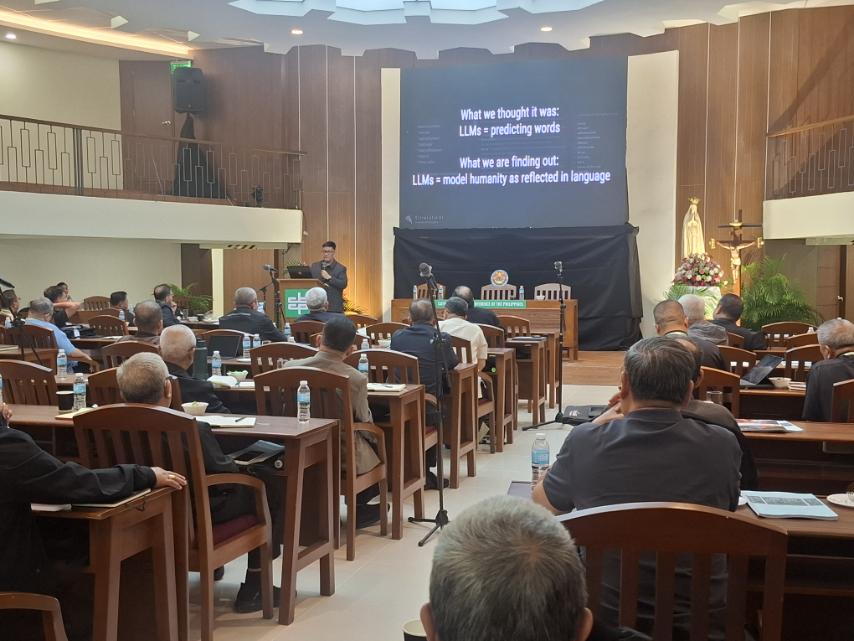
At the CBCP, I was invited to teach bishops how to prompt an AI tool, and I expected hesitation. Instead, I found curiosity. Many bishops already use AI, mostly in simple ways like summaries or quick answers.
Still, there was skepticism. Could AI really write something meaningful, especially a homily? Writing is sacred work, shaped by prayer and faith.
So we tried it together. We crafted a careful prompt and asked the AI to write a short homily. The room fell quiet as they read. It wasn’t perfect, but it was thoughtful and warm. The surprise was obvious.
That led to deeper questions. Some bishops asked, kindly but seriously, what this meant for the role of the priest. Where is prayer? Where is the Spirit?
My answer was simple: AI does not replace the priest. It helps start a process. The priest still prays, discerns, and speaks from the heart.
Over lunch, Cardinal David shared that he “debates” with ChatGPT, pushing it to match his writing style. He spoke with humor and ease, seeing AI as a tool, not a threat.
I left encouraged. Not everyone was convinced, but everyone listened. And that openness felt like a quiet grace.
Failure of Ambition
This is not a problem of ideas. It is a problem of ambition.
Other governments are moving fast because they understand how important artificial intelligence is. In 2019, Finland trained 1% of its people in AI in just one year. Now they are helping train people across Europe. In 2023, Dubai said it would train one million prompt engineers, even though it has only four million people. In China, companies that teach or research AI do not pay taxes. These countries are acting because they see the future clearly.
At home, we spend too much time talking and not enough time acting. We debate long and complex laws. We worry about risks. Meanwhile, AI is already changing how people work and how businesses grow. Waiting does not keep us safe. It puts us behind.
We have done this before. The BPO industry grew because the government supported it early. There were tax breaks and clear rules. That support helped the industry grow and create jobs. Today, it is a big part of our economy. This happened because leaders made bold choices.
We need the same thinking for AI. Training one million Filipinos in AI is not too big or unrealistic. It is a smart way to prepare our workers and protect our economy. Skills are the best defense in a changing world.
This does not need to be complicated. We do not need one huge law to fix everything. Simple and focused actions can work. Fund AI training. Support new AI businesses. Send a clear message that the country is ready for the future.
The countries moving ahead in AI are not just smarter. They are faster and braver. We have the people and the talent to compete. What we need now is the courage to act.
Disinformation Isn’t Going Viral. It’s Being Bought.
Anticipating the upcoming technical working groups for the anti-disinformation bills, I'm resharing my reaction to Dr. Didith Rodrigo and her team’s paper. https://t.co/im0YtyF9wd
Thank you Dr. Didith, for not just warning us, but for asking us to act. We’ve had many talks about disinformation before, but today the danger feels closer. It’s already shaping public opinion in real time.
Dr. Rodrigo’s paper makes an important point: AI is neither a hero nor a villain. It becomes what we allow it to be. That balance matters, especially when fear and hype often take over the conversation.
But I want to add this clearly: deepfakes are not coming someday. They are already here. Fake videos, cloned voices, and invented news spread every day. Some are political. Some seem harmless. All of them weaken trust.
Many people hope AI will save us by detecting truth. That hope is understandable, but misplaced. AI still makes too many mistakes. It flags real journalism as fake and lets fake content through. Relying on it as a judge risks censorship and deception at the same time.
The real problem is not speech. It’s amplification.
Disinformation today is not just bad ideas spreading on their own. It is paid for. It is targeted. It reaches far more people than organic content ever could. This makes disinformation an industry, not an accident.
Our constitution protects the right to speak, even to lie. But it does not protect the right to artificial reach. No one has a right to algorithmic megaphones or industrial manipulation.
That’s where AI should focus. Not on deciding truth, but on detecting paid campaigns, coordinated behavior, and artificial spread.
Because once we let machines decide what truth is, someone else is deciding it for us. And that is far more dangerous than any single lie.
What the Strawberry Problem Teaches Us About Trusting AI
In 2024, the internet fixated on a strange mistake. An AI was asked how many R’s were in the word “strawberry.” It got the answer wrong. Screenshots went viral. People laughed. Others panicked. Many saw it as proof that AI was broken.
But the strawberry mistake wasn’t really about spelling. It was about expectations.
We tend to treat AI like a search engine with a brain. Ask a question, get the truth. But AI doesn’t retrieve facts. It predicts language based on patterns from the past. Most of the time, that works. Sometimes, especially with short or unusual questions, it fails.
I tested another word: “Rappler.” I asked how many T’s were in it. There are none. Yet several AI systems confidently said there were one, two, or even three. Some explained where the T’s appeared. Some cited sources. All of it was wrong.
This behavior has a name: hallucination.
Hallucinations happen when a system doesn’t have enough context. Instead of saying “I don’t know,” it guesses. And because it’s trained to sound helpful, that guess often comes wrapped in confidence.
That’s the real risk. Not that AI makes mistakes, but that it makes them smoothly.
AI is not a source of truth. It’s a tool for working with information, summarizing, simplifying, reorganizing ideas. It performs poorly when treated like an authority.
This matters most in education. Many students will encounter AI through search results and summaries. Telling them to use newer versions won’t solve the issue. Even the latest systems still hallucinate.
The strawberry problem isn’t a punchline. It’s a reminder. Intelligence isn’t one skill, and confidence isn’t accuracy. AI is already part of everyday life. So are its errors. The real challenge is learning how to live with both.