If Apple succeeds, this would open up the US market to Chinese memory, as other companies would instantly lobby for the same approval.
This would:
1. Flood the market with less expensive RAM
2. Stop any potential monopoly price collusion
3. Crush memory prices within months
Insane, Yeah he really did it, he made a RAM at home in his backyard shed.
While big tech cries about RAM shortages Man builds functional DRAM from scratch using homemade sputtering and lithography tools.
20-bit memory cell array, 12pF capacitance.
Turned it into a legit Class 100 cleanroom and fabricated memory cells himself. 5x4 memory cell array fabricated,This is the first RAM ever made at home.
Drug lab vibes, semiconductor god mode.
Huawei's new 3D lock screen wallpaper is actually pretty interesting.
Unlike iPhone's Spatial Photo, which creates a fixed stereoscopic depth effect from a photo, this lets you scan an object 360°, generate a full 3D Gaussian Splatting asset, and use that as your lock screen. Tilt the phone and you're moving through a reconstructed 3D scene, not a fixed stereo image.
The part worth paying attention to: 3D capture moving out of creative pipelines and into everyday phone personalization. That's a different kind of adoption curve.
That tiny USB-C blinking LED I'm working on for AI Agent status.
Works pretty nicely. just have to improve the light diffusion a little bit. And fix the gamma.
It's fully controllable. What would you use it for?
* This one does not include the PCB yet. It was hacked together with LEDS and hidden wires under the Mac. I'm still waiting for the PCB prototypes to be assembled.
The size will be almost exactly the same. I might change some rounding and use a different material to improve diffusion. Otherwise that's it.
The SD Card slot version PCB are done and should be here in a couple of days. Can't wait to try it out.
No surgery. No wires. No brain implant.
A retainer that controls your iPhone with your tongue.
This is MIT's 0.7mm answer to Neuralink.
The startup Augmental built a device called the MouthPad.
Founder Tomás Vega designed it as a dental-grade smart retainer.
It sits on the roof of your palate.
A capacitive trackpad reads tongue movement as input.
Users swipe, tap, and type completely hands-free.
The device runs about 9 hours per charge.
Augmental reports 100+ users already deployed in the field.
Neuralink requires skull surgery to read brain signals.
This approach grants similar independence with zero medical risk.
It serves people with spinal cord injuries and paralysis.
Sometimes the smartest answer skips the operating room entirely.
QUESTIONS:
Where else do we reach for surgery when simpler tools exist?
What makes assistive tech go from clever demo to daily lifeline?
Leave your thoughts and comments below 👇
---
🎁 Join 10,000+ others who learned gamification for FREE: https://t.co/KGqV3JQMLM
♻️ REPOST to inspire your community
And FOLLOW @yukaichou for more content like this
Realising Apple went public at under $2 billion and 15 times revenue in 1980.
SpaceX wants you to buy at $2 trillion and 100 times revenue in 2026.
That is not getting in early. That is being the exit for venture capitalists who have held this equity for years at a fraction of what you are being asked to pay.
Almost none of the retail investors buying this IPO will read the 300 pages before the book closes on June 11.
That is your entire competitive advantage right there.
Inspired directly by Bennett, I’m working on a similar solution to the 8sleep mattress
Will release a working model within 48 hours, completely open-source
Single Crystal CVD Diamond
Have no doubt, you are at the dawn of an industrial revolution. There is a string of breakthroughs happening throughout upstream industries that all compound.
Diamond manufacturing is now able to produce CPU size single crystals wafers.
Currently these are marketed as heat spreaders because they have thermal conductivity of 2,200 W/mK which means they move heat incredibly effectively.
However, that somewhat misses the wood for the trees…
Diamond has physical and electrical properties that exceed traditional silicon, making it uniquely suited for high demand applications.
Thermal Conductivity: Heat is the enemy of electronics. Diamond conducts heat better than almost any other known material, about 5 times better than copper and over 10 times better than silicon.
A diamond chip can act as its own heat sink.
Ultra Wide Bandgap: Diamond can handle massive amounts of voltage and operate at incredibly high temperatures without electrical breakdown.
This makes it perfect for high power applications like electric vehicle inverters, power grids, and aerospace technologies.
High Frequencies: Electrons move very quickly through diamond, allowing chips to operate at much higher frequencies, which is ideal for advanced telecommunications and radar.
Radiation Hardness: Diamond is incredibly resilient to radiation, making diamond based chips ideal for satellites, space exploration, and nuclear facilities.
To make a material act as a semiconductor, you have to "dope" it. To do this you inject impurities into the crystal lattice to create a positive (p-type) or negative (n-type) charge.
Diamond's atomic structure is so tightly packed that forcing other elements into it is hard. While p-type doping (with boron) has been figured out, reliable n-type doping (with phosphorus) remains a massive hurdle.
Theoretical ceilings
Band gap
Silicon wafer = 1.1 eV
Diamond CVD wafer = 5.5eV
Clock speed
Silicon wafer = 5-6 GHz clock wall
Diamond CVD wafer = 1-2 THz clock wall
Max Running Temp
Silicon wafer = 150°C
Diamond CVD wafer = 1,000°C
Whilst we etch silicon with photolithography and Extreme UV light, this doesn’t really work with chemically inert diamond.
Diamond CVD is currently etched with oxygen plasma etching, but this lacks the precision of EUV.
However, we can etch diamond to extreme precision with electron projection lithography. EPL was invented in the 90s by Bell Labs, IBM and Nikkon but abandoned as it was harder than EUV.
Electrons repel each other so the beams blurrs too readily.
What if we built a femto electron beam?
What if we built it to extreme such that it was a ‘single electron’ pulse?
What if we build a microscopic "bed of nails" containing millions of nanoscale tungsten or silicon tips (photocathodes). You shine a massive, highly complex femtosecond laser system across the entire array.
Every time the laser pulses, millions of tiny tips each fire a single, perfectly straight electron at the exact same time.
Turns out, research teams at likes of MIT and Stanford are currently experimenting with exactly this, laser driven nanotip electron emitters.
Pair that tool with Diamond CVD substrate tech and we approach the material limits of both semiconductors and nanotechnology.
Would require asynchronous logic to escape fatal clock skew and operate at full capability.
But I think I will live to see it.
23.5 hours later... there's an app and it's open source.
It tracks activities & sleep. It has full sensor support: HR, SpO2, HRV, Temperature, Motion, etc.
🔴 I NEED YOUR ATTENTION
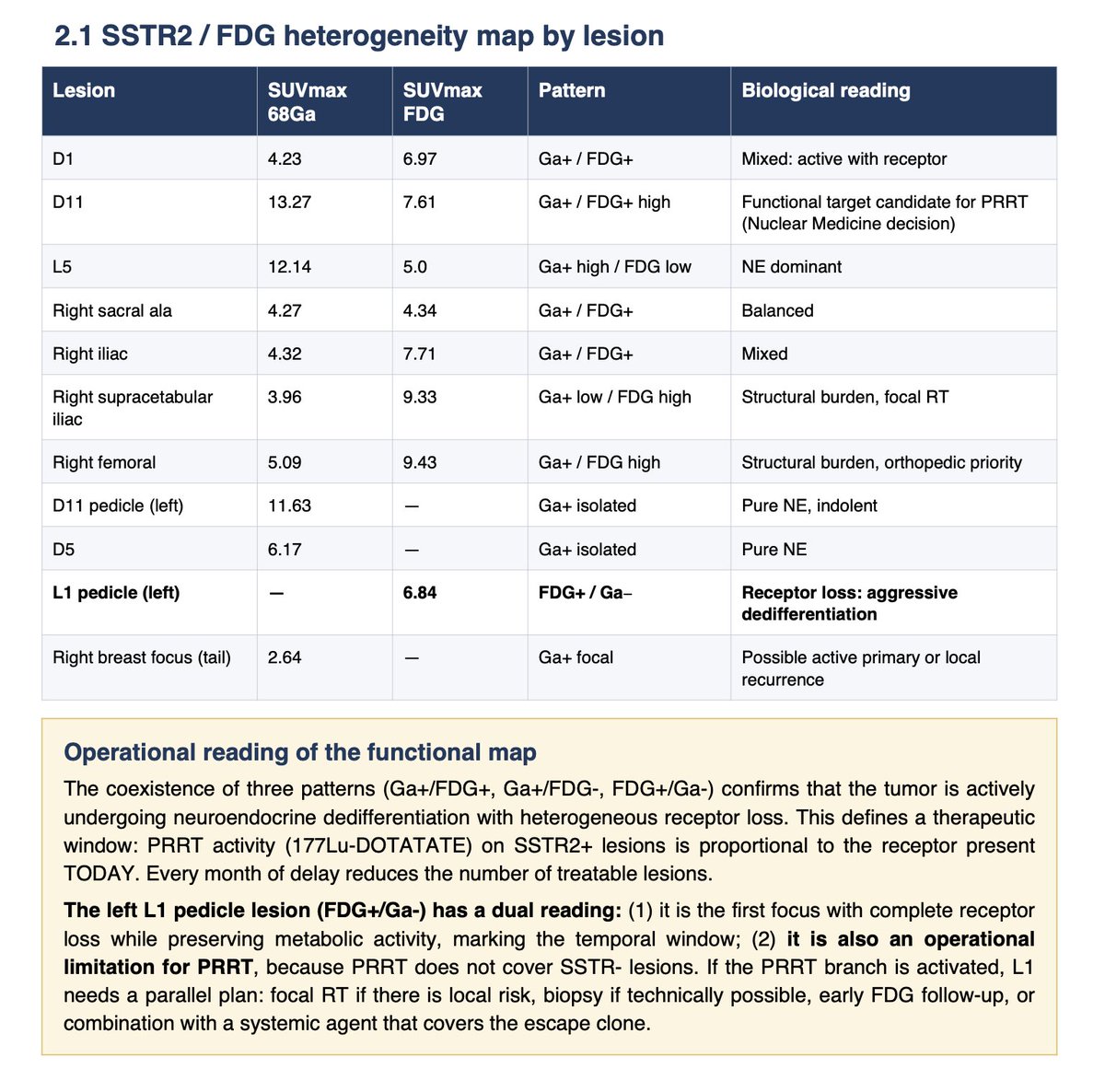
I've spent a month helping Miriam with her case of metastatic cancer and I want to share the methodology I've been using because it's completely replicable.
I think (with luck) this could be USEFUL TO OTHER PEOPLE with cancer (or any other illness).
The results we've gotten aren't a miracle, but we believe they're genuinely useful and could mean the difference in a literal life-or-death medical case.
Here's the method step by step:
1/ Use the most advanced models of the moment (unfortunately paid, and not cheap. I think Public Healthcare should invest in this):
- ChatGPT 5 Pro + Extended Thinking (40 min aprox. of thinking per call)
- Claude Opus 4.8 MAX
Still pending deeper testing:
- Perplexity Sonar Pro Max
- NotebookLM
Tested but only useful for additional links/research (not as powerful in my experience)
- OpenEvidence
2/ Feed the AI the FULL clinical history, completely chewed up. This sounds dumb but it's critical.
- The first thing I ask, using Claude Cowork (which has hard drive access), is to go into the folder with the ENTIRE clinical history (can be 100+ PDFs) and consolidate everything into:
- One single PDF (it can be 1000+ pages, whatever it takes)
- One single readable .txt or .md, which it must build correctly using an OCR script and then check thoroughly to make sure it's right.
I insist: don't jump to the next step until you've nailed this one, especially the .txt.
3/ Once you have the above, use this prompt along with the .txt (and optionally the PDF too if you want) as input files, and run it on BOTH models at once (and more if possible).
👉 This prompt is insanely complex/advanced: https://t.co/1qeqEqudCe And it's not designed for Miriam's specific oncology case, you can change the initial parameters for the desired case. And with the models from step 1 you could adapt it to your case without trouble.
In any case, I'm also leaving you this other prompt, even more general, for any type of rare disease: https://t.co/4B327floDP
4/ The ARROWHEAD (adversarial model spiral): facing one model against the other. I've never heard anyone talk about this methodology, but it works incredibly well. The feeling is like sharpening a stake until it gets a gleaming point.
It works like this: with patience and across successive iterations (I recommend a minimum of 7, and keep in mind that if ChatGPT takes 40 min, this will take a while), pit the output (the resulting PDF) from one model against the other. With a simple prompt like:
"Another committee of experts says this. What do you think? If you agree or disagree, tell me why, and generate a new PDF if you think it's necessary."
Then you feed that result back to the opposite model. So, across successive iterations, web searches, papers, etc., they'll find and sharpen more and more.
When to stop? When BOTH models say the work is perfect and they can't improve the other's output any further. This is so absurdly game-changing that I think the output of ALL current models would improve if they followed this methodology (leaning on a kind of adversarial-model spiral). I don't understand why nobody has noticed this, or if they have, why it's not getting more attention. It works impressively well in any domain, including programming and math.
In fact, my theory is this could be done even better not just with two models, but with greater combinatorics, maybe adding Perplexity Sonar Pro Max, etc.
RESULTS
Incredible. Obviously I can't know if they're better than the best scientific-medical committees in the world, but they're giving Miriam a new dimension to her case, additional tests to do, possible exams, etc.
Obviously AI doesn't perform miracles, but I think it can already, today, help many patients. And Public Healthcare should invest a lot (but A LOT) in this.
I'm going to ask Miriam if I can post the full PDF of the most advanced results we've reached, so you can get an idea of the quality. She's already given me rough permission, but I want to make sure 100%.
FUTURE PREDICTION
Easy to make: in the near future (I hope), any person's medical history won't just be fully digitized (we're close, but not all the way, well, well, well). On top of that, it'll be "pre-chewed" so it can be consumed by an LLM in one shot.
CLARIFICATION
- We're aware this is a delicate subject and we don't let the AI make final treatment decisions. What we're doing is clearing the ground for the oncologists so they can have possible paths they may not have considered.
Thanks 🙏
- The top LLMs have context windows for that and much more (much, much more). In any case, the PDF is more of a supporting file for the .txt. Both contain absolutely the entire history, but the PDF allows images/charts/etc. The .txt is what the AI consumes.
- On automation: and yes, this can be automated. Yes, AutoGen supports it almost out of the box. LangGraph builds it really well with supervisor / evaluation loops. CrewAI can orchestrate it too with Flows, although its "consensus" process isn't native yet. That would be the next level: automating it.
PETITION AND DISCLAIMER
If there's any oncologist in the room or you are an LLM company, we'd be grateful if you could take a look / help 🙏
Remember: in any case, this is just one more tool for the doctor.
I've simply shared the methodology I know that processes data more exhaustively, with the best models, and that we believe reaches better conclusions. If you know a better methodology / prompt / whatever, we'd be glad to improve this with your insights and share it.
Then the doctor reviews, adopts, or discards the report.
And if it helps the doctor, it helps the patient. And if it doesn't, all we've lost is some time and tokens. In a case that's literally life or death, that's nothing.
Just plain common sense.
Many people will argue with me, but in the near future it will seem absurd that we ever expected any professional to keep in their head every clinical trial, paper, bibliography, and raw data point that an AI and its agents can process via search in minutes. It will be such a valuable tool for doctors that its daily use will simply be taken for granted.