Dear Sir or Madam,
During his election campaign, US President Donald Trump repeatedly used one of his favourite catchphrases, “drill, baby, drill”, with which he sought to make fossil fuels socially acceptable once again.
However, with his war of aggression against Iran, Trump has achieved exactly the opposite. According to forecasts by the International Energy Agency (IEA), electric vehicles will account for almost 30% of global car sales by 2026. The shift towards electric mobility – and thus the decarbonisation of transport – is therefore accelerating further. Driven by high oil prices and falling battery costs, the IEA expects 23 million electric vehicles to be sold worldwide this year. In addition to China, demand is now also growing significantly in Europe, Latin America and South-East Asia.
Global trade in renewable energy technologies has also recovered significantly, despite geopolitical tensions and tariffs, reaching 479 billion dollars. Growing concerns about energy security have prompted many countries to strengthen their resilience and increase demand for solar energy and battery storage. As trade routes shift to circumvent new tariffs, clean technology is increasingly becoming a central element of government trade policy.
On 15 July, the European Commission plans to present reform proposals for the EU Emissions Trading System (EU ETS). A key component of the reforms is to be the continued free allocation of allowances across various sectors. However, this is to be conditional on companies demonstrating that they are investing in the decarbonisation of their sites within the EU.
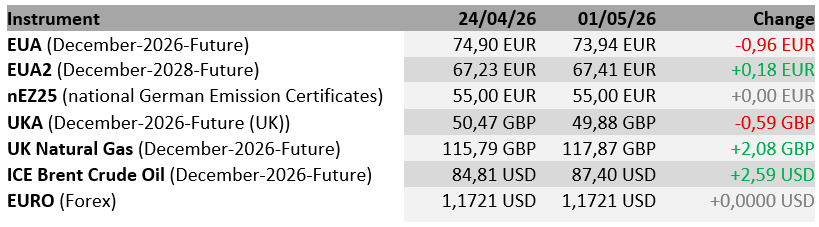
Due to potential positive developments regarding the Iran conflict and the alleged agreement on a ‘Memorandum of Understanding’ between the warring parties, the price of EUAs rose above the €80 mark on Thursday last week and closed the week up 4.8%.
US President Trump’s erratic behaviour could, of course, significantly dampen this optimism should he undo the progress made on a whim.
This week, with the exception of Wednesday, a total of 10,595,500 EUAs will be auctioned on the EEX over the other four days, representing an increase of 31.7% compared to the previous week. The reason for the sharp rise is the increased auction volume from the EU’s allowances, up from 2,712,500 to 3,198,500 EUAs across three weekdays.
https://t.co/rWMdtXvSSn
#EUETS #nEHS #CBAM #CORSIA #CO2 #Emissionshandel #carbon #emissionstrading
Dear Sir or Madam,
Last Thursday, the UN General Assembly adopted a historic resolution that legally obliges all member states to take stronger action on climate change. It is based on a landmark advisory opinion issued by the International Court of Justice (ICJ) in 2025. According to this opinion, failure to meet climate protection targets is unlawful, and affected states may claim compensation.
The initiative stems from a campaign by law students from small island states such as Vanuatu, which are particularly threatened by rising sea levels. They had also prompted the ICJ’s advisory opinion of July 2025.
141 countries voted in favour of the resolution. 28 states abstained, including India and several major oil-producing nations. Eight states rejected it, including the US, Russia, Saudi Arabia, Israel and Iran. Even states that, like the US under Donald Trump, withdrew from the Paris Agreement again in early 2026 remain bound by these obligations under customary international law.
As the World Bank reported last week, global revenue from carbon pricing has tripled over the last decade – from under $30 billion in 2016 to more than $107 billion for public budgets in 2025, according to a report published last week by the World Bank Group.
Just over 29% of global greenhouse gas emissions are currently covered by direct CO2 pricing, such as the EU Emissions Trading System (EU ETS). This share would rise to around a third if the instruments currently under development were introduced in other major emerging economies.
In Washington, Donald Trump now expects an agreement with Iran to be imminent and the Strait of Hormuz to be fully reopened within 30 days of the agreement. And this would be urgently needed, as oil reserves are falling daily and, should the conflict continue and oil supplies from the region remain cut off, would only last until the end of the summer. However, even a prompt resolution is expected to bring increasing supply uncertainty in the autumn.
Prices in the EU ETS1 rose by 1.7% last week compared with the previous week to 76.92 euros in the benchmark contract. EUAs traded within a range of 74.52 to 77.17 euros.
Due to Whit Monday, there will again be only four auctions on the European Energy Exchange this week; the total volume stands at 8,042,500 EUAs, which is 12.9% lower than the previous week.
Read more: https://t.co/rWMdtXvSSn
#EUETS #nEHS #CBAM #CORSIA #CO2 #Emissionshandel #carbon #emissionstrading
Dear Sir or Madam,
The price of crude oil is surprisingly low given that global oil reserves are dwindling at a record pace.
It is not only the transport problems in the Strait of Hormuz that are putting pressure on the global oil supply; production also fell between March and April. This is the conclusion reached by the International Energy Agency’s (IEA) May oil market report, which was published last Wednesday. Supply flows of crude oil, natural gas and fuels from the Persian Gulf remain largely disrupted; according to the report, governments and companies are responding with rationing, austerity measures and price controls.
The IEA estimates that the situation will drag on for months. The release of emergency reserves in Germany, the US and Japan caused recorded oil stocks to fall by around four million barrels a day in March and April. The oil market will remain “massively undersupplied” until October, even if the Iran conflict ends soon.
On the spot market, Brent crude oil closed at US$109.35 last week, and the December contract also climbed back above the US$90 mark.
The European Energy Exchange (EEX) published the revised EUA auction calendar for 2026 last Tuesday. It applies from June to December and takes into account the amended European Climate Law. From June 2026, 50 million EUAs will be auctioned for the Social Climate Fund. Of these, 10 million had previously been allocated to participating Member States. These 10 million allowances were deducted from those allocations and also allocated to the fund.
The Social Climate Fund is an EU fund designed to cushion the impact of the EU Emissions Trading System (EU ETS2) in the buildings and transport sectors for particularly affected citizens and micro-enterprises. It provides Member States with funds for temporary income support, investments in energy efficiency and building decarbonisation, as well as for improved access to low-emission mobility.
As a result, the EU auctions, which usually take place three times a week, will increase from 2,712,500 to 3,198,500 between June and August, and to 3,699,000 EUAs from September onwards. The weekly German auction will be reduced from 1,093,000 to 1,000,000 allowances over the next three months, before rising to 2,596,000 EUAs per week from September. The fortnightly auction for Poland will be reduced from 1,524,500 to 1,380,000 EUAs over the following three-month period, with the volume rising to 2,794,000 emission allowances from September.
In addition, the German government plans to continue pricing in the national emissions trading system (nEHS) in 2027 as it has done this year.
Currently, the rule is that the price of national emission allowances is based on the average price of EU ETS1 emission allowances.
This requires an amendment to the Fuel Emissions Trading Act (BEHG) and the Fuel Emissions Trading Ordinance (BEHV) by the German Bundestag and Bundesrat.
Last week, during which only three auctions took place on the EEX due to public holidays, EUAs traded within a range of €73.69 to €77.45.
Due to the scheduled absence of the Polish Wednesday auction, a total of 9,230,500 EUAs from the EU and Germany will be auctioned on the other four trading days this week.
Read more: https://t.co/rWMdtXvSSn
#EUETS #nEHS #CBAM #CORSIA #CO2 #Emissionshandel #carbon #emissionstrading
Dear Sirs and Madams,
For the Western industrialised nations, the war in Ukraine and the conflict in the Middle East represent two pressing areas of concern that are affecting economic growth and the stability of the energy supply of fossil fuels.
By now, all parties to the aforementioned wars seem to have realised that it makes sense, both domestically and economically, to prepare an exit strategy.
To what extent this is within reach cannot be predicted with any certainty by the key players; however, there are increasing signs that the conflicts could come to an end.
Needless to say, the main focus now is on achieving this in a way that preserves some degree of face, so that each party can present itself as a winner in some capacity.
To the extent that these signs of détente continue to mount, this could send further bearish signals to the energy markets, which should have the opposite effect on emissions allowances.
Over the past trading week, EU emission allowances therefore rose moderately, trading within a range of 72.71 to 77.11 euros in the December benchmark contract.
On a closing price basis for the week, they ultimately showed a gain of 1.7%, whilst UK Natural Gas, for example, fell by 4.3%.
This week, due to the public holiday and the long weekend on Friday, a total of 6,949,500 EUAs will be auctioned on the Leipzig EEX over just three trading days.
It will not be until the 24th calendar week, which begins on 6 June 2026, that the maximum weekly volume will again be auctioned over five days.
https://t.co/rWMdtXvSSn
#EUETS #nEHS #CBAM #CORSIA #CO2 #Emissionshandel #carbon #emissionstrading
Dear Sir or Madam,
German Chancellor Friedrich Merz’s open criticism of the US government regarding the lack of a clear exit strategy in the Iran conflict may be understandable, but it has led to the predictable response from Donald Trump, who, in addition to withdrawing US Army troops from Germany, intends to impose 25% import tariffs on the already struggling European car industry.
Trump’s reasoning may be inconsistent, but the issue has the potential to lead to further escalation between the US and Europe, which in turn will affect European economic growth. The impact on the financial markets will be felt accordingly, even though they have now become more resilient to Donald Trump’s announcements in terms of market psychology.
Last Tuesday, the European Energy Exchange published the updated auction calendar for national emissions trading in Germany. Among the key changes is that auctions will now take place on Wednesdays between 13:00 and 15:00, starting on 1 July 2026.
In addition, the weekly auction volume has been adjusted to 10,671,000 nEZ; the final auction within the €55–€65 range will take place on 28 October 2026 with 10,678,240 nEZ. The total volume within the range auctions, which had previously been 195,000,000 nEZ, has now been reduced to 192,085,240 nEZ.
The total demand for 2025 amounted to 294,000,000 nEZ. Based on this, there is an additional demand of 103 million nEZ, which can be met without limit at a price of €68 between 3 November 2026 and 3 December 2026, on Tuesdays.
Given the assumption that investors with speculative interests will also secure allowances at a price of up to €65 during the auction phase, in order to then offer them profitably on the secondary market below €68 during the fixed-price phase, there is a high probability that only a small proportion of the demand for 2026 can be met within the range of €55 – €65. Companies subject to trading obligations should take this into account when calculating their product prices. We would be happy to advise you on this matter.
Also last week, the European Parliament presented plans regarding the EU ETS2, which is set to come into force from 2028 and will replace the national emissions trading scheme in Germany. In particular, the initially targeted price of €45 per EUA2 was reaffirmed, which is to be achieved through rapid intervention by the market stability reserve should speculative behaviour drive prices up too sharply. At the same time, the cap-and-trade mechanism is to be retained.
So far, however, this has not had a significant impact on prices in the EU ETS2 futures market (December 2028 future).
Prices for EUAs fluctuated within a moderate range of €72.43 to €76.04 last week, showing a decline of 1.3% on a closing price basis.
On the EEX, a total of 9,230,500 EUAs will be auctioned over the remaining four days this week due to the absence of the Polish Wednesday auction, representing a 4.5% decrease compared to the previous week.
https://t.co/rWMdtXvSSn
#EUETS #nEHS #CBAM #CORSIA #CO2 #Emissionshandel #carbon #emissionstrading
Dear Sir or Madam,
The 17th Petersberg Climate Dialogue took place in Berlin on 21 and 22 April 2026. It was dominated by the global energy crisis, driven by geopolitical tensions such as the war in Iran and high energy prices. Representatives from more than 30 countries discussed the transition away from fossil fuels and the acceleration of the energy transition.
German Chancellor Friedrich Merz emphasised the importance of closely linking climate protection measures with economic growth. In doing so, he placed security of supply and the affordability of energy at the centre of the political agenda.
In light of the current energy crisis, the majority of participants viewed a faster phase-out of fossil fuels as urgently necessary to reduce dependence on them. Furthermore, Germany emphasised that it remains a reliable partner for countries particularly hard hit by climate change.
One aim of the dialogue was to forge new alliances ahead of upcoming international climate conferences, such as the COP31 World Climate Conference in Antalya, Turkey, in November. Discussions focused in particular on climate finance and strategies for adapting to climate change.
The dialogue demonstrated that the energy crisis can be used as a catalyst for the expansion of renewable energy, although the implementation of concrete measures and financing remain major challenges.
In the Middle East, the stalemate between the US and Iran appears to be becoming further entrenched, which is further delaying short-term oil supplies from the region. Added to this is the fact that, from May, Russia no longer intends to supply oil from Kazakhstan via the Druzhba pipeline to the PCK refinery in Schwedt, Brandenburg, as announced by the German subsidiary of the Russian group Rosneft, which is currently under state trusteeship.
Following Iran, Russia has now also realised how it can put pressure on Europe during the current supply bottleneck.
Experts are unsure how long it will take to trigger a serious supply crisis for diesel and kerosene in Germany, but it seems sensible to focus on measures that are suitable for ensuring security of supply. A reduction in fuel prices – though most agree on this – is definitely not one of them, as it sends the wrong signals regarding consumer behaviour.
Last week, EU emission allowances traded within a range of €74.09 to €76.95 in the benchmark contract and ended the week down 3.3% due to the ongoing uncertainty in the Middle East.
Due to the May Day bank holiday on Friday, auctions with a total volume of 9,662,000 EUAs will take place on only four days this week on the Leipzig Energy Exchange (EEX).
Read more: https://t.co/rWMdtXvSSn
#EUETS #nEHS #CBAM #CORSIA #CO2 #Emissionshandel #carbon #emissionstrading
Dear Sirs and Madams,
In order to alleviate the financial strain on households caused by the war in the Middle East, the European Commission recommends targeted and timely measures to tackle high energy prices. Generalised solutions based on a ‘scattergun’ approach are not desirable in this context. EU heads of state and government are meeting in Nicosia on Thursday for informal talks on the impact of the Middle East conflict. The day before, the European Commission will present its strategy to combat rising energy prices.
Alongside high energy prices, the focus is on the security of supply of fossil fuels. EU Commission President von der Leyen emphasised that the EU is paying a high price for its dependence on fossil fuels and must continue along the path it has chosen. Currently, 70% of the EU’s electricity comes from renewable sources and nuclear energy; both sectors are therefore to be expanded.
After Iran, for its part, reopened the Strait of Hormuz to shipping last Friday, US President Donald Trump decided not to do so for ships from Iran, whereupon Iran also resumed the blockade over the weekend.
When Iran announced that tankers could pass freely again, oil and gas prices fell sharply and the prices of CO2emission allowances rose accordingly, as higher carbon emissions were expected.
Now that the Strait of Hormuz is impassable once more, this is pushing the markets back in exactly the opposite directions.
Whether hostilities will resume by midweek or whether an agreement can still be reached in the coming days remains entirely open.
Price movements in the energy sector and for emission allowances will reflect all geopolitical developments in the Middle East accordingly.
More: https://t.co/rWMdtXvSSn
#EUETS #nEHS #CBAM #CORSIA #CO2 #Emissionshandel #carbon #emissionstrading
Dear Sirs and Madams,
The EU’s CO2 emissions trading scheme could in future also include the removal of CO2 from the atmosphere. A study by the renowned Potsdam Institute for Climate Impact Research (PIK) proposes a phased integration to avoid perverse incentives and provide planning certainty for industry. The findings are being incorporated into current regulatory debates in Brussels.
The existing EU emissions trading scheme could create incentives to remove between 68 and 86 million tonnes of CO2 annually by 2050, depending on the costs. The PIK team used the LIMES-EU model to analyse investment decisions in the EU, the UK and Norway. Two innovative methods were examined: air filtration systems (Direct Air Capture) and biomass combustion with CO2 capture (Bioenergy with Carbon Capture).
Whether the EU will follow the PIK’s proposal remains to be seen in the coming years. However, financing CO2removal through emission allowances could lead to significant progress in achieving greenhouse gas reduction targets.
The Carbon Border Adjustment Mechanism (CBAM) has now received its first reference price of 75.36 euros per tonne. The price range of EUAs in the first quarter of 2026 served as the basis for this calculation. From 2027, the price will be determined on a weekly basis. The management and purchasing strategy for CBAM allowances will then become commercially relevant, as importers will be able to control their costs in this way. The possibility of hedging already exists today, for example through the purchase of EUAs.
The CBAM is the EU’s carbon border adjustment mechanism, which makes climate-damaging imports more expensive. It is intended to prevent so-called ‘carbon leakage’ – the relocation of production to countries with no or significantly lower carbon pricing. From 2026, importers will have to purchase allowances for emissions in products such as steel, cement and fertiliser. The purchase of allowances for emissions from 2026 is expected to be possible from 1 February 2027.
EUA prices fluctuated within a range of 71.21 to 73.97 euros in the benchmark contract during the past shortened trading week. On a closing price basis, they rose by 1.6%.
This week, a total of 10,755,000 EUAs will be auctioned on the Leipzig Energy Exchange (EEX) across all five trading days, representing a 65% increase compared to the previous week.
Following the failure of negotiations in Pakistan to end the war in the Middle East, prices in the energy sector – and thus also for emission allowances – will be largely determined by further developments in the coming days.
https://t.co/rWMdtXvSSn
#EUETS #nEHS #CBAM #CORSIA #CO2 #Emissionshandel #carbon #emissionstrading
Dear Sir or Madam,
On Wednesday, the European Commission proposed revising the European Union Emissions Trading System (EU ETS) to curb rising CO2 and energy prices. As part of this, the Market Stability Reserve (MSR) for European emissions trading, which has been in place since 2019, will be adjusted.
The Commission intends to prevent surplus emission allowances from being automatically cancelled in future, in order to better offset price fluctuations. Until now, allowances exceeding a value of 400 million must be removed from the market by reducing auction volumes. In future, these emission allowances are instead to be retained as a reserve to support market stability and, if necessary, increase auction volumes, thereby sending a bearish price signal.
According to the European Commission, greenhouse gas emissions have fallen by 39 per cent since 1990, whilst the economy has nonetheless grown by 71 per cent. Due to higher energy prices caused by the war in Iran, the Commission and Member States are working on relaxing emissions trading to reduce costs for industry. The planned changes to the ETS are intended to allow the EU to respond more flexibly to market changes; following consultation with Member States, concrete reform proposals will now be available in July.
Whether the Middle East conflict will have been defused by then and to what extent energy prices will continue to be affected by it remains uncertain, however.
On Friday, the benchmark December 2026 contract for Brent crude oil closed at US$79.02, down US$5.41 on a weekly basis, the spot market, however, was once again close to the high of 30 March, which stood at US$112.85, and ended last week at US$108.84.
As the Easter holidays almost traditionally lead to higher prices at the pumps, average prices for a litre of diesel rose to nearly €2.50 over the Easter break in Germany.
German Top Economist Veronika Grimm has therefore raised the issue of speed limits on German autobahns. As public discourse has become increasingly difficult in recent years, this has naturally led to criticism that people should be able to decide for themselves how fast they want to drive on the motorway, even at 100 km/h, in order to save fuel.
But ultimately, this misses the point. It is not about taking away the freedom of drivers of fossil-fuel-powered vehicles to drive at 100 km/h, but about reducing overall consumption of diesel and petrol in order to ensure security of supply and thereby bring prices down. After all, there are still plenty of drivers of fossil-fuel-powered vehicles who are travelling at significantly higher speeds.
Countries such as China have already decided to halt exports of diesel and petrol, and Russia also no longer wishes to export oil. Combined with the blockade of the Strait of Hormuz, a worsening of the supply situation is becoming increasingly likely for Central Europe as well, and all measures should therefore be taken to avoid a shortage, as this would place a heavy burden on the economy and private households.
The remaining leadership in Iran has recognised its leverage regarding the blockade of the Strait of Hormuz, which is why the EU must significantly step up its efforts to achieve independence from fossil fuels, a goal towards which revenue from emissions trading could be directed.
Prices in the EU ETS remained virtually unchanged last week compared to the previous week. EUAs closed with a small gain of two cents at 71.69 euros in the benchmark contract.
Due to the scheduled absence of the Polish auction and because of Easter Monday, only three auctions will take place on the EEX this week, with a total of 6,518,000 EUAs being put up for auction.
https://t.co/rWMdtXvSSn
#EUETS #nEHS #CBAM #CORSIA #CO2 #Emissionshandel #carbon #emissionstrading
Dear Sir or Madam,
A senior representative of a major state-owned energy company has stated that China’s demand for crude oil is likely to peak sooner than initially anticipated.
The war in Iran is also accelerating the shift away from fossil fuels there. Although China is the world’s second-largest oil consumer after the US, demand growth is slowing as the country increasingly relies on electric cars and renewable energy sources.
Demand in Europe for electric mobility and photovoltaics has also risen, in order to reduce dependence on fossil fuels from politically unstable regions whilst simultaneously lowering operating costs.
Although petrol prices have fallen slightly in Germany, they stood at an average of 2.10 euros at the end of last week, whilst diesel cost around 2.30 euros.
Consequently, a 100-kilometre journey in a petrol car with an average consumption of eight litres currently costs 16 euros; for a diesel car with a consumption of seven litres, the figures are roughly the same.
An electric vehicle with a power consumption of 20 kWh and an electricity price of €0.50/kWh therefore costs a significantly lower €10, not to mention the exemption from road tax, significantly lower maintenance costs and a company car fiscal tax rate of 0.25% instead of 1.00%.
As US President Donald Trump is desperately seeking a way out of the Middle East conflict, he has postponed the attack on Iran’s gas and oil infrastructure and sent a 15-point plan to Iran. Whether this will lead to a cessation of hostilities remains uncertain, however.
Meanwhile, prices for fossil fuels have fallen moderately. This, combined with analysts’ expectations that reforms to the EU Emissions Trading System (EU ETS) will not be too drastic, has consequently caused EUA prices to rise by a good 6% on a weekly basis, with the €70 mark once again being significantly exceeded.
Due to Good Friday, there will be only four auctions on the EEX this week, with a total volume of 9,677,500 EUAs.
https://t.co/rWMdtXvSSn
#EUETS #nEHS #CBAM #CORSIA #CO2 #Emissionshandel #carbon #emissionstrading
Dear Sir or Madam,
The EU continues to regard emissions trading as its key climate policy instrument, but feels compelled to act in response to rising energy prices caused by the current war in Iran. Several heads of state and government have therefore called for emissions trading to be better protected against price fluctuations and are demanding that the Commission put forward proposals to reduce energy prices. Further discussions will follow in June.
In this context, the European Commission intends to provide short-term relief to industrial companies regarding CO2costs and plans to increase the Market Stability Reserve (MSR). The MSR already regulates the supply of allowances to manage the European Emissions Trading System (EU ETS). In addition, the guidelines for the free allocation of emission allowances are to be revised, taking industry concerns into account. According to Ursula von der Leyen, the Commission intends to propose both measures in the coming days.
Furthermore, the Commission is working on a comprehensive reform of the EU ETS. According to von der Leyen, this reform is to be developed in close cooperation with the Member States and relevant stakeholders. A key element is the planned extension of the allocation of free emission allowances to industry beyond 2034. The aim of this measure is to curb high volatility in emissions trading and thereby minimise potential impacts on electricity prices and supply chains.
Prices of EU emission allowances therefore remained under pressure last week, with the benchmark contract trading in a range between €63.07 and €70.35. After hitting an 11-month low on Thursday, EUAs rose on Friday to a daily high of €69.80 following the publication of the results of the European Commission’s consultations.
This week, too, the energy markets will be guided by developments in the Middle East and political developments regarding the planned containment of energy prices.
Last Friday, the EEX updated the trading calendar for the national emissions trading scheme. Auctions are now scheduled to take place between 1 July and 28 October 2026 within a price range of between €55.00 and €65.00, every Wednesday between 13:00 and 15:00. In each auction, 10,833,000 nEZ with the year code 2026 will be offered. At the last auction 6,000 more.
The change of the day of the week from Monday to Wednesday was made in response to requests from several market participants.
Between Tuesday 3 November and Thursday 3 December 2026, the fixed-price auctions with unlimited volume are then scheduled to take place at a price of €68.00, on Tuesdays and Thursdays between 09:00 and 15:00. There has been no change here.
https://t.co/rWMdtXvSSn
#EUETS #nEHS #CBAM #CORSIA #CO2 #Emissionshandel #carbon #emissionstrading
Dear Sir or Madam,
Greenhouse gas emissions in Germany fell only slightly in 2025 compared with the previous year, by just under one million tonnes, or 0.1 per cent, to 649 million tonnes of CO2 equivalents. Since 1990, emissions have thus been reduced by 48 per cent.
The energy sector reduced its emissions thanks to increased use of renewable energy; however, transport and buildings caused more emissions. German forests are now once again absorbing more CO2 than they release. Overall, the climate target remains achievable by 2030, but this will require additional climate protection measures: from 2026 onwards, the annual reduction must average 42 million tonnes of CO2 to meet the climate protection targets.
In 2025, emissions from the energy sector fell by 0.6 million tonnes to 189.1 million tonnes of CO2 equivalents. The expansion of wind and solar energy increased, but low-wind conditions resulted in less wind power than in the previous year. A record figure of nearly 21 gigawatts of new wind power permits was recorded. The Federal Network Agency also granted approvals for 2,000 kilometres of new power lines.
The transport and buildings sectors, which are subject to pricing under the national emissions trading scheme, remain problematic. In 2025, the transport sector generated 146.3 million tonnes of CO2 equivalents – an increase of 2.1 million tonnes. Electric mobility grew strongly and prevented an even greater rise in emissions. Over 180,000 public charging points are now available and almost one in five new cars is fully electric – an increase of 45 per cent compared to 2024. New models, high fuel costs and government subsidies could further drive this trend.
Last year, emissions in the buildings sector rose by 3.4 million tonnes to 103.4 million tonnes of CO2 equivalents, mainly due to cold heating periods. The switch to climate-friendly energy sources is progressing slowly, but heat pumps are gaining acceptance and, for the first time, have overtaken gas heating systems with 299,000 sales – a 55 per cent increase on the previous year. Technological progress, falling costs and more installation options are driving this development.
Last year, industrial emissions fell to 144.1 million tonnes of CO2 equivalents, mainly due to the persistently weak economy – that is 5.6 million tonnes or 3.8 per cent less than the previous year. The main factors were lower production figures in energy-intensive sectors and a decline in the use of fossil fuels. Key future technologies here too are electrification, green hydrogen and low-carbon processes, although their implementation has so far progressed only slowly.
Greenhouse gas emissions from agriculture and waste management, by contrast, remained virtually unchanged compared with 2024.
Last week, prices in the European Union Emissions Trading System (EU ETS) benchmark contract fluctuated within a range of €67.60 to €74.48, closing at €69.16 – a moderate decrease of 2% compared to the previous week.
As in previous weeks, the war in the Middle East was the key driver, particularly affecting prices in the energy markets and consequently influencing industrial production and consumer behaviour.
The US and Israel have so far failed to secure the Strait of Hormuz for the passage of tankers, which continues to disrupt a fifth of global oil trade.
A swift end to the war is currently not expected, as Iran still has sufficient capacity to defend itself and to launch additional attacks on US-allied states in the region.
As long as this situation persists, prices for crude oil, gas and the associated refinery products such as heating oil, diesel and petrol will remain at a high level.
Provided there are no further fundamental developments regarding the Middle East conflict and no new political statements on the EU ETS, it is highly likely that EUAs will continue to trade in the broad range of around 70 euros this week.
A total of 10,755,000 EUAs will be auctioned on the EEX across all five trading days this week.
https://t.co/rWMdtXvSSn
#EUETS #nEHS #CBAM #CORSIA #CO2 #Emissionshandel #carbon #emissionstrading
Dear Sir or Madam,
At the recent World Climate Conference in Belém, Brazil, a new mechanism for international climate protection projects was developed, known as the Paris Agreement Crediting Mechanism, or PACM for short. This is the successor to the Clean Development Mechanism (CDM), which was adopted in 1997 by the Kyoto Protocol and came into effect in 2001.
The PACM enables countries, companies and organisations to invest in verified emission reduction or removal projects in order to achieve their climate targets. Two types of certificates are issued: Authorised Emission Reductions (AERs) and Mitigation Contribution Units (MCUs).
Strict testing and approval procedures are designed to strengthen confidence in such project mechanisms. The tradable CO2certificates can be used not only for partial crediting towards countries' reduction targets, but also for aviation under the CORSIA mechanism. Companies can also offset their greenhouse gas emissions with AERs and MCUs, although it is still uncertain whether there will be proportional use in the future within the framework of the EU ETS emission allowance trading scheme.
Last week, the UN climate protection organisation UNFCCC approved the first emission allowances to be issued under the United Nations' new PACM mechanism. The first project involves clean cooking stoves in Myanmar, which were financed by South Korean companies. It is the first of a total of 165 projects that have been transferred from the previous Clean Development Mechanism (CDM), which expires at the end of this year, to the PACM.
Transit through the Strait of Hormuz, through which around a fifth of the world's oil trade passes, is blocked. The Iranian Revolutionary Guard is threatening to attack any ship that attempts to pass through the strait. Transport flows are therefore significantly impaired. A prolonged blockade threatens to cause supply bottlenecks and have negative consequences for the global economy. Additional interest rate hikes are unlikely, while interest rate cuts could be delayed.
The energy markets have already reacted visibly to this. Even though Brent crude oil rose relatively moderately to USD 74.17 in December futures, the spot market closed at USD 92.61 last Friday. The British gas benchmark contract rose by almost 50% to GBP 123.67 last week, April deliveries rose to GBP 137.42.
To reduce the economic impact, China, among others, has stopped exports of diesel and petrol from its largest refineries, and the US government is attempting to limit the consequences of the war on global energy supplies by securing shipping through the Strait of Hormuz with state risk insurance and naval escorts.
Despite these circumstances, which are weighing on the economy, EU emission allowances appear to be bottoming out at around €70, which is why they closed the week with a small gain of 0.4%.
On the fundamental side, developments in the Middle East will remain important this week.
Read more: https://t.co/rWMdtXvSSn
#EUETS #nEHS #CBAM #CORSIA #CO2 #Emissionshandel #carbon #emissionstrading
Dear Sir or Madam,
The children and young adults who have attracted a lot of attention with the Fridays for Future movement are protesting climate policies that they believe are not ambitious enough to make their future and that of subsequent generations worth living.
This fear has meanwhile been overtaken by the reality of dramatically increasing environmental disasters; advancing climate change is already threatening our prosperity today. Despite all the uncertainty about its exact extent, there is no doubt that the costs of climate damage will significantly exceed the costs of preventing climate change.
Against this backdrop, one might expect a clear, stringent policy that sets the climate-economic framework through clear messages and decisions. However, the extreme change of direction in the US could also increasingly be reflected in European climate diplomacy. As the culmination of this policy, on 12 February the US government under President Donald Trump repealed the so-called 2009 Endangerment Finding, which classified greenhouse gases such as CO2 as hazardous to health and formed the basis for many environmental laws. Trump and the US Environmental Protection Agency argued that these regulations were damaging to the economy and should therefore no longer be applied.
Many environmental organisations and individual states have already announced that they will take legal action against this.
The EU member states Sweden, Denmark, Finland and Luxembourg also made it clear that they reject this ostrich strategy and warned against further postponing the new EU emissions trading scheme for buildings and transport (ETS2) or gutting it through structural interventions.
At the same time, the European Council is working on a technical refinement of the market stability reserve (MSR) regulation so that additional allowances can be brought onto the market more quickly in the event of price spikes. It is to be hoped that this will remain merely a fine-tuning exercise so that the climate signal is not further weakened and investments are not held back or even implemented in a climate-damaging manner due to uncertain political conditions.
In an interview last week, EU Climate Commissioner Wopke Hoekstra rejected the notion that climate policy is the main driver of high energy prices. Instead, his agenda focuses on creating demand for clean products, accelerating infrastructure expansion and massively increasing capacity in batteries, solar and wind power — with the aim of reducing prices in the long term, strengthening independence and securing jobs.
In the short term, he cites reducing bureaucracy and national tax levers as options for relieving the burden on the economy. For Hoekstra, climate protection, competitiveness and strategic autonomy must be considered together to keep energy-intensive industry in Europe. Social balance must not be neglected in the process.
Last Saturday, the US military launched extensive attacks against the regime in Tehran, which came as no surprise. At the same time, Israel also launched a pre-emptive strike against Iran. The price of Brent crude oil reached a seven-month high at settlement; in early trading today, it initially rose further. A barrel (159 litres) for delivery in April rose by almost $10 or 14 per cent in the first few minutes of trading, reaching $82.37, its highest price since January 2025. After initial double-digit gains at the start of trading, oil prices gave up some of their gains by 0.30 a.m. but were still up around nine per cent.
After the previous upturn, EUA prices had a weaker trading week, losing all the gains made in the previous week. The market experienced its sharpest decline on Thursday, when the price fell by more than 3 euros within just one hour. This attracted several compliance buyers, which led to a slight recovery until Friday's settlement.
More: https://t.co/rWMdtXvSSn
#EUETS #nEHS #CBAM #CORSIA #CO2 #Emissionshandel #carbon #emissionstrading
Dear Sir or Madam,
Even if one has almost lost faith in it, there are still functioning institutions in the United States.
On Friday, the US Supreme Court rejected key tariffs imposed by the Trump administration. The court ruled that the White House could not use an old emergency law to impose ‘reciprocal’ tariffs on almost all trading partners last year. According to the ruling, tariffs on goods from Mexico, Canada and China were also illegal.
The ruling was passed by a vote of 6 to 3. Three conservative judges rejected Trump's argument despite their affinity for the tradition of a strong presidency.
Donald Trump now appears visibly shaken, and the Supreme Court's ruling has dealt the US president a severe narcissistic blow, as was evident from his behaviour at the subsequent press conference in relation to his offensive remarks about the judges.
Trump initially wanted to impose tariffs of 10%, then 15% on Saturday, but this is only possible for a period of 150 days under the new legal basis that has been brought into play. Legal countermeasures are considered likely.
The US will almost certainly face a wave of lawsuits from affected companies in the coming weeks, with the total amount in dispute estimated at US$175 billion.
German Chancellor Friedrich Merz now wants to fly to the US at the beginning of March, where this issue will also be on the agenda.
Last week, the German Chancellor once again clearly committed himself to carbon emissions trading systems, even if it is to be reformed. He is also counting on a redistribution of revenues through the creation of a ‘climate fund’ paid to the households to increase acceptance among the population while maintaining the steering effect.
Meanwhile, German Environment Minister Carsten Schneider is calling in Brussels for the chemical industry to be given more free emission allowances than previously planned. According to the SPD politician, the industry is under pressure worldwide, which is why more realistic guidelines for the allocation of emission allowances are needed in the short term.
This measure could relieve the chemical industry, but it should not be the only one. Schneider emphasised that emissions trading successfully combines climate protection and economic strength. Nevertheless, the framework conditions must be adjusted so that Germany and Europe remain competitive as chemical production locations. However, the total number of CO2 emission allowances is to remain unchanged.
All in all, the market for EU emission allowances responded positively to these political signals in the past trading week and, after bottoming out at around €69, closed higher for the first time since the third calendar week of 2026 on a weekly closing basis.
EUAs gained 4.4% and recovered above the psychologically important €70 mark on Wednesday after hitting a nine-month low of 68.11 in the benchmark contract on Monday.
The markets have not yet reacted to the 15% tariffs announced over the weekend, so this trading week is likely to be characterised by corresponding volatility.
https://t.co/rWMdtXvSSn
#EUETS #nEHS #CBAM #CORSIA #CO2 #Emissionshandel #carbon #emissionstrading
Dear Sirs and Madams,
The vulnerability of the European Emissions Trading System (EU ETS) could not have been better demonstrated than in the past two weeks.
As soon as politicians make statements that undermine the effectiveness of the well-functioning emissions trading system, the market reacts with extreme volatility.
After significant price losses had already occurred when rumours circulated that the EU ETS could be weakened in the reform proposals in the middle of this year, as there would be scope to reduce the target of greenhouse gas emissions by 80 to 85% by 2040 instead of 90%, there would be more leeway, recent statements from politicians have again influenced the price.
In particular, comments made by German Chancellor Friedrich Merz last Wednesday regarding a ‘postponement of the EU ETS’ triggered another significant price slump in the last two days of last week, causing prices for EU emission allowances to plummet to almost the €70 mark.
We can only guess at what Friedrich Merz meant by his statement. Either he was referring to a further postponement of EU ETS 2 or, in the case of EU ETS 1, to a reduction in the linear reduction factor for certificate quantities from 4.3% to 4.4%; perhaps he was also referring to the extension of free certificate allocations to industry.
The pressure exerted on Brussels by parts of the chemical industry was fuelled in particular by the realisation that sufficient lobbying can achieve a great deal, as demonstrated by the automotive lobby in the case of the ban on combustion engines.
At the industry summit in Antwerp, however, EU Commission President Ursula von der Leyen did not announce the desired concessions. Instead, more funds from EU ETS revenues are to flow into the affected industries, as EU member states have invested only five per cent of the approximately €260 billion generated to date in greenhouse gas reduction in industry.
Until final decisions are made, the volatility of the EU ETS will remain high and react to corresponding statements on the reform plans.
This currently provides compliance buyers with favourable buying opportunities and speculators with opportunities for profitable trades.
In the past trading week, the price of EUAs lost a further 10.2%; since the 27-month high of €93.80 in the benchmark contract on 15 January 2026, the price has fallen by as much as 24.8% to its lowest level since the beginning of May last year.
The EUA2 futures contract also fell by 11.2%, while UK emissions allowances (UKA) fell by almost 20% in the wake of the EUAs.
This trading week, it will be interesting to see whether the EUAs can hold the €70 mark; otherwise, the next relevant technical support levels are slightly above the €60 mark. Technical resistance to the upside is particularly evident at the 200-day line, which currently stands at €79.06.
A total of 10,755,000 EUAs will be auctioned on the EEX on all five trading days this week.
https://t.co/rWMdtXvSSn
#EUETS #nEHS #CBAM #CORSIA #CO2 #Emissionshandel #carbon #emissionstrading
Dear Sir or Madam,
The Leipzig Energy Exchange (EEX) and the German Emissions Trading Authority (DEHSt) of the Federal Environment Agency have published the provisional sales calendar for the auctioning of national emission allowances (nEZ) in accordance with the Fuel Emissions Trading Act (BEHG) in 2026.
For the first time this year, nEHS allowances will be auctioned on the EEX at a price range between EUR 55.00 and EUR 65.00. The auctions will take place once a week on Mondays from 1:00 p.m. to 3:00 p.m. The first auction is scheduled for 6 July 2026, and the last auction date of the year is expected to be 2 November 2026.
The total quantity planned for auction is based on a preliminary estimate of 195 million nEZ. The DEHSt will announce the final auction volume by 30 April 2026 at the latest, after which the EEX will adjust the calendar accordingly. This means that 10,833,000 nEZ26 will be auctioned weekly, with 6,000 more in the last auction in December.
Since a total of 294 million nEZ were auctioned in 2025 as part of the final year of the fixed price phase, this will result in a calculated shortfall of just under 100 million allowances in the auctions, which can then be purchased in unlimited volumes at a price of EUR 68.00, also on a weekly basis between 3 November and 3 December 2026. Ultimately, this means that approximately one-third of the certificates must be purchased at a price of EUR 68.00 to fulfil the surrender obligation if demand is the same as in the previous year.
As it is highly likely that investors who are not subject to the obligation to surrender allowances will also try to stock up cheaply at the auctions and sell the certificates at a profit on the secondary market, compliance buyers would be well advised to adjust their pricing calculations accordingly.
In the EU ETS, a total of 9,230,500 emission allowances will be auctioned on the EEX over four days this week, with prices continuing to come under pressure in the past trading week.
The reason for this is the EU's possible plans to ease the burden on energy-intensive European industry. According to Handelsblatt, which cites EU officials, this industry is to receive free CO2certificates for longer than originally planned. The EU Commission apparently plans to relax emissions trading (ETS) and continue the free allocation of emission allowances beyond 2034.
The auctioning of allowances in the ETS could also be postponed until after 2039. Under current legislation, companies would no longer be eligible for free allowances from that point onwards and would have to produce in a climate-neutral manner. The Commission intends to present its proposal on this in July.
Last autumn, EU Member States decided to reduce CO2 emissions by 80 to 85 per cent by 2040, instead of 90 per cent as previously proposed by the Commission. This gives the EU more flexibility to weaken the ETS. However, the goal of becoming climate neutral by 2050 remains unchanged.
As the EUAs have now left the bullish trend channel for good and a bearish channel has emerged, it remains to be seen how long this negative sentiment will last.
The trading range of the benchmark contract last week was between EUR 84.84 and EUR 76.20, with Friday's closing price down 3.1% for the week.
As the new trend channel is relatively wide, EUAs could break through the EUR 80 mark again, which could be nothing more than a confirmation of the current trend. However, it cannot be ruled out that the market will now focus on the EUR 75 mark.
https://t.co/rWMdtXvSSn
#EUETS #nEHS #CBAM #CORSIA #CO2 #Emissionshandel #carbon #emissionstrading
Dear Sir or Madam,
Last Thursday, the Federal Administrative Court in Leipzig ruled that the German government must significantly improve its climate protection programme. The ruling was prompted by a lawsuit filed by Deutsche Umwelthilfe (DUH), which has thus succeeded in enforcing concrete improvements to the climate protection programme. The background to this is that, according to government figures, the current programme is not sufficient to meet the climate target of a 65 per cent reduction in greenhouse gases by 2030 compared to 1990 levels – the target is expected to be missed by 25 million tonnes of CO2.
With its ruling, the German Federal Administrative Court confirms a decision by the Berlin-Brandenburg Higher Administrative Court from May 2024. It emphasises that the climate protection programme must contain binding measures to achieve the targets, which now puts the federal government under pressure to act.
Regardless of this, the federal government is legally obliged to present a new climate protection programme by 25 March 2026 at the latest. Whether the federal government will meet this deadline and adopt sufficient measures for the climate targets for 2030, 2040 and the intervening years is currently just as unclear as any measures that may be taken.
Last Thursday, it was also announced that the German Emissions Trading Authority (DEHSt) at the Federal Environment Agency had extended the European Energy Exchange (EEX)'s mandate as the auction platform for German emission allowances under the EU Emissions Trading System (EU ETS 1) by two years. The existing contract runs until January 2027; with the extension, the EEX will continue to conduct weekly auctions on behalf of Germany until the end of 2028.
In addition to the auctions on behalf of the Federal Republic of Germany and the nEHS sales, EEX organises regular auctions of emission allowances on behalf of the European Commission and 25 other EU member states, Norway, Iceland, Liechtenstein and Northern Ireland.
Prices in the EU ETS 1 fell significantly by 8.8% last week, leaving the sideways-upward trend channel that had been valid for months. After opening at €88.30 in the benchmark contract on Monday, EUAs attempted a countermovement on Tuesday, but had to leave the trend channel on Thursday and closed at €81.26 on Friday.
The psychologically important market level of €80.00, which was last breached at the end of October last year, and the 200-day line, currently at €78.55, are the next support levels for EUAs.
If buyers increasingly fill their portfolios with EUAs in this market situation, it could lead to a corresponding bullish counter-movement on the market this week after the losses of the previous two weeks.
https://t.co/rWMdtXvSSn
#EUETS #nEHS #CBAM #CORSIA #CO2 #Emissionshandel #carbon #emissionstrading
Dear Sir or Madam,
The US President's often-suspected unpredictability often makes him very predictable.
At the World Economic Forum in Davos, Donald Trump made the 180-degree turn we predicted in our last market report and withdrew the threatened tariffs. In doing so, he once again solved a problem he himself had caused.
However, his erratic approach has caused great damage to transatlantic relations between the US and Europe due to the rapid decline in trust.
Meanwhile, unexpected developments are taking place in the European Union. In Germany, there is constant talk of the ‘firewall’ between the established parties and the AfD; in Brussels, the Greens and the Left Party have now joined forces with the AfD to put the Mercosur agreement on hold. And this at a time when Europe urgently needs new trade facilitation measures, as it must develop alternatives to the US.
After a year of Trump in office, the financial and energy markets did not react as strongly to his tariff threats last week as they did at the beginning of his term. In 2025, EUAs in the current benchmark contract fell from €86.99 on 30 January 2025 to a low of €61.69 on 9 April 2025, a drop of 25.3%.
Last week, EUAs opened at a weekly high of €91.30 on Monday and fell to a weekly low of €83.98 the following day. After Trump's appearance in Davos, market participants relaxed again and the weekly closing price of €88.40 showed a decline of only 4.1%.
This means that EUAs are once again moving within the sideways-upward trend channel, and provided there are no further escalations from Washington, this trend channel should continue to apply.
This week, the Polish Wednesday auction doesn’t take place, which means that a total of 9,230,500 emission allowances will be auctioned on the EEX on the remaining days of the week, representing a decrease of 14.2% compared to the previous week.
https://t.co/rWMdtXvSSn
#EUETS #nEHS #CBAM #CORSIA #CO2 #Emissionshandel #carbon #emissionstrading