Which Organ Thrives on Which Habit
Heart
Regular walking and aerobic activity improve cardiac output, endothelial function, and long-term survival.
Brain
Reading and learning stimulate neuroplasticity, strengthen memory circuits, and delay cognitive decline.
Lungs
Deep breathing and diaphragmatic exercises enhance lung capacity and autonomic balance.
Bones
Resistance and weight-bearing exercise increase bone mineral density and reduce fracture risk.
Blood
Adequate hydration maintains plasma volume, circulation, and efficient nutrient transport.
Skin
Daily moisturization preserves the skin barrier, reduces transepidermal water loss, and slows aging.
Immune System
Consistent, high-quality sleep regulates cytokines, antibodies, and immune surveillance.
Liver
Minimizing processed foods reduces metabolic load, inflammation, and fatty liver progression.
Gut
Probiotic-rich foods support microbiome diversity, digestion, and immune signaling.
Teeth
Flossing disrupts plaque biofilm where brushing cannot, preventing periodontal disease.
What the Body Quietly Likes
Eyes
Regular screen breaks reduce digital eye strain and protect tear film stability.
Hands
Hand hygiene lowers pathogen transmission and infection burden.
Muscles
Morning or post-sleep stretching restores muscle length and joint mobility.
Nervous System
Meditation improves vagal tone, stress regulation, and emotional resilience.
Hormones
A balanced diet stabilizes insulin, thyroid, and sex hormone signaling.
Memory
Learning new skills strengthens synaptic connections and preserves cognitive reserve.
Bottom line:
Organs don’t need extremes.
They respond best to simple, repeated, boring habits done consistently.
Health is not built in emergencies.
It is built quietly, every day.
“Can I bring my baby to the interview?”
The message came in at 11 PM:
“Hi, I have an interview with you tomorrow at 2 PM. My childcare fell through. Can I bring my 8-month-old? I understand if you need to reschedule.”
Old me would have rescheduled.
Unprofessional. Distraction. Red flag.
New me replied:
“Absolutely. See you tomorrow.”
She showed up with her baby on her hip.
She apologized three times before even sitting down.
Ten minutes in, the baby started crying.
She tried to soothe him while answering questions.
She apologized again.
I stopped the interview and said:
“Hey. You’re managing a fussy baby, answering complex questions, and staying calm under pressure. That’s literally the job. Handling chaos while staying professional. You’re already proving you can do it.”
Her eyes filled with tears.
We hired her.
She’s been with us for a year now.
The most reliable team member we have.
Why?
Because when you’re used to handling a screaming infant at 3 AM and still showing up to work the next day, workplace stress feels like nothing.
Working parents, especially mothers, are some of the most organized, efficient, and resilient people you’ll ever hire.
Yet we lose them because our hiring processes are built for people with zero caregiving responsibilities.
If your interview process can’t accommodate a parent facing a childcare issue, you’re not filtering for professionalism.
You’re filtering for privilege.
1. I said I won't write about why galamsey is not solvable in Ghana's current political culture because it is about policy, instead of politics, and most don't like to read about policy. A friend said it is up to the writer to woo readers. 🤦♂️
2. So, let's see if brevity and charts can help those who don't like long reads.
Here goes:
3. Politicians in a democracy try to do WHAT people want so they can stay in power. HOW to get what people want, however, is POLICY.
4. People want pollution from galamsey stopped but at the same time they want a stable cedi.
5. Politicians thus decide to convert illegal galamsey to legal "community mining" so that gold production can remain high whilst pollution is reduced. The tragically crashed helicopter was en route to Obuasi to launch such a program.
6. Unfortunately, whilst a lot of eyes are on the politics ("stop galamsey now" & "give me a strong cedi"), the actual policies ("legalise all small-scale mining to stop galamsey") are never properly scrutinised. A messy gap hence develops between politics and policy. What I call "Katanomics".
7. In galamsey, here is how:
A. 2023 data says that there are about 34,000 workers in large-scale mining in Ghana and an estimated 1.1 million workers in small-scale mining.
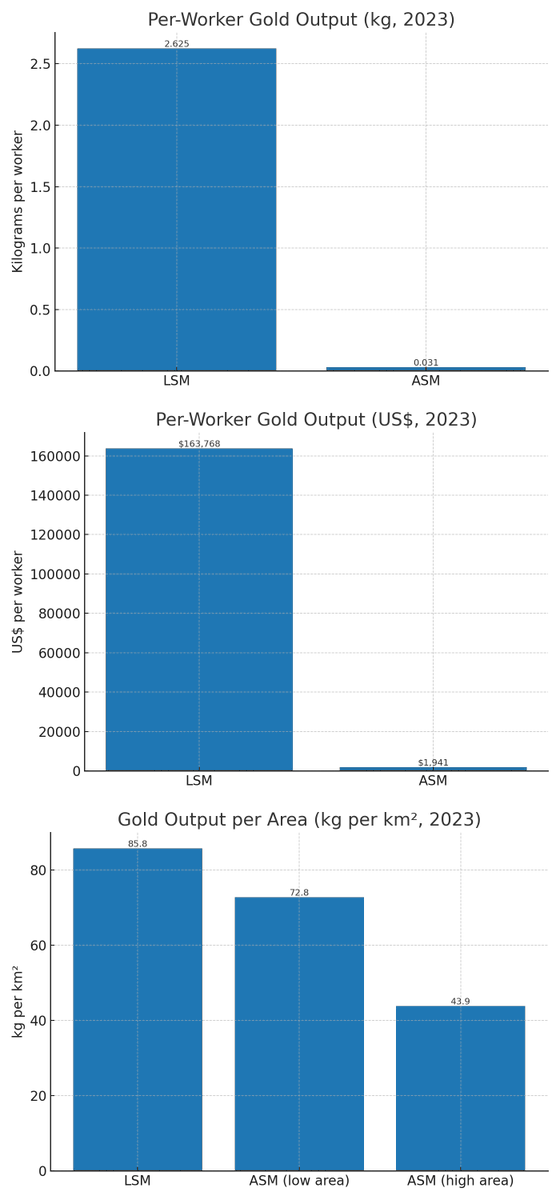
B. Let's strike averages in terms of output and productivity. In large-scale mining (LSM), the average worker produces 2625 grams of gold per year. In small-scale mining (ASM), the average worker produces at most 31 grams of gold per year. Let's even accommodate the smuggling stuff and say 100 grams per year.
C. That means that the average worker generates $2000 in value-add in the ASM sector. Let's even double this to account for unseen factors. The average LSM worker, on the other hand, generates over $163,000 per year. Once again, the gap is crazy.
D. What is even crazier is that the LSM workers extract more gold from each sq. kilometer of land because the companies only mine where the gold is most abundant. The LSM workers produce about 86 kilograms of gold per square kilometer versus between 73 and 44 kilograms of gold per sq km for the ASM workers.
E. From the data available, Galamsey productivity is just like the ASM sector's. (At any rate, if galamsey was far more productive, legalisation would be even harder since there are no taxes.)
F. Because each LSM worker is generating ~$163,000, it is possible to invest more in environmental controls like dams, filtration, treatment plants, etc.
G. But this means very low densities. The average large-scale mining footprint is about 70 sq km. And the average of number of workers per sq km is about 30.
H. Contrast that with ASM & galamsey where you have about 1500 workers on each sq km. To get a community mining operation to the same level of scale as an LSM one, each community mining project would have to accommodate 105,000 workers!
I. To be able to build a viable community mining project that can invest in the right technology and practices (massive retraining and hiring of skilled engineers and machine operators), one simply has to drastically reduce employment and ensure massive land area of high quality deposits per project.
J. Doing that well is extremely hard work. Unless politicians and civil servants are under tight scrutiny by a sizeable group of well-informed citizens who are not afraid to publicise results, forget it. That is where we are.
In the near future, I will expand this into a more rigorous piece.
In the meantime, read more about mining governance policy issues here: https://t.co/fPF5VlPrfk
More on katanomics here: https://t.co/w4q6OHKIBr
For those more interested in the actual research from a professional or academic standpoint, a high-level overview of the evolving methodology is attached. Get cracking!
We needed that same energy when you were in power. Anyway, closely monitor it, so they also don't loot it like you guys did. We want a country that works.
Kalyjay’s Open Letter
First of all, I want to make it clear that everything you’re about to read reflects my personal views. I am not speaking on behalf of anyone else.
I’d like to congratulate President-elect John Dramani Mahama, our first-ever female Vice President, Prof. Naana Jane Opoku-Agyemang, the NDC, and all Ghanaians on an incredible victory at the polls. This was a statement win. Before, during, and after the elections, I had a few thoughts that I would like to share with those willing to listen.
To President-elect John Dramani Mahama
I believe this victory is a second chance from God. You are inheriting leadership from arguably one of the worst administrations in the history of our country. While the bar has been set low, it doesn’t mean we will hold you to lower standards. After January 7th, the real work begins.
Please learn from the mistakes of the previous government. Listen to the citizens. There is a significant gap between the people and their leaders, as evidenced by this year’s voter turnout. Many people voted for you not because they fully believe in you but because they wanted the NPP out. You have four years to win them over, leave a lasting legacy, and rebuild the reputation of the NDC.
I pray that when you leave office in 2028, you will be remembered as the president who put this great nation back on track. People must be held accountable, promises must be fulfilled, and you must prioritize the voices of the youth. Your campaign last year showed you were willing to listen to Ghanaians. You know what we want and how to achieve it. Please don’t forget that.
To the NDC
The election results speak for themselves: Ghanaians are wiser now. Bags of rice, money, gadgets, and job promises during election years won’t secure votes anymore. The real work begins the moment you take office.
Not everyone who voted for you fully believes in you—it’s your job to win them over. By the next election, they should be able to proudly say, “I voted for the NDC, and I wasn’t disappointed.” You’ve seen how far the NPP has fallen. Please keep President Mahama accountable. There is no time to rest. This is a nation to rebuild, and it’s your responsibility to ensure that happens.
To the Media
You now have freedom under President Mahama—please use it wisely. Reduce the propaganda and focus on educating the public about government policies. Break them down in a way everyone can understand.
There are critical issues at hand: a massive debt, a looming power crisis, and the need to review Free SHS, among others. These challenges will undoubtedly be used by critics to fuel hate against the government. Help the people understand how we got here and why. The country needs a reset, and we cannot afford for the government to fight propaganda and fake news while trying to build.
Hold the government accountable with facts and truth. Call out your colleagues in other media houses when necessary. This reset requires all hands on deck, and you have a critical role to play.
To the Youth
After January 7th, it’s time to put away the party jerseys and wear Ghana’s jersey. Fact-check the leaders, watch them closely, and hold them accountable. This is our future, and we have a lot of work to do.
Over the past two to three years, the political awakening among the youth has been incredible. Activists and pressure groups have emerged, and their efforts have been inspiring. Now, it’s time to rebuild. Let’s strive for the Ghana we all dream of and never prioritize political parties over our country.
In Conclusion
I’d also like to take a moment to thank everyone for the messages and support I’ve received over the past few years, especially on this platform. I appreciate it more than you know. I hope I never let down those who believe in me. I will continue to stand for what I believe is right and keep pushing for progress.
Thank you.