Staying properly hydrated is essential for maintaining optimal brain function. 🧠
What creative ways do you incorporate for proper hydration into your daily routine?🚰
@wholemars Please advise people to be wary of margin loans. Tesla has always been a high variability stock, often with no obvious rhyme or reason.
We are confident about long-term value creation, but cannot control the manic-depressive nature of the stock market.
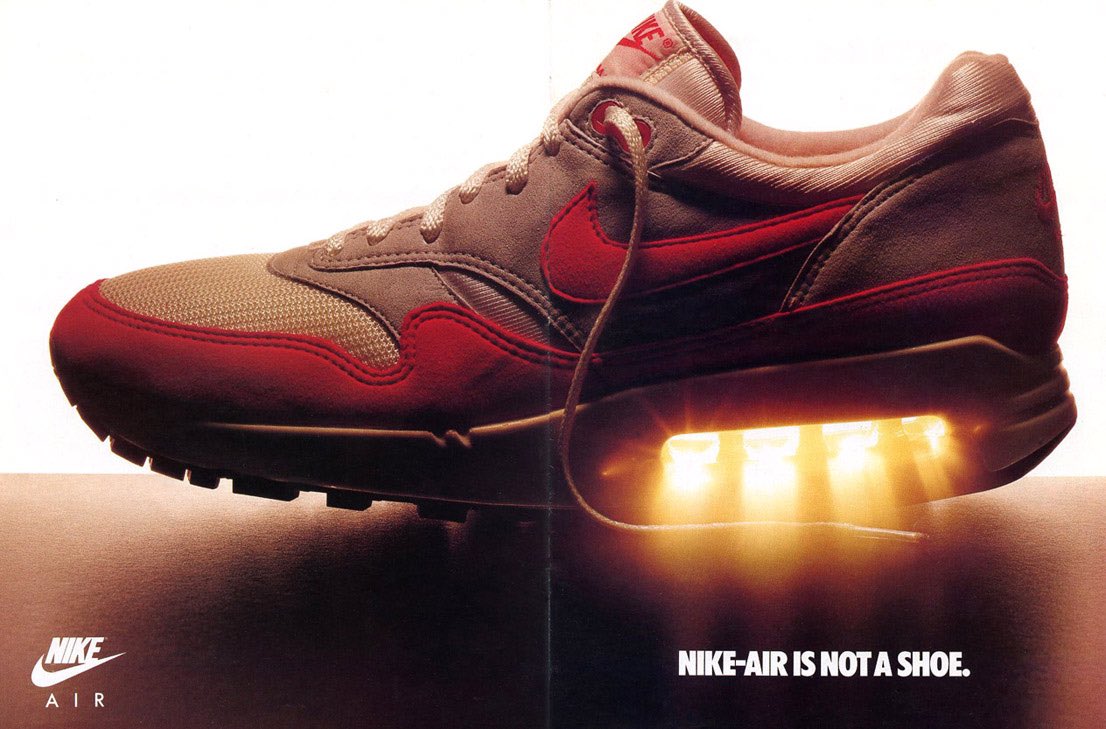
In 1985, Nike held a 24-hour shoe design contest.
Nike was struggling. Their stock dropped 50%. They had to lay off people. Adidas, Converse, & Reebok were all selling more shoes.
So in a panicked attempt to find creative talent, Nike held a shoe design contest.
The winner was
A corporate architect named Tinker Hatfield.
"Two days after the competition," he said, "I wasn't even asked—I was told that I was now a footwear designer for Nike."
As he got to work on his first official shoe design, he thought about a building he had studied in architecture school: The Centre Pompidou in Paris.
The Centre Pompidou is an inside-out building, meaning that the structural, mechanical, and circulation systems are all exposed.
“That building,” Tinker said, “was describing what it was to the people of Paris. And I thought, ‘Well why not do that with a shoe? Let’s cut a hole in the side and show what’s in the shoe.’”
So Tinker designed an inside-out shoe:
The Air Max 1.
The Air Max 1 was a massive success, and it steered Nike's design direction from then on.
"To this day," Tinker says, "Phil Knight says I saved Nike."
Takeaway 1:
Had he not studied that building in Paris, Tinker says, he couldn’t have created the Air Max.
Creativity, he says, is a function of the “library in your head."
“When you sit down to create something...what you create is a culmination of everything you’ve seen and done previous to that point.”
Takeaway 2:
Tinker Hatfield went to architecture school and then he was a corporate architect for 4.5 years. Then, literally overnight, he became one of the best shoe designers in the world.
This makes me think of a counter-intuitive discovery made by psychologist Charles Spearman in 1904.
Before Spearman, the natural assumption was that the more you specialize in one thing, the worse you’ll be at other things.
Instead, Spearman discovered "the positive manifold" phenomenon.
He found that different abilities tend to be positively correlated. That the expertise gained through specialization is transferrable. That the cognitive and creative abilities cultivated as an architect could positively correlate with being a shoe designer.
- - -
"Creativity is a function of the previous work you put in." — Robert Greene
Follow @bpoppenheimer for more content like this!
Headlines everywhere are celebrating today's official announcement that the stock market is back in a bull market.
Now tiny tim, aunt sally, and joe schmoe will see these headlines and buy stocks...a full 20% move later.
What's that old adage? Buy when fearful...oh nvm.
You buy insurance on your:
Life
Car
Home
Travel
Pet
iPhone
TV
Wedding ring
WHY NOT BUY INSURANCE ON YOUR STOCK PORTFOLIO?
VIX has never been cheaper in over 3 yrs.
Fwiw.
Jerry Seinfeld was once thinking about golf announcers whispering.
He then found something in his notebook about how people whisper when they talk about tipping.
"Now we make what's called a charm bracelet," Seinfeld says in this 144-second masterclass on the creative process:
When you notice a commonality between two or more things, Seinfeld explains,
"You say, 'Oh there's something there.' And now we make what's called a charm bracelet: You take these things and you find a way to associate them."
"So that's the process: I'm thinking about this [one] thing and then remember this [other] thing, and then you go, 'Oh there's something there—let me connect those 2 things.'"
Takeaway 1:
Whether it's in a notebook like Seinfeld, on notecards, in Apple Notes or a Notion database—many great artists have a habit of capturing the interesting thoughts or ideas they come across.
The comedian George Carlin said his capture habit started because...
“I had a boss in radio when I was 18 years old, and my boss told me to write down every idea I get even if I can’t use it at the time...and have a system for filing it away—because a good idea is of no use to you unless you can find it…"
A lot of creativity, Carlin said, “is discovery. A lot of things are lying around waiting to be discovered and that’s our job is to just notice them and bring them to life.”
That's what Seinfeld did: he noticed the various contexts in which people whisper and brought them to life.
Takeaway 2:
The great fantasy and science fiction writer Brandon Sanderson says,
“The way that human creativity works is by combination. That’s what we’re really good at. We don’t come up with a completely new creature. We put a horn on a horse and go, ‘Look at that, that’s cool.’ That’s how we create on a fundamental level.”
- - -
“Creativity equals connecting previously unrelated experiences and insights that others don’t see.” — Steve Jobs
Follow @bpoppenheimer for more content like this!
Walt Disney's first studio went bankrupt.
In 1921, he founded Laugh-O-Gram Films.
"The financial situation was never less than dire," one biographer writes. And in 1923, LOGF declared bankruptcy.
For the rest of his life, Walt would say it was a critical turning point because
It taught him 2 important lessons.
First...to not fear failure.
As Laugh-O-Gram's financial situation worsened, Walt had to sleep at the office, scavenge for food, and bathe at the local train station. Despite these terrible circumstances, Walt said, "I was happy all the time. I was excited. I was doing things."
Which is why he would often say,
“I think it’s important to have a good hard failure when you're young...Because it makes you kind of aware of what can happen to you. Because of it, I’ve never had any fear in my whole life when we’ve been near collapse and all of that. I’ve never been afraid."
Second...to get out of Kansas City.
Even before Laugh-O-Gram, Walt had been trying and failing to make it as an artist in Kansas City for almost a decade.
Laugh-O-Gram's demise would finally force Walt to admit:
"We were in the wrong area. Kansas City wasn't the place for this kind of work."
So after filing for bankruptcy, Walt went door to door in one of Kansas City's nicest neighborhoods, looking for parents who might want short films of their kids.
And in two weeks, Walt had enough money to afford a one-way train ticket to his "spiritual destination," Hollywood.
Takeaway 1:
In experiencing the worst-case scenario, Walt realized that the thing many people are afraid of really isn't all that bad.
In psychology, this is known as “exposure therapy.”
Similar to Walt, Dave Chappelle talks about becoming fearless through his exposure to failure.
During a performance at the Apollo Theater in the 1990s, Chappelle was booed off stage.
“And that was the best thing that ever happened to me,” he said, “because, before that time, I had never bombed, let alone got booed off the stage. And bombing was horrifying—nobody wants to bomb. Nobody.
So that night was liberating because I failed so far beyond my wildest nightmares of failing. And it was like…‘Hey…this is not that bad.’
And after that, I was fearless.”
Takeaway 2:
Disney moved to Hollywood. Bob Dylan moved to Greenwich Village. Chappelle moved to New York City. Schwarzenegger moved to Venice Beach. Taylor Swift moved to Nashville.
The songwriter and record producer Ryan Tedder tells the story of a time he was speaking to a group of aspiring songwriters. After his talk, one audience member told him that they had been trying and failing for years to break into the music business.
As Tedder tells it,
"I said, 'where do you live?' She said, 'Holland.' I said, 'That's why.' She said, 'What?' We were in LA—I said, 'Move here. Move to London. Or move to New York...You gotta go to where it is.'"
- - -
"Walt Disney was made for Hollywood. He loved dress-up and make-believe, was boisterous, outgoing, self-aggrandizing, and histrionic. Hollywood was his spiritual destination...It was more than a provider of entertainment. It was the capital of the imagination." — "Walt Disney: The Triumph of the American Imagination" by Neal Gabler
Follow @bpoppenheimer for more content like this!