Don't miss the exact text though: "We’re changing Fable 5’s safeguards for frontier LLM development to make them visible" - make them visible means they're undoing the truly egregious (dare I say "unaligned") decision to have the model lie about its refusals, it will still refuse
The notion that the world is less equal today than it was between 1910 and 1950 is just historically ridiculous and really makes the point that all these metrics should take much more seriously the vast welfare state systems that emerged during and in the immediate aftermath of this period.
This is the main blind spot of Piketty, Saez and Zucman’s empirical view of the world. They consider the distribution of tax rates, of which a substantial part fund social insurance, without considering the distribution of transfers and benefits. They consider the distribution of wealth without considering the value of entitlements…
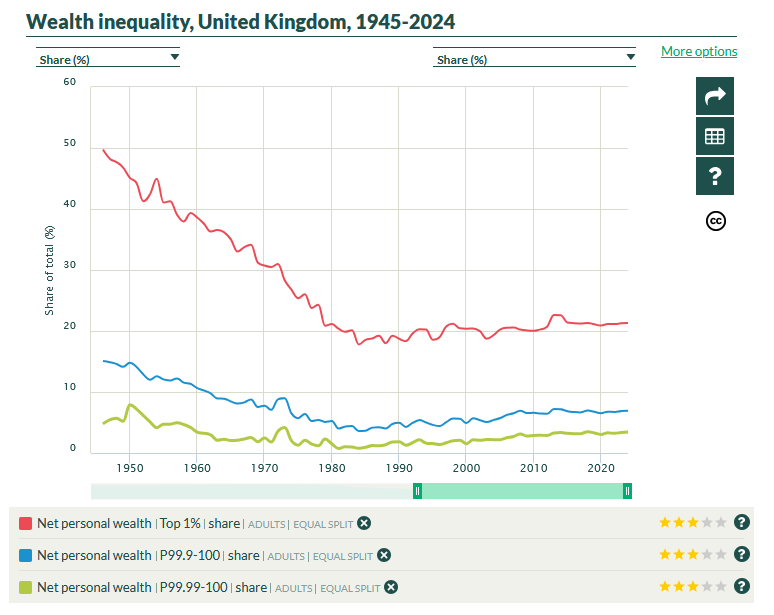
This approach creates inequality metrics that would improve if we were to dismantle the welfare state. Which is exactly what this graph suggests by implying that the world is just as unequal today as it was during a period that saw two world wars and the greatest economic depression since the Industrial Revolution.
You cannot celebrate Roosevelt, Attlee and so on and use inequality metrics that make social insurance programs look like they foster inequality
@joseph_h_garvin B: Well, I don't know whether I really want power...
SH: Bernard, if the right people don't have power, do you know what happens? The wrong people get it!
@pskocik As a counterpoint, I got a 2% speedup by throwing away two intrusive linked lists that were used only in part of the critical loop. TLB misses add up...
@JohnHCochrane As a counterpoint, during the EU debt crisis bond holders did end up being "senior" compared to retirees. Most countries in the EU did some kind of austerity or pension reform, but only Greece defaulted on its debt.
@FelixCLC_@CamelCdr A question: Is the usecase from dynamic language interpreters (e.g. zero-stage JS and Lua) worth optimizing for and/or worth having some FP instructions that operate on integer registers in the ISA?
In the agentic world, it's tempting to automate everything, but we should resist the urge and first think hard about whether the process should exist at all.
Delete, then automate.
@corsix@disruptnhandlr@samlakig That I knew. Isn't that a nightmare for register ports though?
(Also, I think GP was referring to it being a cut-down thing of a more ambitious thing _on the Intel/APX side_, if I am reading their tweet correctly)
Economists who report top wealth holdings relative to GDP conflate three distinct phenomena: inequality, changes in the aggregate capital stock relative to annual production, and asset-pricing effects. And they implicit lead their audience to attribute all three to inequality.
The conventional way to measure wealth inequality is to look at the share of total wealth held by the top x%. This isolates changes in inequality from changes in the overall level of wealth. It is unaffected by the fact that everyone's wealth can rise or fall relative to GDP at the same time.
Take the UK, which is the topic of this interview. What has happened to wealth inequality since World War II? According to the World Inequality Database, a project run by Piketty and co, this is the evolution of the top 1%, 0.1% or 0.01%'s shares of total wealth. It fell up to the mid 1980s and has barely increased since then.
If you know how the sausage is made, most of these variations are not very meaningful given the margins of errors in these estimates that vary widely from study to study.
So why divide the wealth of the rich by the GDP rather than the total national wealth itself?
By the way, since the proponents of the wealth tax are now using the top wealth relative to GDP as their favorite metric, why can't we find this metric on their database website? Is it because it's an odd metric to begin with?
@FUZxxl@Waffl3x Observing the intermediate state forces the compiler to emit more stores than necessary, you'd rather avoid that in release mode.
Also, making the partial state observable means that people will be lazy and derive the later assignments from the earlier ones, which tends to [...]
There are zillions of books about how such and such government introduced enlightened policies that drove economic success. We love such stories because they show agency, rationalize randomness and end with a happy end.
In reality, many successful countries, including South Korea🇰🇷, more or less blindly stumbled into success, scaling up successful policies only ex post.
@D_A_Irwin : "As Yoo (2020, 23) points out, at least in
the beginning, export growth led to the adoption of the export promotion policy, not the other way around."
@Noahpinion
https://t.co/w05WwCJqJP