Picture depositing into a vault once, then simply letting the system take it from there
That's the experience @ConcreteXYZ delivers with its automated vault infrastructure and the daily three-party automation cycle
The workflow stays remarkably simple
Capital enters the vault
Strategies are deployed automatically according to predefined rules
The NAV updates daily through the three-party verification process, giving users a transparent and trustworthy view of performance
When it's time to redeem, withdrawals follow the vault's liquidity framework flexibly without requiring constant manual oversight
Behind that straightforward experience, the infrastructure runs the full three-party automation cycle every day, continuously handling:
> capital allocation
> portfolio rebalancing
> daily NAV calculation with independent verification
> yield compounding
The objective isn't to ask users to make better decisions every day
It's to build a system that consistently makes disciplined decisions on their behalf within clearly defined risk parameters, operating quietly like a dedicated robot asset manager
That shift feels important
Instead of spending time monitoring markets, moving assets between protocols or reacting to every change in APY, users can focus on long-term participation while the vault keeps the entire cycle operating seamlessly in the background
Good automation doesn't replace judgment
It applies that judgment consistently, day after day, without emotion or fatigue
That's the direction I'd love to see more DeFi infrastructure take
Reliable systems quietly doing their job while users gain a simpler, more predictable experience
Real world experience is becoming one of the most valuable datasets in AI
@PrismaXai turns that experience into something robots can actually learn from
Every teleoperation session captures more than a completed task. It records synchronized video, robot actions and sensor signals that reveal how people respond when the real world refuses to follow a script
A successful grasp
A small correction after an object slips
The subtle adjustment that keeps a task moving instead of starting over
Those moments become the foundation of learning. These aren't just success stories. The recoveries and adjustments show models how to handle uncertainty and friction, something simulation data can rarely provide with the same richness
PrismaX's Verify Quality process then reviews each demonstration. It rewards skilled operators while selecting the strongest examples for Vision-Language-Action (VLA) models
That creates a flywheel where every stage strengthens the next
> skilled operators produce better demonstrations
> better demonstrations become higher quality datasets
> stronger datasets improve foundation models
> better models allow one operator to supervise more robots
As more robots enter real environments, they generate even more valuable data, feeding the cycle all over again
What stands out to me is that human expertise stays at the center of the process. Instead of treating teleoperation as a temporary step, PrismaX turns it into the engine that continuously improves physical AI
Every careful movement, every recovery, and every successful task becomes knowledge the next robot can build on. This is how robots move beyond repeating motions and begin understanding how to operate in the messy, unpredictable world we live in
It's thoughtful infrastructure, and it's exciting to watch it take shape one verified session at a time
A developer wants to add private cross-chain execution to their application
A year ago, that usually meant diving into complex cryptography, custom infrastructure and months of engineering before users ever saw the feature
The upcoming @FlutonIO TypeScript SDK takes a much more approachable route
Instead of building an entire privacy stack from scratch, developers can integrate encrypted intents through a familiar TypeScript workflow with just a few lines of code
The process is surprisingly clean
> query the relayer network for available execution paths
> encrypt the intent using Fully Homomorphic Encryption so computation can happen directly on encrypted data
> submit the protected intent for shielded on-chain execution
From that point forward, computation happens directly on encrypted data
Validators, relayers and outside observers do not gain access to sensitive transaction details while execution is underway
That helps protect information such as transaction amounts, routing preferences, execution strategy and cross-chain workflow
Another detail I like is the modular design
Developers do not have to rebuild an entire application around a new framework. They can integrate the confidentiality components they need while keeping the rest of their architecture unchanged
This is what good infrastructure should do
It lowers the barrier to building better applications instead of raising it
Because the SDK is built TypeScript-first, the integration feels native to developers who already work in JavaScript and TypeScript environments. A simple import like:
"import { getOffers } from "@fluton/sdk"
followed by a query call is often enough to start fetching execution paths before the encryption and submission steps take over
The heavy cryptographic work stays abstracted away inside the SDK
FHE lets the network process everything without ever decrypting the original intent, which removes the need for developers to write their own proofs or manage separate privacy infrastructure
As privacy moves closer to becoming a default capability rather than a specialized feature, SDKs like this could make confidential execution accessible to far more wallets, DeFi protocols and cross-chain applications than ever before
It turns what used to feel like an expert only task into something every builder can add without leaving their existing stack
Picture finishing a game, cashing out your winnings and seeing USDT arrive in your wallet almost instantly
That's the experience BetFury is aiming to bring through its upcoming integration with @utexocom
As Utexo's first launch partner for Bitcoin native USDT over Lightning, BetFury is taking a meaningful step toward bringing stablecoin payments directly onto Bitcoin's payment rails
The architecture combines several technologies that complement each other:
> Lightning enables near-instant transfers
> RGB brings client-side validation and confidential asset ownership
> Bitcoin provides the settlement foundation
For players, that could translate into a much smoother experience in iGaming. Deposits settle in seconds. Withdrawals reach wallets almost instantly, letting players access their winnings quickly without long confirmation times. Fees remain predictable even during periods of heavier network activity
For BetFury, the impact goes beyond payment speed. Supporting Bitcoin native USDT at scale gives one of crypto's largest gaming platforms an opportunity to demonstrate how this infrastructure performs under continuous, high volume usage typical in iGaming. This also allows operators to reduce payment processing fees significantly, often by at least two to three times compared to existing rails
If successful, it provides a strong example for other exchanges, wallets, gaming platforms and payment providers considering similar integrations
That's what makes this announcement interesting to me. It's less about adding another payment option and more about putting Bitcoin native stablecoin infrastructure into a real production environment with millions of potential users. This marks the first major deployment of Utexo's technology at scale in the iGaming space, where instant experiences and high transaction volumes are essential. It offers meaningful validation for Utexo by testing its rails in a live, high activity crypto casino setting rather than in theory
Sometimes the strongest validation for new infrastructure comes from seeing people use it every day rather than simply reading about the technology behind it
Looking forward to watching this rollout later this summer
Imagine teaching a robot how to fold a towel
A video shows what happened
The sensor data explains how it happened
That is the combination I find most compelling about @PrismaXai's data pipeline
The visual stream captures the full context of the task
A person reaches for the towel, adjusts their grip, smooths the fabric, and reacts naturally when it slips. Every movement unfolds in a real environment instead of a perfectly controlled lab. This egocentric perspective gives the model an immersive view of the scene as the operator experiences it
Alongside that, the sensor stream records another layer of understanding
It captures joint positions, grip force, velocity and acceleration, plus spatial movement throughout the task. These signals make it possible to reconstruct the physical state of the embodiment at all times
Together, those signals create a much richer training example than either modality could provide alone.
The video tells the model what the world looked like from the operator's point of view
The sensors reveal how the body interacted with that world through precise dynamics and forces
When those two perspectives stay synchronized, robots gain a far better understanding of physical tasks instead of simply copying appearances. The model learns not only the visual outcome but also the causal relationships between actions and results. This is especially valuable for everyday activities where tiny adjustments matter far more than perfect repetition, because real environments are full of variability, slips and unexpected changes
Whether it is organizing shelves, preparing food, or folding laundry, the goal is not collecting more recordings
It is collecting demonstrations that capture both perception and action with enough fidelity for physical AI to learn from
That foundation becomes even stronger when the community helps validate the quality of each contribution before it enters the training pipeline. Reviewers score episodes against PrismaX data standards, ensuring only high fidelity examples move forward
Good models begin with good data
Great models begin with data that reflects how people actually move through the real world
A developer starts building a cross-chain application
The feature list is straightforward
Private execution isn't
Protecting transaction details usually means stitching together multiple tools, redesigning workflows or accepting compromises somewhere along the way
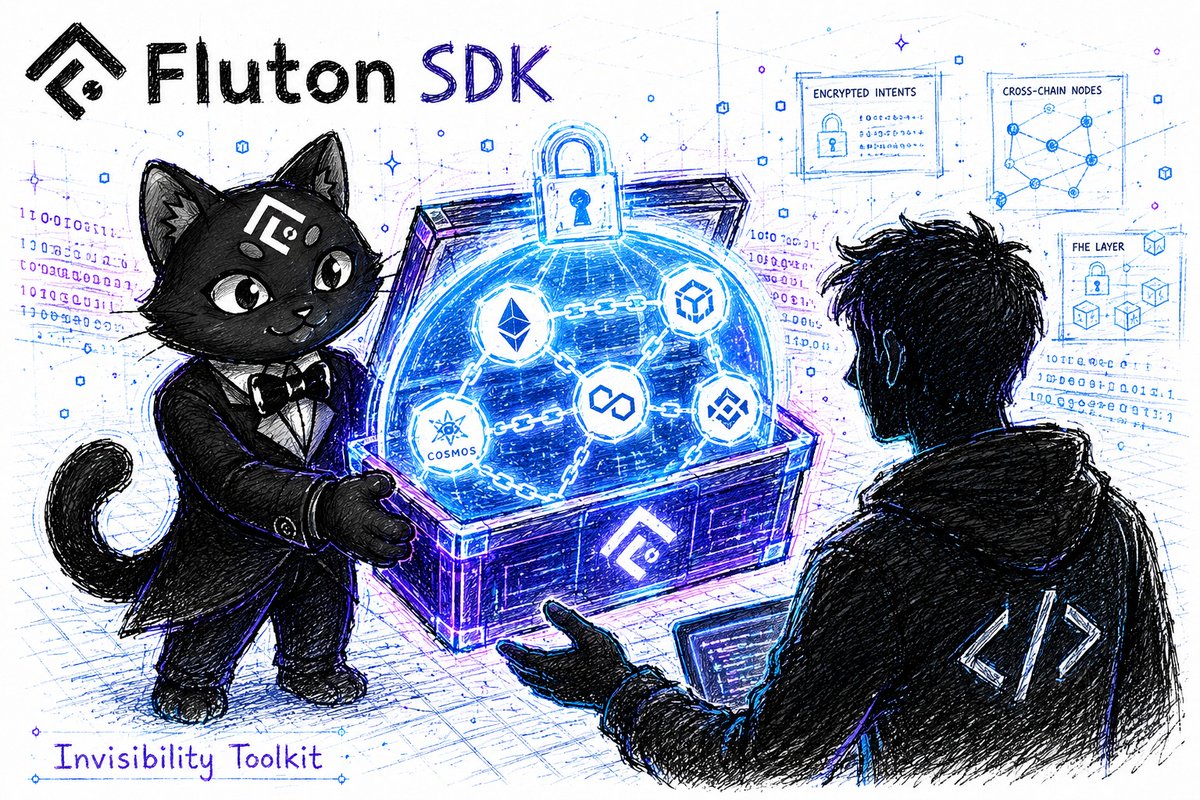
That's why the upcoming @FlutonIO SDK caught my attention
Instead of treating confidentiality as an optional add-on, it makes encrypted intents part of the development flow from the beginning. Applications can submit cross-chain intents while sensitive information stays encrypted throughout execution. The network computes directly on encrypted data using fully homomorphic encryption, allowing requests to be processed without exposing details to validators, relayers or outside observers
For builders, that opens the door to applications where:
> transaction details remain confidential during execution
> cross-chain workflows stay private by design
> encrypted intents integrate through a familiar TypeScript SDK
> developers can focus on product logic instead of building custom privacy infrastructure
What I appreciate most is the philosophy behind it
Rather than keeping the underlying technology behind closed doors, Fluton is packaging this confidentiality engine into tools that other teams can build with. It's like gifting developers their own ready made invisibility toolkit. Privacy no longer feels like something you have to fight for or stitch together later. It simply becomes part of the foundation
Good infrastructure doesn't stop at solving a problem once. It gives other builders the ability to solve new problems on top of it
I'm looking forward to seeing what developers create once this SDK is in their hands
Sometimes the biggest impact comes from enabling thousands of builders instead of launching one more application
Imagine managing a vault with hundreds of millions of dollars
Generating yield is only part of the job
The harder challenge is deciding who can move capital, how much authority they have and what happens when markets change unexpectedly
That's where @ConcreteXYZ's architecture stands out
Instead of relying on a single operator or broad multisig permissions, responsibilities are separated across clearly defined onchain roles
Each layer has a specific purpose
> allocators rebalance capital within predefined limits
> strategy managers define the investment framework
> immutable hooks enforce risk controls and compliance rules
That separation allows day-to-day execution to remain efficient while keeping critical decisions governed by transparent and enforceable rules onchain. This is a meaningful difference from many curated vaults, where control often stays more centralized or discretionary through multisig or curator teams
Another piece I find interesting is the probability engine
Rather than reacting after collateral comes under pressure, it continuously evaluates potential stress scenarios and can adjust positioning or provide protection before risk becomes a larger issue. This quantitative, proactive layer helps maintain stability when managing capital at scale
Across DeFi, different protocols specialize in different parts of the capital stack
Morpho has pushed curated lending forward with strong curator driven optimization
Pendle transformed how markets price and split future yield
Kamino built sophisticated capital efficiency on Solana through automated liquidity and lending strategies
Concrete is approaching problem from another angle: creating infrastructure for managing capital across strategies with automation, quantitative risk controls, modular role based vaults and cross chain flexibility. Instead of focusing primarily on a single primitive or chain specific optimization, it embeds professional asset management structures directly into the protocol layer
That distinction matters
The conversation moves beyond "Where is the highest APY?" toward "How should capital be governed over time in a scalable and transparent way?"
To me, that's one of the more interesting directions vault infrastructure is taking in 2026
As more institutional and long-term capital enters DeFi, governance, risk management and operational design may become just as important as yield itself
Think about sending USDT on Bitcoin in 2014
Every transfer was recorded through Omni
It worked, but every movement lived onchain, confirmations took time and scaling depended on Bitcoin's block space
Fast forward to today and architecture looks very different
RGB reimagines how assets live on Bitcoin by moving validation to the client side instead of broadcasting every state update across the network
That changes the experience in several important ways, especially when compared directly to Omni from 2014
> Privacy: Omni recorded every USDT transfer as visible onchain data on the Bitcoin blockchain. Anyone could trace movements using explorers. RGB uses client-side validation, keeping ownership and state details private between the involved parties. Bitcoin only anchors cryptographic commitments, without creating a public transaction graph for analysis
> Speed: Omni depended on Bitcoin block confirmations, typically requiring 10 minutes or more, with potential delays from congestion. RGB combined with Lightning enables instant payments that settle in milliseconds to seconds, with minimal fees
> Scalability: Omni tied growth directly to Bitcoin's constrained block space and onchain footprint. RGB performs most work offchain, and Lightning adds high throughput payment channels. This keeps the base layer lightweight while supporting significantly higher transaction volumes without bloating Bitcoin's global state
The foundation is still Bitcoin
What's changed is how much work happens above it
For users, that means native USDT can move through Lightning channels in milliseconds while inheriting Bitcoin's security model underneath
For developers, it creates a much more scalable platform without expanding Bitcoin's global state
@utexocom helps bridge that final gap by providing the API, SDK and production infrastructure needed to bring RGB into real payment systems
Watching USDT return to Bitcoin isn't just a story about a stablecoin coming home
It's a story about how the underlying technology has matured
The security model remains familiar
The user experience becomes dramatically smoother
And Bitcoin gains another building block for serving as a global settlement network for digital dollars
It's been a long journey from Omni to RGB, and seeing that evolution reach production is rewarding in its own right
@Utexoasia