🚨 someone just dropped a full 10-stage academic research pipeline for Claude Code.
It doesn’t write your paper for you, it hunts references, formats citations, verifies data, and even runs a "devil's advocate" agent to attack your own thesis.
Here's why it's a massive deal for academics:
→ Anti-AI Voice: Learns your specific writing style.
→Integrity Gates: Actively hunts down fabricated citations and statistical errors.
→Simulated Peer Review: Runs your draft through a 7-agent panel (including a Devil’s Advocate).
→Cheap: A full 15k-word paper costs ~$4–$6 in API credits.
Best part?
It's 100% free and open-source.
Install in 30s: `/plugin install academic-research-skills`
repo in 🧵↓
Já devemos estar a viver todos em marte por esta altura...
Nova via externa e soterramento da AEP: os projetos que prometem mudar o trânsito no Porto - SIC Notícias https://t.co/eCKMyEKjdG
🚨Alert🚨 CVE-2026-23918 : Double Free and possible RCE vulnerability in Apache HTTP Server with the HTTP/2 protocol.
📊 3.8K+ Services are found on the https://t.co/g3tSyh13yE yearly.
🔗Hunter
Link:https://t.co/o3OLfMCjPa
👇Query
HUNTER : https://t.co/yFFcJwdIUc="Apache HTTP Server"&&https://t.co/yFFcJwdIUc="HTTP/2"
📰Refer:https://t.co/7YHug75osO
https://t.co/vhMzwiEHao
#hunterhow #infosec #infosecurity #OSINT #Vulnerability
This Docker container boots a full Android phone.
Not a simulator.
A real Android emulator running entirely inside Docker:
• KVM acceleration for near native emulator performance
• GPU acceleration support for smoother rendering and testing
• Google Play Store emulator images built in
• remote ADB access directly over the network
• scrcpy support for low latency remote control
• customizable Android API levels and device presets
• persistent AVD storage support between container restarts
• fully headless operation for CI/CD environments
How it works:
• build or pull the Docker image locally
• mount the host KVM device into the container
• expose port 5555 for remote ADB connectivity
• connect instantly using normal adb commands
• control the Android screen remotely with scrcpy
Supports:
• Android API 28 up to API 33+ builds
• Google APIs and full Play Store variants
• x86 and x86_64 Android emulator images
• Docker Compose setups for scalable deployments
Android phones are slowly becoming cloud infrastructure.
do you understand what just happened to your computer..
Google Chrome secretly downloaded a 4GB AI model onto your device. Without asking.. Without telling you..
It's called weights.bin. It lives deep in your system folders. It powers Gemini Nano - Google's on-device AI.
And if you delete it? Chrome re-downloads it automatically. Like nothing happened.
Just Google deciding your hard drive is their storage unit.
At 1 billion Chrome users - that's 4 BILLION gigabytes of data pushed silently across the internet.
The carbon footprint alone equals tens of thousands of cars running for a year.
Check your disk right now:
📁 %LOCALAPPDATA%\Google\Chrome\User Data\OptGuideOnDeviceModel
To stop it: chrome://flags → disable Optimization Guide On Device Model → restart Chrome → delete the folder.
Reshare so people know what's sitting on their computers.
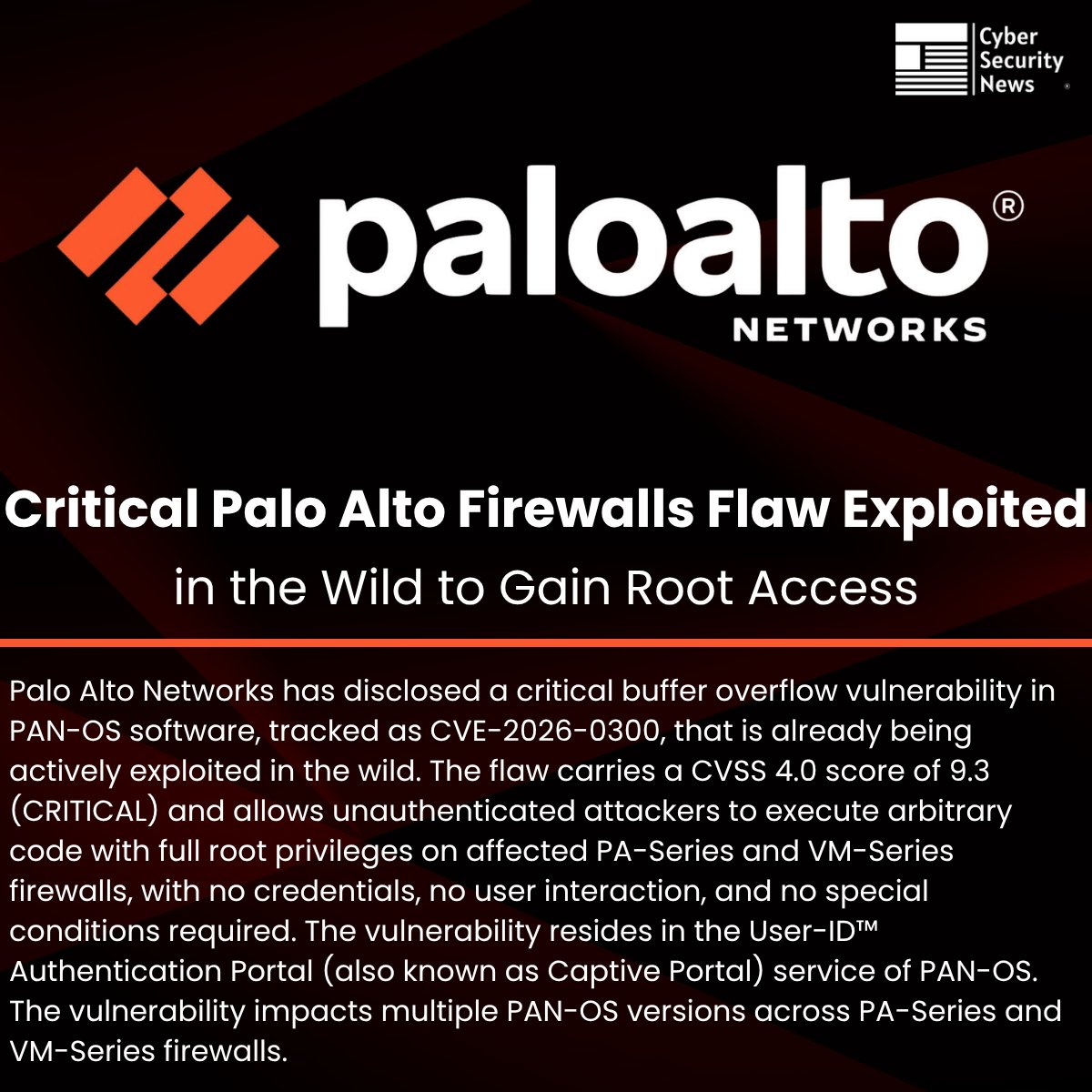
🚨 Critical Palo Alto Firewalls Vulnerability Exploited in the Wild to Gain Root Access
Source: https://t.co/dYCJQ6Hi1o
Palo Alto Networks has disclosed a critical buffer overflow vulnerability in PAN-OS software, tracked as CVE-2026-0300, that is already being actively exploited in the wild.
The flaw carries a CVSS 4.0 score of 9.3 (CRITICAL) and allows unauthenticated attackers to execute arbitrary code with full root privileges on affected PA-Series and VM-Series firewalls, with no credentials, no user interaction, and no special conditions required.
The vulnerability resides in the User-ID™ Authentication Portal (also known as Captive Portal) service of PAN-OS. The vulnerability impacts multiple PAN-OS versions across PA-Series and VM-Series firewalls.
#cybersecuritynews #vulnerability
🛡️ Critical Android Zero-Click Vulnerability Grants Remote Shell Access
Source: https://t.co/EUEZkh4CEa
Google has published the May 2026 Android Security Bulletin, alerting the ecosystem to a highly severe remote code execution (RCE) flaw. Tracked as CVE-2026-0073, this critical vulnerability resides deep within the core Android System component.
It allows an attacker to gain remote shell access without requiring a single tap, download, or click from the device owner. Threat actors can launch this zero-click attack proximally, meaning they only need to be on the same local network or in physical proximity to exploit a vulnerable mobile device.
#cybersecuritynews #Android
⚠️ Critical Apache HTTP Server Flaw Exposes Millions of Servers to RCE Attacks
Source: https://t.co/nyaOOtouZa
The Apache Software Foundation has released a critical security update for Apache HTTP Server, patching five vulnerabilities, including a dangerous double-free flaw capable of enabling Remote Code Execution (RCE) in version 2.4.67, released on May 4, 2026.
All users running version 2.4.66 or earlier are strongly urged to upgrade immediately. The most severe of the five vulnerabilities is CVE-2026-23918, rated High with a CVSS base score of 8.8.
The flaw is a double-free memory corruption bug triggered within Apache's HTTP/2 protocol implementation during an "early stream reset" sequence.
#cybersecuritynews #vulnerability