I just got back from SF and I FEEL INSPIRED.
I spent 5 days with frontier AI model teams, AI startup founders, and 3 billionaires.
My takeaways:
1. I had lunch with 3 billionaires. All of them are buying SaaS companies and rebuilding them agent-first. They were deeply inspired by Bending Spoons and Ryan Cohen's eBay deal. Buy the company, cut the headcount, rebuild the tech, add agents, add features, make more valuable experience, raise prices.
2. The frontier model companies are hungry for usage data from the field. They can see API calls and token counts. They can't see the actual workflows. If you're deep in a niche using these models in ways the model companies haven't seen, that understanding is incredibly valuable. Usage intelligence is the new alpha.
3. Consumer AI is massively underbuilt. Every billboard in SF is either B2B inference infrastructure or vertical agent companies. The entire city is optimized for enterprise. Meanwhile you have companies like Cal AI doing $50M ARR in 18 months as a consumer app. I met with a cool few teams doing consumer AI (@paulscherer / @ekuyda)
4. MCP came up in literally every conversation. The companies exposing their product as MCP endpoints are getting pulled into deals they never pitched for. The ones that aren't are becoming invisible to agents. This is the new SEO. If agents can't find you, you don't exist. Building products for agents is the new zeitgeist in general.
5. Not uncommon for hot seed rounds to be $25-50 million valuations. I saw a Series A at $450 million
6. If I had a dollar every time someone mentioned "forward-deployed engineer" this trip I could have funded a seed round. It's the hottest role in SF right now. The person who sits between the agent and the customer, making sure everything actually works.
7. The mood around open source shifted. A year ago it felt like open source was chasing the frontier models. Now founders are telling me Gemma and DeepSeek are good enough for 80% of what they need at a fraction of the cost. The "which model do you use" conversation is being replaced by "which model for which task." Model loyalty kinda feels dead.
8. Voice agents came up more than I expected. Multiple founders told me voice is the interface for the next billion users. The billion people who will never type a prompt will absolutely talk to one.
9. The Obsidian community in SF is weirdly intense. Multiple founders showed me their vaults unprompted. Like showing someone your home gym. It's a flex now. The quality of your knowledge base (second brain?) is becoming a status symbol among builders.
10. Maybe it was just the people I met but the age of the founders is shifting. I met more founders over 40 this trip than any trip before and more founders under age 21 than ever before. Founders getting older and younger at the same time.
11. I spoke to a lot of fast-growing startups, VCs and frontier models who are hiring content creators right now.
12. The restaurant scene in SF is actually better than it's been in years. Founders are going out more. Alcohol is out, not surprisingly.
13. SF doesn't feel like the only place anymore. We all have access to the same frontier models. We all read the same X feed. A founder in NYC or Lagos is calling the same APIs as a founder in SoMa. So in the past it felt like SF was always lightyears ahead, doesn't feel that way anymore. It's okay not to live in SF and have BIG DREAMS.
14. The coworking spaces in SF are half empty but the coffee shops are packed. People want to be around people. I had a few startup ideas here....
15. Walking around the Mission I noticed something: the street-level businesses, the taquerias, the barbershops, the laundromats, none of them use any AI at all.
16. I heard the phrase "agent debt" for the first time. Like technical debt but for agents. When you hack together an agent workflow fast and never clean it up, the system prompts conflict, the memory gets polluted, the tools overlap. 6 months later the agent is doing weird things and nobody knows why lol.
17. Met a few people who carry two phones now. One for personal. One that's basically an agent terminal running Telegram or iMessage connections to their agent fleet.
It's always amazing to get that dose of inspiration in SF. I FEEL INSPIRED.
But I'm so happy to be back home, locked in and building.
We're 12-18 months into a shift that will take 15 years to play out. The urgency in every conversation was real.
What an incredible time to be building.
Alyssa Liu went viral during the Met Gala for her rant on the state of the public perception of data centers.
"We are being manipulated into ceding the compute frontier. Data center development is vital to national security." She adds, "Karen Hao's overstimation of data center water consumption by a factor of 1000 has done irreparable damage to the nation's efforts to stay ahead."
Just co-led an AI training for 20 execs from one of the largest financial institutions in the world.
We covered a lot of ground from how LLMs work to what an agent is and how to transform your work, but here were the biggest aha moments for the group.
1. Historically, leaders had to think about allocating budget for headcount and software. Now, token budget must be a serious consideration. Do you set limits per employee? How do you measure the ROI on your token budget? How much budget do you allocate to which employees? How do employees know which models to use to most efficiently spend tokens?
2. The models are good enough now, where most bad output is user error not technology error. And a major contributor to user error is bad context management. To have clean context hygiene you need to understand what the context window is, why separation of concerns is important, and how tactically to treat context like a precious resource.
3. A skill is a scary word. It’s nothing more than an SOP. If you asked an intern to write a one page document breaking down their step-by-step process for building a great deck, you’ve created a skill. A skill is a long prompt that codifies a repeatable process, can be edited as you see fit, and helps to generate more predictable output that meets your standards.
4. Saying you use AI gets you style points. But the real unlock is in process mapping. During the workshop, we asked every exec to write out one of their/their teams key processes step by step and place an E (eliminate), A (automate), or D (delegate) next to each step. The exercise not only revealed opportunities for AI, but also existing inefficiencies that have gone undetected.
5. Claude Cowork opened their eyes. Many people still see AI as a chat-based supercharged Google. They may have heard the phrase “agent,” but they assume it’s sophisticated tech reserved for engineers. Cowork is the layperson’s gateway drug to agents, showing the possibility of building web apps, ai workflows, and live artifacts in a single place.
6. Every company talks about the “bad guys”slowing down AI transformation: legal, compliance, and IT/security. One of the most powerful choices leadership can make is flipping the script and making them the heroes of the transformation story. Help them understand the risks of doing nothing, work with them to make calculated bets, and celebrate them publicly when they partner to drive transformation with speed.
7. Getting an AI system to perform requires four things to go right: picking the right model, teaching it the right process, providing the right context, and establishing the right guardrails. Most people assume the right model is 99% of it, they don’t think enough about giving the right context, and they don’t realize the right guardrails make things like hallucinations and mistakes less dangerous.
In Mere Christianity, CS Lewis has an awesome opening riff about how most people know the difference between right and wrong, but they justify acting immorally by appealing to "special exception." They know they shouldn't hit a friend, but what if that friend was being so mean? They know they shouldn't steal a seat a bus, but what if that person got up and created a moment's confusion and then the seat was up for grabs? Etc.
When I read this section, I thought a lot about contemporary politics and the way that people justify their politics, not by appealing to higher principles, but rather by appealing to "special exception" to argue that their admitted indecency is justifiable in context.
A lot of MAGA vice is justified by special exception. Trump's defenders rarely defend his crookedness directly. They don't say "it's wonderful to use trade policy to enrich the Oval Office, it's really awesome." They say: Well, look, it doesn't really matter, because the left is so dangerous, Biden maybe did something similar 3 years ago, Democrats would do the same in power, and so forth.
I heard something similar in that NYT conversation everybody's talking about. You even see it in the headline: ‘The Rich Don’t Play by the Rules. So Why Should I?’ Why, hello, special exception. When you start arguing that stealing food and French paintings is justifiable in the context of political protest in an age of prevailing distrust, you're similarly not arguing *for* any kind of a universal principle. Nobody actually wants 300 million people stealing fruit from the grocery store. Nobody actually wants every Louvre visitor trying to rip a Manet off the walls. These virtues don't scale. (Because they're not virtuous!)
Sap that I am, I want us to get to a place where politics is about fighting for what is right and decent, not about justifying what sort of indecent behavior might be somewhat understandable or technically justifiable given the other side's vice or the prevailing levels of indecency. The point is to build the kind of goodness that scales.
https://t.co/iPF65NuyeU
New Hungarian Prime Minister Peter Magyar finally appeared as a guest on state television M1 for the first time ever. Here’s what he told the journalist.
“We will suspend this channel's news service. This isn't about me; I'm not seeking revenge. Our people deserve journalism that reflects the truth.”
“We will nationalize the assets given to businesspeople and foundations during the Orbán era.”
“The Mathias Corvinus Collegium Foundation, close to Orbán, was transferred 10% of MOL (oil company) and Gedeon Richter (pharmaceutical company) for free. We will take back these shares.”
“After 16 years of the Orbán era, 400,000 Hungarian children in this country are living in deep poverty.”
“President Sulyok is no longer the president of this country in my eyes or in the eyes of the people.”
(In response to the host asking about his meeting with Zelensky as a counterpoint) “I get your joke, and I even like it. But your references no longer carry any meaning.”
“According to you, Germany has collapsed, there's no internet there, people aren't even having sex. The Hungarian people were laughing at you.”
“It was said on this channel that even my young children won't talk to me, when in fact my children live with me.”
(When the host interrupted him) “No host in this studio ever dared to interrupt Hungary's most corrupt and most lying prime minister.”
(When asked about the legal basis for closing the news service) “For someone on this channel to accuse me of breaking the law looks like a thief accusing the police.”
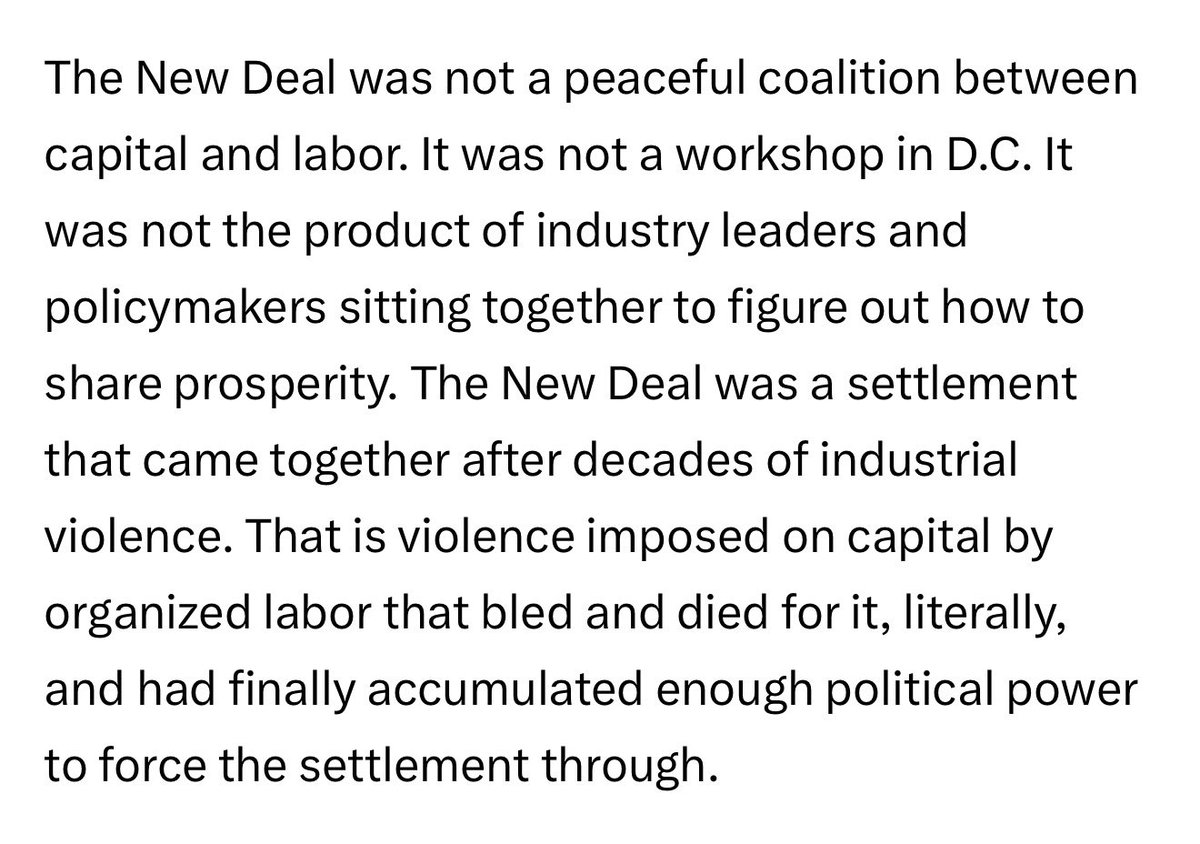
“The forty-hour work week was extracted from capital by people willing to be shot at, imprisoned, and charged with treason. The Wagner Act was not a gift from an enlightened capital class: it was rammed through Congress while factory owners hired private armies to shoot their own employees. Social Security was not a consensus position but a minimum concession that capital could offer to prevent armed revolution. The trust busters were not convened by Standard Oil and given grants. They were sent by a government that had watched Standard Oil buy state legislators and decided that if they did not act, the Republic would fall.
When OpenAI invokes this history, it is invoking a process in which it would have been the target -- whether it knows it or not.”
When Russia invaded Ukraine 4 years ago now, NATO soon settled on a strategy of helping Ukraine just enough to bleed Russia of its offensive capabilities. As long as Russia wasted its military in Ukraine, the rest of Europe benefitted (too bad about Ukraine though!)
But what happened is that both Russia and Ukraine have become experts in waging a 21st century war. And since China is supplying a lot of basic materials for this conflict, they too are learning and have been strengthened militarily.
Meanwhile, a lot of Europe is asleep. The US has lately been waking up to this strategic blunder and is trying to catch up. No doubt the Iran war put extra urgency into its efforts with a realization that the face of war has changed.
Anyway, great response from a Ukrainian drone manufacturer.
Robert Mueller died last night.
He was 81 years old. He had a wife who loved him for sixty years. He had two daughters, one of whom he met for the first time in Hawaii, in 1969, on a few hours of military leave, before he got back on the plane and returned to Vietnam. He had grandchildren. He had a faith he practiced quietly, without performance. He had, in the way of men who have seen real things and survived them, a quality that is increasingly rare and increasingly mocked in the country he spent his life serving.
He had integrity.
And tonight the President of the United States said good!
I have been sitting with that word for hours now. Good. One syllable. The thing you say when the coffee is hot or the traffic is moving. The thing a man who has never had to bury anyone, never had to sit in the specific silence of a room where someone is newly absent, reaches for when he wants the world to know he is satisfied. Good. The daughters are crying and the wife is alone in the house and good.
I want to speak directly to the Americans reading this. Not the political Americans. Just the human ones. The ones who have lost a father. The ones who know what it is to be in that first hour, when you keep forgetting and then remembering again, when ordinary objects become unbearable, when the world outside the window seems obscene in its indifference. I want to ask you, simply, to hold that feeling for a moment, and then to understand that the man you elected looked at it and typed a single word.
Good.
This is not a country having a bad day. I need you to understand that. Countries have bad days. Elections go wrong. Leaders disappoint. Institutions bend. But there is a different thing, a rarer and more terrible thing, that happens when the moral center of a place simply gives way. Not dramatically. Not with a single catastrophic event. But quietly, in increments, until one evening a president celebrates the death of an old man whose family is still warm with grief, and enough people find it acceptable that it becomes the weather. Just the weather.
That is what is happening. That is what has happened.
The world knows. From Tokyo to Oslo, from London to Buenos Aires, people are not angry at America tonight. Anger would mean there was still something to fight for, some remaining faith to be betrayed. What I see, in the reactions from everywhere that is not here, is something older and sadder than anger. It is the look people get when they have waited a long time for someone they love to find their way back, and have finally understood that they are not coming.
America is being grieved. Past tense, almost. The idea of it. The thing it represented to people who had nothing else to believe in, who came here with everything they owned in a single bag because they had heard, somehow, across an ocean, that this was the place where decency was written into the walls. That idea is not resting. It is not suspended. It is being buried, in real time, with 7,450 likes before dinner.
And the church said nothing.
Seventy million people have decided that this man, this specific man who has cheated everyone he has ever made a promise to, who has mocked the disabled and the dead and the grieving, who celebrated tonight while a family wept, is an instrument of God. The pastors who made that bargain did not just trade away their credibility. They traded away the thing that made them worth listening to in the first place. The cross they carry now is a costume. The faith they preach is a loyalty oath with scripture attached. When the history of American Christianity is written, this will be the chapter they skip at seminary.
Now I want to talk about the men who stand next to him.
Because this is the part that actually breaks my heart.
JD Vance is not a bad man. I have to say that, because it is true, and because the truth matters even now, especially now. Marco Rubio is not a bad man. Lindsey Graham is not a bad man. They are idiots, but not bad, as in BAD! These are men with mothers who raised them and children who love them and friends who remember who they were before all of this. They are not monsters. Monsters are simple. Monsters do not cost you anything emotionally because there is nothing in them to mourn.
These men are something more painful than monsters.
They are men who knew better, and know better still, and will get up tomorrow and do it again.
Every small compromise they made had a reason. Every moment they looked the other way had a justification that sounded, at the time, almost reasonable. And now they have arrived here, at a place where a president celebrates the death of an old man and they will find a way, on television, to say nothing that means anything, and they will go home to houses where children who carry their name are waiting, and they will say goodnight, and they will say nothing.
Their oldest friends are watching. The ones who knew Rubio when he still believed in something. Who knew Graham when he said, out loud, on the record, that this exact man would destroy the Republican Party and deserve it. Who sat next to Vance and thought here is someone worth knowing. Those friends are not angry tonight. They moved through anger a long time ago. What they feel now is the quiet, irrecoverable sadness of watching someone disappear while still being present. Of watching a person they loved choose, again and again, to become less.
That is what cowardice costs. Not the coward. The people who loved him.
And in the comments tonight, the followers celebrate. People who ten years ago brought casseroles to grieving neighbours. Who stood in the rain at gravesides and meant the words they said. Who told their children that we do not speak ill of the dead because the dead were someone's beloved. Those people are tonight typing gleeful things about a man whose daughters are not yet done crying. And they feel clean doing it. Righteous. Because somewhere along the way the thing they were given in exchange for their decency was the feeling of belonging to something, and that feeling is very hard to give up even when you can no longer remember what you gave for it.
When Trump is gone, they will still be here.
Standing in the silence where the noise used to be. Without the permission the crowd gave them. Without the pastor who told them their cruelty was holy. They will be alone with what they said and what they cheered and what they chose to become, and there will be no one left to tell them it was righteous.
That morning is coming.
Robert Mueller flew across the Pacific on military leave to hold his newborn daughter for a few hours before returning to the war. He came home. He buried his dead with honour. He served presidents of both parties because he understood that the institution was larger than any one man. He told his grandchildren that a lie is the worst thing a person can do, that a reputation once lost cannot be recovered, and he lived that, every day, in the quiet and unglamorous way of people who actually believe what they say.
He was the kind of American the world used to point to when it needed to believe the story was true.
He died last night. His wife is alone in their house in Georgetown. His daughters are learning what the world is without him in it. And somewhere in the particular hush that falls over a family in the first hours of loss, the most powerful man and the biggest loser on earth sent a message to say he was glad.
The world that loved what America was supposed to be is grieving tonight. Not for Robert Mueller only. For the country that produced him and then became this. For the distance between what was promised and what was delivered. For the suspicion, growing quieter and more certain with each passing month, that the America people believed in was always partly a story, and the story is over now, and there is nothing yet to replace it.
That is all it needed to be.
A man died. His family is broken open with grief.
That is all it needed to be.
Instead the President said good.
And the country that once stood for something looked away 🇺🇸
Gandalv / @Microinteracti1
It is important to understand the logic of Europeans when they say “no” to Trump, who is trying to convince them that the war in Iran is their war.
Former Deputy Supreme Allied Commander Europe Michel Yakovleff explains:
Five reasons to say “no”:
First. If this is a NATO operation, then it must truly be a NATO operation — unified, with a single command, clear logic, and where “everyone does their part.”
Second. Allies are not a backup dance crew.
If you want to involve the Alliance, put a clear strategy and end goal on the table. Not improvisation or statements that change every five minutes — but an actual strategy.
Third. This is not about ships or soldiers. Not even about mine-clearing vessels. It is about political risk that someone is trying to simply spread across allies.
Fourth. Trust. If you have already abandoned partners before, as happened with Afghanistan, why should this time be any different?
Fifth. The strongest metaphor: “This is not the time to buy cheap tickets for the Titanic.”
And one more important point that is implied between the lines: you cannot reinforce failure.
This, by the way, is a very American kind of logic.
The conclusion is simple and somewhat obvious: the world is increasingly unwilling to adapt to Trump’s chaotic decisions. And respect cannot be demanded — it is either earned or it isn’t.
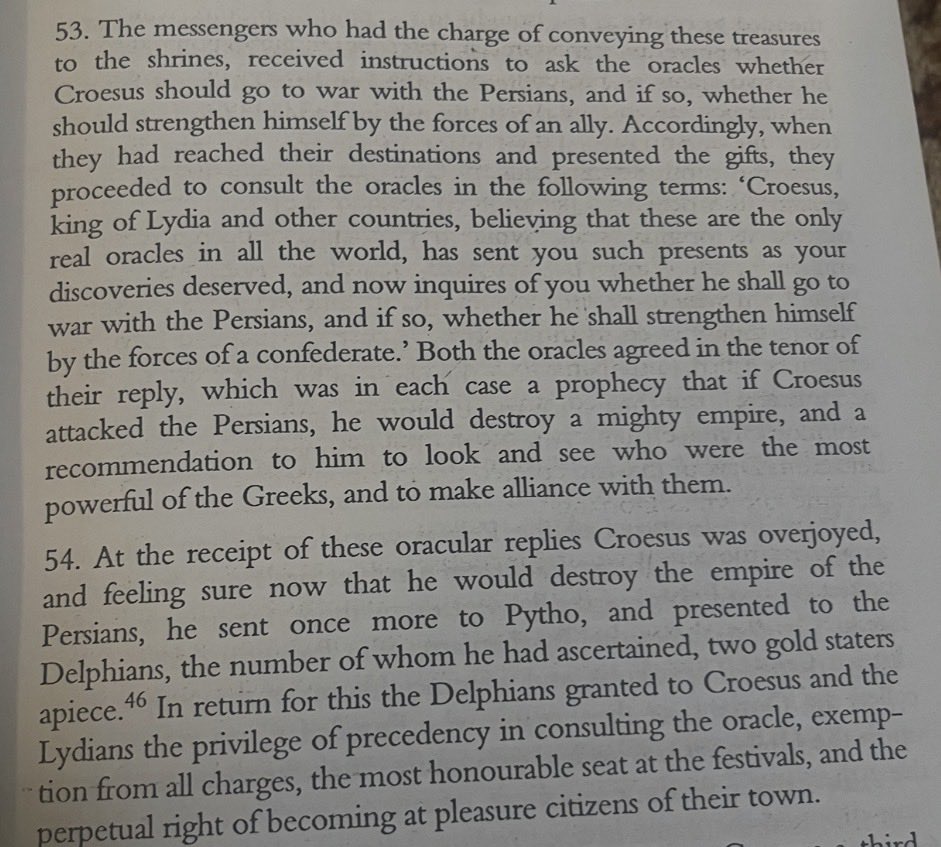
Herodotus writes in Book 1 of his Histories that Croesus of Lydia consulted oracles before waging preemptive war upon Persia. Such was his hubris that when the oracles replied that should he undertake this venture a mighty empire would be destroyed, it never occurred to him that the empire that would be destroyed (as it turned out) was his own:
He took the greatest military force in world history, lost a war to a middle power in a week, begged the world to save him, and demanded that the media lie about this and everything else. I try, but at a simple human level I do not see how anyone can mistake this man’s almost supernatural weakness for strength. His weakness is something negative, gravitational, so deep that it can draw in a whole country. But only if we fail to see it. Only if we let it.
Three weeks into the war with Iran, a number of observations as someone who spent years war-gaming this scenario.
1. The U.S. and Israel may have produced regime transition in the worst possible way.
Ali Khamenei was 86 and had survived multiple bouts of prostate cancer. His death in the coming years would likely have triggered a real internal reckoning in Iran, potentially opening the door to somewhat more pragmatic leadership, especially after the protests and crackdown last month. Instead, the regime made its most consequential decision under existential external threat giving the hardliners a clear upperhand. Now we appear to have a successor who is 30 years younger, deeply tied to the IRGC, and radicalized by the war itself – including the killing of family members. Disastrous.
2. About seven years ago at CNAS, I helped convene a group of security, energy, and economic experts to walk through scenarios for a U.S.--Iran war and the implications for global oil prices. What we’re seeing now was considered one of the least likely but worst outcomes. The modeling assumed the Strait of Hormuz could close for 4–10 weeks, with 1–3 years required to restore oil production once you factored in infrastructure damage. Prices could spike from around $65 to $175–$200 per barrel, before eventually settling in the $80–$100 range a year later in a new normal.
3. One surprising development: Iran is still moving oil through the Strait of Hormuz while disrupting everyone else. In most war games I participated in, we assumed Iran couldn’t close the Strait and still use it themselves. That would have made the move extremely self-defeating. But Iran appears capable of harassing global shipping while still pushing some of its own exports through. That changes the calculus.
4. The U.S. now finds itself in the naval and air equivalent of the dynamic we faced in Iraq and Afghanistan. It’s a recipe for a quagmire where we win every battle and lose the war. We have overwhelming military dominance and are exacting a tremendous cost. But Iran doesn’t need to win battles. They just need occasional successes. A small boat hitting a tanker. A drone slipping through defenses in the Gulf. A strike on a hotel or oil facility. Each incident creates insecurity and drives costs up while remind everyone that the regime is surviving and fighting.
5. The deeper problem is that U.S. objectives were set far too high. Once “regime change” becomes the implicit or explicit goal, the bar for American success becomes enormous. Iran’s bar is simple: survive and keep causing disruption.
6. The options for ending this war now are all bad. You can try to secure the entire Gulf and Middle East indefinitely – extremely expensive and maybe impossible. You can invade Iran and replace the regime, but nobody is seriously going to do that. Costs are astronomical. You can try to destabilize the regime by supporting separatist groups. It probably won’t work and if it does you’ll most likely spark a civil war producing years of bloody chaos the U.S. will get blamed for. None of these are good outcomes.
7. The other escalatory options being discussed are taking the nuclear material out of Esfahan or taking Kargh Island. Esfahan is not really workable. Huge risk. You’d have been on the ground for a LONG time to safely dig in and get the nuclear material out in the middle of the country giving Iran time to reinforce from all over and over run the American position.
8. Kharg Island can be appealing to Trump. He’d love to take Iran’s ability to export oil off the map and try to coerce them to end the war. It’s much easier because it’s not in the middle of IRan. But it’s still a potentially costly ground operation. And again. Again, the Iranian government only has to survive to win and they can probably do that even without Kargh.
9. The least bad option is the classic diplomatic off-ramp. The U.S. declares that Iran’s military capabilities have been significantly degraded, which is how the Pentagon always saw the purpose of the war. Iran declares victory for surviving and demonstrating it can still threaten regional actors. It would feel unsatisfying. But this is the inevitable outcome anyway. Better to stop now than after five or ten more years of escalating costs. Remember in Afghanistan we turned down a deal very early in the war with the Taliban that looked amazing 20 years later. Don’t need to repeat that kind of mistake.
10. The U.S. and Israel are not perfectly aligned here. Trump just needs a limited win and would see long-term instability as a negative whereas for Netanyahu a weak unstable Iran that bogs the U.S. down in the MIddle East is a fine outcome. If President Trump decided he wanted Israel to stop, he likely has the leverage to push it in that direction just as he pressured Netanyahu to take a deal last fall on Gaza.
11. When this is over, the Gulf states will have to rethink their entire security strategy. They are stuck in the absolute worst place. They didn’t start this war and didn’t want it and now they are taking with some of the worst consequences. Neither doubling down with the U.S. and Israel nor placating the Iranians seems overwhelmingly appealing.
12. One clear geopolitical winner so far: Russia. Oil prices are rising. Sanctions are coming off. Western attention and military resources are shifting away from Ukraine. From Moscow’s perspective, this war is a win win win.
13. At some point China may have a role to play here. It is the world’s largest oil importer, and much of that supply comes from the Middle East. Yes they are still getting oil from Iran. But they also buy from the rest of the Middle East, and a prolonged disruption in the Gulf hits Beijing hard. That gives China a real incentive to help push toward an end to the conflict.
And I’d like to remind everyone that not so long ago, by helping Ukraine with weapons, America was:
- securing valuable contracts for its own defense industry and spending a large part of U.S.-Congress-allocated funds in America
- gaining massive global advertising for American weapons, which in Ukrainian hands performed superbly in a war against a vastly superior enemy (just look at the impact systems like the Bradley, HIMARS, and Patriot had)
- gaining an extremely loyal ally in Ukraine, ready to share its cutting-edge experience from a new era of warfare, especially in drones and highly intensive missile defense
- reinforcing its image as the arsenal of democracy and the powerful leader of the free world, sending a clear signal to dictatorships worldwide: don’t even think about wars of conquest, we will support our democratic allies
- sending Ukraine, to a significant extent, older weapons from its stockpiles that would have had to be written off anyway in the future, while simultaneously modernizing its own arsenals
- achieving the radical military weakening of an aggressive militaristic Russia, a dictatorship fundamentally built on revenge for the Cold War, hatred of America and the West, and a desire to dismantle the American-led world order
And all of this -- without a single American servicemember having to get deployed and fire a single shot.
Ukraine pleaded, humbly asking for nothing more than a simple win-win partnership: with your weapons we save ourselves from extermination -- you get a defeated fascist Russia.
I genuinely cannot understand how anyone could trade all of that for absurd lies about “$350 billion,” then smear and humiliate Ukraine, insult America’s key NATO allies, side with that KGB cyborg in the Kremlin -- and then to squander billions of dollars, cost American lives, and derail the global economy in a poorly thought-out war in the Middle East.
And then eventually end up asking Ukraine to help defend American bases in Jordan from Iranian-Russian drones.
Everyone’s saying OpenAI got the “same deal” Anthropic was banned for.
Read the fine print. They’re not the same:
On weapons:
Anthropic asked for “no fully autonomous weapons without human oversight” = a human involved in the decision.
OpenAI’s deal says “human responsibility for the use of force” = someone accountable, which can happen after the fact.
Oversight ≠ Responsibility. One requires a human before the trigger. The other requires a name on the paperwork after.
On surveillance:
Dario said explicitly: current law hasn’t caught up with AI. The government can already buy your movement data, browsing history, etc without a warrant. AI can assemble that into a complete picture of your life, at scale. That’s mass surveillance without breaking a single law.
Anthropic wanted protections beyond current law.
OpenAI’s deal says the Pentagon “reflects them in law and policy.” That’s existing law as the safeguard, the exact law Anthropic said is insufficient.
Same words. Different agreements. Read them carefully
Shared today by Bev Perry in the Expand Dem Values in the House and Senate Facebook group.
I need to say something that's been bothering me for a while, and I'm saying it as a Marine Corps veteran who leans center-right.
This isn't partisan. This is observation.
We've slow-faded into accepting militarized police as normal, and nobody seems to notice or care.
Even as a USMC pilot, I went through six months of infantry training as an officer before flight school. I've worn the gear. The helmet, the tactical vest, the whole kit. And I can tell you from experience, it changes you.
There's a psychological shift that happens when you strap that stuff on. You feel different. You carry yourself different. You start seeing the environment differently. In the Marine Corps, that shift was appropriate because it's a combat culture and organization.
But these are American streets. American citizens. And we've got law enforcement dressed like they're kicking down doors in Fallujah to serve warrants in suburbia.
What happend to high standards and real policing tactics? Think Adam-12...Officers Reed and Malloy. Crisp uniforms. A revolver. A baton. High standards and professionalism. They looked like public servants because they were public servants. They de-escalated. They talked to people. They were part of the community.
Now? Tactical gear, beards, ball caps, Oakley sunglasses, sleeve tattoos, and a tactical kit that would make special operators jealous. And we've turned it into a fetish. We celebrate it. We assume that because someone looks hard, they must be a professional.
They're not.
I loved the Marine Corps. But I'll be honest, I was also blinded by it for a while. Mission first. Unit over everything. And that mentality made sense in that context.
But law enforcement doesn't get that critical examination. "Back the Blue" has become a shield against accountability. A blanket assumption that a badge plus gun equals hero. That tactical gear equals competence.
It doesn't.
Most people who join law enforcement aren't special operators. They're average people who desperately want to belong to something bigger than themselves. I understand that impulse deeply, it's why I joined the Marines. But wanting to belong doesn't make you qualified. Looking the part doesn't mean you can perform under pressure. And wrapping yourself in warrior aesthetics doesn't make you a warrior.
Old school law enforcement represented something. Standards. Bearing. Discipline. Professionalism that was demonstrated, not costumed. A revolver and a baton meant you had to rely on your training, your words, your judgment, not overwhelming firepower.
What I see now in law enforcement is the costume without the culture. The gear without the training. The authority without the accountability.
Are there good people in law enforcement? Of course. I know some personally. But this reflexive "law enforcement can do no wrong" mentality is lazy, dangerous, and intellectually dishonest.
A woman is dead. And before we sort ourselves into teams and start assigning blame, maybe we should ask harder questions:
Why do we accept a militarized police force as normal?
Why do we assume tactical gear equals tactical competence?
Why have we let "Back the Blue" become a substitute for actual standards?
I wore the uniform. I went through the training. I know what that gear does to your head.
It shouldn't be normalized on American streets against American citizens.
And we shouldn't pretend everyone wearing it is qualified to carry it. The fact that he called her a “fucking bitch” after he shot her three times should be a huge red flag for all of us.