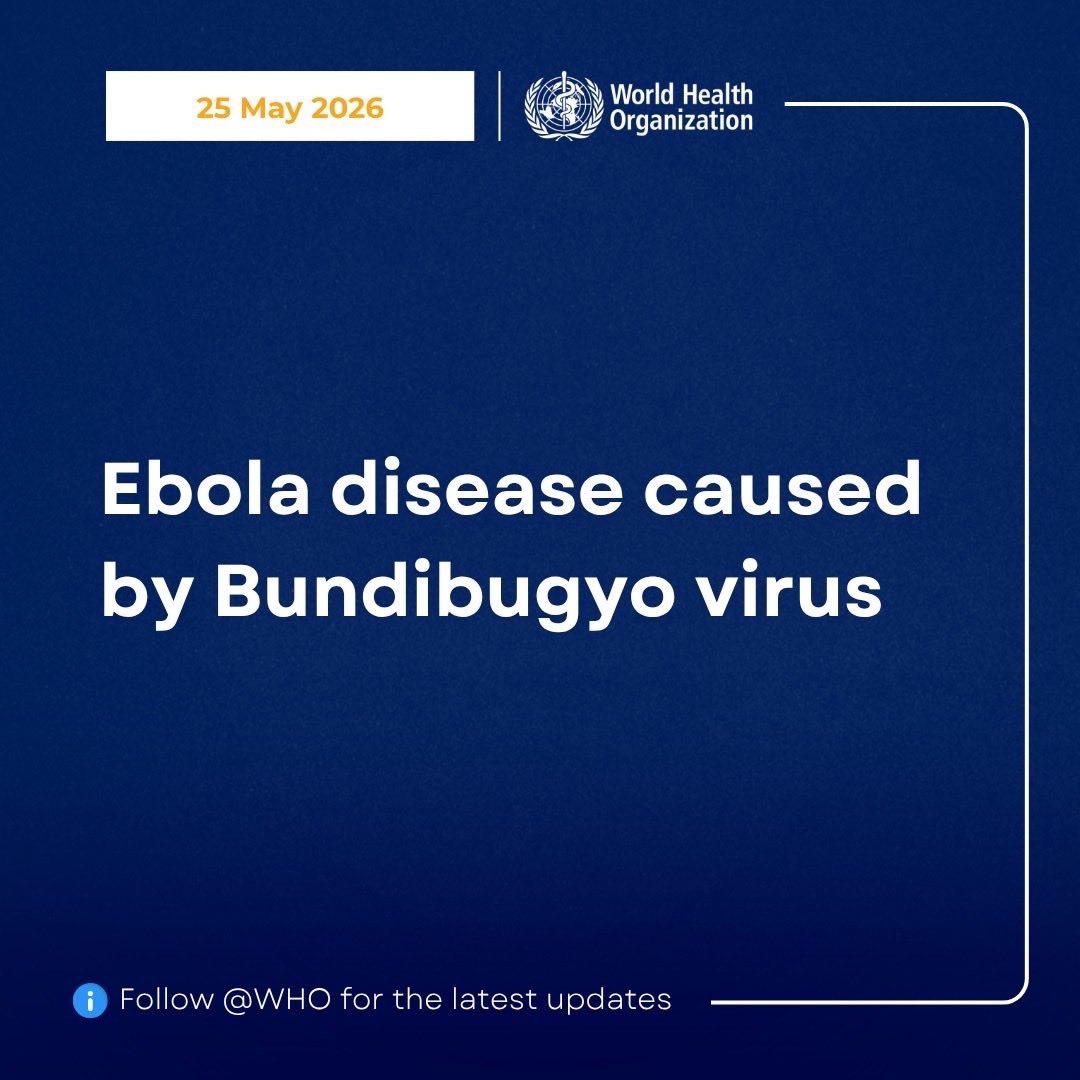
#Ebola Bundibugyo virus update:
- So far, 101 cases have been confirmed in the #DRC, including 10 confirmed deaths. But we know the epidemic in the DRC is much larger. There are now more than 900 suspected cases and 220 suspected deaths.
- #Uganda has reported two additional confirmed cases among healthcare workers, bringing the total number of confirmed cases to seven, including one confirmed death.
We are continuing to scale up the response with our partners, and we expect more cases to be identified in the coming days and weeks.
The sooner we can trace people with infections and identify their contacts, the sooner we can provide the care they need and bring this outbreak under control.
"The #Ebola outbreak in the #DRC is spreading rapidly.
Previously, WHO assessed the risk as high at the national and regional levels and low at the global level.
We are now revising our risk assessment to very high at the national level, high at the regional level, and low at the global level.
So far, 82 cases have been confirmed in DRC, with seven confirmed deaths.
But we know the epidemic in DRC is much larger. There are now almost 750 suspected cases and 177 suspected deaths.
The situation in #Uganda is stable, with two cases confirmed in people who travelled from DRC, with one death.
The measures taken in Uganda, including intense contact tracing and cancelling the Martyrs’ Day commemoration, appear to have been effective in preventing the further spread of the virus.
An American national who was working in DRC has also been confirmed positive, and transferred to Germany for care.
We are also aware of reports today about another American national who is a high-risk contact who has been transferred to the Czech Republic.
The governments of DRC and Uganda are leading the response, with support from WHO and partners.
In addition to our national staff in DRC, so far we have deployed 22 international staff to the field, including some of our most experienced people;
And we have released $3.9 million from the Contingency Fund for Emergencies.
We’re also in touch with UN humanitarian chief Tom Fletcher, and I thank him for allocating $60 million to the response.
On the ground, we’re supporting national authorities with every pillar of the response, including contact tracing, establishing treatment centres, risk communication and community engagement, and more.
Together with the @AfricaCDC, WHO is also establishing a continental Incident Management Support Team.
In the coming days we will publish a multi-agency Strategic Preparedness and Response Plan, aligned with the national plans of both DRC and Uganda, and with our partners.
As you know, unlike many previous Ebola outbreaks, which were caused by Zaire virus, this outbreak is caused by the Bundibugyo virus, for which there are no approved vaccines or therapeutics.
There have only been two previous outbreaks of Bundibugyo, in Uganda and 2007 and DRC in 2012.
Yesterday, WHO convened the leaders of several partner organizations under the interim Medical Countermeasures Network, to review the pipeline of vaccines, therapeutics and diagnostics.
The WHO R&D Blueprint has also convened its technical advisory group on therapeutics and recommended to prioritize two monoclonal antibodies to advance in clinical trials.
In addition, the advisory group recommended the evaluation of the antiviral obeldesivir in a clinical trial as post-exposure prophylaxis for people who are high risk contacts.
This clinical trial is now being developed jointly with Africa CDC and the Collaborative Open Research Consortium on filovuruses.
We are also discussing with partners candidate vaccines in the development and manufacturing pipeline.
As you know, the provinces of Ituri and North Kivu in which the outbreak is occurring are highly insecure, with intensified fighting in recent months, causing more than 100,000 people to be newly displaced.
Across both provinces, around 4 million people need urgent humanitarian assistance, 2 million are displaced, and 10 million face acute hunger.
There is also significant distrust of outside authorities among the local population.
Just yesterday, there was a security incident at a hospital in Ituri, where tents and medical supplies were set on fire.
Building trust in the affected communities is critical to a successful response, and is one of our highest priorities.
We are also committed to ensuring that essential health services for the affected communities are maintained and strengthened, based on their needs"-@DrTedros
Sí, la vacuna contra el Covid puede causar miocarditis, entre uno y cinco casos por cada cien mil vacunas.
El Covid, sin embargo, tiene un riesgo de miocarditis de 50 a 60 por cada cien mil infecciones o 50 veces más.
Que está sucediendo en mi facmed UAEM? Ya no estoy entendiendo.
¿Por que ahora son los más odiados y la lucha se volvió hacia compañeros contra compañeros?
Para prevenir y controlar brotes de sarampión son importantes tres cosas:
1. Alcanzar una inmunidad de al menos 95% por vacunación,
2. Alcanzar una inmunidad de al menos 95% por vacunación, y
3. Alcanzar una inmunidad de al menos 95% por vacunación.
Nunca había tenido tan mala experiencia en una interfaz bancaria como la de @BBVA_Mex , es increíble que no me puedan resolver y no procuren a sus nuevos usuarios. Solo llevaba 2 días pero ya bye
⚠️ BREAKING:
Glasgow Hospitals Reintroduce Mask Mandate Amid Rapid Flu Surge
VISITORS have been told to wear facemasks in Glasgow hospitals amid a flu outbreak.