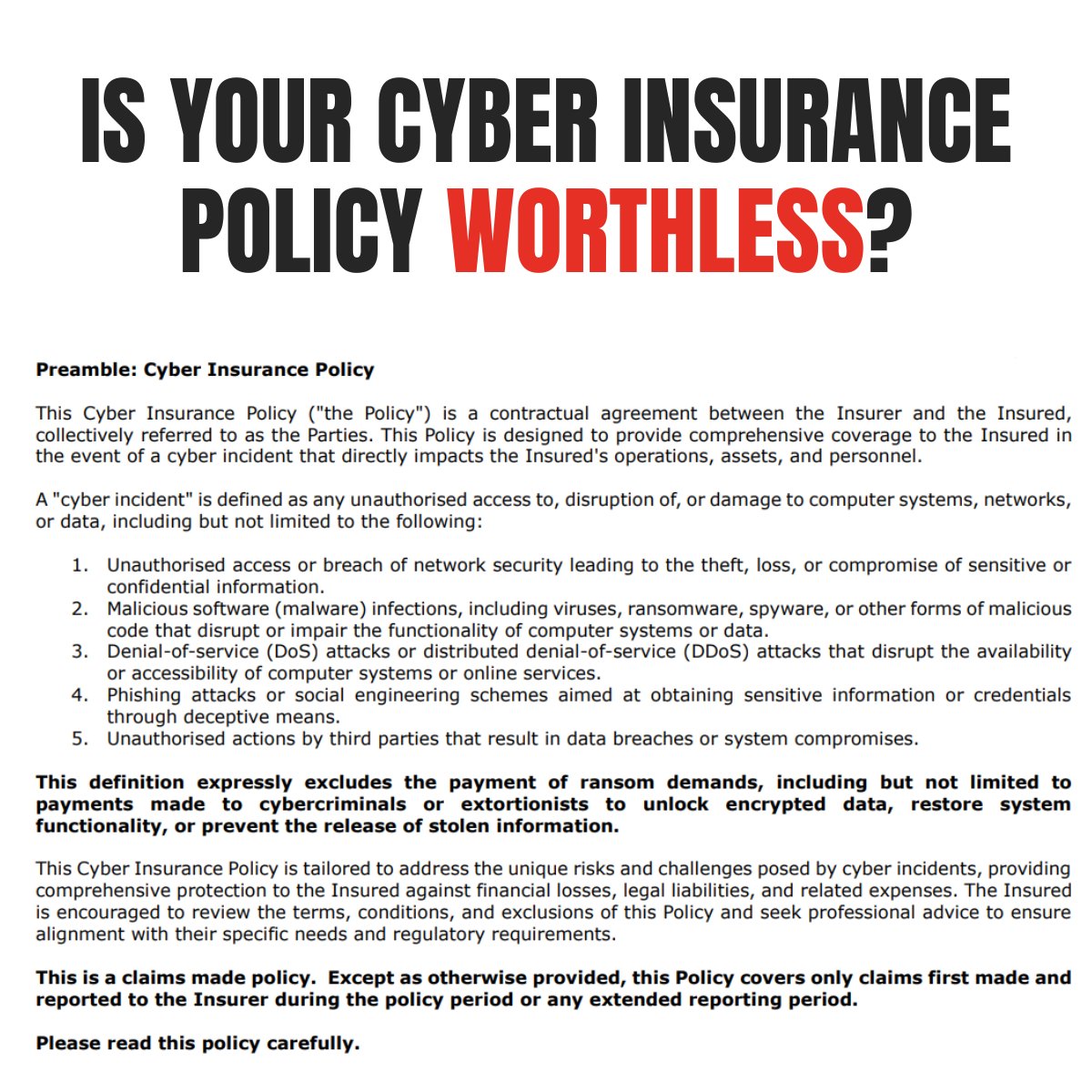
Read the fine print… your Cyber Insurance Policy could be worthless.
Many small business owners breathe easier once they've purchased cyber insurance.
The assumption is simple: if ransomware strikes, the insurer will pay. But the reality is far more complicated. Increasingl
Read the fine print… your Cyber Insurance Policy could be worthless.
Many small business owners breathe easier once they've purchased cyber insurance.
The assumption is simple: if ransomware strikes, the insurer will pay. But the reality is far more complicated. Increasingl
Your website is online 24/7 for anyone to poke at, and most owners never think about its security. Make sure it uses HTTPS, keep its software and plugins updated (outdated plugins are the top way sites get hacked), and lock down the admin login with MFA and a strong password.
#c
Hit with ransomware and your files are locked. Do you pay? Before paying: it doesn't guarantee you get your files back, and in some cases it can break the law. Start with your backups instead. If you can restore yourself, you may not need to pay. Plan this before it happens.
#cy
Don't let your router or firewall get old. These devices have a shelf life, and once they stop getting security updates, your hacking risk goes up. Ask your IT for a list of your network gear and whether each piece is still supported. Anything past end of life needs replacing.
#
The face on your video call might not be real. Deepfakes can now fake a familiar face and voice live, and people have been talked into wiring out fortunes. If someone on a call pushes you to move money fast, verify another way first. Call them back on a number you already have.
You're probably holding way more customer data than you need: old card numbers, files from clients who left years ago. If you don't need it, it's just data for a hacker to steal. Delete what you've no reason to keep, old payment details first. You can't lose what you don't have.
Attackers don't always need your password. They click 'forgot password' and reset it through your recovery email or security questions, and those answers are often on your social media. Lock down your recovery email with MFA, and make up fake answers to security questions.
#cybe
From August 2nd 2026, the EU requires AI-generated content to be labeled, and it can apply even outside Europe if you have EU customers. If you use AI for images, video, or text the public sees, you might need to flag it. Worth a quick chat with whoever ha
https://t.co/FkvpK6U4v7
Found a USB stick in the parking lot? Don't plug it in to see what's on it. A dodgy USB drive can install malware the second it's connected, or even act like a keyboard and type commands itself. If you didn't buy it, it goes in the bin, not into your laptop.
#cybersecurity#USB
The phone in your pocket holds the same company email and files as your laptop, but rarely gets the same care. Put a screen lock on it, leave automatic updates on, only install apps from the official store, and set up a way to wipe it remotely if it's ever lost or stolen.
#cyber
The old advice to spot a scam by its bad spelling is dead. AI now pumps out scam texts and fake websites that look perfect, right down to the logo. Judge a message by what it asks you to do. If it's rushing you to click, log in, or move money, stop. Go to
https://t.co/LBgz9QvpoB
If your team has a different password for every app, single sign-on is simpler, and you may already own it in Microsoft 365 or Google Workspace. One login opens everything. When someone leaves, switch off that one account and they lose all access. Fewer passwords to leak.
#cyber
That handy browser extension, the ad blocker or coupon finder, can read everything you type, including passwords. Some get sold to new owners who push out a malicious update. Check chrome://extensions, delete what you don't use, and have IT approve new ones first.
#cybersecurity
Read the fine print… your Cyber Insurance Policy could be worthless.
Many small business owners breathe easier once they've purchased cyber insurance.
The assumption is simple: if ransomware strikes, the insurer will pay. But the reality is far more complicated. Increasingl
Microsoft's June updates fixed 200 security holes, some already being used by attackers. Most businesses don't install updates for weeks, and that delay is exactly when attackers strike. Set computers to update on their own, and don't forget the spare lapt
https://t.co/D8VEpQzcoW
Microsoft 365 and Google Workspace ship with security settings switched off, and most businesses never turn them on. Ask your IT to confirm four things: legacy auth is blocked, audit logging is on, external sharing is controlled, and MFA is on for everyone, not just admins.
#cyb
Once-a-year security training does almost nothing. People forget it in weeks. A 5-minute reminder once a month sticks far better, especially when it uses real scams like fake 'paste this' prompts. And make it safe to report a click with no blame, so you catch attacks early.
#cyb
Two Scattered Spider hackers just pleaded guilty in the UK. They're teenagers who broke into major companies by calling IT help desks and talking their way in. No elite hacking. The same trick works on a 30-person firm. Train your team to verify anyone bef
https://t.co/FsHmNQPdZZ
On open wifi at a hotel or cafe, someone on the same network can capture what your team sends, or set up a fake hotspot. Use a VPN on any device on public wifi, or better, use your phone's hotspot for anything sensitive. And turn off 'auto-connect to open networks.
#cybersecurit