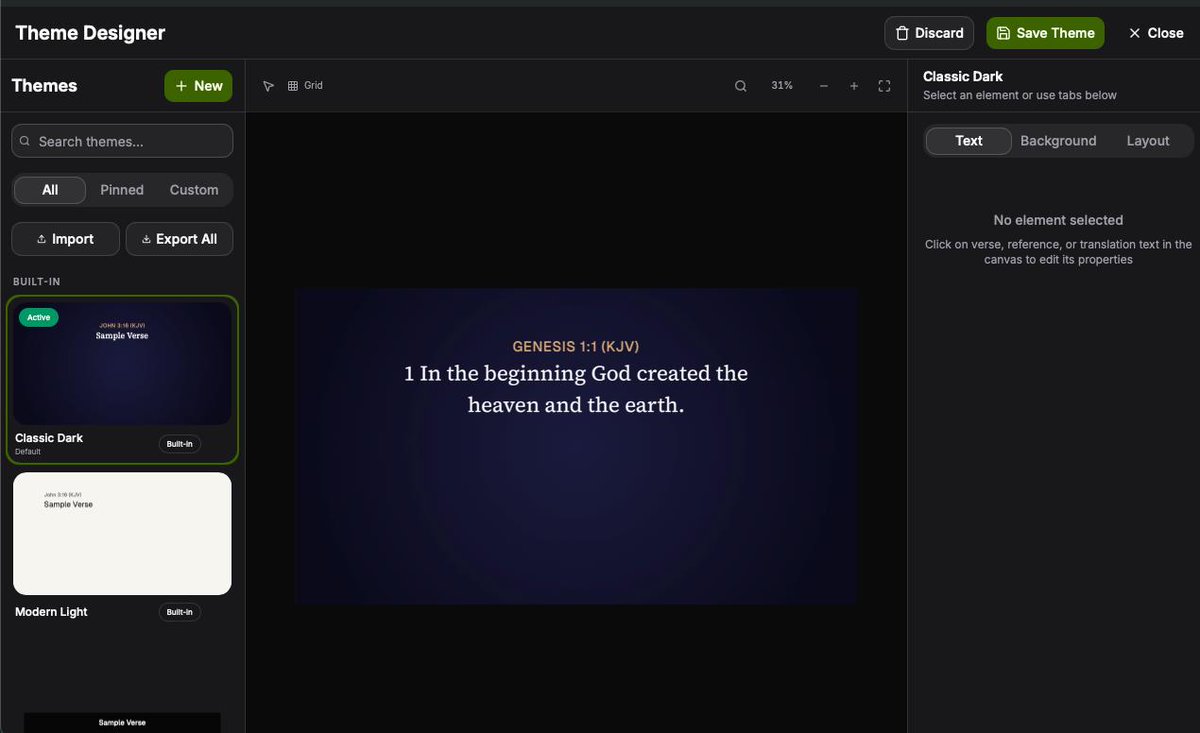
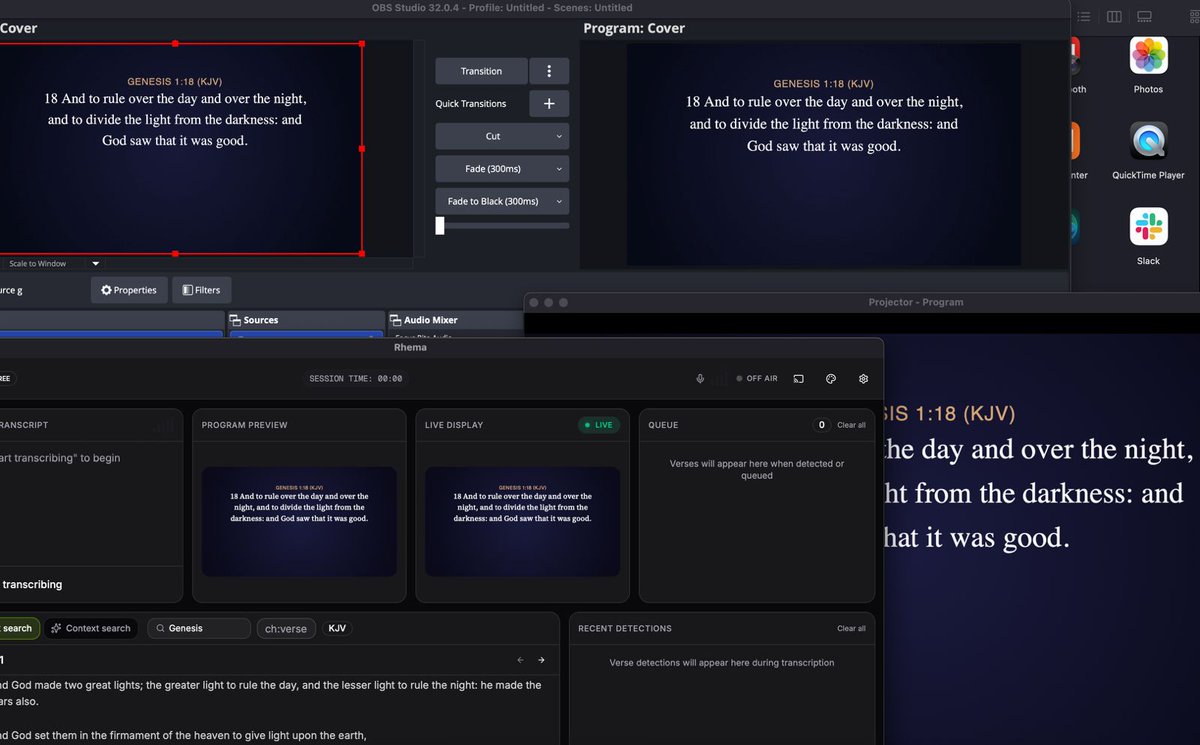
Hi guys, I built an open-source alternative to @pewbeam_ai in one week.
https://t.co/WwyVRtv8H3
Started coding during a Sunday church service. By the following Sunday, we were using it live during our church service. Wild.
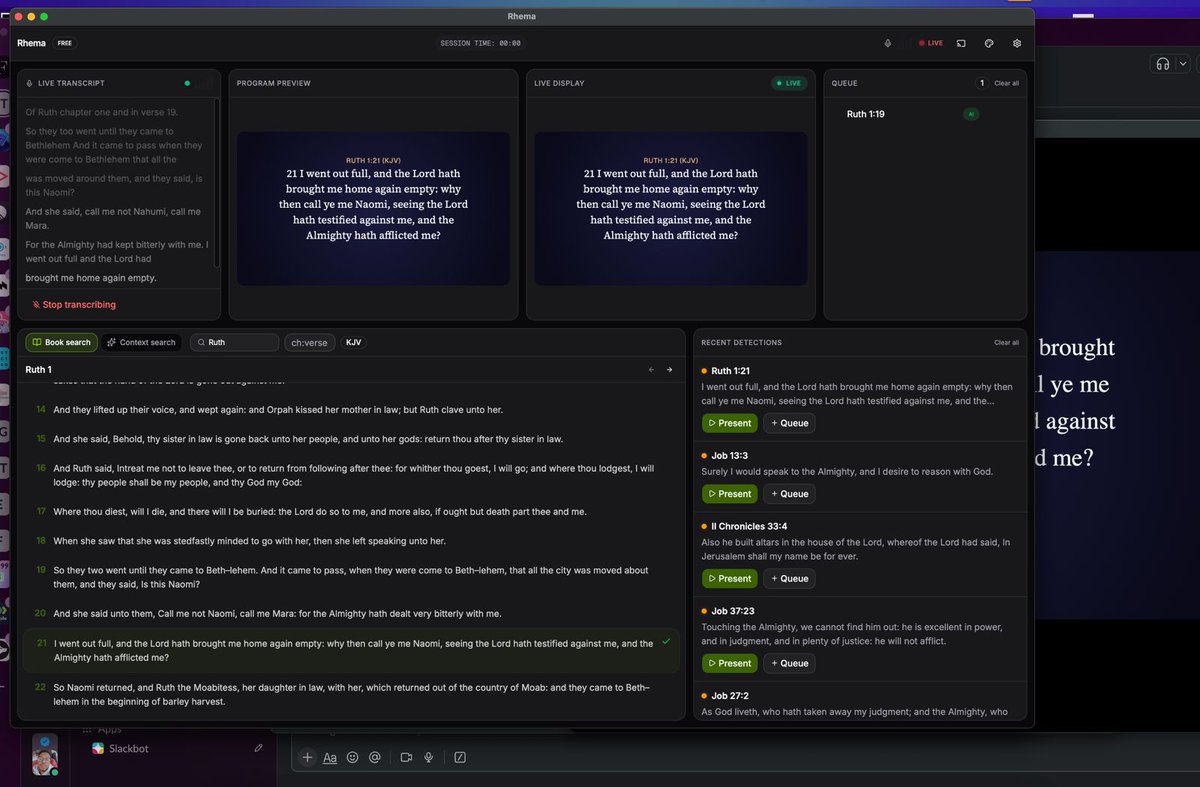
Here's what Rhema does: it listens to your pastor's sermon in real-time, detects Bible verse references as they're mentioned, and displays them on screen instantly. No manual clicking, no dedicated slide operator needed.
The tech stack:
- Tauri 2.0 with a Rust backend handling all the heavy lifting: audio capture, transcription pipeline, verse detection logic, and system tray integration
- Local AI embeddings using Qwen3-0.6B so everything runs on-device with zero cloud dependency. Your sermons never leave your machine
- Real-time audio transcription paired with semantic search against a full Bible verse database
The Rust backend was a deliberate choice. We needed low latency audio processing and efficient memory usage for running an embedding model locally, and Rust delivers on both.
Is it perfect? Probably not. But the core functionality works and we're already using it in a real church environment
This is where you come in. Rhema is fully open source and we need contributors to help take it to the next level. Whether it's improving the verse detection accuracy, adding multi-language support, building a better overlay UI, adding support for more Bible translations, or optimizing the transcription pipeline, there's real work to be done and real impact to be made.
If you're a Rust developer, a frontend engineer, an ML enthusiast, or just someone who loves building tools for the church, come build with us.
Star the repo. Fork it. Open a PR. Let's make this the go-to open-source solution for live Bible verse display in churches worldwide.
https://t.co/WwyVRtv8H3
National Grid: Explaining the complexities and challenges
By Michael Chibuzo
In recent times in Nigeria, the term ‘national grid’ has become part of our popular lexicons. It is common to hear a lot of people say, or even media organisations report that the “national grid has collapsed”. What immediately then comes to the mind of most people is that there is a national blackout.
When this happens, “expert advices” from both the informed and uninformed would start flying around. Opposition politicians also try to cash in by bashing the government in power and indirectly saying that the situation would have been different if they were the ones in power instead.
After going through the commentary of people including those who ordinarily should be better informed on issues pertaining to the national grid and its collapses, I have found out that majority are really ignorant about what the national grid is all about in the first place, not to talk of its operation.
Most people erroneously see the national grid in Nigeria simply as the TCN network of the power sector. As a result of this misconception, I will attempt to explain what a national grid is, x-raying the complexities and challenges especially with Nigeria in focus.
What is an electric power grid?
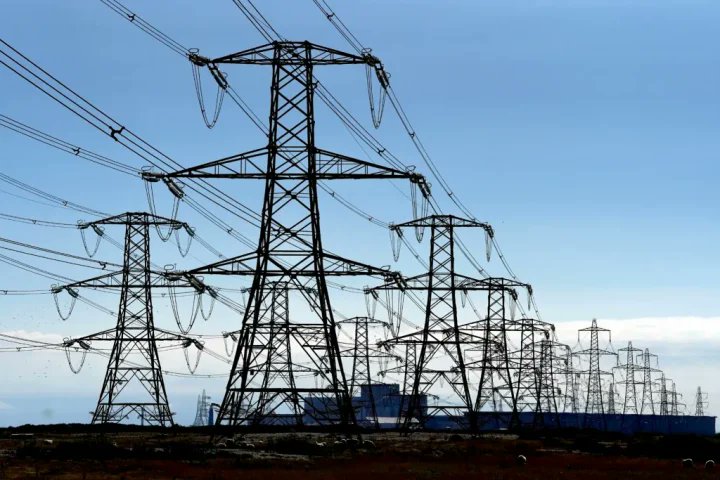
In a simple language, an electric power grid is an interconnected network for electricity delivery from producers of the electricity (power generation plants) to the consumers of the electricity. In other words, a grid consists of power plants, transformers that step up voltage of electricity produced by the power plants for efficient transmission through transmission lines (high tension lines), electricity substations with transformers that step down voltage of electricity from the transmission lines, distribution substations that further step down voltage of the electricity before supplying to consumers.
So, in essence, the power grid is a network of power plants, transmission lines and distribution lines. It becomes a NATIONAL GRID if the network extends throughout a nation. If the network is restricted to a region, it is called regional grid. In Nigeria, we have the national grid because there is only one interconnection network that transfers electricity generated from different power stations to electricity consumers passing through the transmission and the distribution networks.
Why do we have a national grid in the first place?
To understand why an electricity grid is necessary, we would need to start by understanding how electricity is produced in the first place and also how it is transmitted from the point of generation to the electricity consumers.
Electricity is produced mostly through the use of a a turbine generator set, which converts mechanical energy to electrical energy. The turbine and the generator are two different devices, which carry out two different functions. The generator however needs the services of the turbine to produce electricity.
A turbine is a rotor shaft with special blades attached to to it and is used to transform the energy of moving water, steam, combustion gases or wind into mechanical energy. The force of the fluid on the blades spins or rotates the rotor shaft of a generator. The generator, in turn, converts the mechanical (kinetic) energy of the rotor to electrical energy (electricity) at relatively low voltage (i.e. tension) of 11.5kV to 16kV.
So, in the gas power plants or the hydropower plants, the work of the gas or water respectively, is simply to force the blades of the turbine to rotate, which then turns the shaft of the generator – the electromagnetic device that generates electricity.
A Thread...👇
1/6
In this kairos season, let's come together as Zionites to travail over Arepo. We trust the Lord to get equipped and activate mighty wonders in the land.
Isaiah 66:8 - "...for as soon as Zion travailed, she brought forth her children."
#GlHarvesters#STeM#MissionZion#Groans