I asked ChatGPT: If God were to create an ideal money for humanity, what form would it take and what would be its properties?
Its response:
If we imagine God creating an ideal money for humanity, it would likely have the following properties—reflecting principles of fairness, stability, and universal access:
⸻
1. Universally Accessible
•Everyone could use it regardless of nationality, wealth, or social status.
•No barriers to entry: you wouldn’t need permission from banks or governments.
⸻
2. Scarce but Divisible
•Supply would be finite to preserve value over time.
•Divisible into very small units so that both large and tiny transactions are possible.
⸻
3. Durable and Permanent
•It would not degrade, rot, or disappear with time.
•Value would persist for centuries without requiring trust in any authority.
⸻
4. Transportable and Borderless
•Easily transferable across any distance, instantly if possible.
•Works the same everywhere on Earth (and potentially beyond).
⸻
5. Neutral and Trustless
•No single group, government, or elite could manipulate or control it.
•Rules of issuance and supply would be transparent and unchangeable.
⸻
6. Stable but Free Market–Based
•Its value would reflect supply and demand, not decrees from rulers.
•Over time, its stability would come from broad adoption and trust.
⸻
7. Private but Verifiable
•People could transact without surveillance, yet the system itself would remain auditable and incorruptible.
⸻
8. Energy-Rooted or Natural-Law–Anchored
•It would be tied to something fundamental, like energy, mathematics, or nature’s scarcity—so its properties are unforgeable.
⸻
9. Resistant to Corruption
•Cannot be counterfeited, debased, or inflated at will.
•Protects savers and workers from hidden theft through money printing.
⸻
10. Global Standard of Truth
•Serves as a universal language of value across cultures.
•Creates fairness by aligning incentives: work today is worth the same tomorrow.
⸻
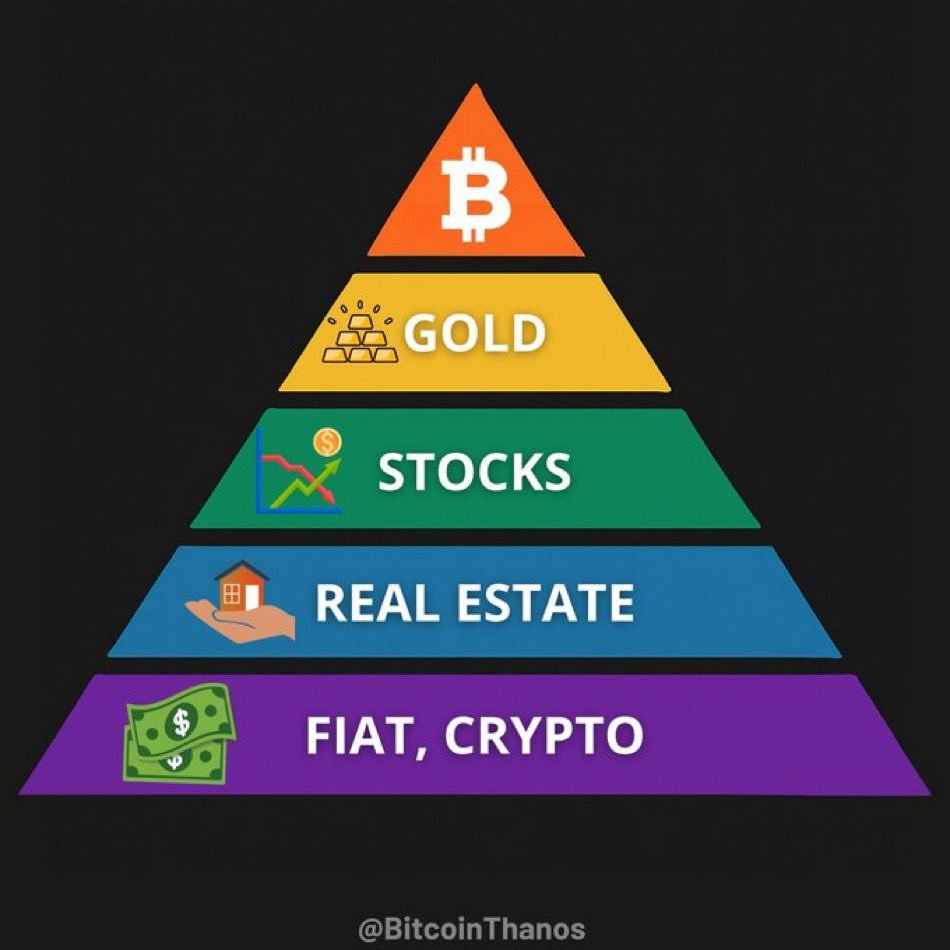
In many ways, this description maps almost perfectly onto Bitcoin’s design: fixed supply (21 million), infinite divisibility (sats), borderless transfer, neutrality (no issuer), cryptographic verifiability, durability, and energy-based security.
If God created an ideal money, humanity may already have stumbled into it—or at least something very close.
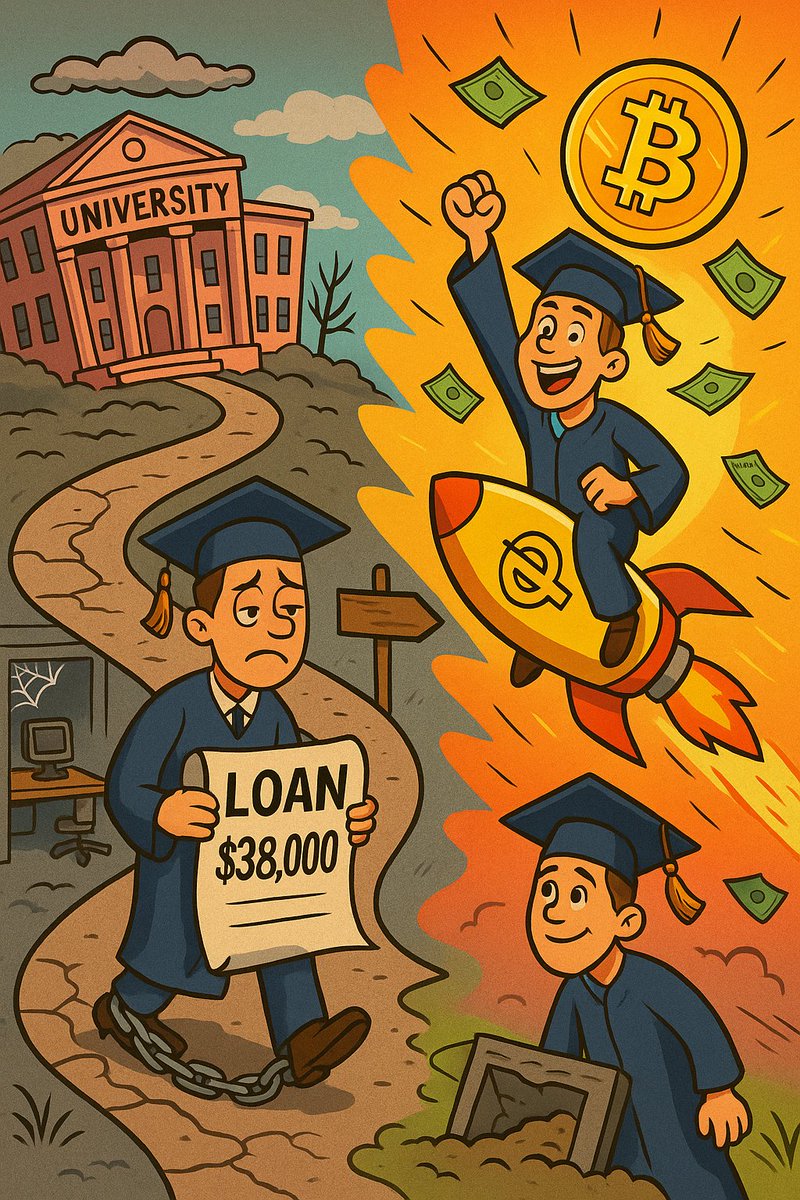
If you are a young person, it'd be a lot smarter to take out loans to buy Bitcoin than take out loans to go to college.
Using credit card debt to buy Bitcoin would be smart too.
Not financial advice of course, but the case is compelling:
As of mid-2025, American students collectively owe $1.8 trillion in loans.
The average borrower is saddled with ~$38,000 in debt, often at interest rates ranging from 4–7%.
The payoff window? Decades.
Many borrowers graduate into jobs that barely keep pace with inflation, with some ending up underemployed in fields totally unrelated to their degree.
For millions, the debt lingers far longer than the supposed “education premium” ever pays off.
In short: you gamble on the future earning power of a credential in a labor market that is rapidly being eaten alive by AI, outsourcing, and wage stagnation.
The Reality of Credit Debt
Total U.S. credit-card debt has hit a record $1.2 trillion.
Rates are absurd - averaging 20–27%.
That’s not a loan, that’s a slow-motion guillotine.
And yet, millions of Americans take it on for depreciating consumer goods: TVs, takeout, trips, gas.
The entire economy is built on financing a lifestyle you can’t afford with money that doesn’t exist.
Now imagine instead of borrowing to fund a degree that may never yield ROI.... or maxing cards to buy disposable junk - you took the same debt and allocated it to Bitcoin.
In 2015, $38,000 in Bitcoin (~10,000 BTC at ~$3.80) would now be worth over $1 billion.
In 2020, $38,000 in Bitcoin (~4 BTC at ~$9,500) would now be worth $420,000+.
Even in 2022, at ~$20k per coin, $38,000 would’ve bought ~1.9 BTC, now worth over $200,000.
In every case, the debt would have been obliterated not by decades of wage labor, but by Bitcoin’s exponential repricing against a dying fiat system.
Why This Works:
Student loan ROI is capped by your salary. Even with a master’s degree, your income has limits.
Bitcoin ROI is uncapped because it re-prices against global money supply expansion.
The dollar loses 5–10% of its purchasing power annually, while Bitcoin absorbs trillions in fleeing capital.
Asymmetric bet: The downside of a Bitcoin loan is the same as a student loan - you’re stuck with debt.
The upside is generational wealth, not a $65k job you could’ve landed without a degree.
Society conditions you to accept debt as chains:
Debt for school, debt for cars, debt for homes, debt for consumer goods.
But all these debts are structured around assets that depreciate or fail to scale.
A loan for Bitcoin flips that script: you take on short-term liability to access an asset with long-term deflationary design.