Data Is Overrated — Better Models Beat Bigger Datasets.
For years, the AI industry believed that the answer to building better models was simple: collect more data, more text, more images, more videos, infact more everything. But in 2026, that idea is starting to break down. The next leap in AI isn't coming from bigger datasets, instead it's coming from better models and smarter training.
Look at what's happening across the industry today. Leading AI labs are putting just as much effort into improving model architectures, reasoning, training methods, and synthetic data generation as they are into collecting new data. The reason is simple: the internet isn't an infinite source of high-quality information, and researchers are seeing diminishing returns from simply throwing more data at models.
We're also seeing smaller, more efficient models outperform much larger ones on specific tasks because they're better designed and trained. Instead of relying on massive datasets, they're learning from higher-quality data, better reinforcement learning techniques, and more efficient architectures. In many cases, smarter training is proving more valuable than simply adding billions of extra tokens.
This doesn't mean data no longer matters. It absolutely does. But quality is becoming more important than quantity. A well-curated dataset combined with a strong model will often outperform a weaker model trained on significantly more data. That's why synthetic data, data curation, and efficient training have become some of the hottest areas of AI research in 2026.
The AI race is no longer just about who has the most data. It's about who can learn the most from the data they already have. And that may end up being even more important than scaling datasets ever was.
EngineAI(@engineairobot) has showcased its T800 humanoid robot performing explosive kicks and martial arts movements with remarkable speed, balance, and precision.
The demonstration highlights the robot's advanced motion control, coordination, and stability, allowing it to execute dynamic movements that require accurate timing and full-body control.
As humanoid robotics continues to advance, demonstrations like this show how improvements in AI, locomotion, and control systems are enabling robots to perform increasingly complex physical tasks.
Mouser Electronics (@MouserElec) has launched a new edition of its Rise of the Robots educational program, exploring the technologies driving the next generation of humanoid robots.
According to Mouser's technical content director Raymond Yin, the program focuses on key areas such as humanoid robot design, AI-powered sensing, motion control, embedded computing, and real-world engineering challenges involved in building intelligent robots.
It also features expert discussions, technical articles, videos, and educational resources designed to help engineers better understand how AI and robotics are transforming industries including manufacturing, healthcare, education, and automation.
Mistral AI (@MistralAI) has introduced Robostral Navigate, a new AI navigation model that enables robots to move through complex environments using just a single camera and simple natural-language instructions.
The model was trained entirely in simulation, eliminating the need for real-world data collection during development. According to Mistral AI, it outperforms previous single-camera navigation approaches while using significantly fewer computational resources.
By removing the need for expensive LiDAR and depth sensors, Robostral Navigate could lower deployment costs for robots in manufacturing, logistics, warehousing, and delivery. The hardware-agnostic model is designed to work across different robot types, from wheeled mobile robots to legged and humanoid platforms, making robotics deployment more accessible and scalable.
Mistral AI (@MistralAI) has entered the robotics race with a breakthrough that could make autonomous robots significantly cheaper and easier to deploy.
The company has unveiled Robostral Navigate, its first robotics foundation model, capable of guiding robots through complex environments using nothing more than a single camera and plain-language instructions. By removing the need for expensive sensors like LiDAR and depth cameras while still achieving state-of-the-art performance, the model challenges one of the biggest assumptions in autonomous robotics.
How can a robot navigate unfamiliar spaces with just one camera? Why did Mistral train the model entirely in simulation? And what could this mean for warehouses, hospitals, factories, delivery robots, and the future of embodied AI?
This article explores how Robostral Navigate works, why its hardware-light approach is attracting attention, and how it could reshape the economics of robotics by replacing costly sensor stacks with smarter AI.
Read the full article to discover why Mistral AI's latest breakthrough could mark a major turning point in the future of autonomous robots.
https://t.co/jtcqIL3eUE
French startup UMA Robotics has revealed its first bipedal humanoid robot prototype just nine months after the company was founded, highlighting how quickly new players are entering the humanoid robotics race.
One of the robot's most distinctive features is its curved digital face, which doubles as an interactive display and could enable more natural communication between humans and robots.
The prototype also demonstrates an impressive high-degree-of-freedom neck, allowing smooth and expressive head movements. As the technology evolves, this could support richer facial expressions and more lifelike human-robot interactions.
The announcement reflects the rapid pace of innovation in humanoid robotics, where startups are increasingly combining mobility, AI, and expressive design to build robots that are not only capable of working alongside people but also communicating with them in more intuitive ways.
Mitsubishi Motors (@Mitsubishi_ES) is making a major move into humanoid robotics through a partnership with Highlanders, a University of Tokyo-affiliated robotics startup.
The collaboration will transform unused space at Mitsubishi's Kyoto engine plant into a humanoid robot production facility, with manufacturing supported by Mitsubishi's existing automotive supply chain.
Mass production is expected to begin in 2027, with an initial goal of producing 1,000 humanoid robots per month.
The first robots will be deployed inside Mitsubishi's own factories, where they will assist with tasks such as parts handling and engine assembly. Beyond automation, the robots will continuously collect real-world operational data to help train next-generation Physical AI foundation models, improving their capabilities over time.
The announcement signals Japan's growing momentum in humanoid robotics, with companies like Highlanders joining a new wave of startups aiming to build intelligent robots for industrial applications.
Robotics doesn't have to be as complicated as it seems, but most beginners are learning it the wrong way.
Many aspiring robotics engineers jump between random tutorials, YouTube videos, and online courses without understanding how the different pieces fit together. The result is often confusion, frustration, and giving up before building anything meaningful.
This article breaks robotics down into three core engineering fields and explains how they work together to create intelligent machines. It also highlights a practical learning path, from building a strong foundation in hardware, electronics, and programming to applying those skills through real open-source robotics projects.
What are the essential skills every robotics engineer should learn? Where can beginners find a structured roadmap instead of scattered resources? And why is building real robots the fastest way to grow?
Read the full article to discover a clear, practical roadmap for learning robotics, and how to go from complete beginner to confidently building your own robots.
https://t.co/844wdXx898
This article was done in collaboration with @tnkrdotai and @Em_Nomadic
What are the essential skills every robotics engineer should learn? Where can beginners find a structured roadmap instead of scattered resources? And why is building real robots the fastest way to grow?
Read the full article to discover a clear, practical roadmap for learning robotics and how to go from complete beginner to confidently building your own robots.
https://t.co/844wdXx898
1X Introduces NEO's 25-DoF Tendon-Driven Hands
Humanoid robotics company @1X_tech has unveiled NEO's new 25-degree-of-freedom tendon-driven hands, bringing the robot closer to human-level dexterity, strength, speed, and reliability.
The hands are designed to perform complex manipulation tasks with greater precision, enabling NEO to grasp, rotate, and handle everyday objects in ways that have long challenged robots.
For decades, most industrial robots avoided tasks that required highly dexterous hands by relying on specialized tools or simplified grippers. Humanoid robots take the opposite approach, aiming to replicate the versatility of the human hand so they can operate in environments already built for people.
The announcement marks another milestone in humanoid robotics, where advances in robotic hands are increasingly seen as one of the biggest keys to unlocking practical, general-purpose robots capable of working safely and effectively alongside humans.
1X (@1x_tech) has just unveiled what could be one of the most important breakthroughs in humanoid robotics this year, and it’s not about walking.
The company’s new robotic hands for the NEO humanoid are designed to match or even surpass human-level dexterity, strength, and reliability, enabling tasks that have long been extremely difficult for robots. From picking up coins and plugging in USB-C cables to using tools, sorting objects, and pouring tea, NEO is moving closer to becoming a truly general-purpose robot.
But the bigger story is what happens behind the scenes. These hands don’t just grip objects, they feel them. Rich tactile sensing, force control, and tendon-driven actuation allow the robot to adapt its grip in real time while generating valuable training data that continuously improves its embodied AI models.
Why is robotic manipulation considered one of the hardest problems in robotics? How do these new hands work? And could this be the breakthrough that finally makes humanoid robots useful in homes, workplaces, and everyday life?
Read the full article to explore 1X’s new robotic hands, the technology behind them, and why many researchers believe the future of humanoid robots will be defined by what they can do with their fingers.
https://t.co/CXMhmRelON
Booster Robotics (@boosterobotics) has officially launched the Booster T2, its new flagship humanoid robot development platform built for AI and robotics researchers.
The bipedal humanoid delivers up to 2,070 TFLOPS of AI computing power, making it one of the most powerful humanoid development platforms in its class. Combined with its high-degree-of-freedom body, the robot is designed to support advanced perception, reasoning, motion planning, and precise manipulation.
Booster T2 is built to handle complex real-world tasks, offering fast real-time perception, agile movement, rapid decision-making, and reliable execution. It also integrates with Booster Studio, the company's software platform, providing developers with tools to build, train, test, and deploy embodied AI applications.
With the launch of Booster T2, Booster Robotics is expanding the growing ecosystem of humanoid robot platforms designed to accelerate research and the development of next-generation Physical AI systems.
The race to build smarter humanoid robots is accelerating and Booster Robotics (@boosterobotics) has just introduced a powerful new platform built to help shape the next generation of Physical AI.
The company has unveiled the Booster T2, a high-performance humanoid robot designed for AI researchers, robotics developers, and universities. Equipped with NVIDIA's Thor computing platform, advanced perception systems, agile mobility, and precision manipulation, the robot is built to develop and test the AI models that will power future intelligent machines.
But the hardware is only part of the story. Booster Robotics is also launching Booster Studio, an open software platform that allows developers to build, simulate, train, and deploy robotics applications more efficiently, helping bridge the gap between research and real-world deployment.
What makes the Booster T2 different from other humanoid development platforms? Why are companies increasingly building robots for researchers instead of end users? And how could platforms like this accelerate the future of embodied AI?
Read the full article to discover how Booster Robotics is helping researchers build the next generation of intelligent humanoid robots and why development platforms are becoming one of the most important drivers of innovation in robotics.
https://t.co/MiI7Pix7S5
Robotics Starts Here is live.
13 parts. Complete beginner's guide. No gatekeeping, no prerequisites, just clarity on what robotics actually takes and where to start building.
From understanding the stack to your first robot at https://t.co/hkMJIL9jLt
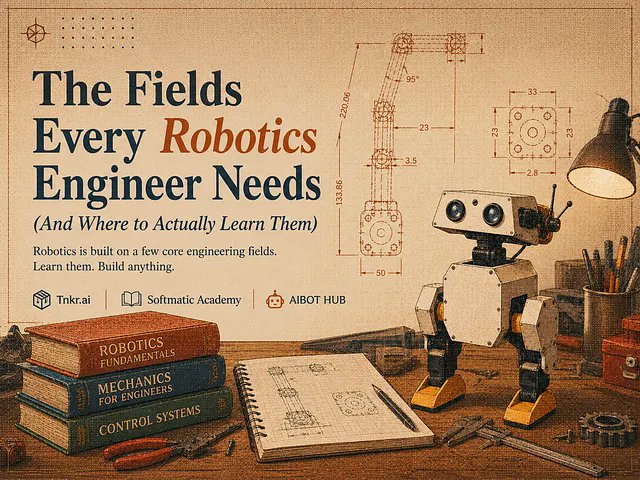
The Fields Every Robotics Engineer Needs (And Where to Actually Learn Them).
You don’t need to know everything to start building. You need three fields: mechanical, electronics, software, and to know which one comes first.
A collaboration between @tnkrdotai Softmatic Academy, and @theaibothub @peterokiokpa
Why Robots Need Bodies
There’s a growing belief in AI that real intelligence can’t be learned from text alone. It needs a body.
The idea is called embodiment. A system that only reads about the world understands it very differently from one that acts in it, bumps into things, and feels consequences.
You can read every book about riding a bike and still fall off. Some knowledge only comes from having a body in the world.
This is why so many researchers think the path to deeper AI runs through robotics. Not just bigger models, but models that live in physical reality.
Intelligence might not be something you can fully download. It might be something you have to earn through experience.
Introducing NEO’s 25 Degrees of Freedom, tendon-driven hands — nearing or surpassing human-level dexterity, strength, speed, and reliability.
For seventy years, robotics worked around the hand problem. The humanoid bet is the reverse: it lives or dies at the fingertips.