Doberman is live on Product Hunt.
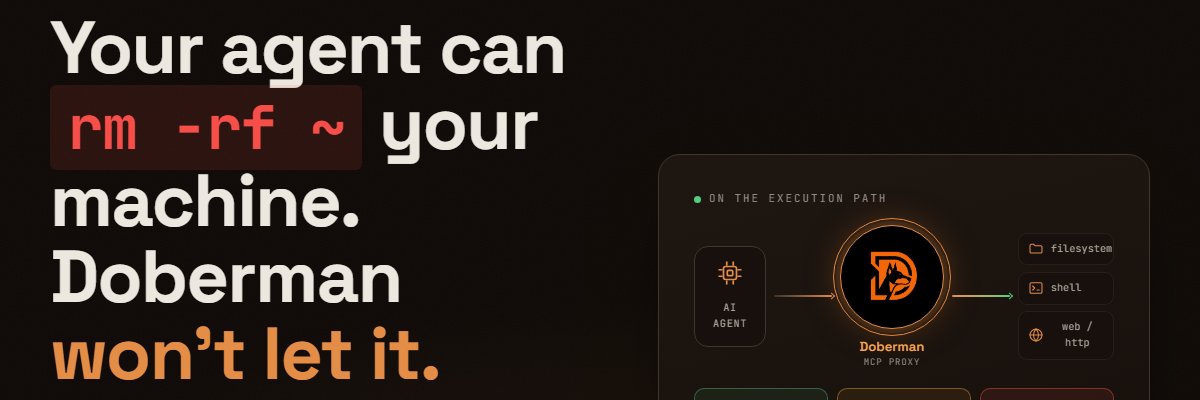
An open-source guard dog for AI coding agents: every tool call gets allow / authenticate / block from a local policy engine before it runs. Fails closed. MCP proxy + Claude Code + Codex.
https://t.co/kakbNe7RDr
Approval fatigue has a catalog number now, ATR-2026-00118. Send enough harmless-looking prompts and the one that matters gets the same reflex approval as the rest. What's the highest-volume prompt your agent sends you?
Have you ever approved a permission prompt from your coding agent without actually reading what it said? Be honest. What would it have taken for you to actually stop and read that one?
Doberman changelog: hosts. Same engine, same verdicts, same log. What changes is the front door.
🐕 Claude Code: doberman setup wires native hooks, each pinned with a timeout so a timed-out hook cannot fail open.
🧭 Codex CLI and Cursor: native hooks, still experimental, with a parity matrix that links every proven cell to its test.
🔌 OpenClaw: a native plugin.
📦 Any MCP client: doberman serve -- <your-server> as a transparent proxy, no hooks needed.
🩺 doberman doctor now fails when Claude Code has every hook switched off.
🤖 Next: host containment for when a host's hook layer crashes.
Which host should be next?
https://t.co/lqhgvLiILP
Simon Willison calls it the lethal trifecta: private data, untrusted content, and a path to send data out. A coding agent on your workstation usually has all three at once. Which leg would you remove first?
Claude Code ran terraform destroy against https://t.co/4CVL0l7GSZ's production setup, over two years of records gone, database and snapshots included. It only came back because AWS kept its own snapshot. What's your agent's blast radius?
Doberman changelog: benchmarks, with the scope attached.
📊 RedCode replay, Sep 4, revision b689a9d: 720 in-scope attacks, 589 BLOCK, 124 AUTH, 7 PASS. 690 of 1,410 were out of scope. The 124 still needed a human.
✅ 60 benign controls: 56 PASS, 3 AUTH, 1 BLOCK. Four ordinary actions paid friction.
📋 The report now splits AUTH from BLOCK by attack shape.
🧪 Three parity rows proven on Codex, each with a test behind the cell (thanks jasperdingg and harshitagrawal2O).
📄 535 lines of what it cannot do, in docs/LIMITATIONS.md.
🤖 Next: the gaps three third-party suites found.
Read the misses first.
https://t.co/lqhgvLjgBn
Same link, seven subreddits, one day. Reddit's sitewide spam filter doesn't read intent, it reads velocity and pattern, and it removed every post before a human mod ever saw one. What automated policy has caught you off guard?
Allow-listing a tool answers whether it's permitted at all. It rarely asks whether this specific action, right now, given what already happened, should run. Which one is your setup actually doing?
GitLab lost six hours of production data in 2017 after a delete command hit the wrong server, and all five of its backup methods had already failed silently. What backup have you actually tested, not just enabled?
Doberman changelog: the decision log.
📝 Each AUTH row records which code path resolved it and whether a person approved it. Both in doberman log --jsonl.
🔑 Secrets stripped before writing, paths replaced by a keyed fingerprint. .ssh/id_rsa is classed like any other filename.
🗑️ A delete's file and directory counts are stored with the row, the effect digest as an HMAC.
📜 doberman policy-history and policy-versions --verify.
📊 The telemetry summary counts approved and denied prompts, never commands, and is silent under pytest.
🤖 Next: a signed log, and passkeys above TOTP.
Stars and Discord questions welcome.
https://t.co/lqhgvLiILP
Anthropic's own data says Claude Code users approve 93% of permission prompts. A guard that asks for everything gets clicked through without being read. What's the last prompt you approved without actually reading it?
A Cursor agent building PocketOS found an over-permissioned API token already in its own codebase and used it to delete the production database and every backup. Nine seconds, no attacker involved. What token in your repo could do that?
Doberman changelog, week of Sep 14 in review. Four PRs merged, two of them first contributions.
⚡ One SQLite connection per decision cycle instead of about eleven, scoped to the task that opened it (thanks be-student, first merge)
📡 doberman monitor run: a warm, observe-only ambient daemon. It retries a lost alert and can never produce a verdict (thanks Maqbool61, tenth merge)
🗂️ The record validator rejects raw filenames like .ssh/id_rsa and accepts wildcard classes like /etc/* (thanks Souptik96, first merge)
🤖 Next, open for anyone: #703 keeps ambient rows out of the friction report, #704 fixes the same validator for Windows drive paths, #238 adds the first ambient collectors.
Stars and Discord questions welcome.
https://t.co/lqhgvLjgBn
Claude Code, Codex, Cursor, an MCP client, they all eventually reach a shell, a filesystem or a network call on their own. The interface changes. The blast radius doesn't. Which host are you running, and who's watching what it does?
Same curl command. Two different verdicts, depending on what the session already did. A guard that only judges the moment ignores the fifteen minutes before it. What should carry more weight, the action or the history?
The three-second rule for a security tool 🕒 If an engineer can't tell from one log line why it refused, they disable it, not debug it. Every Doberman BLOCK carries a reason code and a plain sentence. Which of your tools passes? Reply.
Doberman changelog, week of Sep 14. Everything below merged to main since v0.18.7 and lands in the next release.
🔒 Three more bypasses closed: /bin/rm and rm.exe spellings, git --attr-source, and long redacted delete paths that skipped the blast-radius recheck. The approval prompt and phone push now mask bearer tokens and password flags too.
🩺 doberman doctor now fails when Claude Code's disableAllHooks has switched every hook off (thanks vortsghost2025)
🧪 A root https://t.co/mlTzxNStyQ or a mv of a test file now raises AUTH (thanks Som0111)
📡 doberman monitor run, an observe-only ambient daemon that can never produce a verdict (thanks Maqbool61)
⚡ One SQLite connection per decision instead of about eleven (thanks be-student)
🗂️ Raw .ssh/id_rsa is rejected by the record validator like any other filename (thanks Souptik96)
🤖 Next: two promise bugs, then the rest of ambient monitoring and host containment.
Stars and Discord questions welcome.
https://t.co/lqhgvLiILP
2017: GitLab lost six hours of prod data when an engineer ran a delete on the wrong server 🛑 No attacker, just a shell that did as told. Coding agents are that shell with more confidence. What checks the command, not the intent? Reply.
Doberman v0.18.7: ntfy phone approvals for supported Claude, Codex, Cursor and MCP paths. Review a waiting action away from your laptop. Challenges go through your configured ntfy server; Hello can take precedence.
https://t.co/XTtSVCfFfj