𝐖𝐡𝐲 𝐀𝐝𝐚𝐩𝐭𝐚𝐛𝐢𝐥𝐢𝐭𝐲 𝐈𝐬 𝐭𝐡𝐞 𝐑𝐞𝐚𝐥 𝐌𝐞𝐚𝐬𝐮𝐫𝐞 𝐨𝐟 𝐈𝐧𝐭𝐞𝐥𝐥𝐢𝐠𝐞𝐧𝐜𝐞
A robot can perform well when everything goes according to plan.
But what happens when conditions change?
A new environment.
A different object.
An unexpected obstacle.
That’s where adaptability becomes important.
Inside PrismaX, intelligence isn’t just about following instructions.
It’s about responding effectively when situations are different from what was expected.
• Adaptability helps handle uncertainty
• Flexible systems learn faster
• New situations create new learning opportunities
• Intelligent behavior grows through adjustment
• From my teleoperator experience:-
No two sessions are exactly the same.
Sometimes a task requires a different approach.
Sometimes a small adjustment makes all the difference.
Those moments show that learning isn’t about memorizing actions.
It’s about understanding how to respond when things change.
Think about the progression:
Experience → Adaptation → Learning → Confidence → Intelligence
The most valuable systems aren’t the ones that only work in perfect conditions.
They’re the ones that continue performing when conditions become unpredictable.
Inside PrismaX, every new challenge becomes another opportunity to improve.
Because intelligence isn’t measured by how well a system follows a plan.
It’s measured by how well it adapts when the plan changes.
𝐖𝐡𝐲 𝐑𝐞𝐥𝐢𝐚𝐛𝐢𝐥𝐢𝐭𝐲 𝐌𝐚𝐭𝐭𝐞𝐫𝐬 𝐌𝐨𝐫𝐞 𝐓𝐡𝐚𝐧 𝐂𝐚𝐩𝐚𝐛𝐢𝐥𝐢𝐭𝐲
In robotics, capabilities often get the attention.
A robot that moves faster.
A model that processes more data.
A system that can perform more tasks.
But there’s something even more important:
Reliability.
Because a highly capable system isn’t useful if you can’t depend on it consistently.
• Reliability builds trust
• Predictable behavior reduces risk
• Consistent performance improves efficiency
• Dependable systems scale more easily
From my teleoperator experience:-
The goal isn’t just completing a task once.
The real goal is completing it correctly again and again.
A reliable action today is often more valuable than an impressive action that only works occasionally.
Think about how intelligence develops:
Capability → Consistency → Reliability → Trust → Autonomy
This is why teleoperation is so important.
Every correction, adjustment, and repeated success helps create behavior that is not only intelligent but dependable.
Inside PrismaX, the future isn’t just about building robots that can do more.
It’s about building robots that can be trusted to perform when it matters most.
Because in real-world environments, reliability is what turns technology into something people can actually rely on.
𝐖𝐡𝐲 𝐑𝐞𝐥𝐢𝐚𝐛𝐢𝐥𝐢𝐭𝐲 𝐌𝐚𝐭𝐭𝐞𝐫𝐬 𝐌𝐨𝐫𝐞 𝐓𝐡𝐚𝐧 𝐂𝐚𝐩𝐚𝐛𝐢𝐥𝐢𝐭𝐲
In robotics, capabilities often get the attention.
A robot that moves faster.
A model that processes more data.
A system that can perform more tasks.
But there’s something even more important:
Reliability.
Because a highly capable system isn’t useful if you can’t depend on it consistently.
• Reliability builds trust
• Predictable behavior reduces risk
• Consistent performance improves efficiency
• Dependable systems scale more easily
From my teleoperator experience:-
The goal isn’t just completing a task once.
The real goal is completing it correctly again and again.
A reliable action today is often more valuable than an impressive action that only works occasionally.
Think about how intelligence develops:
Capability → Consistency → Reliability → Trust → Autonomy
This is why teleoperation is so important.
Every correction, adjustment, and repeated success helps create behavior that is not only intelligent but dependable.
Inside PrismaX, the future isn’t just about building robots that can do more.
It’s about building robots that can be trusted to perform when it matters most.
Because in real-world environments, reliability is what turns technology into something people can actually rely on.
𝐖𝐡𝐲 𝐒𝐡𝐚𝐫𝐞𝐝 𝐋𝐞𝐚𝐫𝐧𝐢𝐧𝐠 𝐈𝐬 𝐭𝐡𝐞 𝐅𝐮𝐭𝐮𝐫𝐞 𝐨𝐟 𝐑𝐨𝐛𝐨𝐭𝐢𝐜𝐬
One robot learning a task is useful.
But hundreds of robots learning from the same experience?
That’s where things become powerful.
Inside PrismaX, the long-term vision isn’t just smarter robot, it’s shared intelligence across an entire network.
• One lesson can benefit many robots
• Successful behaviors can be replicated faster
• Mistakes don’t need to be repeated everywhere
• Learning scales beyond a single machine
From my teleoperator experience:-
When operating a robot, it may feel like you’re solving one specific problem.
But in reality, every correction, adjustment, and improvement has the potential to contribute to a much larger learning system.
A solution discovered once can help future robots handle similar situations more effectively.
Think about the progression:
Human Action → Robot Learning → Shared Knowledge → Network Intelligence
This is what makes Physical AI exciting.
The goal isn’t just teaching individual robots.
It’s creating systems where knowledge can spread, improve, and compound over time.
𝐖𝐡𝐲 𝐒𝐡𝐚𝐫𝐞𝐝 𝐋𝐞𝐚𝐫𝐧𝐢𝐧𝐠 𝐈𝐬 𝐭𝐡𝐞 𝐅𝐮𝐭𝐮𝐫𝐞 𝐨𝐟 𝐑𝐨𝐛𝐨𝐭𝐢𝐜𝐬
One robot learning a task is useful.
But hundreds of robots learning from the same experience?
That’s where things become powerful.
Inside PrismaX, the long-term vision isn’t just smarter robot, it’s shared intelligence across an entire network.
• One lesson can benefit many robots
• Successful behaviors can be replicated faster
• Mistakes don’t need to be repeated everywhere
• Learning scales beyond a single machine
From my teleoperator experience:-
When operating a robot, it may feel like you’re solving one specific problem.
But in reality, every correction, adjustment, and improvement has the potential to contribute to a much larger learning system.
A solution discovered once can help future robots handle similar situations more effectively.
Think about the progression:
Human Action → Robot Learning → Shared Knowledge → Network Intelligence
This is what makes Physical AI exciting.
The goal isn’t just teaching individual robots.
It’s creating systems where knowledge can spread, improve, and compound over time.
𝐓𝐡𝐞 𝐏𝐨𝐰𝐞𝐫 𝐨𝐟 𝐇𝐮𝐦𝐚𝐧 𝐅𝐞𝐞𝐝𝐛𝐚𝐜𝐤 𝐢𝐧 𝐏𝐡𝐲𝐬𝐢𝐜𝐚𝐥 𝐀𝐈
One thing I’ve realized while exploring PrismaX is that robots don’t improve just because they collect data.
They improve because they receive meaningful human feedback.
Data shows what happened.
Feedback explains what should happen.
That’s a huge difference.
• Human corrections improve decision quality
• Feedback helps identify mistakes faster
• Better feedback creates better learning signals
• Continuous feedback accelerates improvement
From my teleoperator experience:-
Every adjustment may seem small in the moment.
A slight movement correction.
A safer path.
A better timing decision.
But these actions become valuable signals that help shape future robot behavior.
Over time, the process looks like this:
Human Feedback → Better Data → Better Learning → Smarter Decisions
𝐓𝐡𝐞 𝐏𝐨𝐰𝐞𝐫 𝐨𝐟 𝐇𝐮𝐦𝐚𝐧 𝐅𝐞𝐞𝐝𝐛𝐚𝐜𝐤 𝐢𝐧 𝐏𝐡𝐲𝐬𝐢𝐜𝐚𝐥 𝐀𝐈
One thing I’ve realized while exploring PrismaX is that robots don’t improve just because they collect data.
They improve because they receive meaningful human feedback.
Data shows what happened.
Feedback explains what should happen.
That’s a huge difference.
• Human corrections improve decision quality
• Feedback helps identify mistakes faster
• Better feedback creates better learning signals
• Continuous feedback accelerates improvement
From my teleoperator experience:-
Every adjustment may seem small in the moment.
A slight movement correction.
A safer path.
A better timing decision.
But these actions become valuable signals that help shape future robot behavior.
Over time, the process looks like this:
Human Feedback → Better Data → Better Learning → Smarter Decisions
𝐖𝐡𝐲 𝐂𝐨𝐧𝐬𝐢𝐬𝐭𝐞𝐧𝐜𝐲 𝐂𝐫𝐞𝐚𝐭𝐞𝐬 𝐁𝐞𝐭𝐭𝐞𝐫 𝐈𝐧𝐭𝐞𝐥𝐥𝐢𝐠𝐞𝐧𝐜𝐞 𝐓𝐡𝐚𝐧 𝐏𝐞𝐫𝐟𝐞𝐜𝐭𝐢𝐨𝐧
Most people think robots learn from doing things perfectly.
But inside PrismaX, one thing stands out: Consistency matters more than perfection. A perfect action done once teaches little.
But repeated, reliable actions over time create patterns intelligence can actually learn from.
• Consistent inputs reduce confusion
• Repeated actions improve learning quality
• Stable patterns create reliable behavior
• Small improvements compound over time
Perfection sounds ideal.But real-world environments are messy
Conditions change.
Unexpected situations happen.
Humans adapt.
And that’s exactly why consistent decision-making becomes more valuable than flawless execution.
From my teleoperator experience:-
Some days aren’t perfect.
Small corrections happen.
Adjustments are needed.
But over time, I noticed something:
The system improves faster when actions are repeatable and reliable, even if they aren’t perfect every single time.
Inside PrismaX, intelligence grows through:
Consistency → Patterns → Learning → Reliability
Not perfection.
Because systems scale better when behavior is predictable.
𝐖𝐡𝐲 𝐂𝐨𝐧𝐬𝐢𝐬𝐭𝐞𝐧𝐜𝐲 𝐂𝐫𝐞𝐚𝐭𝐞𝐬 𝐁𝐞𝐭𝐭𝐞𝐫 𝐈𝐧𝐭𝐞𝐥𝐥𝐢𝐠𝐞𝐧𝐜𝐞 𝐓𝐡𝐚𝐧 𝐏𝐞𝐫𝐟𝐞𝐜𝐭𝐢𝐨𝐧
Most people think robots learn from doing things perfectly.
But inside PrismaX, one thing stands out: Consistency matters more than perfection. A perfect action done once teaches little.
But repeated, reliable actions over time create patterns intelligence can actually learn from.
• Consistent inputs reduce confusion
• Repeated actions improve learning quality
• Stable patterns create reliable behavior
• Small improvements compound over time
Perfection sounds ideal.But real-world environments are messy
Conditions change.
Unexpected situations happen.
Humans adapt.
And that’s exactly why consistent decision-making becomes more valuable than flawless execution.
From my teleoperator experience:-
Some days aren’t perfect.
Small corrections happen.
Adjustments are needed.
But over time, I noticed something:
The system improves faster when actions are repeatable and reliable, even if they aren’t perfect every single time.
Inside PrismaX, intelligence grows through:
Consistency → Patterns → Learning → Reliability
Not perfection.
Because systems scale better when behavior is predictable.
𝐖𝐡𝐲 𝐒𝐩𝐞𝐞𝐝 𝐀𝐥𝐨𝐧𝐞 𝐃𝐨𝐞𝐬𝐧’𝐭 𝐁𝐮𝐢𝐥𝐝 𝐈𝐧𝐭𝐞𝐥𝐥𝐢𝐠𝐞𝐧𝐭 𝐒𝐲𝐬𝐭𝐞𝐦𝐬
In robotics, speed looks impressive.
Faster movements.
Quicker decisions.
Instant execution.
But inside PrismaX, one thing becomes clear: Speed without accuracy creates mistakes.
Real intelligence isn’t about doing things fast. It’s about doing the right thing consistently.
• Fast actions without context can fail
• Accuracy improves reliability
• Consistent decisions build trust
• Smart systems balance speed + precision
At first, teleoperation may feel slower.
You pause.
Adjust.
Correct mistakes.
But that process matters.
Because every careful decision helps train systems to become more reliable before becoming faster.
𝐖𝐡𝐲 𝐒𝐩𝐞𝐞𝐝 𝐀𝐥𝐨𝐧𝐞 𝐃𝐨𝐞𝐬𝐧’𝐭 𝐁𝐮𝐢𝐥𝐝 𝐈𝐧𝐭𝐞𝐥𝐥𝐢𝐠𝐞𝐧𝐭 𝐒𝐲𝐬𝐭𝐞𝐦𝐬
In robotics, speed looks impressive.
Faster movements.
Quicker decisions.
Instant execution.
But inside PrismaX, one thing becomes clear: Speed without accuracy creates mistakes.
Real intelligence isn’t about doing things fast. It’s about doing the right thing consistently.
• Fast actions without context can fail
• Accuracy improves reliability
• Consistent decisions build trust
• Smart systems balance speed + precision
At first, teleoperation may feel slower.
You pause.
Adjust.
Correct mistakes.
But that process matters.
Because every careful decision helps train systems to become more reliable before becoming faster.
𝐖𝐡𝐲 𝐑𝐞𝐚𝐥-𝐖𝐨𝐫𝐥𝐝 𝐃𝐚𝐭𝐚 𝐁𝐞𝐚𝐭𝐬 𝐒𝐢𝐦𝐮𝐥𝐚𝐭𝐢𝐨𝐧
Simulations are useful.
They help robots practice in controlled environments But real intelligence grows when systems face the messiness of the real world.
Different lighting.
Unexpected obstacles.
Human unpredictability.
Situations no simulation fully captures.
That’s where PrismaX becomes interesting.
• Teleoperation bridges the gap between simulation and reality.
• Real-world data teaches practical behavior
• Human corrections improve decision quality
• Unexpected scenarios build adaptability
• Edge cases make systems stronger over time
• Inside PrismaX, robots don’t just learn from perfect conditions.
They learn from:
• Small mistakes
• Human judgment
• Real environments
• Continuous feedback
𝐖𝐡𝐲 𝐑𝐞𝐚𝐥-𝐖𝐨𝐫𝐥𝐝 𝐃𝐚𝐭𝐚 𝐁𝐞𝐚𝐭𝐬 𝐒𝐢𝐦𝐮𝐥𝐚𝐭𝐢𝐨𝐧
Simulations are useful.
They help robots practice in controlled environments But real intelligence grows when systems face the messiness of the real world.
Different lighting.
Unexpected obstacles.
Human unpredictability.
Situations no simulation fully captures.
That’s where PrismaX becomes interesting.
• Teleoperation bridges the gap between simulation and reality.
• Real-world data teaches practical behavior
• Human corrections improve decision quality
• Unexpected scenarios build adaptability
• Edge cases make systems stronger over time
• Inside PrismaX, robots don’t just learn from perfect conditions.
They learn from:
• Small mistakes
• Human judgment
• Real environments
• Continuous feedback
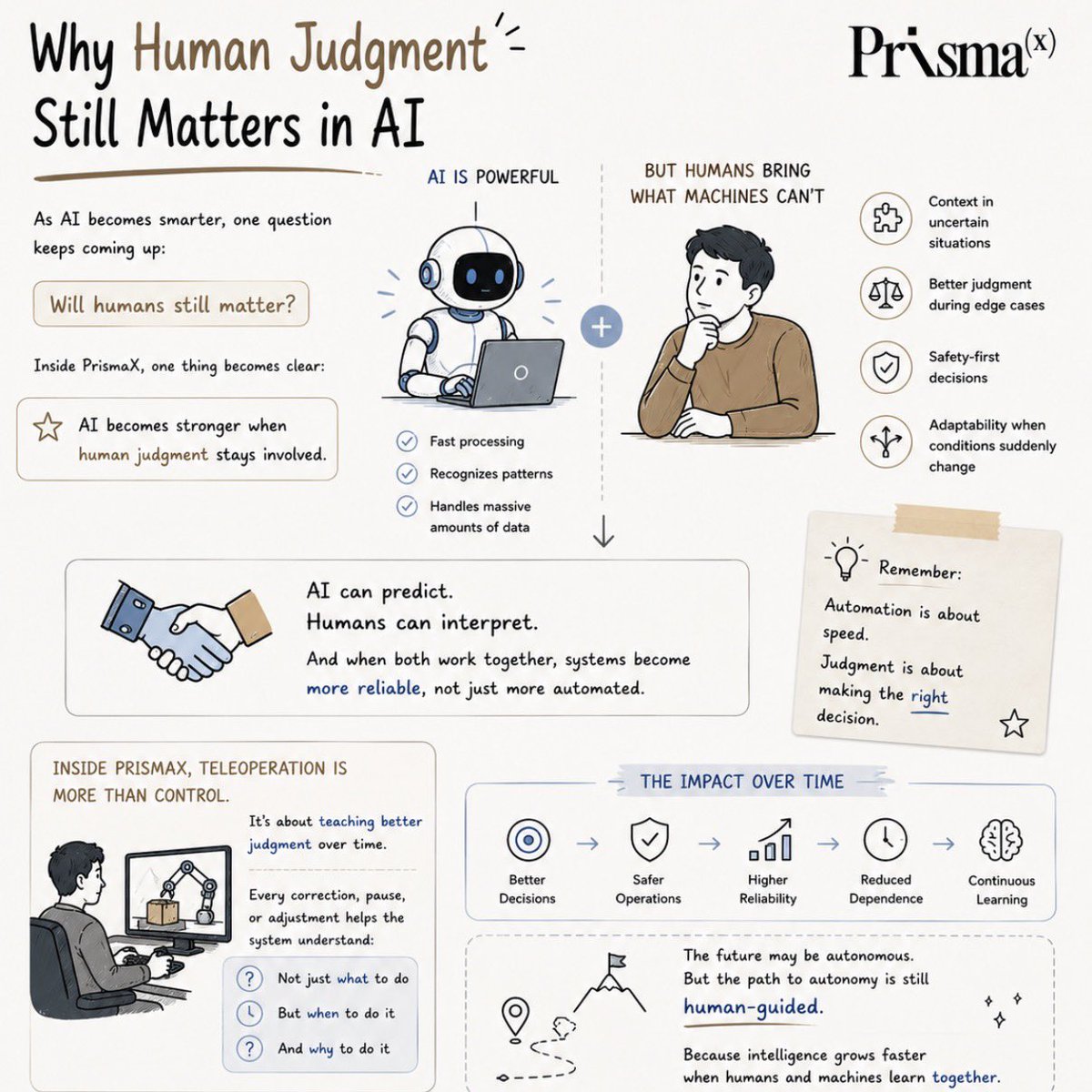
𝐖𝐡𝐲 𝐇𝐮𝐦𝐚𝐧 𝐉𝐮𝐝𝐠𝐦𝐞𝐧𝐭 𝐒𝐭𝐢𝐥𝐥 𝐌𝐚𝐭𝐭𝐞𝐫𝐬 𝐢𝐧 𝐀𝐈
As AI becomes smarter, one question keeps coming up:
Will humans still matter?
Inside PrismaX, one thing becomes clear, AI becomes stronger when human judgment stays involved.
Machines are fast.
They recognize patterns.
They process massive amounts of data.
But humans still bring something different:
• Context in uncertain situations
• Better judgment during edge cases
• Safety-first decisions
• Adaptability when conditions suddenly change
AI can predict.
Humans can interpret.
And when both work together, systems become more reliable, not just more automated.
𝐖𝐡𝐲 𝐇𝐮𝐦𝐚𝐧 𝐉𝐮𝐝𝐠𝐦𝐞𝐧𝐭 𝐒𝐭𝐢𝐥𝐥 𝐌𝐚𝐭𝐭𝐞𝐫𝐬 𝐢𝐧 𝐀𝐈
As AI becomes smarter, one question keeps coming up:
Will humans still matter?
Inside PrismaX, one thing becomes clear, AI becomes stronger when human judgment stays involved.
Machines are fast.
They recognize patterns.
They process massive amounts of data.
But humans still bring something different:
• Context in uncertain situations
• Better judgment during edge cases
• Safety-first decisions
• Adaptability when conditions suddenly change
AI can predict.
Humans can interpret.
And when both work together, systems become more reliable, not just more automated.
𝐖𝐡𝐲 𝐄𝐝𝐠𝐞 𝐂𝐚𝐬𝐞𝐬 𝐌𝐚𝐭𝐭𝐞𝐫 𝐌𝐨𝐫𝐞 𝐓𝐡𝐚𝐧 𝐏𝐞𝐫𝐟𝐞𝐜𝐭 𝐂𝐨𝐧𝐝𝐢𝐭𝐢𝐨𝐧𝐬
Robots perform well in perfect environments.
The real challenge begins when things become unpredictable.
A slightly misplaced object.
Different lighting.
Unexpected movement.
A situation the system hasn’t seen before.
That’s where real intelligence is tested.
Inside PrismaX, teleoperation helps robots learn from these difficult moments not just ideal ones.
• Edge cases improve adaptability
• Unexpected situations build resilience
• Corrections teach better responses
• Rare mistakes become future learning
Perfect scenarios teach repetition.
But imperfect scenarios teach judgment.
Over time, this creates systems that:
• Handle uncertainty better
• Make smarter decisions
• Need fewer interventions
• Perform reliably in real-world environments
The goal isn’t building robots that only work when conditions are perfect.
𝐖𝐡𝐲 𝐄𝐝𝐠𝐞 𝐂𝐚𝐬𝐞𝐬 𝐌𝐚𝐭𝐭𝐞𝐫 𝐌𝐨𝐫𝐞 𝐓𝐡𝐚𝐧 𝐏𝐞𝐫𝐟𝐞𝐜𝐭 𝐂𝐨𝐧𝐝𝐢𝐭𝐢𝐨𝐧𝐬
Robots perform well in perfect environments.
The real challenge begins when things become unpredictable.
A slightly misplaced object.
Different lighting.
Unexpected movement.
A situation the system hasn’t seen before.
That’s where real intelligence is tested.
Inside PrismaX, teleoperation helps robots learn from these difficult moments not just ideal ones.
• Edge cases improve adaptability
• Unexpected situations build resilience
• Corrections teach better responses
• Rare mistakes become future learning
Perfect scenarios teach repetition.
But imperfect scenarios teach judgment.
Over time, this creates systems that:
• Handle uncertainty better
• Make smarter decisions
• Need fewer interventions
• Perform reliably in real-world environments
The goal isn’t building robots that only work when conditions are perfect.
Yesterday’s Trivia Tango at PrismaXai turned out to be a solid challenge.
I finished at 13th place with 9,797 points, and honestly, it pushed my limits in the best way. The quiz, hosted by @vivianrobotics , had some really thoughtful questions around PrismaX and its service layer which definitely not something you could breeze through without focus.
What stood out most was how much quick thinking and fast reactions mattered. Each round demanded sharp attention, and it made the competition feel intense but rewarding.
Big shoutout to everyone who joined in and drop your rankings, I’m curious to see how others performed
Yesterday’s Trivia Tango at PrismaXai turned out to be a solid challenge.
I finished at 13th place with 9,797 points, and honestly, it pushed my limits in the best way. The quiz, hosted by @vivianrobotics , had some really thoughtful questions around PrismaX and its service layer which definitely not something you could breeze through without focus.
What stood out most was how much quick thinking and fast reactions mattered. Each round demanded sharp attention, and it made the competition feel intense but rewarding.
Big shoutout to everyone who joined in and drop your rankings, I’m curious to see how others performed
𝐅𝐫𝐨𝐦 𝐂𝐨𝐧𝐭𝐫𝐨𝐥 𝐭𝐨 𝐓𝐫𝐮𝐬𝐭
In the beginning, teleoperation is all about control.
Every movement is guided, every decision is checked.
But over time inside PrismaX, something subtle shifts:
Control starts turning into trust.
• Repeated correct actions build reliability
• Reliable behavior builds confidence
• Confidence reduces the need for intervention
• Systems begin to operate more independently
At first, you’re involved in everything.
Then, you start stepping back not because you have to,
but because the system has earned that space.
This is where real progress shows up:
• Fewer corrections needed
• Smoother task execution
• More predictable outcomes
• Higher system confidence
Trust isn’t given to machines.
It’s built step by step, action by action.
𝐅𝐫𝐨𝐦 𝐂𝐨𝐧𝐭𝐫𝐨𝐥 𝐭𝐨 𝐓𝐫𝐮𝐬𝐭
In the beginning, teleoperation is all about control.
Every movement is guided, every decision is checked.
But over time inside PrismaX, something subtle shifts:
Control starts turning into trust.
• Repeated correct actions build reliability
• Reliable behavior builds confidence
• Confidence reduces the need for intervention
• Systems begin to operate more independently
At first, you’re involved in everything.
Then, you start stepping back not because you have to,
but because the system has earned that space.
This is where real progress shows up:
• Fewer corrections needed
• Smoother task execution
• More predictable outcomes
• Higher system confidence
Trust isn’t given to machines.
It’s built step by step, action by action.
𝐖𝐡𝐞𝐧 𝐅𝐞𝐞𝐝𝐛𝐚𝐜𝐤 𝐋𝐨𝐨𝐩𝐬 𝐁𝐞𝐜𝐨𝐦𝐞 𝐈𝐧𝐭𝐞𝐥𝐥𝐢𝐠𝐞𝐧𝐜𝐞 𝐋𝐨𝐨𝐩𝐬
Inside PrismaX, everything starts with feedback.
But over time, that feedback doesn’t just fix mistakes it becomes a self-improving loop that continuously upgrades the system.
What begins as human correction evolves into machine understanding.
• Feedback captures what went wrong
• Repetition refines the correct behavior
• Patterns begin to stabilize
• Systems start predicting better actions
• Learning becomes continuous, not reactive
At first, you correct the system.
Then, the system starts correcting itself.
That’s the shift.
From: Human-in-the-loop
To: Learning-in-the-loop
Over time, this creates:
• Faster adaptation
• Reduced dependency on humans
• Smarter decision-making
• More autonomous performance
𝐖𝐡𝐞𝐧 𝐅𝐞𝐞𝐝𝐛𝐚𝐜𝐤 𝐋𝐨𝐨𝐩𝐬 𝐁𝐞𝐜𝐨𝐦𝐞 𝐈𝐧𝐭𝐞𝐥𝐥𝐢𝐠𝐞𝐧𝐜𝐞 𝐋𝐨𝐨𝐩𝐬
Inside PrismaX, everything starts with feedback.
But over time, that feedback doesn’t just fix mistakes it becomes a self-improving loop that continuously upgrades the system.
What begins as human correction evolves into machine understanding.
• Feedback captures what went wrong
• Repetition refines the correct behavior
• Patterns begin to stabilize
• Systems start predicting better actions
• Learning becomes continuous, not reactive
At first, you correct the system.
Then, the system starts correcting itself.
That’s the shift.
From: Human-in-the-loop
To: Learning-in-the-loop
Over time, this creates:
• Faster adaptation
• Reduced dependency on humans
• Smarter decision-making
• More autonomous performance
𝐖𝐡𝐲 𝐒𝐦𝐚𝐥𝐥 𝐈𝐧𝐭𝐞𝐫𝐚𝐜𝐭𝐢𝐨𝐧𝐬 𝐌𝐚𝐭𝐭𝐞𝐫 𝐌𝐨𝐫𝐞 𝐓𝐡𝐚𝐧 𝐁𝐢𝐠 𝐁𝐫𝐞𝐚𝐤𝐭𝐡𝐫𝐨𝐮𝐠𝐡𝐬
Inside PrismaX, progress doesn’t come from one big moment it comes from small, consistent actions repeated over time. What feels like a minor correction today quietly becomes part of a much bigger system learning tomorrow.
• Every small adjustment improves the system
• Repetition turns actions into patterns
• Patterns evolve into reliable intelligence
• Consistency compounds faster than rare breakthroughs
Most days don’t feel extraordinary , you just show up, learn something small, and move forward. But over time, those small efforts create smoother performance, fewer errors, and better decisions.
𝐖𝐡𝐲 𝐒𝐦𝐚𝐥𝐥 𝐈𝐧𝐭𝐞𝐫𝐚𝐜𝐭𝐢𝐨𝐧𝐬 𝐌𝐚𝐭𝐭𝐞𝐫 𝐌𝐨𝐫𝐞 𝐓𝐡𝐚𝐧 𝐁𝐢𝐠 𝐁𝐫𝐞𝐚𝐤𝐭𝐡𝐫𝐨𝐮𝐠𝐡𝐬
Inside PrismaX, progress doesn’t come from one big moment it comes from small, consistent actions repeated over time. What feels like a minor correction today quietly becomes part of a much bigger system learning tomorrow.
• Every small adjustment improves the system
• Repetition turns actions into patterns
• Patterns evolve into reliable intelligence
• Consistency compounds faster than rare breakthroughs
Most days don’t feel extraordinary , you just show up, learn something small, and move forward. But over time, those small efforts create smoother performance, fewer errors, and better decisions.
Gm Prisma fam ☀️
Finally hit my 3rd role — Proactive at @PrismaXai
and this one genuinely feels different.
What stands out the most here is how everything is earned.
No shortcuts, no hype just consistent effort, real contributions, and progress that builds over time.
Showing up every day, figuring things out as you go,
having those random conversations, learning from others…
it all compounds.
Honestly, the people here make the biggest impact.
The support, the small interactions that’s what keeps me going.
Grateful to be part of this journey.
And yeah, still early.
More to learn.
More to contribute.
Just getting started.
Let’s keep building ❤️
@vivianrobotics@shayebackus
Gm Prisma fam ☀️
Finally hit my 3rd role — Proactive at @PrismaXai
and this one genuinely feels different.
What stands out the most here is how everything is earned.
No shortcuts, no hype just consistent effort, real contributions, and progress that builds over time.
Showing up every day, figuring things out as you go,
having those random conversations, learning from others…
it all compounds.
Honestly, the people here make the biggest impact.
The support, the small interactions that’s what keeps me going.
Grateful to be part of this journey.
And yeah, still early.
More to learn.
More to contribute.
Just getting started.
Let’s keep building ❤️
@vivianrobotics@shayebackus
𝐅𝐫𝐨𝐦 𝐈𝐧𝐝𝐢𝐯𝐢𝐝𝐮𝐚𝐥 𝐋𝐞𝐚𝐫𝐧𝐢𝐧𝐠 𝐭𝐨 𝐍𝐞𝐭𝐰𝐨𝐫𝐤 𝐈𝐧𝐭𝐞𝐥𝐥𝐢𝐠𝐞𝐧𝐜𝐞
At the beginning, robots learn from one operator, one task, one correction.
But PrismaX doesn’t stop there. It scales learning across a network.
This is where things become powerful:
Every teleoperator interaction is not isolated.
It becomes part of a shared intelligence layer.
That means:
• One operator’s correction → benefits all robots
• One improved strategy → spreads across the system
• One edge-case solution → prevents future failures globally
From my teleoperator experience:-
At first, it feels like you’re helping your robot. But over time, you realize:
Your decisions don’t stay local.
They propagate.
The system starts behaving better even in tasks you never directly. You’re not training a robot
you’re contributing to a network of intelligence.
This is the shift PrismaX enables:
From → Individual machine learning
To → Collective system intelligence
𝐅𝐫𝐨𝐦 𝐈𝐧𝐝𝐢𝐯𝐢𝐝𝐮𝐚𝐥 𝐋𝐞𝐚𝐫𝐧𝐢𝐧𝐠 𝐭𝐨 𝐍𝐞𝐭𝐰𝐨𝐫𝐤 𝐈𝐧𝐭𝐞𝐥𝐥𝐢𝐠𝐞𝐧𝐜𝐞
At the beginning, robots learn from one operator, one task, one correction.
But PrismaX doesn’t stop there. It scales learning across a network.
This is where things become powerful:
Every teleoperator interaction is not isolated.
It becomes part of a shared intelligence layer.
That means:
• One operator’s correction → benefits all robots
• One improved strategy → spreads across the system
• One edge-case solution → prevents future failures globally
From my teleoperator experience:-
At first, it feels like you’re helping your robot. But over time, you realize:
Your decisions don’t stay local.
They propagate.
The system starts behaving better even in tasks you never directly. You’re not training a robot
you’re contributing to a network of intelligence.
This is the shift PrismaX enables:
From → Individual machine learning
To → Collective system intelligence
𝐓𝐡𝐞 𝐑𝐞𝐚𝐥 𝐌𝐨𝐚𝐭: 𝐃𝐚𝐭𝐚, 𝐍𝐨𝐭 𝐉𝐮𝐬𝐭 𝐓𝐞𝐜𝐡𝐧𝐨𝐥𝐨𝐠𝐲
After everything I’ve seen inside PrismaX, one thing stands out:
The real advantage isn’t just better robot and it’s better data.
Most people think robotics is about:
• Hardware
• Algorithms
• Speed
But in reality, the biggest differentiator is:
Who has the best real-world interaction data
Inside PrismaX, every teleoperation session creates:
• High-quality human decisions
• Edge-case handling data
• Safety-first corrections
• Context-aware actions
This isn’t synthetic.
This isn’t simulated.
It’s real human intelligence captured in real environments.
From my experience:-
At first, it feels like you’re just helping a robot complete tasks.
But over time, you realize:
Every small action you take…
is becoming part of a massive training dataset.
A dataset that:
• Competitors can’t easily replicate
• Improves with every interaction
• Compounds over time
This is the flywheel:
Human Actions → Data → Better Models → Less Intervention → More Scale → More Data
𝐓𝐡𝐞 𝐑𝐞𝐚𝐥 𝐌𝐨𝐚𝐭: 𝐃𝐚𝐭𝐚, 𝐍𝐨𝐭 𝐉𝐮𝐬𝐭 𝐓𝐞𝐜𝐡𝐧𝐨𝐥𝐨𝐠𝐲
After everything I’ve seen inside PrismaX, one thing stands out:
The real advantage isn’t just better robot and it’s better data.
Most people think robotics is about:
• Hardware
• Algorithms
• Speed
But in reality, the biggest differentiator is:
Who has the best real-world interaction data
Inside PrismaX, every teleoperation session creates:
• High-quality human decisions
• Edge-case handling data
• Safety-first corrections
• Context-aware actions
This isn’t synthetic.
This isn’t simulated.
It’s real human intelligence captured in real environments.
From my experience:-
At first, it feels like you’re just helping a robot complete tasks.
But over time, you realize:
Every small action you take…
is becoming part of a massive training dataset.
A dataset that:
• Competitors can’t easily replicate
• Improves with every interaction
• Compounds over time
This is the flywheel:
Human Actions → Data → Better Models → Less Intervention → More Scale → More Data
𝐅𝐫𝐨𝐦 𝐓𝐞𝐥𝐞𝐨𝐩𝐞𝐫𝐚𝐭𝐢𝐨𝐧 𝐭𝐨 𝐀𝐮𝐭𝐨𝐧𝐨𝐦𝐲: 𝐓𝐡𝐞 𝐅𝐮𝐥𝐥 𝐂𝐢𝐫𝐜𝐥𝐞 𝐨𝐟 𝐈𝐧𝐭𝐞𝐥𝐥𝐢𝐠𝐞𝐧𝐜𝐞
At the start of this journey, robots needed humans for almost everything.
Every movement, every correction, every decision will guide up step by step through teleoperation.
But over time, something powerful happens inside PrismaX:
• Control starts turning into autonomy.
It doesn’t happen instantly.
It evolves through layers:
• First → Humans control actions
• Then → Robots learn patterns
• Then → They understand context
• Finally → They act with intent
This is the full learning loop.
From my teleoperator experience:-
In the beginning, I was actively involved in every task.
Constant adjustments.
Frequent corrections.
Close monitoring.
But gradually, I noticed a shift:
• Fewer interventions were needed
• Movements became smoother
• Decisions became more reliable
Until one moment stood out and I watched the robot complete a task
exactly the way I would have done it
without my input.
𝐅𝐫𝐨𝐦 𝐓𝐞𝐥𝐞𝐨𝐩𝐞𝐫𝐚𝐭𝐢𝐨𝐧 𝐭𝐨 𝐀𝐮𝐭𝐨𝐧𝐨𝐦𝐲: 𝐓𝐡𝐞 𝐅𝐮𝐥𝐥 𝐂𝐢𝐫𝐜𝐥𝐞 𝐨𝐟 𝐈𝐧𝐭𝐞𝐥𝐥𝐢𝐠𝐞𝐧𝐜𝐞
At the start of this journey, robots needed humans for almost everything.
Every movement, every correction, every decision will guide up step by step through teleoperation.
But over time, something powerful happens inside PrismaX:
• Control starts turning into autonomy.
It doesn’t happen instantly.
It evolves through layers:
• First → Humans control actions
• Then → Robots learn patterns
• Then → They understand context
• Finally → They act with intent
This is the full learning loop.
From my teleoperator experience:-
In the beginning, I was actively involved in every task.
Constant adjustments.
Frequent corrections.
Close monitoring.
But gradually, I noticed a shift:
• Fewer interventions were needed
• Movements became smoother
• Decisions became more reliable
Until one moment stood out and I watched the robot complete a task
exactly the way I would have done it
without my input.
𝐖𝐡𝐞𝐧 𝐑𝐨𝐛𝐨𝐭𝐬 𝐒𝐭𝐚𝐫𝐭 𝐔𝐧𝐝𝐞𝐫𝐬𝐭𝐚𝐧𝐝𝐢𝐧𝐠 “𝐈𝐧𝐭𝐞𝐧𝐭,” 𝐍𝐨𝐭 𝐉𝐮𝐬𝐭 𝐀𝐜𝐭𝐢𝐨𝐧𝐬
In the beginning, robots follow
Everything is action-based.
But inside PrismaX, something deeper starts to happen over time:
Robots begin learning the intent behind actions.
Instead of just copying movement, they start understanding:
• Why the grip was adjusted
• Why speed was reduced
• Why a safer path was chosen
• Why a task was paused
This shift is powerful.
Because real-world environments are never identical.
Exact actions won’t always work.
But intent can transfer across situations.
From my teleoperator experience:-
At first, I was focused on controlling every step.
But over time, I noticed something:
The system didn’t just repeat what I did
it started making similar decisions in new situations.
Not identical…
but aligned with the reasoning behind my actions.
That’s when it clicked:
I wasn’t just teaching movements.
I was teaching judgment.
Inside PrismaX, this is how learning evolves:
Action → Pattern → Understanding → Intent
And once robots reach this level, they become:
• More adaptable
• More context-aware
• Less dependent on exact instructions
• Better at handling new environments