Simplifying mutual funds without the jargon.
Helping you understand funds, ask better questions, and make your own investment decisions.
Not SEBI registered
Also one of the fund never beat benchmark even once in last 10 years even taking into considering the 5Y rolling window which boils down to 1231 data points
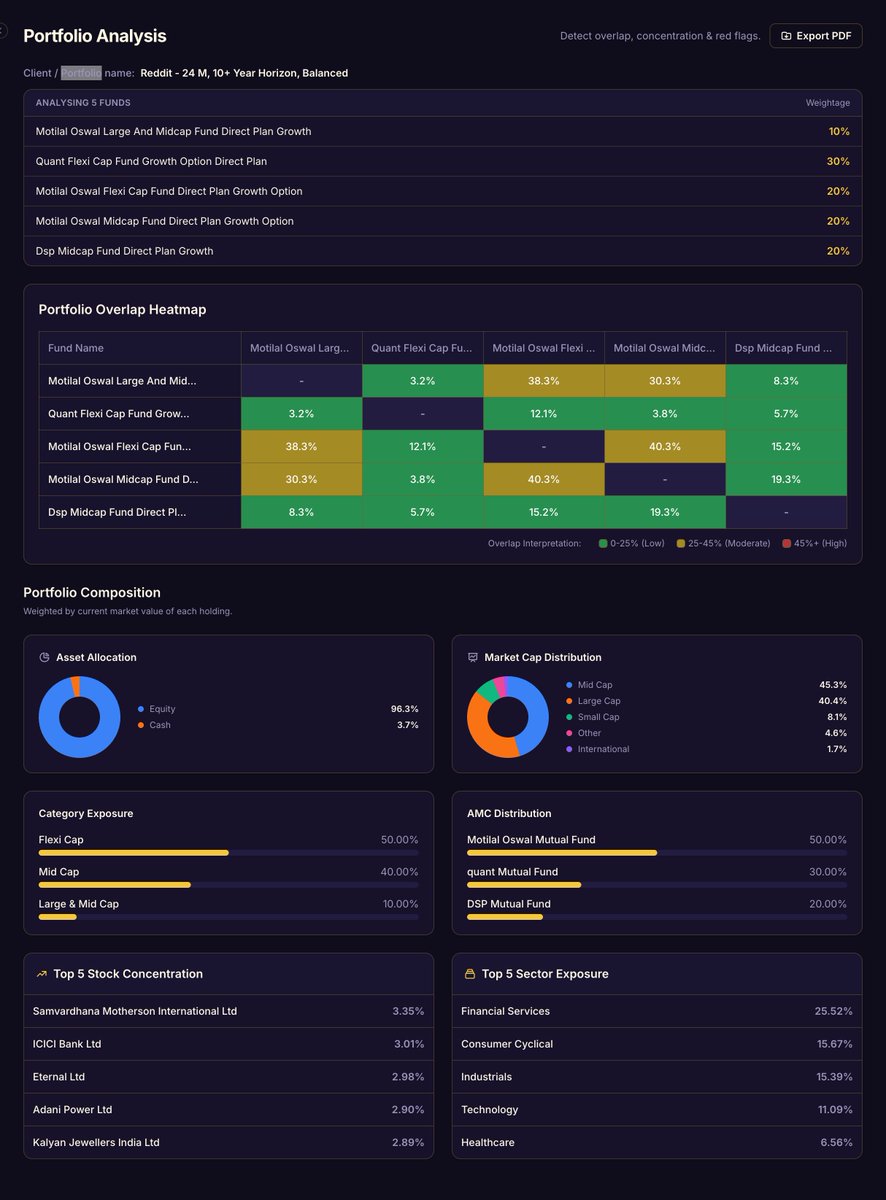
Attaching the portfolio summary
MF Portfolio Review #001
This reddit user selected funds from different category of Flexi cap, Mid cap and Large & Mid cap fund.
But 3 out of his 5 funds have an overlap more than 30%.
Reason might be same AMC
Do you want the fund to be aggressive in chasing returns or do you want the fund to have a great risk management practice?
You will want to have fund with Capture Ratio > 100% but that is practically not possible, so understand your need and choose accordingly.
MF Simplified #008: Capture Ratio
How do you analyse a fund’s performance relative to its benchmarks during market ups and downs?
How do you choose between funds with same returns?
Comes to the rescue, Capture Ratio.
It has two components, Upside Capture and Downside Capture
Fund B was able to capture only 83% of the gains but limited the loss to 44% only compared to its benchmark
So this fund might have an average return but is very good with risk management.
You see it is always a trade-off.
Formula for Sortino Ratio = [Fund Return – Risk-Free Return] / Downside Risk
Check series MF Simplified #006 for Sharpe Ratio formula, only the denominator has changed. It is replaced with Standard Deviation.
Here, Downside Risk is the measurement for Negative returns only.
MF Simplified #007: Sortino Ratio
While choosing a fund, you have return and risk to evaluate and we have seen that Sharpe ratio helps with it which uses standard deviation to measure the return per unit of risk.
But Sharpe ratio has one limitation
So, even if the fund has high returns sometime, it will be penalized as it will be measured as variation.
Eventually, our positive return is getting penalized even though our concern should only be the negative returns
This is where Sortino Ratio comes into the picture.
Wait, do you see a problem here?
Standard Deviation/Risk has both positive and negative volatility, so even if the fund fluctuates in a positive direction, we are penalizing it. We will check in next series, how to handle this
MF Simplified #006: Sharpe Ratio
Till now we have seen returns and risks but separately while judging a fund.
Consider below scenario
Fund A
Return: 14%
Risk: 28%
—
Fund B
Return: 16%
Risk: 34%
In this case, Fund B is better because it generates extra return for every unit of risk taken.
So, if confused between 2 funds based on risk and return, look out for Sharpe Ratio
Going back to our initial question of how risky a fund is individually can be answered by looking at the Standard Deviation of that fund
The volatility nature of the fund can be used to choose between different funds who have the same returns.