Grad school applications are stressful! I shared *practical* tips from my experience at Microsoft Research last year and my slides were greatly appreciated. To encourage inclusivity in academia, I am making my slides public: https://t.co/NuA8er5nB6
#AcademicChatter@ThePhDPlace
I interviewed at @SakanaAILabs (research intern) earlier this year and it was one of my favorite interview experiences in ~a decade. The technical assessment was so thoughtfully crafted and so much fun (like those psets in college that gave you eureka moments)! Every interviewer engaged deeply with my solutions from a position of curiosity and collaboration. Unfortunately I couldn't accept the offer due to visa constraints, but I highly recommend anyone interested to apply—I can vouch for the interview process, and it seems like an amazing place to work on fresh, interesting ideas in AI!
PSA: If you're applying for a research position at @SakanaAILabs (intern/full-time), we have a guide on what we look for
Researchers here pursue different directions - and may disagree - but have thought deeply about why
Over-reliance on LLMs to do your thinking isn't good
@adityaag Hard relate. Writing code was always my creative expression and it's been disorienting to see it go away. Earlier the joy was in *how* you build stuff, now it's in *what* you build.
Wrote more about this feeling as an ode to coding before AI:
https://t.co/3s0pjSzCN2
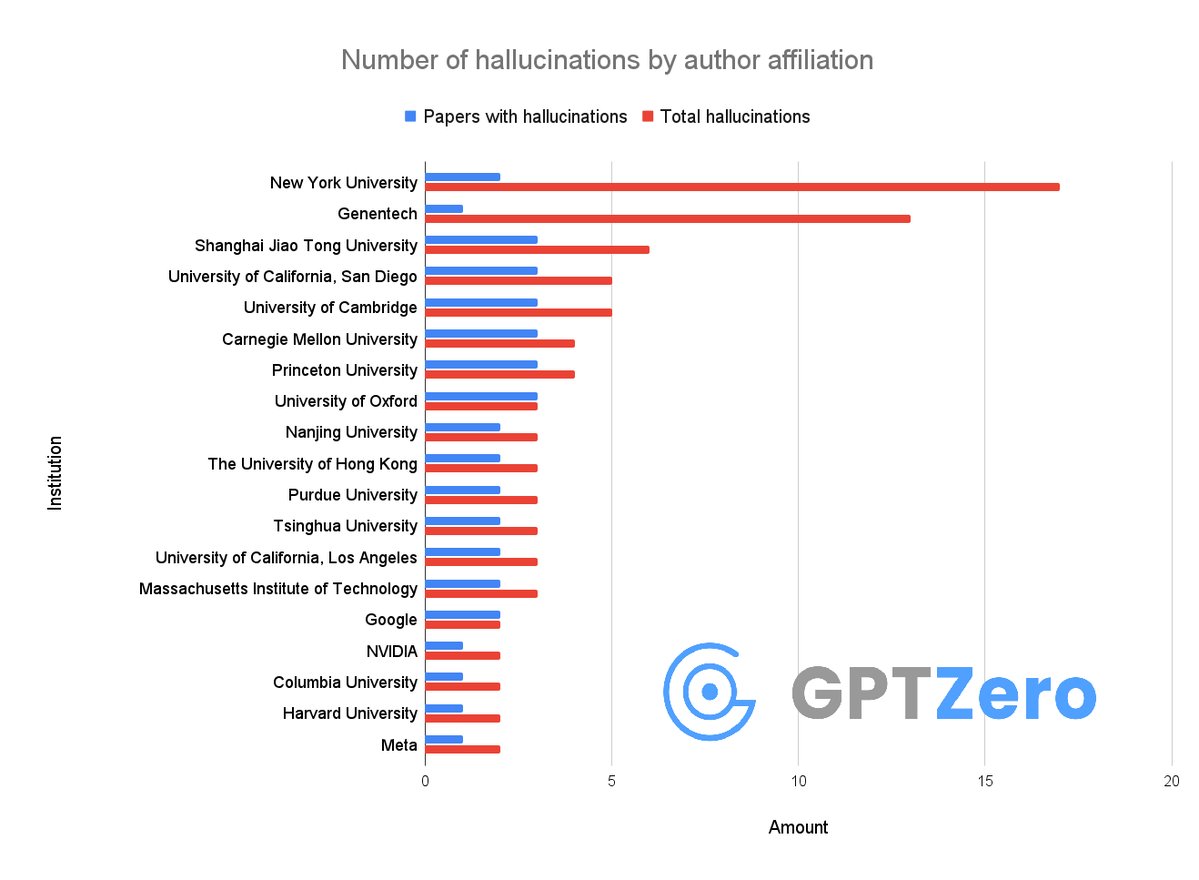
The NeurIPS hallucinated citations debacle is a good example of Goodhart's law:
When a measure (NeurIPS acceptance) becomes a target (prestige), it ceases to be a good measure (people will do anything to achieve it)
Okay so, we just found that over 50 papers published at @Neurips 2025 have AI hallucinations
I don't think people realize how bad the slop is right now
It's not just that researchers from @GoogleDeepMind, @Meta, @MIT, @Cambridge_Uni are using AI - they allowed LLMs to generate hallucinations in their papers and didn't notice at all.
It's insane that these made it through peer review👇
An Ode to Coding Before AI
Like most others, I learned to code in 2014, long before AI coding agents, autocomplete, and such. My friend and I would exchange HTML/CSS/JS tutorials on 1TB hard drives. I’d flip between VLC, Sublime Text, and Chrome on my family’s old HP laptop, trying to center a div or fix a PHP bug I barely understood. We built websites at high school tech competitions without any internet access. In college, I built a lowkey viral Facebook Messenger chatbot that shared our campus food menu and bus timings. It crashed when someone sent it a cat GIF haha. I "vibe-coded" so many other projects (the vibe came from my inexperience) and encountered creative bugs on the way.
Every bug was painful, but every bug taught me something: OS quirks, file systems, logs, APIs, threading, the GIL, tensor dimensions. These days, I use Cursor, Claude Code, and all the AI tools. They’re amazing! But I do feel a weird nostalgia. When AI writes so much of the code, you enjoy the product more than the process. As an engineer, I was wired to enjoy the process, but that's changing.
AI coding makes me productive, but a part of me misses when coding was slow, messy, and deeply personal...
Excited to be at the Alignment Workshop at @NeurIPSConf 2025 to talk about AI safety and alignment. Unexpectedly some of the conversations were about pre-training, not just post-training! Looks like Gemini 3 Pro is making pre-training cool again!!!
AI commentary unlocks new possibilities
- Personalized commentary: beginner-friendly, numbers-focused, drama-heavy, biased to your team...your choice!
- Interactive: e.g. discuss strategy with the commentator as the game unfolds
- Democratizing sports: commentary can drive viewership for smaller/local games
Built this with @justachetan and Sushrut
@vinodgansan@perplexity_ai@OpenAI My cognitive investment at this point is for Chrome, not Chromium. Investment = muscle memory, knowing exactly what it where, down to ~pixel level. If I switch to Comet or Atlas, I lose that flow, and I gain very little (and Chrome will cover up even those small gains soon)
My hot take on AI browsers: if it's Chromium-based (@perplexity_ai@OpenAI), I'll try it and move back to Chrome. Too much cognitive investment to leave behind (and Chrome will ship the same features anyway). The only way to dethrone Chrome is to rethink browsing – from scratch!
@anupamsobti@perplexity_ai@OpenAI Doesn't it slow you down for less than proportionate productivity gains? My browsing on Chrome is muscle memory. Minor design changes inhibit that flow without much gains
If you code in python and aren't using uv yet, this is your sign to jump ship! It's so fast and fun...I look forward to installing dependencies now lol
@astral_sh
This @acm_chi paper finds that AI assistance homogenized writing in a controlled experiment with American and Indian participants (n=118). With a classifier, it was harder to predict writer origin without AI (83.5% vs. 90.6%).
https://t.co/4U3yycxE2E