@ChipotleTweets I love you guys and spend a lot of money but these skimpy and inconsistent serving are getting out of hand. My wife and daughter both got skimped in their orders
Don't let the market downturn distract you from the fact that:
1. Inflation has been at or above 3% for 39 straight months
2. A record number of Americans are working multiple jobs
3. ~9% of credit card balances became delinquent over the last year
4. Housing market affordability is near record lows
5. Mortgage demand is at its lowest levels in 30 years
6. The US Dollar has lost 25% of its purchasing power in 4 years
This is not a "soft landing."
The Fed’s fight against inflation is still not over:
Supercore inflation CPI increased by 4.7% year-over-year in June, slightly down from 4.8% in May.
Supercore inflation is an important gauge that the Fed follows which includes Core services less housing.
Despite the first month-over-month decline since August 2021, at -0.1%, Supercore inflation remains elevated.
Moreover, it has been above the Fed's 2% long-term target for 39 straight months.
The Fed still has more work to do.
@KamalaHarris lol if it was with the people you would have opposition to your nomination through a primary. You didn’t even earn a nomination, it was handed to you.
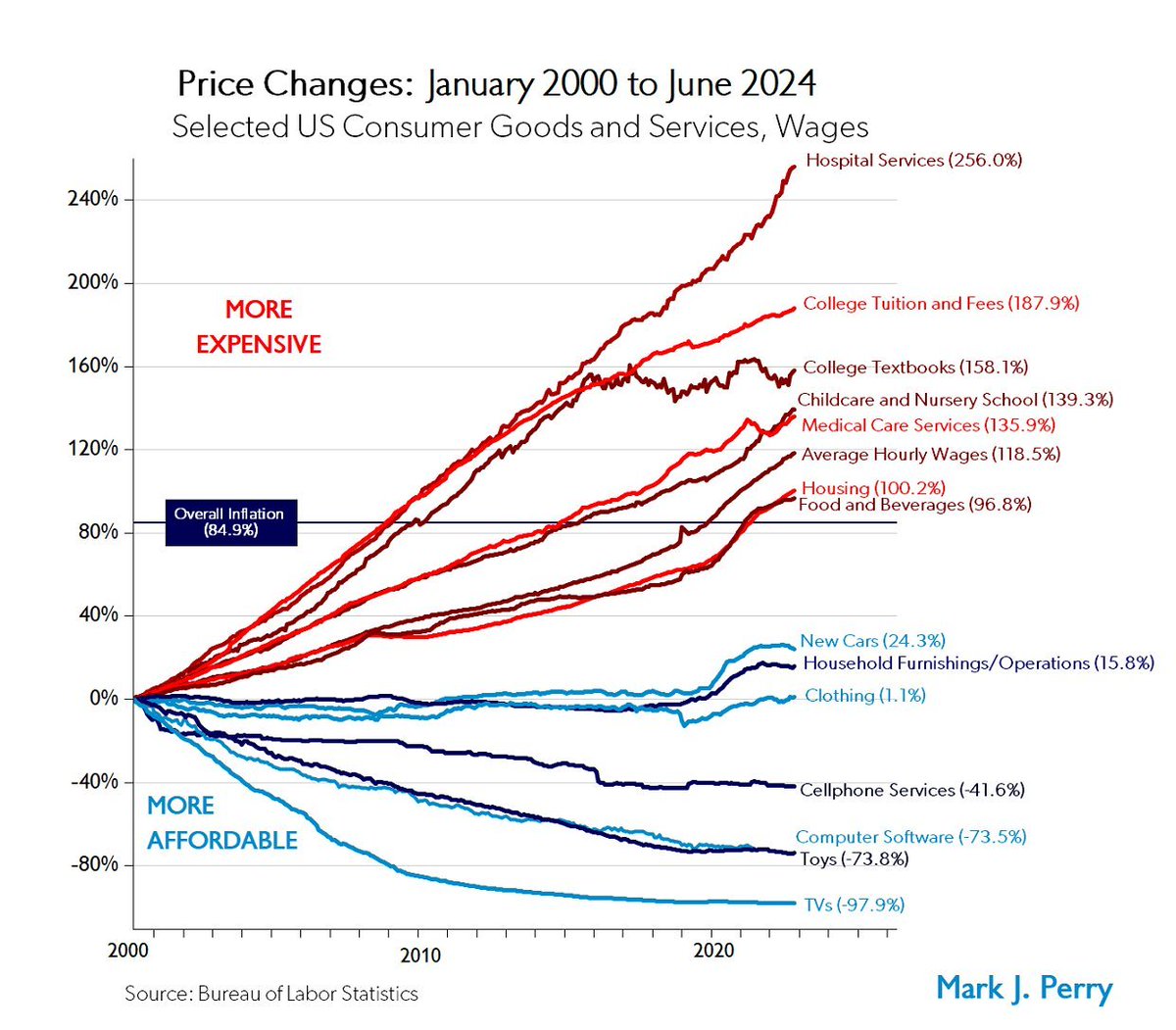
The updated version of this chart is always worth reviewing each year.
What caught my attention this time?
The acceleration in cost for hospital services.
Wild.
Existing home inventory: near record low.
New home inventory: near record high.
What's the real story?
Let's explore the true US housing inventory situation and what it means for the construction sector and the broader economy going forward 👇
1/x
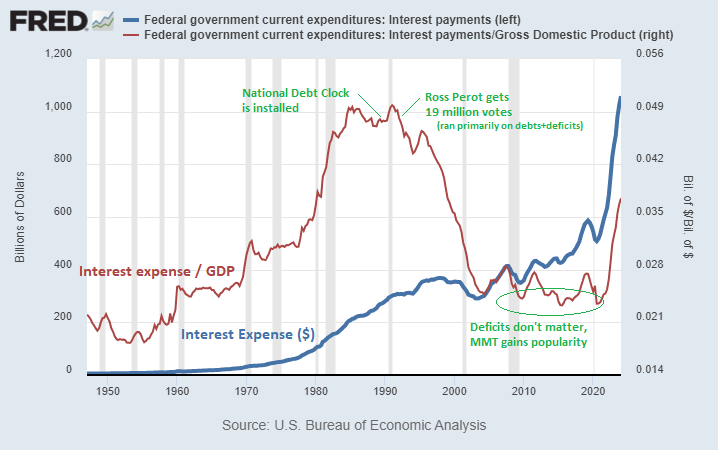
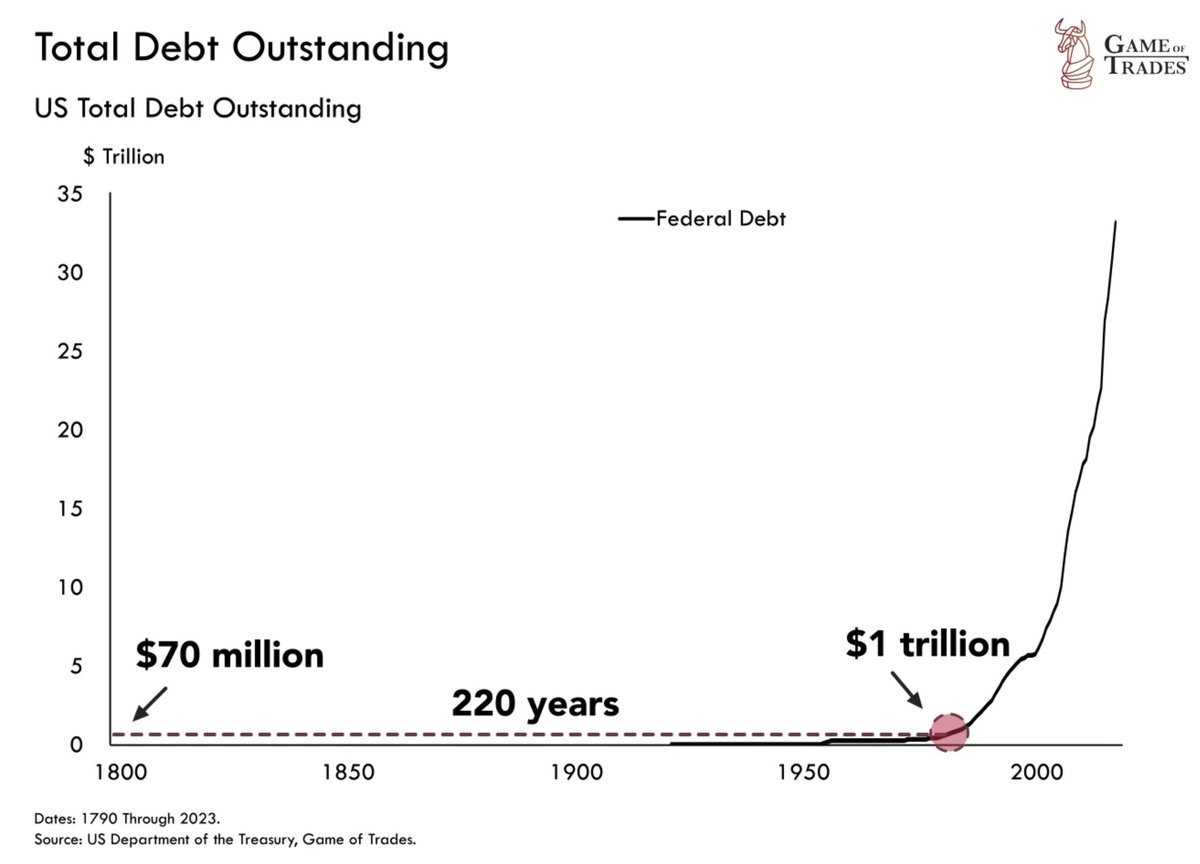
In the late 1980s and early 1990s, concern about the public debt reached its peak. The national debt clock was installed, and Ross Perot ran the most successful independent presidential campaign in the past century focused largely on debts and deficits.
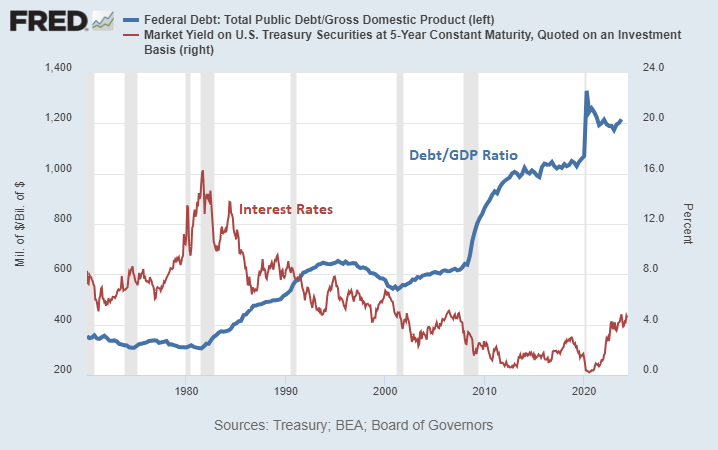
But then China and the post-Soviet Union region opened up to the world, and the resulting offshoring and globalization sparked all sorts of disinflation. Interest rates fell, and so U.S. interest expense relative to the size of the economy dropped by a lot, even as debt/GDP continued to head higher.
The lesson that many people took from that era, by the time we reached the 2010s and early 2020s, is that deficits don't really matter. All those people worrying about the deficit were viewed as wrong. And so, the *lack* of concern about public debt reached its peak.
But that's also when four decades of falling interest rates hit zero and started going sideways. And so, the falling-rate offset to ever-higher public debt growth is no longer there now. Globalization is slowing down, and putting more frictions back into global supply chains. The pendulum is swinging in the other direction.
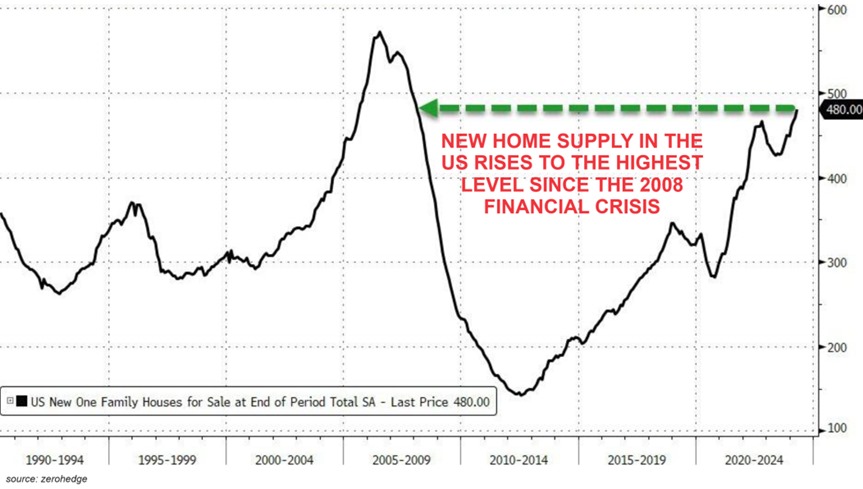
BREAKING: The number of NEW single-family houses for sale has surged to 480,000 in April, the highest since the 2008 Financial Crisis.
This came after new home sales were down 7.7% year-over-year last month, the largest drop in 13 months.
Excluding the 2008-2009 housing crisis this is by far the largest supply of new homes in US history.
Notably, the number of new homes on the market has more than TRIPLED in 12 years.
Meanwhile, the median price of a new home is at $433,500 and remains near record highs.
New homes are becoming the only option for buyers.
@sweatystartup Your assumption is the wealth equals fulfillment. He works remote and has a surplus income where he can invest in other ideas that are not owning a business
BREAKING: For the first time in history, interest payments on non-mortgage debt in the US are equivalent to interest on mortgage debt, at $575 billion.
Exactly 3 years ago, interest on non-mortgage debt was at $250 billion.
This marks a 130% increase in household interest expense on non-mortgage items over just 3 years.
Furthermore, 3 years ago interest on non-mortgage debt was HALF of interest on mortgage debt.
Americans are "fighting" inflation with high interest rate debt.
How is this sustainable?