Your AI just hired another AI. Who's holding the money?
AgentAnvil: escrow for agent-to-agent work on the XRP Ledger. Payment locks, the work gets done, the payer releases it from their own wallet. No delivery, no payout.
Testnet pilot. Waitlist 👇 https://t.co/bZN8Aq0qav
Last month, six of Scotland’s pioneering deep tech startups made waves at the inaugural Deep Tech Week London. 🚀
Over seven days, alongside 750+ founders, scientists, investors and industry leaders, our cohort got direct face time with dedicated deep tech investors, sat in on technical sessions and put their hardware in front of delegates at the Techscaler stand.
On the flagship day, Techscaler opened the door to a global room. Over an exclusive breakfast hosted by our Entrepreneur in Residence, Allan Cannon, our founders sat down with leaders from the Sovereign AI Fund, ChipStart, and international VCs spanning Australia, Asia, and Europe to explore the future of compute.
By the end of the week, the cohort walked away with an average of 7 investor introductions and 6 confirmed follow-up meetings each.
A fantastic week for Scotland’s deep tech founders and we can’t wait to see what comes next!
Head to our website for a full breakdown: https://t.co/PZotkuXSeU
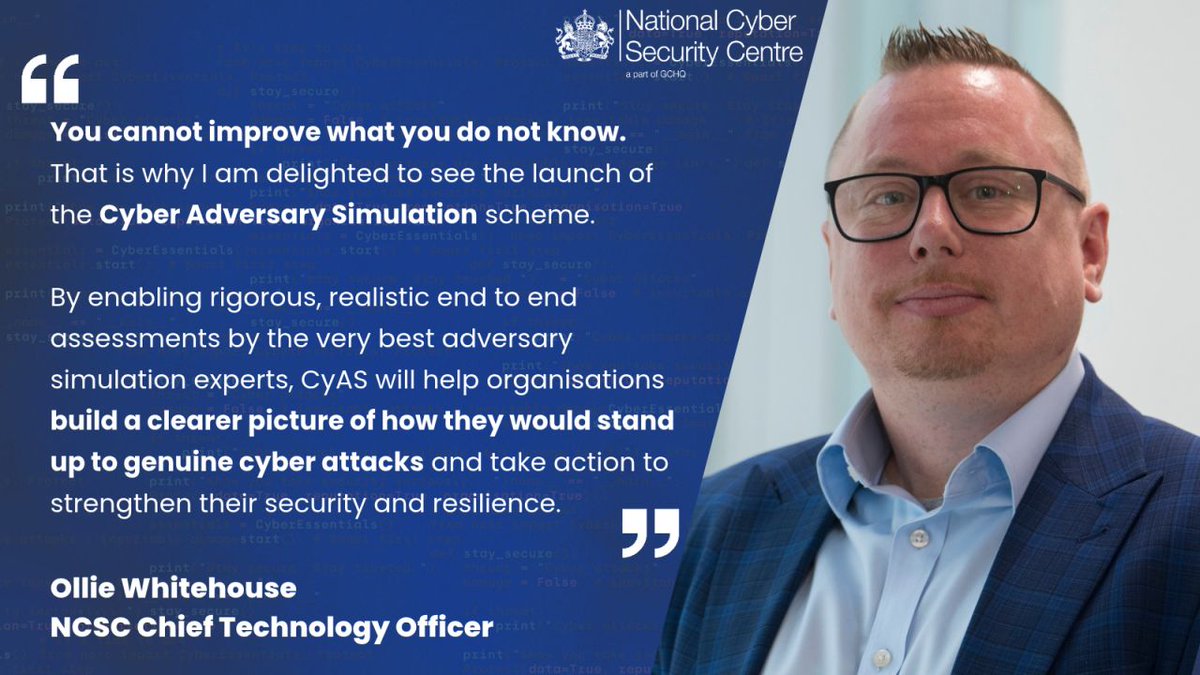
The NCSC has launched a new Cyber Adversary Simulation scheme that will help critical organisations strengthen their resilience through rigorous, real-world testing by trusted providers.
Read more:
https://t.co/G5ODYZIvkb
NEW: @OKX and @NYSE parent @ICE_Markets set November 23 as its 24/7 tokenized stock venue launch date, confirming 70 assets including @Coinbase, @Circle and @RobinhoodApp alongside 59 ETFs under the SEC’s Innovation Exemption.
Tokenization has the potential to deliver significant benefits for investors and issuers. Realizing that potential at scale requires preserving the transparency, liquidity and protections that underpin our markets.
Nasdaq’s John Zecca shares his perspective in @barronsonline: https://t.co/mG9htSFylY
@tech_scaler Brilliant to see. Over 10,000 users protecting and pitching their IP is serious going. That line about a million thoughts rings very true (more like a gazillion😆). Congrats to Fiona and the team at @mysmashmedia 👏
Fried onions that wouldn't stay in the wrap. Hands too cold to grip the burger. Walking down Copland Road with my dad after a Rangers win.
That's where I learned what trust feels like. AI agents don't get any of that, so it has to be designed in.
#Rangers#Glasgow#AIAgent #Finance
https://t.co/USvks1iVZQ
@ge0xrge It doesn't, and it shouldn't have to guess. The funds sit locked on the XRP Ledger until the buyer confirms the parcel matches what was asked for. If nothing's confirmed by the deadline, the escrow expires and the money goes back. No parcel, no release. Trust, but escrow.
The XRP Ledger reaches agreement without mining.
It uses its own consensus protocol: a new ledger version is confirmed only when a supermajority of trusted validators, at least 80%, agree.
The result: settlement in seconds. It is one of the reasons Yellow Onchain is built here.
Agents are buying services, using credit and settling payments on their own.
Over 15M agent transactions have already settled on the XRP Ledger.
Here's what t54 is building, what we’ve achieved and how our trust layer will help the agentic economy scale. https://t.co/U30jaR9Zfa
We started t54 because we believe AI agents will become real participants in the economy, once people and institutions can trust them with money.
A year in, this is what we’ve built so far.
I put this week's four industry notes into a longer piece: Visa's shopping benchmark, Cloudflare on who answers for the action, a frank interview from Hedera, and real agent payment volume on the XRP Ledger. When the agent gets it wrong, who pays?
https://t.co/HEOYYyNe4h
Roughly a quarter of XRP Ledger activity in October was agentic payments, according to @t54ai. Agents paying for services is already happening at real scale. The next big question is what protects both sides when the work they paid for isn't delivered as agreed.
https://t.co/0PsfDvB6aX
"AI agents can hallucinate and cannot always be trusted." Refreshingly honest from Lindsay Walker at @hedera. Hard limits and records nobody can quietly edit beat good intentions every time. Trust between agents has to be designed in, not hoped for.
https://t.co/PouHTUomrL
“AI agents can hallucinate and cannot always be trusted.”
@Lindsayjowalk@hashgraph explains why agentic commerce needs deterministic, on-chain spending limits and tamper-proof records, in an interview with @futuristdotai of @securitiesio 🔐
https://t.co/ti4pnrNCqJ
"Who answers for the action?" @Cloudflare puts that question at the heart of agent trust, alongside identity and reputation. When a merchant only ever sees the agent, accountability gets blurry fast. It can't be an afterthought in agent commerce.
https://t.co/vE5zfh0jYY
AI agents act for millions, but servers see intermediaries that strip user visibility. This post defines the problem space and introduces a collaborative approach to safely identifying, allowing, and managing this automated traffic. https://t.co/RPMP0u7CpI
Visa's new benchmark found that in 54% of failed AI shopping runs, the agent still bought something. That's the bit worth sitting with. Agents will keep improving, but payments between them need a way to wait until the job is actually right. Thoughtful work from @Visa.
https://t.co/geWRt3lwzD