pr-af is the top open-source code reviewer on the Martian Code-Review-Bench.
Benchmarked against 42 tools, with ~3× more valid findings than the leading commercial ones. Deep review, not diff summaries - on open or closed models.
→ Star & deploy: https://t.co/rd1kDHNhyy
See you at AI Dev NYC, from @AndrewYNg and @DeepLearningAI . Nov 30 - Dec 1, Chelsea Piers.
Our CTO @santoshradha runs a hands-on workshop: Software Factory Architecture - the engineering skill after coding agents.
Find us at our booth both days.
https://t.co/XvT5U8u4ot
⚠️ Heads up: @agentfieldai is not affiliated with AgentField.
Our only official account is @AgentField_ai.
We will never ask you for crypto or send you a wallet address. Don't click links from that account or send it funds. Please report it if you see it.
Introducing AgentField Integrations : One AI control plane. Every system.
Your AI stops waiting for you to push the button.
Now your systems can launch and talk to any agent on their own — and your agents reach back across every system to take action. All landing with audit, identity, and policy attached.
Not an MCP. Structured, adaptable, policy-controlled access - the way any API talks to your backend.
→ Your stack launches the agent.
A ServiceNow P1 lands — checkout failing for top-tier accounts. A triage agent fires before anyone is paged.
→ The agent acts back across your stack.
It pulls the affected accounts from Salesforce. Asks Snowflake Cortex in plain English what changed in the last hour, gets back the SQL it ran. Triggers a NIM inference workload on NVIDIA enterprise to classify the root cause from error logs.
Drafts a revert PR in GitHub and files a Jira issue against the suspect commit. Updates the ServiceNow incident with the hypothesis. Issues Stripe refunds for the affected charges. Writes comms back into Salesforce for the CSMs and posts a status to the Slack bridge.
By the time oncall reads the page, the work is done.
This is what an autonomous AI backend looks like, agents firing on the events your stack already emits, acting with the audit, identity, and policy of any production API.
A few connectors are public today. Early access available for the rest to our design partners, reach out.
→ https://t.co/VNSSxTCnrY
Agent loops are the new prompt engineering.
Useful, but probably not the end state.
At @AgentField_ai we’ve gradually gone from:
Loops → Graphs → Programs
where the execution graph itself is generated at runtime.
Here’s an example archi in our project PR-AF, which does this for code review. Every PR compiles a different review organization around itself.
We’ve been calling these JIT Organizations.
Agentic LLM systems this year have mostly gone to coding, browsing, research.
With the @activeloop (Deeplake) team, we pointed agents at a job they don't usually do: curating a robotics dataset.
Roboscribe-AF automates the work a human curator would do — segment episodes, cross-check video vs trajectory, flag the messy ones.
Disagreements between reasoners get written back as queryable Deeplake fields.
Open source: https://t.co/mJumKkKGeb
We just made https://t.co/aTLhdWv5bI AI Agent Native. And gave it a complete redesign. ✨
Your AI agents can now read our docs the same way you do.
How it works:
→ .well-known/ai-plugin.json for standard agent discovery. Any agent following the OpenAI plugin spec finds us automatically.
→ A full Agent API. Search (BM25), topic browsing, full page retrieval. Designed for programmatic consumption, not a docs wrapper.
→ Graceful agent 404s. Hit a wrong endpoint? Agents get a discovery payload pointing to the right routes.
→ Structured manifests (docs-ai.json, openapi.json) describing every page, endpoint, and capability.
→ /llms.txt serving our entire docs corpus as plain text for any LLM.
Building an AI backend means your website should be agent-readable too. We think every open-source project should do this.
We also refreshed the entire experience:
• fundamentally new design focusing on our
• New developer page - interactive code walkthrough in Python, Go, TypeScript
• New enterprise page - governance, identity, audit trails, verifiable credentials
• 72+ production features, documented
• Claims-processor example from start to production
1.1K+ GitHub stars. 100K+ Downloads. Apache 2.0. Open source.→ https://t.co/VS42hSfo4s
AgentField just crossed 1,000 GitHub stars !
Three months ago when we open-sourced AgentField, we didn't set out to hit a number. We set out to solve a problem : AI agents need backend infrastructure the same way APIs and services needed one.
Scale. Identity. Observability. Boundaries. Audit trails. The things you need when agents go from demos to production.
1,000+ engineers looked at that bet and said: yes, this matters.
Thank you to every builder who starred, forked, opened an issue, or shipped agents on AgentField. This milestone belongs to you.
We're just getting started.
If you haven't already, check out the repo and let us know what you think - https://t.co/m5yHT3wET2
Agents are just services that reason. 🚀
The moment you see it that way, everything clicks.They need the same things every production service needs:
→ Identity and auth
→ Discovery
→ Coordination
→ Observability
→ Governance
We didn't need a new paradigm. We needed to apply the one we already have.
That's what we built AgentField on. Four primitives. Just Python.
Your agent becomes a production service with cryptographic identity and a full audit trail.
No DAGs. No YAML. No workflow DSLs.
Open source. Apache 2.0. ✅
Build in any language - Python, TypeScript, Go SDKs.
Stop building AI agent workflows like it's 2023. 🙅
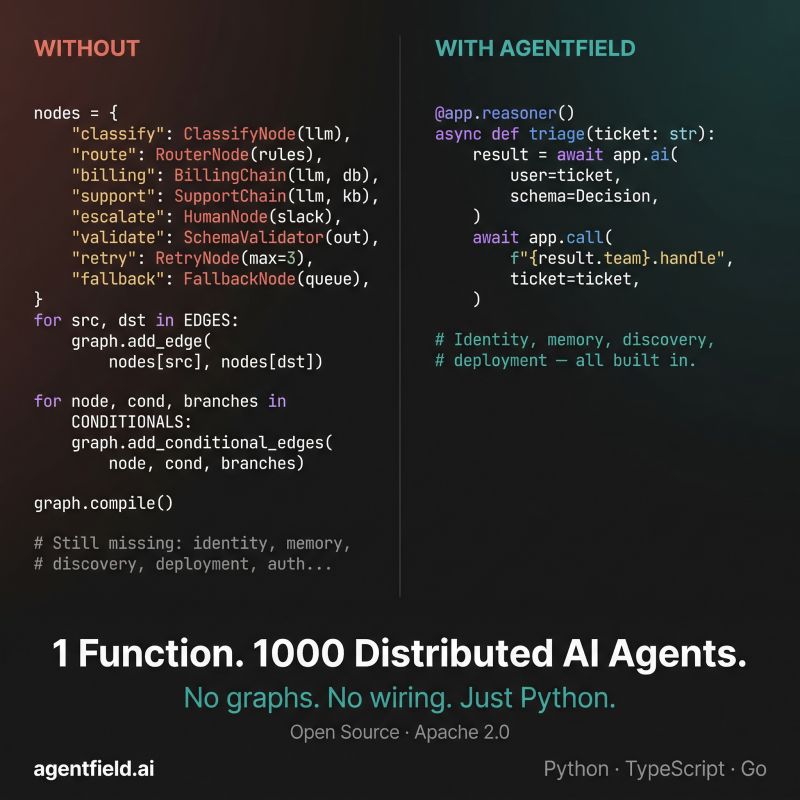
The left side of this image is what most agent code looks like today:
→ Define every node manually
→ Wire edges between them one by one
→ Add conditional routing logic
→ Compile the graph
→ And you STILL don't have identity, memory, discovery, or deployment
The right side is AgentField:
→ Write a Python function
→ It becomes a distributed service automatically
→ Agents discover and call each other by name (Agent mesh!)
→ Structured output through Pydantic, not prompt hacks
→ Identity, memory, deployment - all built in
One function on the right replaces 30+ lines of graph wiring on the left. 🪄
And it scales to 1000's agents without changing a single line.
No DAGs. No YAML. No workflow DSLs.
SDKs in python, tsx and go. 🎯
Try it out - https://t.co/25RujJySGQ
Open source. Apache 2.0.
💡 AgentField is now a member of the Agentic AI Foundation (AAIF).
146 organizations collaborating on open standards and protocols for agentic AI - interoperability, identity, governance, and production-ready infrastructure.
We've been building toward this from day one. Agents in production need open, verifiable foundations - not proprietary silos. The AAIF is the right place for that work.
Glad to be part of it alongside Anthropic, OpenAI, JPMorganChase , American Express, Red Hat, ServiceNow and many others. 💫
→ https://t.co/b3VW7IdPrf
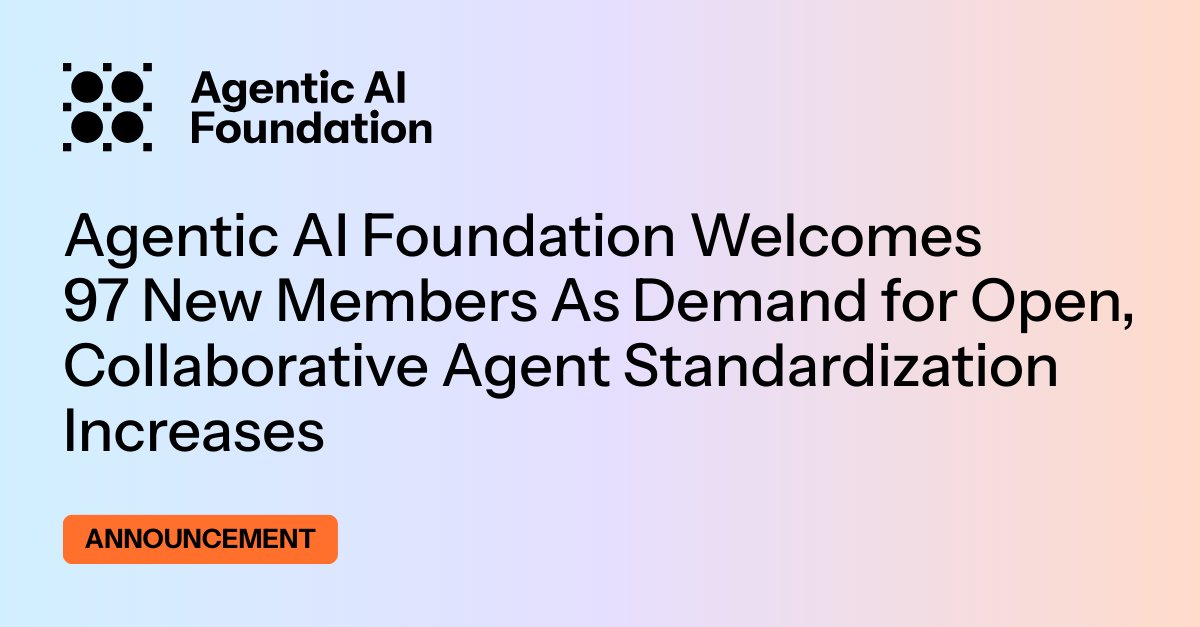
97 new members. 146 total. 1 mission: Open Agentic AI. 🚀
Our members are working together to reduce fragmentation, advance open protocols and shape production-ready standards for agentic AI.
Read the announcement: https://t.co/mO0ChxIVip
AI agent governance isn't a new problem.
You solved it 10 years ago for microservices — mTLS, Service mesh, Centralized auth, Immutable logs.
Now you're deploying AI agents that approve invoices , and trigger workflows — and the audit trail is... a JSON file in S3?
We've been here before.
The answer is the same: infrastructure-grade identity and governance.
AgentField gives every AI agent:
🔐 Cryptographic identity (not a shared API key)
🛡️Tamper-proof audit trail (not editable logs)
🔗Delegation chains (not "it was authorized...probably")
✨Ed25519 signatures on every action
Your compliance team will thank you. Your future self will thank you more.
Open source: https://t.co/m5yHT3wET2
Yes, your agent demo works.
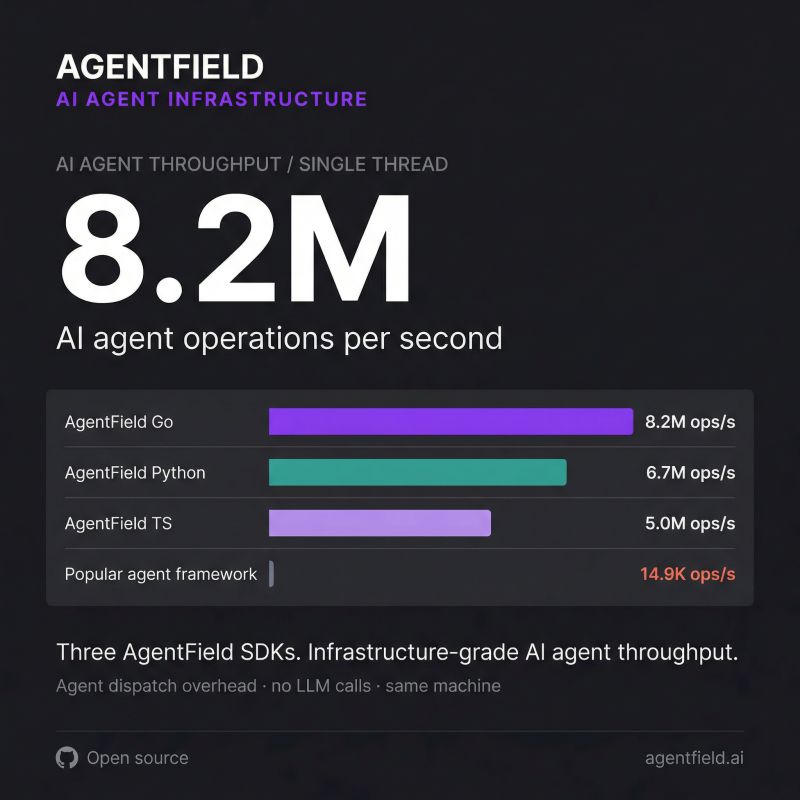
Now try running it 8.2 million times per second. 🚀
If intelligence is moving into your backend, the runtime matters.
AgentField delivers infrastructure grade throughput for autonomous software. Lightweight control plane built for scale. ⚡️
Checkout our latest benchmarks - https://t.co/5sUjK9eqGI
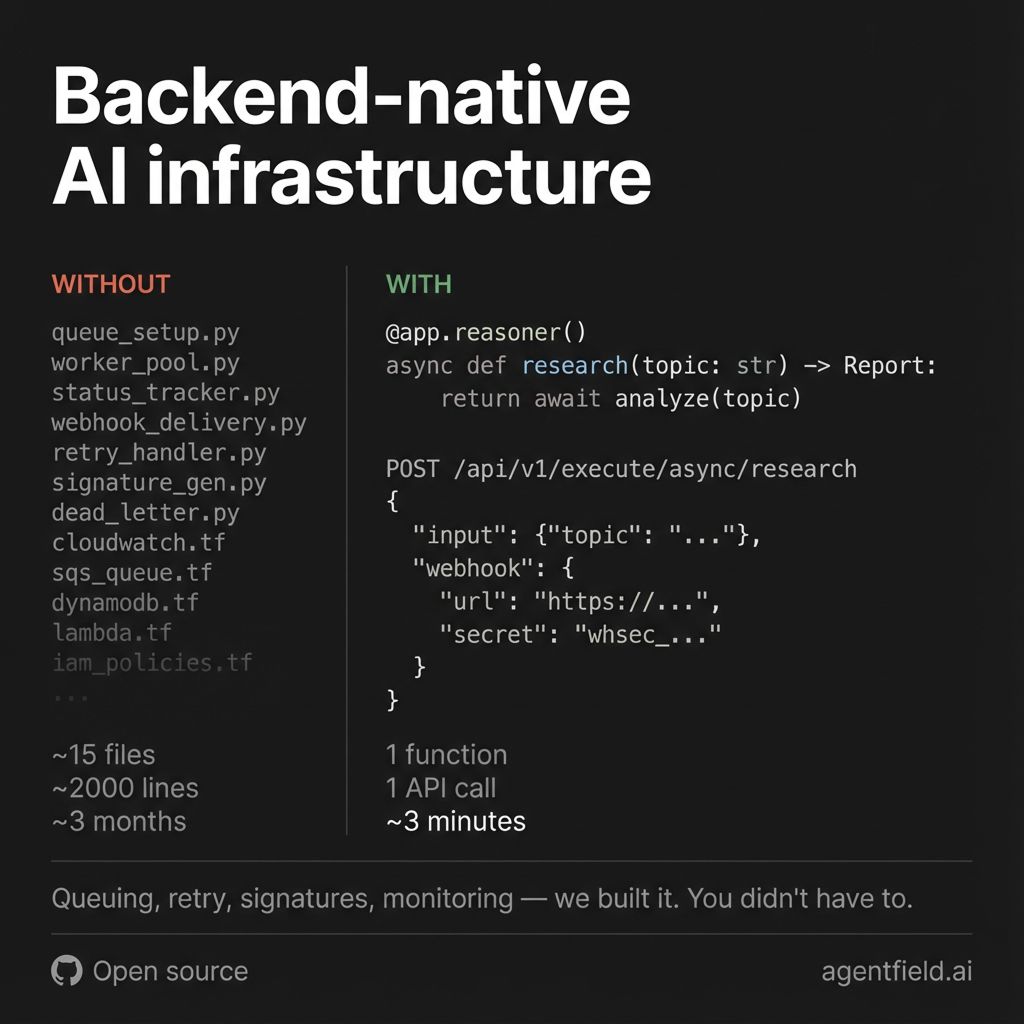
Building production AI agents shouldn't feel like building infrastructure from scratch. 🤖
But right now, most teams are writing:
→ Queue setup code
→ Worker pool management
→ Retry handlers
→ Webhook delivery + signatures
→ Monitoring and alerting
→ All the Terraform to glue it together
~15 files. ~2000 lines. ~3 months.
With AgentField:
→ 1 function
→ 1 API call
→ ~3 minutes
The infrastructure is the product.
You just write your agent logic. 🛠️
Open source: https://t.co/m5yHT3wET2
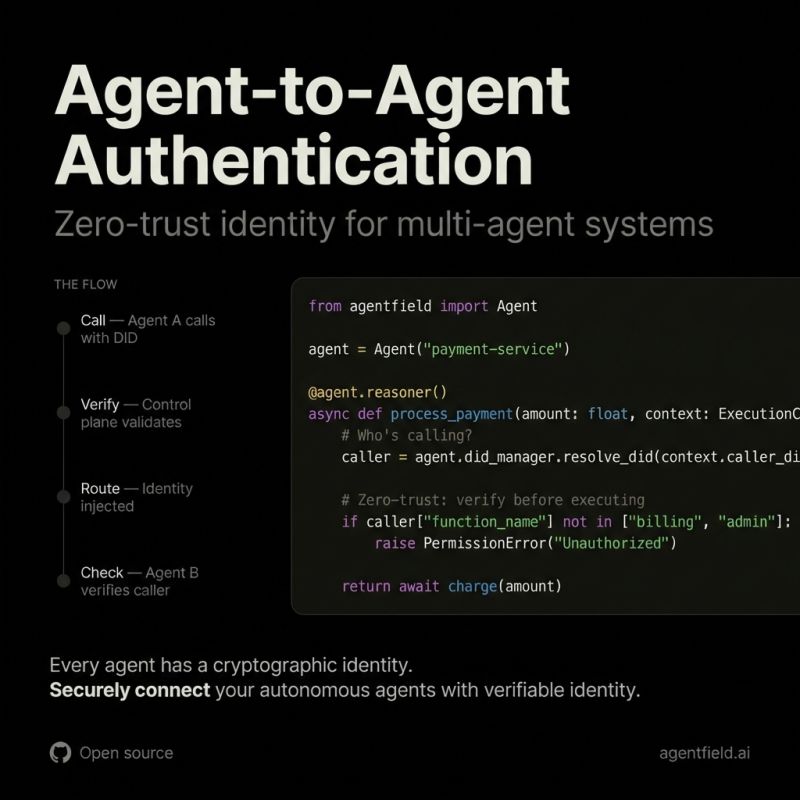
Zero trust Agent-to-Agent Authentication ?
If you're building multi-agent systems and you're not thinking about this, you should be.
When Agent A calls Agent B:
- How does B verify A's identity?
- How do you audit who called whom?
- How do you revoke access if something goes wrong?
AgentField: cryptographic identity for every agent. DID-based verification. Zero-trust by default. Let Identity and auth be part of your infrastructure.
And the best developer experience is cherry on top 🍒 ( yes its that easy! )
Open source: https://t.co/m5yHT3wET2
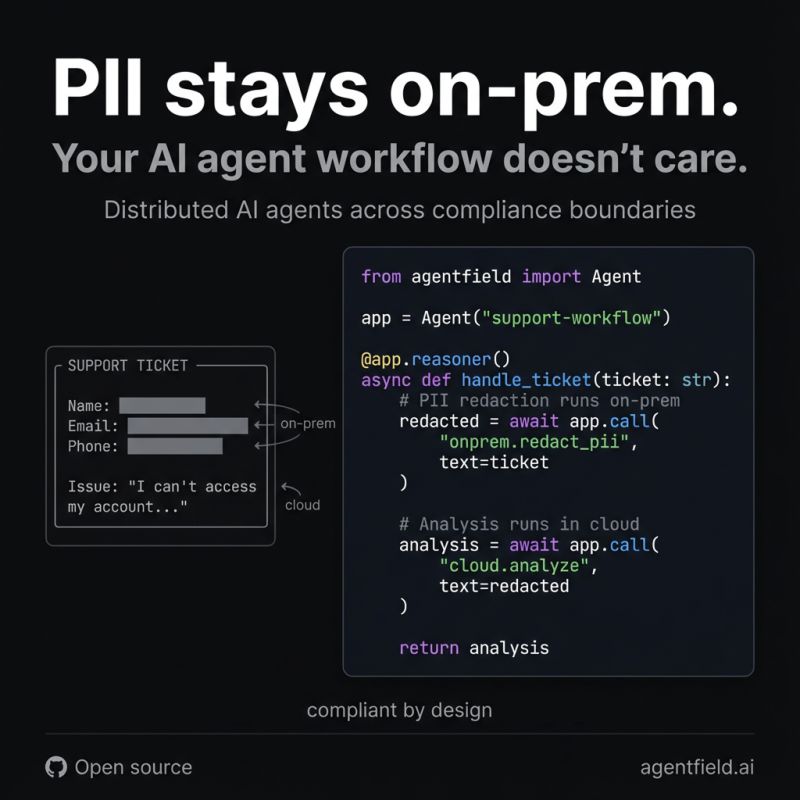
Hot take 🔥: Most AI agent frameworks think everything has to live in one cozy box.
What if your agents could run on-prem - and still just… work together seamlessly?
No custom networking mess
No message queues to babysit
No serialization nightmares
Just: Agent A calls Agent B.
The AI Backend magic handles the rest
Haven't checked out Agentfield yet? 👀
→ https://t.co/KeheA9dMVJ
Open-Source • Apache 2.0 🚀
The next infrastructure layer isn't about smarter prompts.
It's about agents that deploy like microservices, discover each other, and prove what they did.
Singapore → Feb 7th.
Let's build the next layer together. 🇸🇬🚀