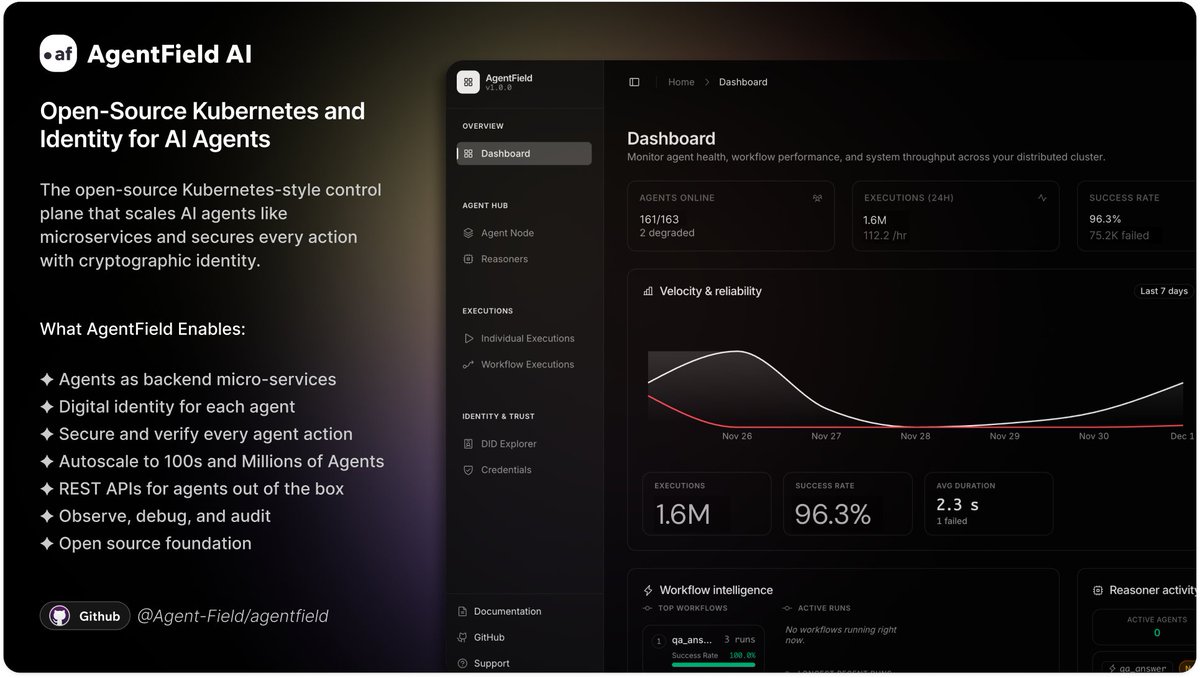
🚀 AgentField is live - the open-source AI backend for autonomous software.
Agents are moving beyond chat into systems where they touch money, data, and decisions. The traditional backend stack (OAuth for humans, API keys for static services, DAGs for brittle flows) breaks there.
AgentField gives agents cryptographic identity (DIDs), delegated trust (VCs), long-running execution, async orchestration, and verifiable audit receipts - so you can run agents like micro-services in production, with policy-as-code and full observability.
Agentic LLM systems this year have mostly gone to coding, browsing, research.
With the @activeloop (Deeplake) team, we pointed agents at a job they don't usually do: curating a robotics dataset.
Roboscribe-AF automates the work a human curator would do — segment episodes, cross-check video vs trajectory, flag the messy ones.
Disagreements between reasoners get written back as queryable Deeplake fields.
Open source: https://t.co/mJumKkKGeb
We just made https://t.co/aTLhdWv5bI AI Agent Native. And gave it a complete redesign. ✨
Your AI agents can now read our docs the same way you do.
How it works:
→ .well-known/ai-plugin.json for standard agent discovery. Any agent following the OpenAI plugin spec finds us automatically.
→ A full Agent API. Search (BM25), topic browsing, full page retrieval. Designed for programmatic consumption, not a docs wrapper.
→ Graceful agent 404s. Hit a wrong endpoint? Agents get a discovery payload pointing to the right routes.
→ Structured manifests (docs-ai.json, openapi.json) describing every page, endpoint, and capability.
→ /llms.txt serving our entire docs corpus as plain text for any LLM.
Building an AI backend means your website should be agent-readable too. We think every open-source project should do this.
We also refreshed the entire experience:
• fundamentally new design focusing on our
• New developer page - interactive code walkthrough in Python, Go, TypeScript
• New enterprise page - governance, identity, audit trails, verifiable credentials
• 72+ production features, documented
• Claims-processor example from start to production
1.1K+ GitHub stars. 100K+ Downloads. Apache 2.0. Open source.→ https://t.co/VS42hSfo4s
AgentField just crossed 1,000 GitHub stars !
Three months ago when we open-sourced AgentField, we didn't set out to hit a number. We set out to solve a problem : AI agents need backend infrastructure the same way APIs and services needed one.
Scale. Identity. Observability. Boundaries. Audit trails. The things you need when agents go from demos to production.
1,000+ engineers looked at that bet and said: yes, this matters.
Thank you to every builder who starred, forked, opened an issue, or shipped agents on AgentField. This milestone belongs to you.
We're just getting started.
If you haven't already, check out the repo and let us know what you think - https://t.co/m5yHT3wET2
Agents are just services that reason. 🚀
The moment you see it that way, everything clicks.They need the same things every production service needs:
→ Identity and auth
→ Discovery
→ Coordination
→ Observability
→ Governance
We didn't need a new paradigm. We needed to apply the one we already have.
That's what we built AgentField on. Four primitives. Just Python.
Your agent becomes a production service with cryptographic identity and a full audit trail.
No DAGs. No YAML. No workflow DSLs.
Open source. Apache 2.0. ✅
Build in any language - Python, TypeScript, Go SDKs.
Stop building AI agent workflows like it's 2023. 🙅
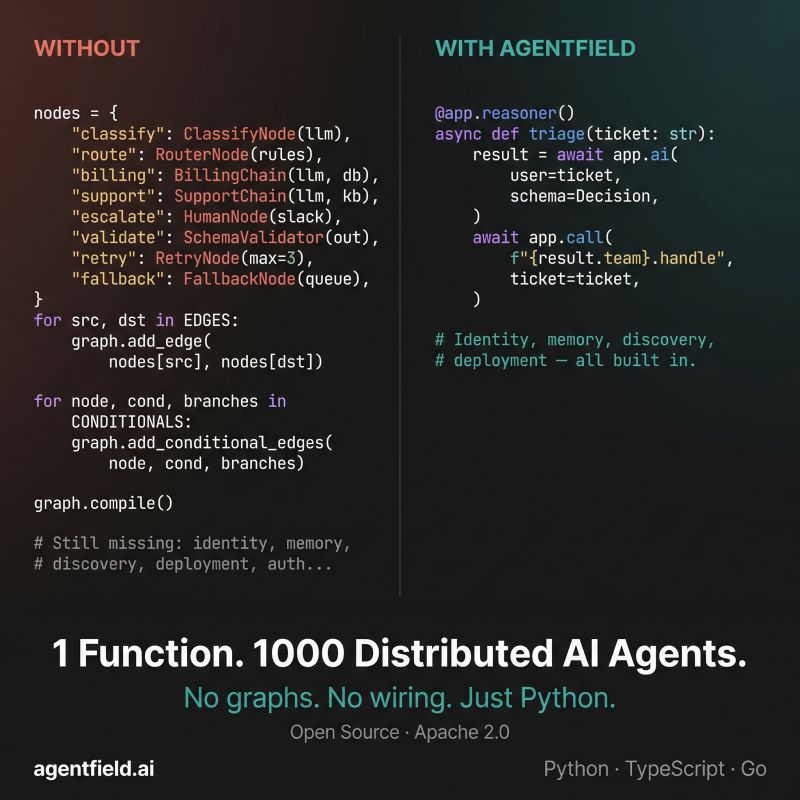
The left side of this image is what most agent code looks like today:
→ Define every node manually
→ Wire edges between them one by one
→ Add conditional routing logic
→ Compile the graph
→ And you STILL don't have identity, memory, discovery, or deployment
The right side is AgentField:
→ Write a Python function
→ It becomes a distributed service automatically
→ Agents discover and call each other by name (Agent mesh!)
→ Structured output through Pydantic, not prompt hacks
→ Identity, memory, deployment - all built in
One function on the right replaces 30+ lines of graph wiring on the left. 🪄
And it scales to 1000's agents without changing a single line.
No DAGs. No YAML. No workflow DSLs.
SDKs in python, tsx and go. 🎯
Try it out - https://t.co/25RujJySGQ
Open source. Apache 2.0.
💡 AgentField is now a member of the Agentic AI Foundation (AAIF).
146 organizations collaborating on open standards and protocols for agentic AI - interoperability, identity, governance, and production-ready infrastructure.
We've been building toward this from day one. Agents in production need open, verifiable foundations - not proprietary silos. The AAIF is the right place for that work.
Glad to be part of it alongside Anthropic, OpenAI, JPMorganChase , American Express, Red Hat, ServiceNow and many others. 💫
→ https://t.co/b3VW7IdPrf
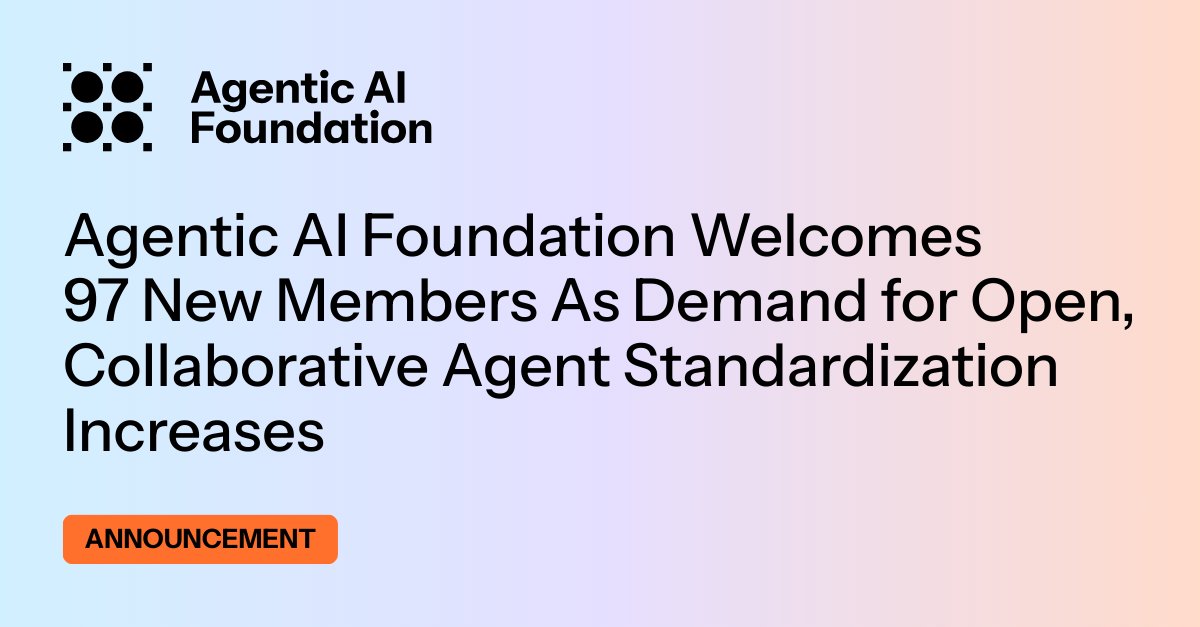
97 new members. 146 total. 1 mission: Open Agentic AI. 🚀
Our members are working together to reduce fragmentation, advance open protocols and shape production-ready standards for agentic AI.
Read the announcement: https://t.co/mO0ChxIVip
AI agent governance isn't a new problem.
You solved it 10 years ago for microservices — mTLS, Service mesh, Centralized auth, Immutable logs.
Now you're deploying AI agents that approve invoices , and trigger workflows — and the audit trail is... a JSON file in S3?
We've been here before.
The answer is the same: infrastructure-grade identity and governance.
AgentField gives every AI agent:
🔐 Cryptographic identity (not a shared API key)
🛡️Tamper-proof audit trail (not editable logs)
🔗Delegation chains (not "it was authorized...probably")
✨Ed25519 signatures on every action
Your compliance team will thank you. Your future self will thank you more.
Open source: https://t.co/m5yHT3wET2
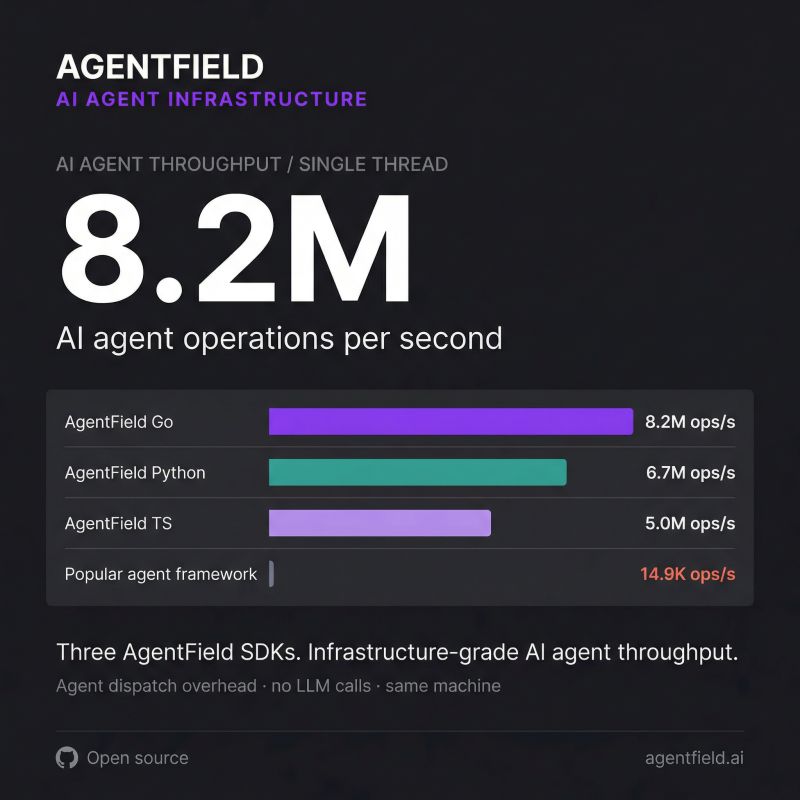
Yes, your agent demo works.
Now try running it 8.2 million times per second. 🚀
If intelligence is moving into your backend, the runtime matters.
AgentField delivers infrastructure grade throughput for autonomous software. Lightweight control plane built for scale. ⚡️
Checkout our latest benchmarks - https://t.co/5sUjK9eqGI
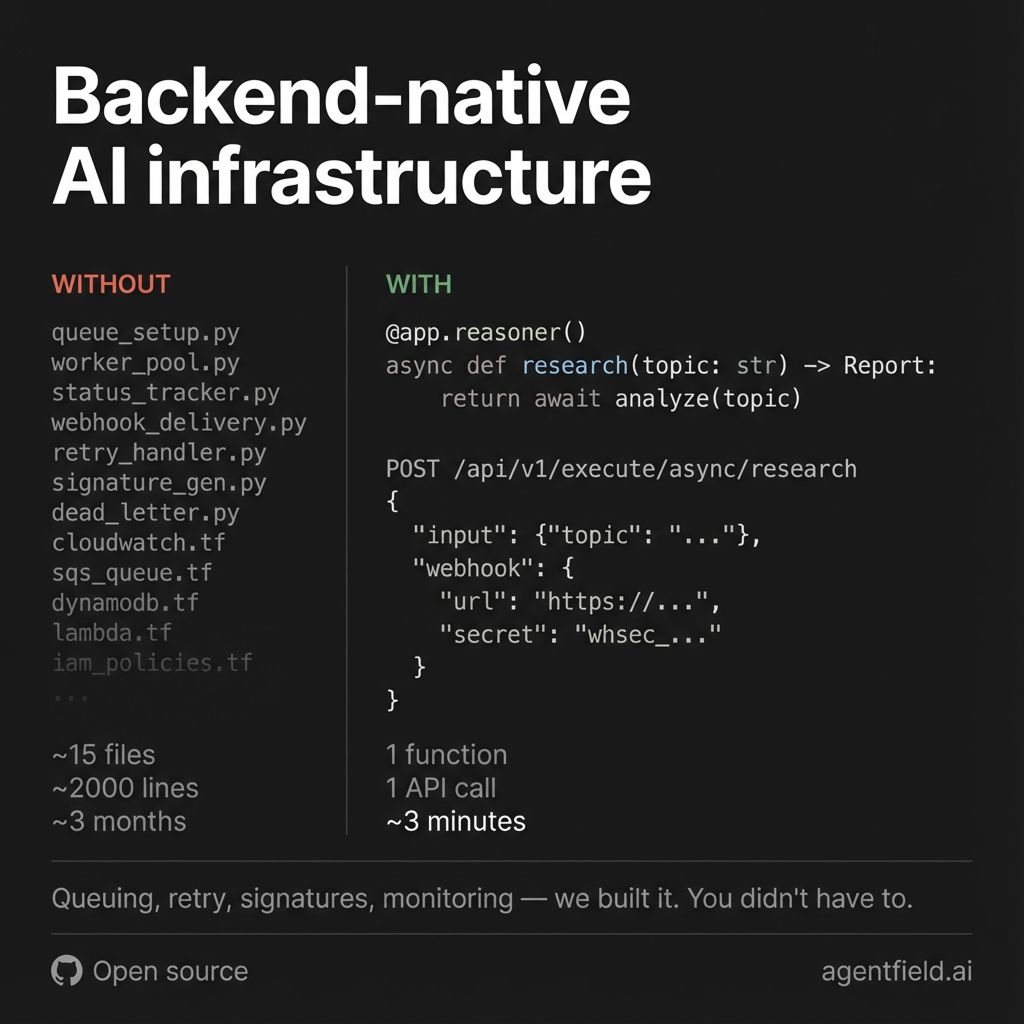
Building production AI agents shouldn't feel like building infrastructure from scratch. 🤖
But right now, most teams are writing:
→ Queue setup code
→ Worker pool management
→ Retry handlers
→ Webhook delivery + signatures
→ Monitoring and alerting
→ All the Terraform to glue it together
~15 files. ~2000 lines. ~3 months.
With AgentField:
→ 1 function
→ 1 API call
→ ~3 minutes
The infrastructure is the product.
You just write your agent logic. ��️
Open source: https://t.co/m5yHT3wET2
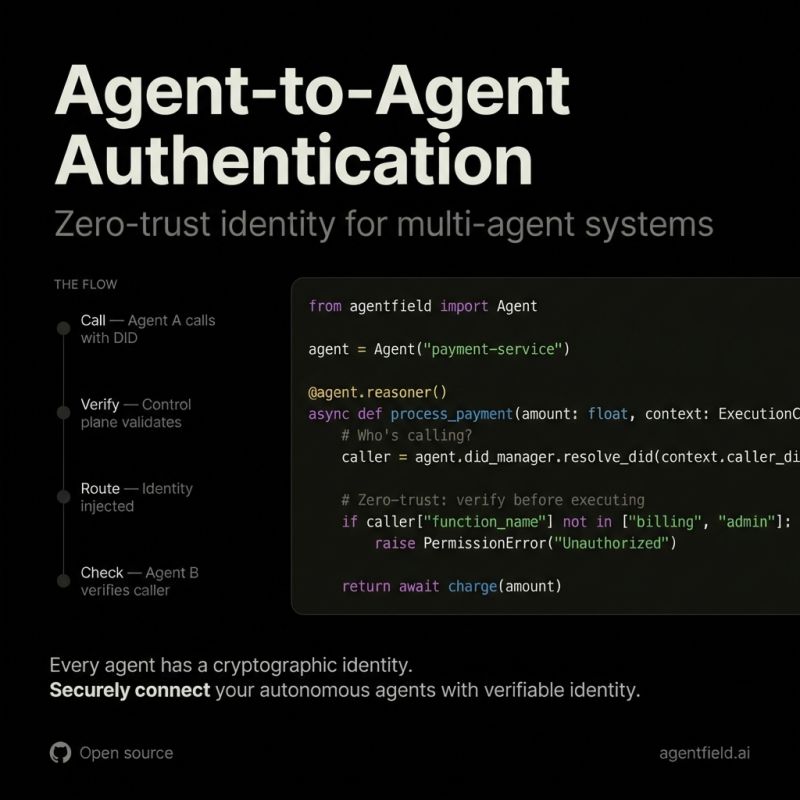
Zero trust Agent-to-Agent Authentication ?
If you're building multi-agent systems and you're not thinking about this, you should be.
When Agent A calls Agent B:
- How does B verify A's identity?
- How do you audit who called whom?
- How do you revoke access if something goes wrong?
AgentField: cryptographic identity for every agent. DID-based verification. Zero-trust by default. Let Identity and auth be part of your infrastructure.
And the best developer experience is cherry on top 🍒 ( yes its that easy! )
Open source: https://t.co/m5yHT3wET2
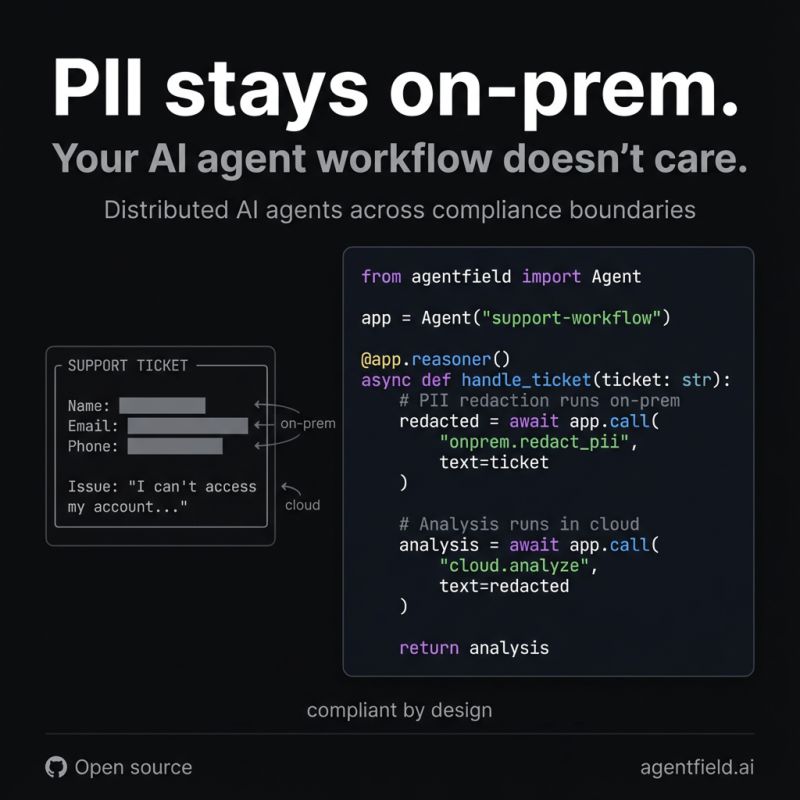
Hot take 🔥: Most AI agent frameworks think everything has to live in one cozy box.
What if your agents could run on-prem - and still just… work together seamlessly?
No custom networking mess
No message queues to babysit
No serialization nightmares
Just: Agent A calls Agent B.
The AI Backend magic handles the rest
Haven't checked out Agentfield yet? 👀
→ https://t.co/KeheA9dMVJ
Open-Source • Apache 2.0 🚀
The next infrastructure layer isn't about smarter prompts.
It's about agents that deploy like microservices, discover each other, and prove what they did.
Singapore → Feb 7th.
Let's build the next layer together. 🇸🇬🚀
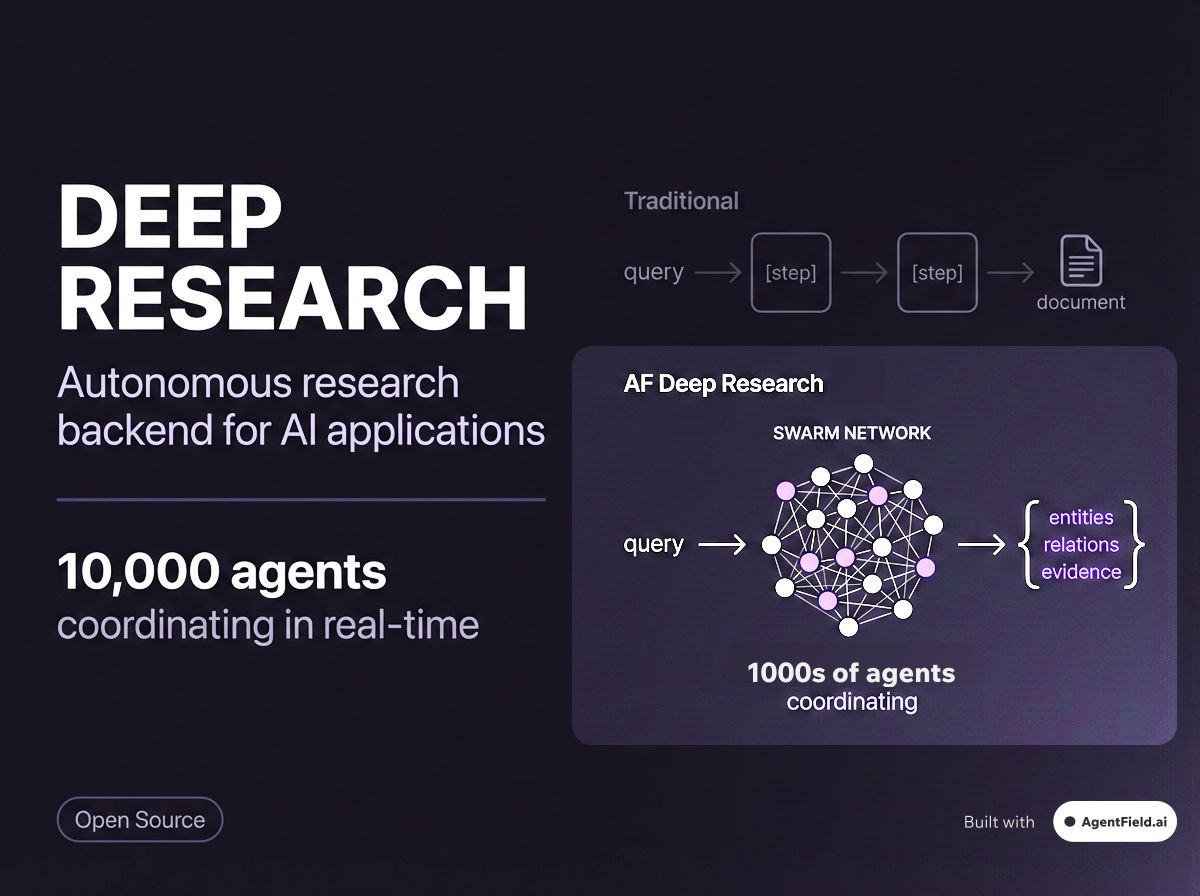
What happens when deep research enters your AI backend?
Most research tools are built for humans to read. When the machine is the consumer, your entire architecture changes, you optimize for computation, instead of comprehension.
Today we're releasing AF Deep Research, a deep research unlike any other, built for machine-native research. 🚀
What makes this architecture different:
• Guided exploration at scale: 1000's of agents deciding what to investigate next, within defined boundaries
• Higher-order analysis: surfaces cross-source correlations and causal relationships no single document reveals
• Structured output for machines: typed entities, directed relationships, evidence chains with citations. Data systems can reason over, not just read
• Full infrastructure control: open-source models, no third-party constraints, deploy inside your own environment
• Unlimited parallel scaling, you control how many agents run. No rate limits. No waiting.
Here’s where it gets interesting. A few examples of what's possible:
• M&A due diligence: agents parallelizing across patents, supplier networks, regulatory exposure, key person risk. Coordinating to find what's missing from the data room. Output flows directly into valuation models.
• Clinical trial design: agents researching competing protocols, FDA feedback letters, biomarker validation literature. Exploring novel endpoints as they surface. Structured output plugs into trial design software.
• Supply chain risk: agents recursively mapping Tier-N suppliers to surface hidden concentration risks in suppliers-of-suppliers you've never heard of. Risk scores feed straight into SAP Ariba or Resilinc.
These are just a few. We are more excited to see what others build on top of it.
AF Deep Research currently supports OpenRouter for AI Models, Jina AI, Tavily, Firecrawl and SerpApi for scraping, https://t.co/04ssFtesID is the control layer that turns raw data into structured intelligence.
2 lines of code to host and try it. Apache 2.0. Self-host it.
Bring your own models.
AgentField: https://t.co/m5yHT3wET2
AF Deep Research: https://t.co/zGEN7koAAN
What would you build with this massive scale of research as infrastructure? ��
If you’re building with agents - copilots, internal automations, agentic apps, AI-driven ops - the constraints you’re hitting (auth, long-running tasks, orchestration chaos, missing audit) are symptoms of the same root issue:
The stack wasn’t designed for autonomous software.
AgentField is that missing backend layer: run agents like services, with proof, not logs.
Read the announcement: https://t.co/YVEV5ZELGk
🚀 AgentField is live - the open-source AI backend for autonomous software.
Agents are moving beyond chat into systems where they touch money, data, and decisions. The traditional backend stack (OAuth for humans, API keys for static services, DAGs for brittle flows) breaks there.
AgentField gives agents cryptographic identity (DIDs), delegated trust (VCs), long-running execution, async orchestration, and verifiable audit receipts - so you can run agents like micro-services in production, with policy-as-code and full observability.
Why this matters: as autonomous software becomes real, we need an AI-native control plane where agents can:
• carry identity + authority across hops
• run long, branching, multi-agent workflows (hours/days)
• generate tamper-proof receipts for every action
• operate safely inside production systems behind guardrails and policy
That’s what we built with AgentField.