One session ends → poof. Everything important disappears.
A teammate cracks a brutal prod issue → it dies in their terminal forever.
Next week you’re debugging the exact same damn problem for the third time.
We were so done with it.
So we built Hivemind. A shared memory layer that connects Claude Code, Codex, and OpenClaw across sessions and across the entire team.
Tag the teammate who keeps debugging the same bug twice 😂
Building a truly continual learning is hard. Deciding where to store the learning is not yet figured out. Is it cn the context, updating weights, or learning cartridges? What signal it should supervise the learning from? How do you learn from your own traces?
There many more questions one needs to answer. We did many experiments to help with building continual learning.
Can AI learn from its own traces?
To build a true continual learning system, I had to answer the following questions.
- What is in the agent traces?
- Where should model store the learning?
- Which it should supervise from?
- How do you learn from failed experience?
- Which learned capability should it route to?
To close the loop. Did more than 40 experiments. Shared our findings in 7 research reports.
From Learning From Your Own Traces to The Loop Running End to End
Link to the first article below👇
Hivemind is now on WhatsApp.
Ask it what your agents are doing:
“Can you check the status of my agents?”
“What did the team work on last week?”
• See agent activity and outputs
• Switch between organizations
• Get team recaps
All from one WhatsApp chat.
Every eng team working with agents now has the same problem: documentation is outdated the moment it's written.
So we made it self-updating.
Hivemind already turns your coding agents' traces into skills. Now that same pipeline maintains your docs.
As your agents learn, your documentation stays current.
Because everything traces back to source, two things get dramatically easier:
• If you get a new team member, they onboard on docs that reflect how things work today.
• Something sticky happens with an agent? See exactly what led to the choices it made.
Get started with Hivemind and stop manually shuffling with docs today.
We talked to hundreds of engineers at AGI Summit this weekend.
We started to notice some patterns around issues.
The same frustrations came up over and over:
• “We are trying to reel in our engineer spend and API cost on tokens”
• “We’re seeing the same bugs come up repeatedly from different engineer output. There doesn’t seem to be any knowledge carry over from things we’ve already fixed across teammates.”
• “Our knowledge base doesn’t seem to be enough to optimize agent output. My agent finally learns our codebase conventions, then the session ends and it's all gone."
Are you facing similar issues internally? What do your agents keep forgetting? 👇
Over the last 90 days, we captured traces from our coding agents to do continual learning.
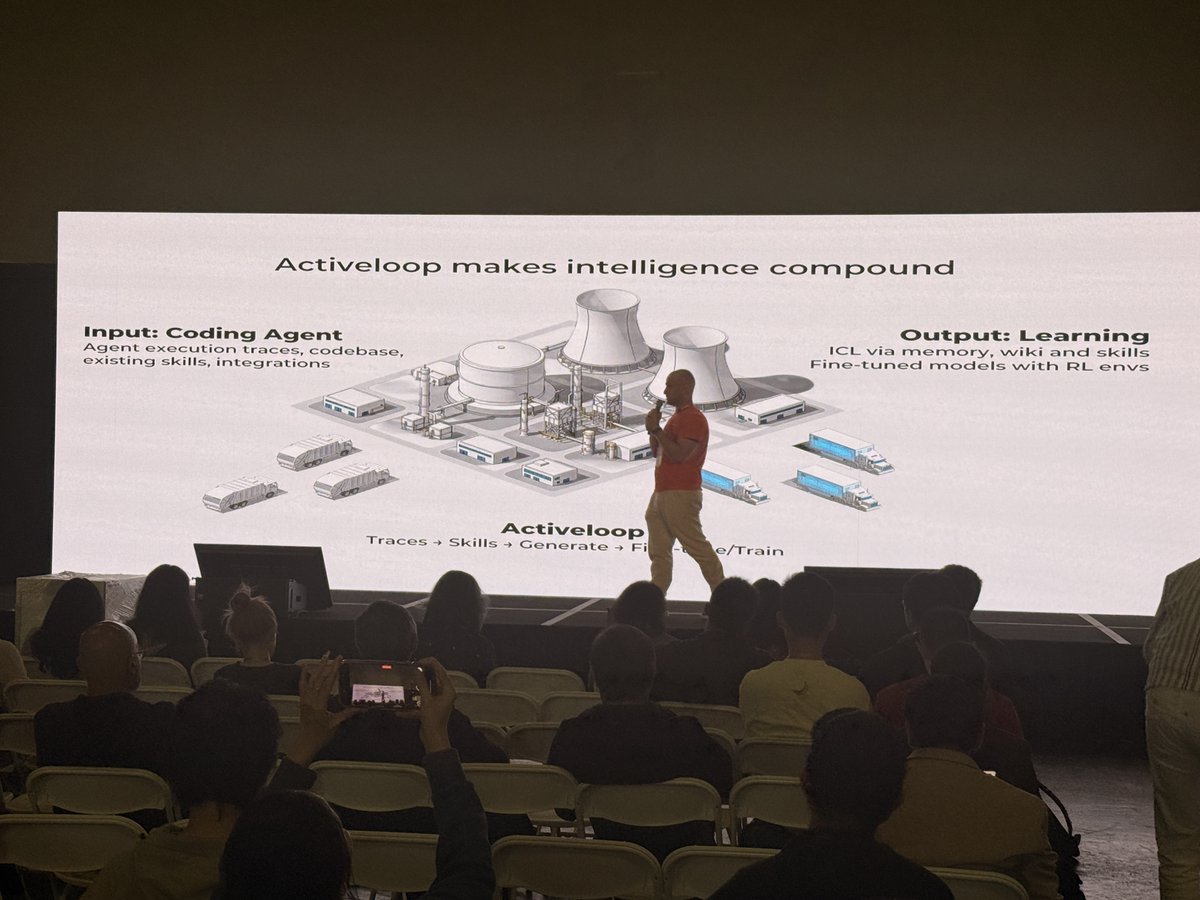
Here’s what I shared during my keynote on the Continual Learning Loop at the AGI Summit.
We plugged Hivemind into every coding agent at the company: Claude Code, Codex, Cursor, OpenClaw, and Hermes.
- 93% of tokens are used for computer interaction
- 77% of sessions contain at least one correction
- 60% of sessions are judged by an LLM to have been resolved correctly
More interestingly, 1 in 10 sessions leaked a secret credential to an LLM provider.
In-context learning is considered one of the best continual learning methods so far. But how good is it?
Apparently, it is 80% as good as weight updates without all the heavy lifting of fine-tuning.
Naive SFT on coding-agent traces causes the model to collapse. At best, it delivers only marginal improvements. As coding agents use frontier models, distillation can work into smaller models.
But learning from your own LLM traces is very hard. You can easily
- misalign the model
- forget knowledge
- lose capability.
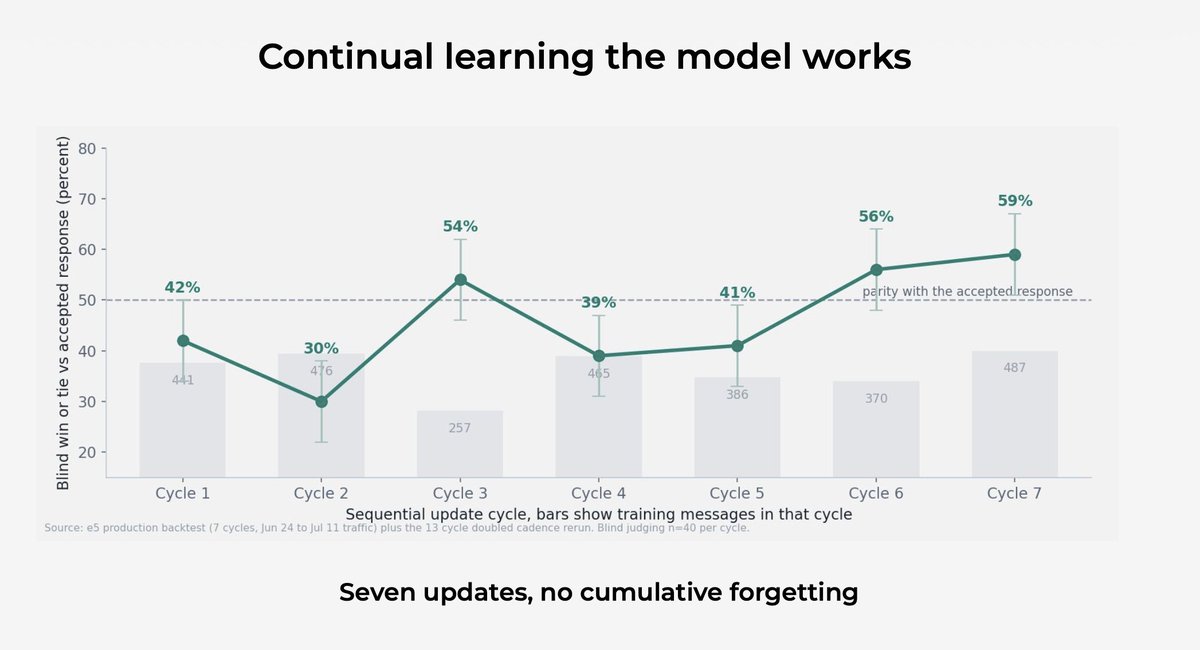
Doing this continually is even harder. You can easily run into cumulative catastrophic forgetting.
Furthermore, learning a new capability from your own traces does not work. So how can we expect the model to develop new capabilities?
How can we dream?
One recipe that worked for us was generating the missing experiences based on failures observed in the traces.
We then used RL environments to train the model and ran it in shadow mode for three weeks. It outperformed Claude Code 60% of the time.
Many people asked, Where should we start?
Start capturing your traces now.
That's a wrap on AGI Summit 2026
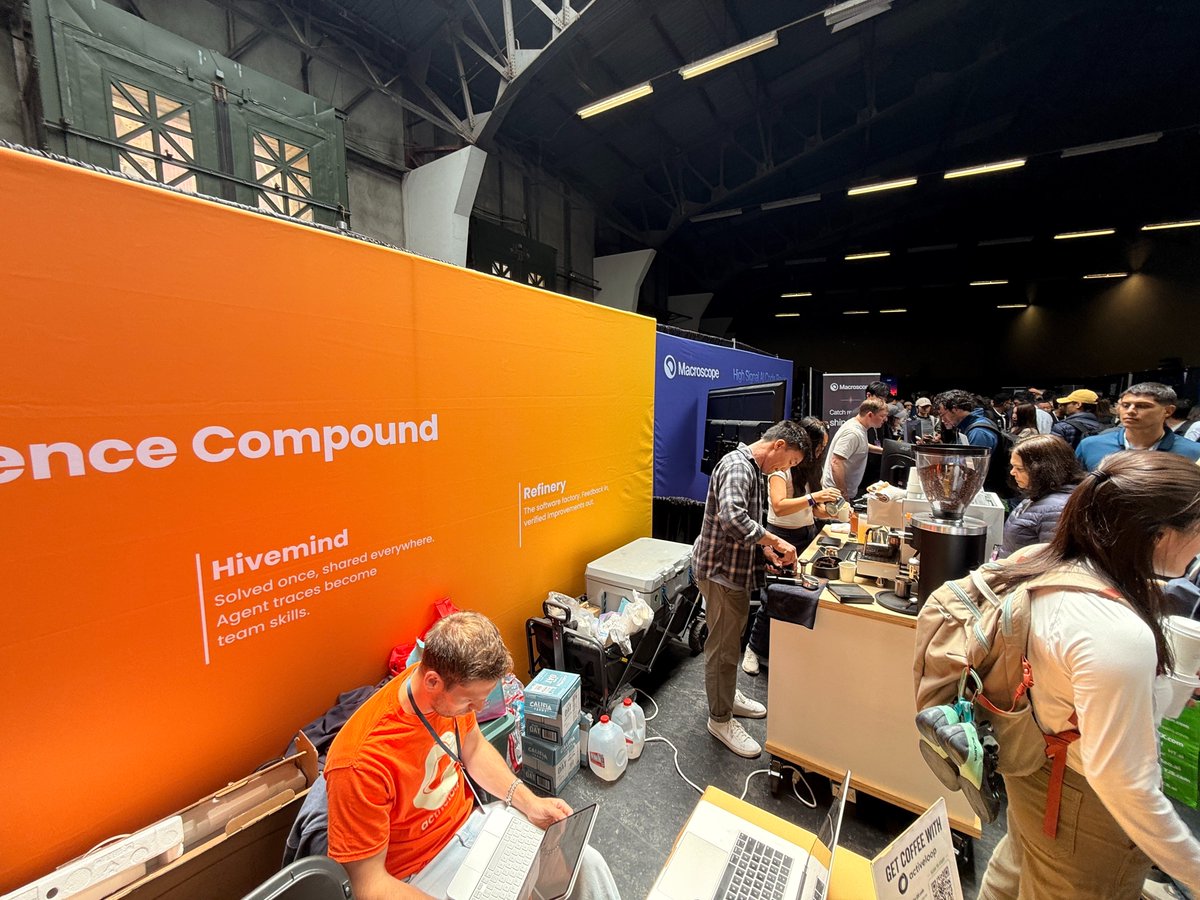
Two days at the Palace of Fine Arts. 500+ of you stopped by the booth and wanted to learn more about the infra layer that levels up your coding agents.
Standard memory tools collect prompts and outputs.
Hivemind turns your coding agents' traces into skills: crystallized once and propagated to every agent on your team.
Legion Code cut token spend 34% (~$12K/month saved) doing exactly this.
Missed us at the booth? DMs are open.
Agents that compound.
Stop guessing what your AI infrastructure costs.
Hivemind is one monthly price with a high usage ceiling. No usage math and no surprise bills.
It pays for itself too:
1. Traces become skills
2. Agents stop repeating work
3. Token spend drops 33%.
Make sure you have continual learning on for your AI agents.
We have 3 new updates to Hivemind that are in service of our mission: making organizational agents more cost efficient and effective.
1. Proactive search experience for Claude Code + Cursor. After each user prompt, Hivemind automatically searches for relevant stored traces from the past and passes them to the agent as additional context. This improves reasoning and output.
2. Ability to share skills across teams and devices. Skill sharing is a simpler feature: it syncs the skills a user already has in their system through Deeplake, so everyone on the team can access them. Previously, we were more focused on generating and improving skills. This is about sharing existing skills across the team.
3. Ability to create and assign goals. Any teammate can create and assign goals to another that can persist across sessions until marked completed. Agents can automatically reason when the goal has been reached, and will notify the creator of the goal automatically.
All of these new features work to level up your team, reduce errors and redundant work and lower AI token spend.
Get set up with one command line install.
serving data to labs is a depreciating function. once in the model, data looses its value.
however, finding rarer data becomes exponentially more challenging and valuable.
hence labs would pay far more for finding those edge cases in nature.
The future of the firm is a learning loop in which human capital and token capital compound.
With our new Frontier Co., our ambition is to help every enterprise build its own AI capability, and to help create a frontier ecosystem where every organization can turn its knowledge, workflows, and judgment into its own AI systems that continuously improve. https://t.co/mvYhkRFyqa
great to see that Microsoft adopting @activeloop.
every firm is going to be in active loop from small to F500.
co-designed with humans in the loop and tokens.
Hivemind just crossed 250 stars on github
2K weekly downloads on NPM. 🚀
Connect coding agents to a shared brain
> Collect traces into deeplake
> Auto-optimize skills
> Share across agents, machines and teammates
Your agents continuously learn from each other's experience.
Get them to compound your intelligence.
Hivemind helps coding agents get smarter with every team interaction, across all your agents, not just one.
SkillOpt is what makes it real: your skills don't just accumulate, they get trained on your own traces and sharpened over time.
The result is measurable. +19.1 points of accuracy in Claude Code, +24.8 in Codex, best or tied on all 52 setups tested.
Your codebase becomes a graph-based knowledge base, helping your agent retrieve the right context beyond simple ranking.
Coding agents that actually get better the more your team uses them.
Introducing Hivemind: continual learning for AI coding agents.
Hivemind turns the traces from every agent your team runs (Claude Code, Codex, Cursor, Hermes, OpenClaw, Pi) into reusable skills, then pushes those skills across all of them. All on your cloud storage.
Now with SkillOpt built in, your skills get trained: +19.1 points of accuracy in Claude Code, +24.8 in Codex, best or tied on all 52 setups tested.
Open source, one line install.
Coding agents that actually get better the more your team uses them.
Introducing Hivemind: continual learning for AI coding agents.
Hivemind turns the traces from every agent your team runs (Claude Code, Codex, Cursor, Hermes, OpenClaw, Pi) into reusable skills, then pushes those skills across all of them. All on your cloud storage.
Now with SkillOpt built in, your skills get trained: +19.1 points of accuracy in Claude Code, +24.8 in Codex, best or tied on all 52 setups tested.
Open source, one line install.
Agentic LLM systems this year have mostly gone to coding, browsing, research.
With the @activeloop (Deeplake) team, we pointed agents at a job they don't usually do: curating a robotics dataset.
Roboscribe-AF automates the work a human curator would do — segment episodes, cross-check video vs trajectory, flag the messy ones.
Disagreements between reasoners get written back as queryable Deeplake fields.
Open source: https://t.co/mJumKkKGeb