The existing financial system neither reflects the culture nor addresses the economic realities of this upcoming generation of financial participants.
Our team, composed of emerging market citizens and perma-online Gen Zers are here to build the financial operating system for the internet-native generation.
We’ve spent the past two years building MegaEVM, the fastest execution environment in the industry. The MegaEVM withstood a 11B tx stress test in mainnet production, averaging 40k TPS, while consistently charging lower fees than all others competitors.
Our technical milestones paved the way for a collaboration with @chainlink to begin building the first real-time oracle, providing unparalleled speed and security to the DeFi ecosystem.
The past two years has seen a notable and eventful ecosystem grow through MegaETH. Today, some of the most interesting new applications sit on Mega. The points program on Terminal has allowed crypto-native users to further explore the initial Mega Ecosystem, but we believe it has run its course.
We will be providing boosted USDm rewards to all eligible participants in the program. Moving forward, we will double down on sourcing and accelerating the best applications on MegaETH through personalized GTM, targeting users beyond crypto.
We are momentarily launching the MOSS SDK, a self-custody wallet that unifies liquidity between applications while maintaining top in class security through smart approvals.
These pieces lay the foundation for M(OS)S to become the financial OS built for users born to this generation.
Live Q3, MEGA blends finance and entertainment with primitives and risk preferences that have never been available to everyday users.
The MOSS SDK is uniquely positioned to solve the embedded wallet <> generalized wallet dilemma by giving best in class security guarantees to users across all apps while still maintaining one unified account.
MOSS SDK builds on the foundational work of Porto by Ithaca, providing a user-first mentality to product. We look forward to working with applications to integrate Moss and provide users with a solution to the crypto UX problem.
The legacy financial system merely adopted the internet, it was not born in it. M(OS)S is being built by people who understand the culture of internet-native users and how finance, entertainment, and identity are converging online.
@kirsanovtrade Don't you think that the bottom in $MEGA is also simply determined by the bottom in $BTC - meaning if $BTC would show some aggressive downside over the next weeks and months, $MEGA wont hold well too. That's what I'm playing...
THEY DID IT.
The SEC and CFTC just dropped a landmark document that officially classifies crypto assets.
They're actually telling us which crypto assets are securities and which ones aren't - by name!
THIS IS SOMETHING GENSLER REFUSED TO DO
(he focused on prosecuting crypto out of existence)
This rule doc gives crypto many of the benefits of the clarity bill - it lifts us out of the gray market - it gives every asset a path.
It's almost like the Clarity act just passed by way of regulator.
(of course, the actual clarity act will harden all this into legislation and make it irreversible in the event we get another Gensler, we still want it)
This rule says there's 5 categories for crypto assets:
1) Digital Commodities - assets tied to a functional, decentralized crypto system (e.g., BTC, ETH, SOL, XRP, ADA, DOGE). Not securities. (yes, they name them on page 14)
2) Digital Collectibles - NFTs, meme coins, artwork tokens, in-game items. Not securities (fractionalized collectibles may be an exception).
3) Digital Tools - membership tokens, credentials, domain names (e.g., ENS). Not securities.
4) Stablecoins - payment stablecoins under the GENIUS Act are not securities. Other stablecoins, it depends.
5) Digital Securities - tokenized versions of traditional securities. Like tokenized stocks. Always securities.
Amazing! This makes so much sense I can't believe it's coming from a regulator.
No more enforcement threats to Ethereum developers and crypto exchanges.
How about the Howey test?
More common sense! If an issuer makes specific promises of managerial efforts from which buyers expect profits, the offering is a security until those promises are fulfilled. Then it's a commodity. The asset itself was never the security, the deal around it was. (E.g. XRP was a security pre launch, became a commodity after).
How about stuff like staking and mining?
Mining? Not a securities transaction.
Staking? Also not a securities transaction, that includes custodial and liquid staking even with LSTs!
How about wrapping BTC? Not a securities transaction.
Airdrops? NOT SECURITIES. NO MORE GEO BANS PROTECTING AMERICANS from free airdrops.
Remember this is a joint doc from the SEC and CFTC, They're actually cooperating on this, no internal strife, this is binding to both.
SEC regulates $80-100 trillion assets
CFTC regulates $5-10 trillion assets
Both of the world's largest capital markets are showing us that crypto assets are here to stay and they're welcome alongside traditional assets.
Every country will follow.
This is the biggest move toward legitimacy I've seen in all my time in crypto. Maybe bigger than the genius act since is covers all crypto assets.
Well done @MichaelSelig and @SECPaulSAtkins.
And especially well done to the indefatigable @HesterPeirce. Her fingerprints are all over this, couldn't have happened without her eight years of principles-based curiosity.
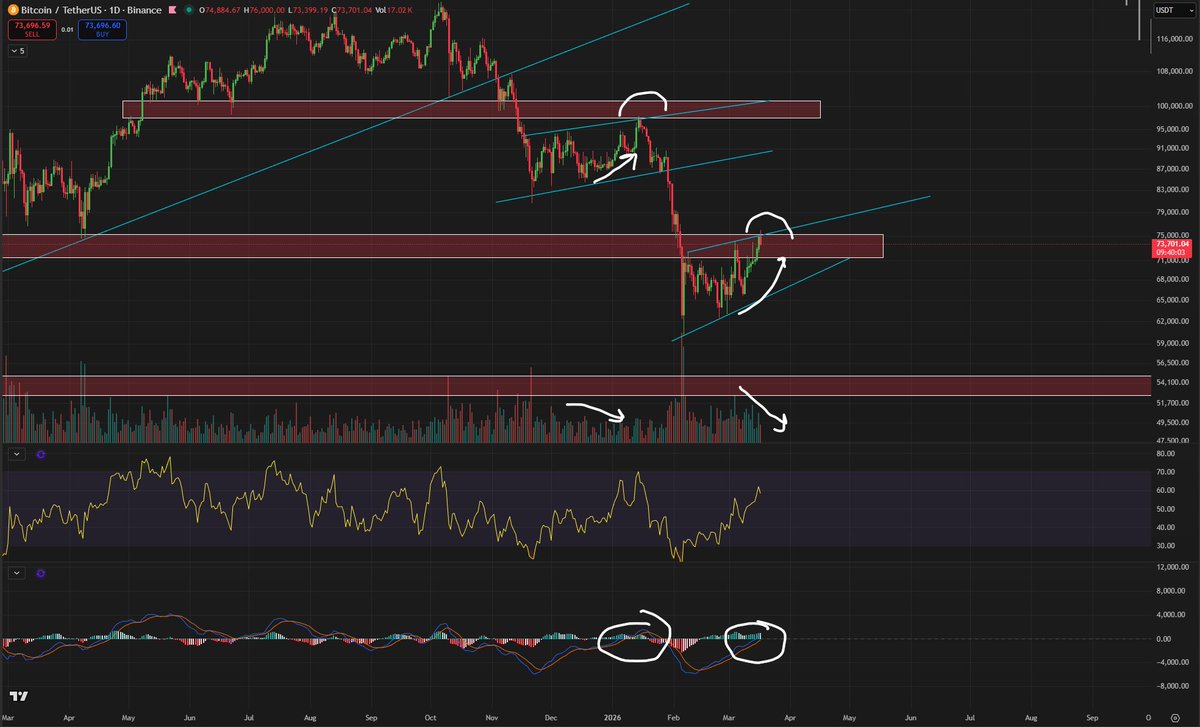
$BTC 1D
It looks almost exactly the same.
Bear Flag Breakdown & Retest with low volume on the upward move.
Most oversold indicators have completely reset.
AI agents won’t just use crypto…
They’ll become the primary users of blockchain.
@cz_binance predicts AI agents will make 1Mx more payments than humans..
The agentic internet isn’t coming.
It’s already here. And it needs infrastructure built for it.
If Bitcoin sees no counter-trend relief rally, and instead continues the downtrend to sub $50k (into March/April), the possibility this type of action induces an early 4 Year Cycle low is real.
Again just possibilities, but extreme price action can/does force premature ends to cycle. Those price levels, regardless of where we think the low forms from a time perspective, should be too good to pass up, accumulate.
Then what you see during the "expected timing - Q3" is a retrace and only partial test of the lows.
Stay flexible, multiple paths. Focus on accumulation opportunities now, not doomer posts.
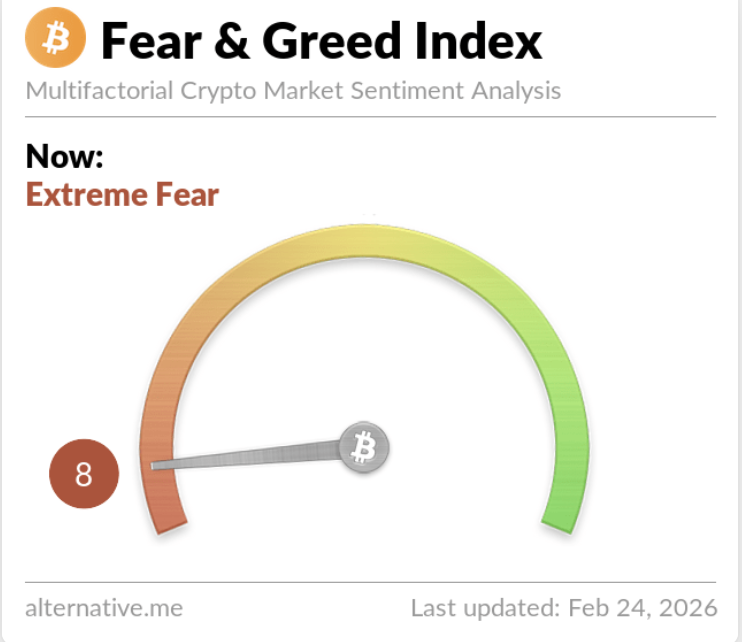
Signs of a bear market (as noted in November) are when we get "extreme fear" and no bounces occur.
The Fear & Greed Index is good at identifying local lows in bull markets, not identifying macro lows in bear markets.
The price of Bitcoin color-coded by social interest shows that BTC topped on apathy rather than euphoria, similar to mid-2019, which also corresponded to an end of quantitative tightening.
Everyone loves to play the blame game in bear markets, but Bitcoin has always topped in Q4 of post-halving years.
People want a narrative, but narrative follows price.
The most likely low for BTC is October 2026, based on the 4 year cycle.
Under some circumstances it could happen as early as May.
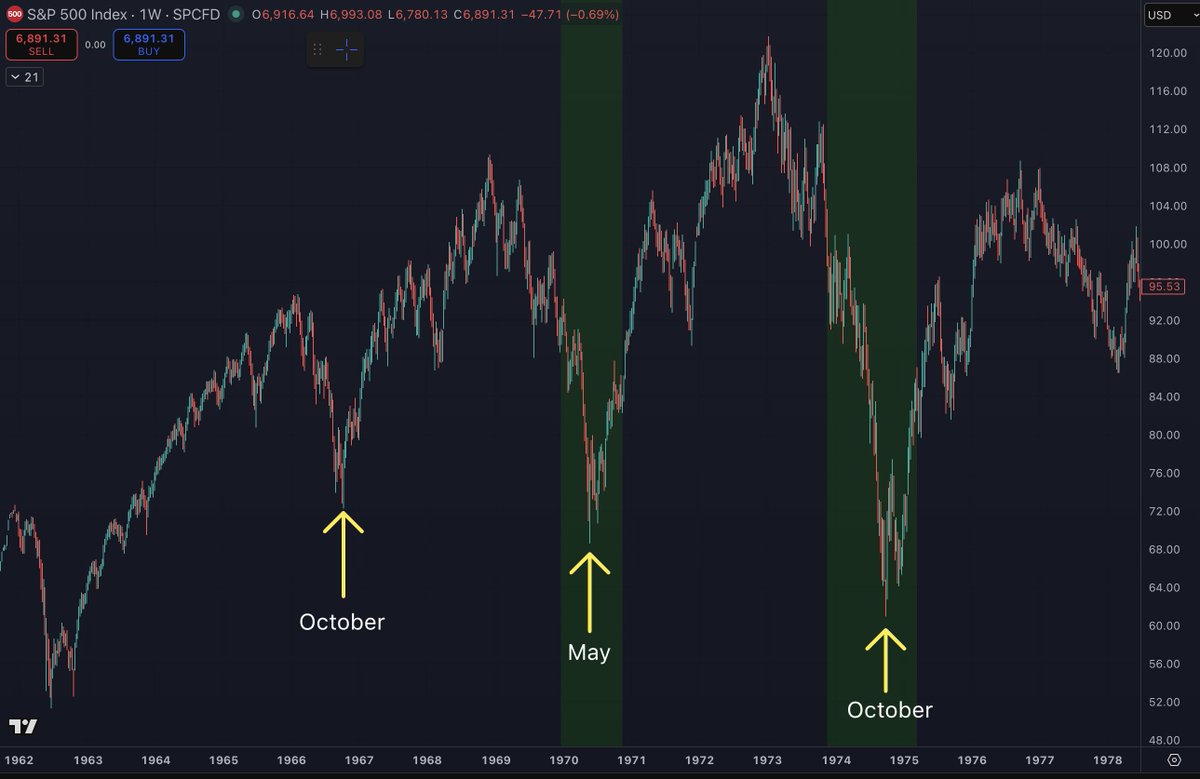
BTC does not have a monopoly on the four-year cycle.
You can that the S&P 500 has gone through many periods where it bottoms approximately every 4 years.
Major lows tends to occur in early Q4, but in some cases it occasionally happens in May.
October would be favored if we get multiple week-to-month long countertrend rallies that delay things.
May would be favored if the countertrend rallies just last a few days to a couple weeks, and deeper drawdowns occur sooner.
I favor October over May for now, but as an investor we have to be aware that markets can always evolve in ways we do not expect.
Every cycle is the same.
Yes, crypto could bounce. And honestly, it would be great for sentiment if it could. But even if it does, it would most likely result in a macro lower high.
I don't try and time those bounces. I have tried before with mixed levels of success. Sometimes it works, other times I got rekt.
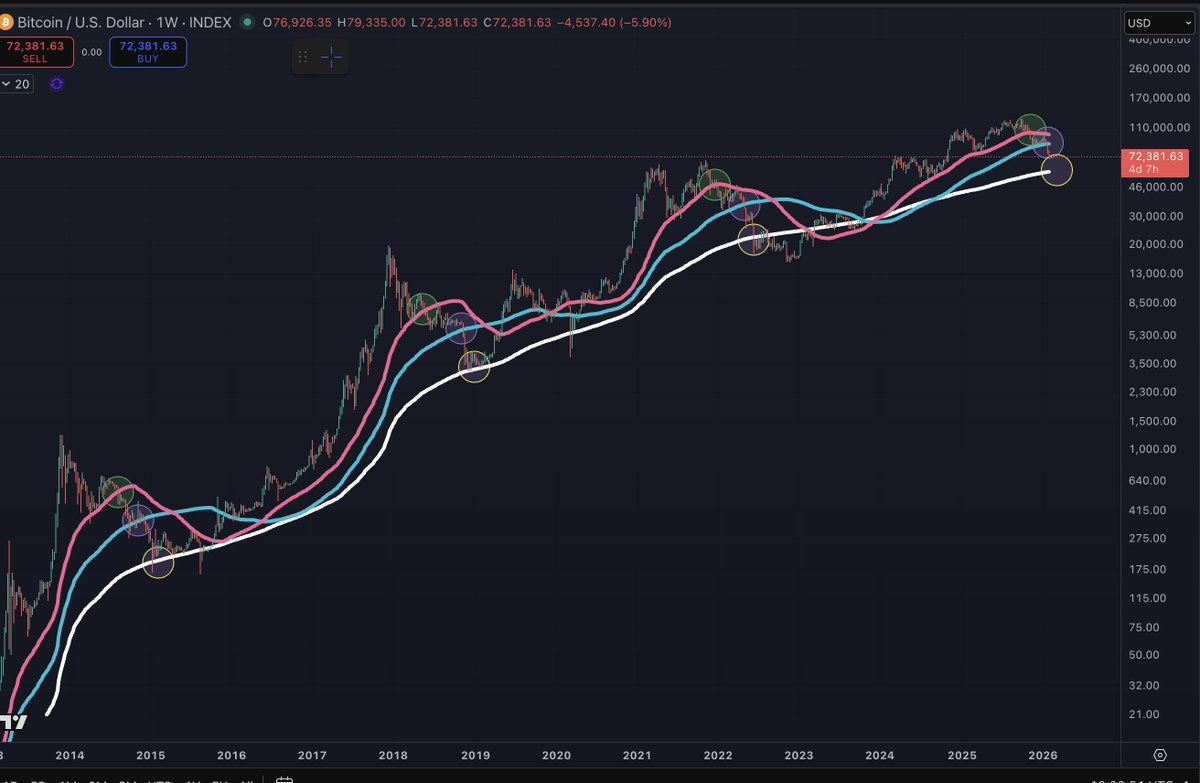
When BTC drops below the 50W moving average, it then goes to the 100W moving average, spends a little time there, then goes to the 200W moving average.
Every cycle is eventually the same.
BTC topped when it always does (Q4 of the post-halving year), and so many have spent so many hours trying to convince you that it has not.
And BTC entered into a bear market, and so many have tried to get you to believe that alt season is "just around the corner" because it always happens after BTC tops. What they fail to account for is social interest. After the 2019 top there was also no rotation into altcoins, which also occurred just before QT ended.
I track the social interest in the asset class, and it has been trending down since 2021. There is no one new here for people to sell their altcoins to.
Alt seasons historically occur *after* social interest has been trending up for a year, not after it has been trending down for 5 years.
Have an actual plan on navigating this brutal asset class. Because if the altcoins you hold drop another 50%-80% from here, not a single influencer who promoted them will express an ounce of regret for it. And you will simply be living with the consequences.
I get a lot of hate for saying the truth, but an inconvenient truth is better than a lie.
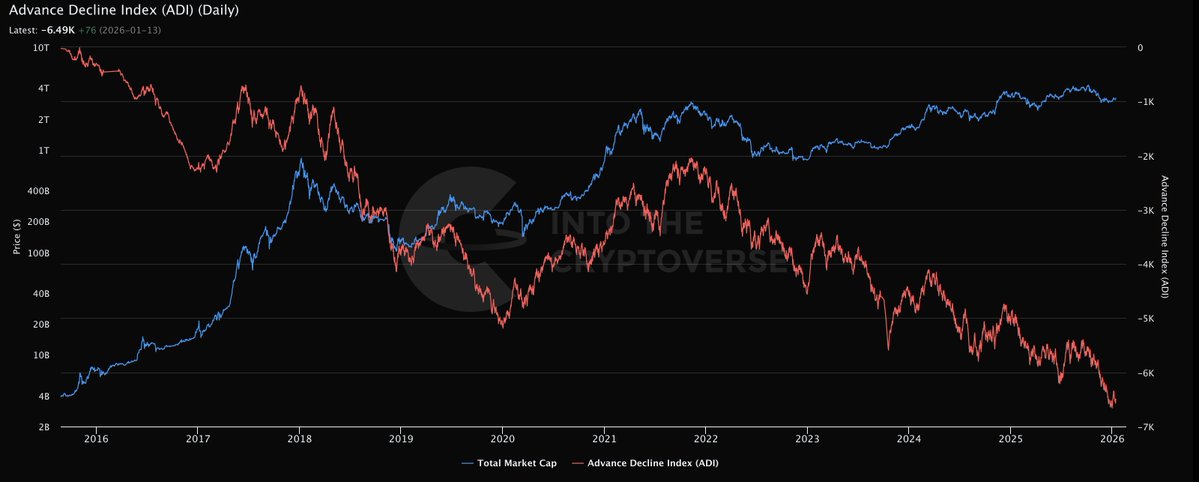
Don't try to manufacture the crypto bull market in 2020-2021. The Advance Decline Index of the top 100 cryptocurrencies has been in a brutal downtrend since 2021.
The uptrend you see in 2020-2021 is the bull market people remember, when the BTC bull market was accompanied by breadth throughout the asset class.
However from late late 2021-2026, the ADI of the top 100 cryptocurrencies has been decreasing.
BTC's bull market was more of a defensive positioning play (people selling alts and buying BTC) plus some institutions buying BTC.
The broader altcoin market did not participate because there a general lack of interest in the crypto markets to begin with, and as more and more altcoins were minted, liquidity was spread thinner and thinner.
BTC's bull market masked some of the underlying weakness in altcoins for years. But now that BTC has stalled out for the last year, the weakness in the altcoin market has become much more apparent and harder for people to ignore.
https://t.co/hAevv2DLEE
I largely agree with @santiagoroel’s recent article.
Crypto is very clearly in the post–dotcom crash phase that the early internet went through. That has been my core assumption for the last 1–2 years already.
That said, I’d like to add a few important thoughts of mine:
1) I would separate Bitcoin from the rest. Just like gold ≠ tech stocks during the early internet era, Bitcoin ≠ altcoins today. That explains why BTC has held up relatively well while many of the best crypto projects are arguably going through one of the toughest bear markets ever.
2) Yes, after the dotcom crash in 2000 it took roughly 15 years for markets to fully recover and make new ATHs, despite user growth and fundamentals exploding. We’ll likely see a similar pattern in crypto. However, if you account for point 1), I’d argue that crypto’s equivalent of the dotcom bubble already burst in 2021.
On top of that, we live in a much faster moving world. Trends evolve quicker, adoption curves can go parabolic faster, and cycles compress. Because of that, I wouldn’t be surprised if the 15-year recovery analogue in crypto ends up being closer to 5–10 years. Given that we’re already a few years in, the odds that the worst is behind us don’t look that bad.
3) Many people treat this phase as if it’s the end of the world. I’d argue the opposite: this might be one of the best things that could happen to the industry. The last cycle was obviously insane, and expectations around valuations, airdrops, funding, and returns drifted far away from reality. This phase is incredibly valuable for crypto to reset, mature, build real businesses, and come back much stronger.
4) The period from roughly 2000 to 2007 was probably the window of maximum opportunity, one of the greatest investment windows in history.
Amazon, Google, eBay, and many others looked like dumb internet scams or overhyped startups back then. In hindsight, they turned into some of the most valuable companies in the world, delivering 100x or even 1000x returns. We love to shit on altcoins today, but I don’t expect this to look very different in 10 years.
That’s what maximum opportunity looks like. It feels uncomfortable. It feels non-obvious.
So like it or not, but the right time is right now.
We’re in early bear market.
Technical evidence is clear. Majority is trapped, denying simple facts. 4-year cycle context: midterms bring crashes.
Markets lead economy by 6-9 months. Future rate cuts & QE will start new bull in Q4 2026.
Rallies are for selling.
Eyeing $30-50k.