Beautiful, heartwarming picture.
Leon Rose, president of the New York Knicks, with his 88-year-old father on the court at 2 a.m. on championship night.
A lifelong Jewish Knicks fan, his father spent more than half a century waiting to see the Knicks bring a title back to New York.
And there he is, looking at his son with pure nachas.
Not as a fan celebrating a championship, but as a father bursting with pride.
After decades of waiting, they finally got to experience it together.
It’s one thing to call for a two-state solution. It’s another thing to present Israel as the sole obstacle to that solution.
This is what it looks like when an elected official works to actively misinform the American public.
A 🧵…
My grandfather @RabbiAviWeiss told me this story over the weekend. I'm sharing it for no reason other than it's a beautiful example of the kind of quiet, selfless heroism we should all try to embody.
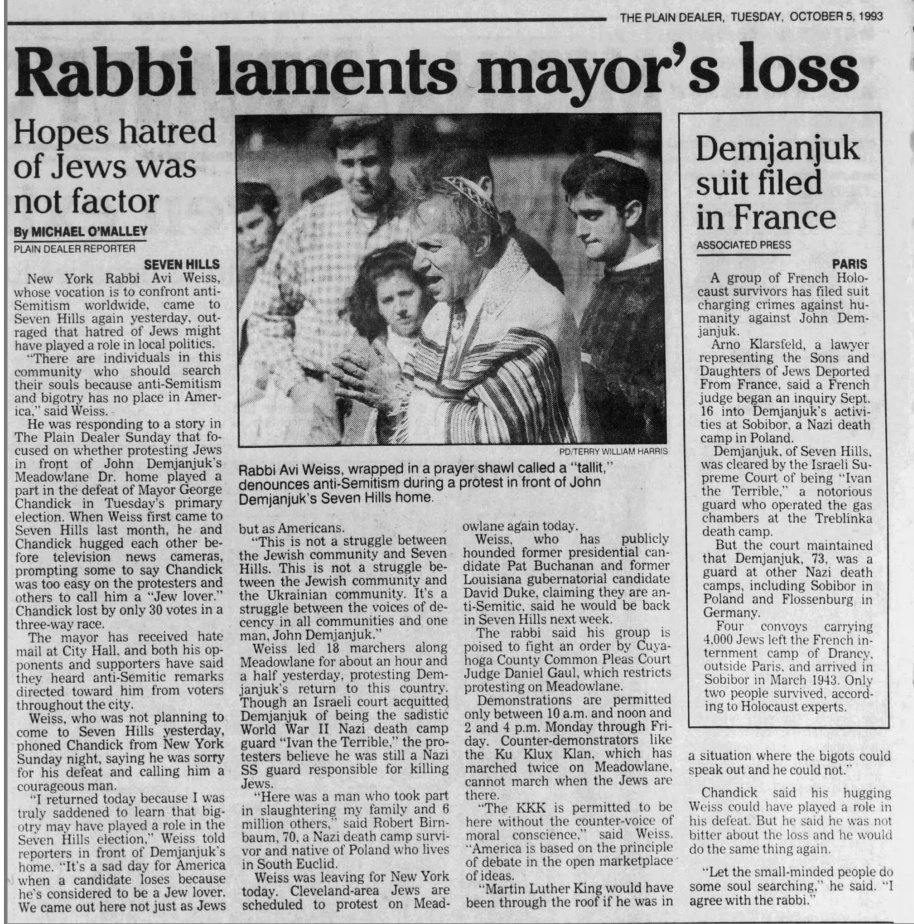
In 1993, my grandfather Rabbi Avi Weiss was leading protests outside the home of accused Nazi war criminal John Demjanjuk (A.K.A. "Ivan the Terrible") in Seven Hills, Ohio.
At the height of the tension, the mayor of Seven Hills — George Chandick — received my grandfather in his office with dignity and respect. At the end of the meeting, my grandfather spontaneously hugged him in front of the TV cameras.
The Cleveland Plain Dealer ran the photo on the front page. Residents were quoted saying they would never vote for someone who hugged a Jew.
Chandick lost his reelection bid by 30 votes.
When my grandfather called to apologize, Chandick stopped him.
"If I had to do it again, I would do it no differently."
He meant it. He later walked into my grandfather's Riverdale, NY synagogue and received a hero's welcome from the community whose dignity he had defended — at real personal cost.
The Plain Dealer followed up two days after the election with the headline: "Rabbi laments mayor's loss."
My grandfather lamented it. I'm not sure George Chandick ever did.
This is a devious rhetorical trick. Labeling someone a “Nakba survivor” is designed to evoke instant sympathy and a false sense of moral clarity, but it is little more than taxpayer-funded propaganda.
Consider the absurdity: roughly 99% of Palestinian Arabs alive in 1949 survived the war and its displacements. Calling the displaced a “survivor” stretches the word beyond recognition. It is a newly coined term, crafted in academia and activist circles long after the events.
Its real genius lies in creating false equivalence. It places ordinary Palestinian civilians who were displaced amid a war their own leaders launched on the same moral plane as Holocaust survivors (of whom only about one-third emerged alive).
It airbrushes away the ~6,000 Jews killed in 1948, elevates the ~12,000 Arab deaths, and erases the thousands of Jews forcibly expelled from the Old City of Jerusalem and other areas.
By anointing the displaced as sacred “survivors,” the term invites us to forget that the Nazi-aligned Palestinian leadership rejected the UN partition plan, chose war to prevent any Jewish state, and promised quick victory while urging Arabs to flee.
It glosses over Israel’s Declaration of Independence, which explicitly invited Arab inhabitants to “participate in the upbuilding of the State on the basis of full and equal citizenship.” And it conveniently overlooks the ~150,000 Arabs who stayed put, accepted Israeli citizenship, and whose descendants now form over 20% of Israel’s population.
This is international grievance politics pushed by the Mayor of New York City, who genuinely believes that Palestinians should be able to “return to their homes” – a nonsensical idea designed to justify perpetual victimhood and violence.
The move weaponizes real civilian hardship while inverting roles: turning a war of choice and rejectionism into an unprovoked “catastrophe” inflicted by the intended victims. It sustain grievance and does not nothing to advance peace.
The displacement of 800,000 Palestinians happened in the context of a war declared by Arab states explicitly to destroy the newly founded Jewish state after rejecting partition.
Some Palestinians fled fearing violence; some were expelled; some were encouraged to leave by Arab forces expecting a quick victory and return.
Nakba Day without this context is incomplete history.
Imagine if leadership in this country did even minimal due diligence before making sweeping changes that decimate the flaming house of cards that is our health system…
Doctors From Countries Under Travel Ban Now Allowed to Stay in U.S. https://t.co/kNlr2HKD5W via @NYTimes
Born in 2001 on Kibbutz Beit Zera in northern Israel, Deni is the product of a unique, only-in-Israel story. His Muslim father came from Kosovo to play professional basketball in Israel in the 1990s — and never left. He met Deni's Israeli mother there, herself a professional athlete, built a life, and raised a family. Deni identifies as Jewish, and has never let anyone forget it. His parents watched his son grow up to carry the Israeli flag across the world.
Deni debuted for Maccabi Tel Aviv at the age of 16, the youngest player ever to do so, and went on to win both the Israeli basketball league championship and its Most Valuable Player award. The wider basketball world soon took notice, and in 2020, he was drafted ninth overall by the Washington Wizards — the highest an Israeli player had ever been selected.
But before boarding a flight to Washington, Deni did something that every Israeli his age is required to do. He showed up to the Tel HaShomer military base with his parents and enlisted in the Israel Defense Forces. Due to his unique situation, he was granted a shortened service role as an "Exceptional Athlete."
"I am happy and proud to join the IDF just like every other citizen of my age," he said at the time. "I will do whatever is asked of me just like I do on the basketball court." Then he went to America and became a star.
Read the full article: https://t.co/TR6zwkMynq
In Opinion
Rebecca Archer’s daughter died of measles that she contracted before she was old enough to be vaccinated. “Parents must realize that refusing vaccinations doesn’t just put your own child at risk. It puts other children at risk,” Archer writes. https://t.co/AerHBIb23U
Two years ago, I happened to attend a Shabbat gathering of bereaved families in Tel Aviv. Usually, in a full synagogue, there are something like five Levites, one woman who recently gave birth, perhaps a Bar Mitzvah, and four people reciting the Mourner's Kaddish.
But when they reached the Kaddish there, the entire synagogue—hundreds of congregants—stood up and said, "Yitgadal v'yitkadash shmei raba" (May His great name be exalted and sanctified). Because their loved ones fell on Simchat Torah of that year or in the months that followed.
I was reminded of another time something like this happened to me, in the synagogue at Hadassah Ein Kerem Hospital, a year prior. When suddenly a line formed of five or six fathers who had come to name their newborn daughters, alongside three circumcision ceremonies for sons.
And I thought about these places, seemingly opposites of one another. And about the painfully short distance between the naming of a child and the reciting of the Kaddish. For the fallen remain teenagers, or in their twenties, but in our eyes, as we grow older, they look younger and younger every time.
And I thought about how each and every one of these fallen soldiers was blessed at their circumcision with the words, "Sustain this child for his father and his mother." And the child was sustained, until he decided, of his own absolute volition, to leap into the fire, in a country where people run toward the inferno as if running to the sea.
And afterwards, in the hall next to the synagogue, I passed by and caught a conversation I couldn't believe could exist. Bereaved parents were debating when it is harder: when the fallen son leaves behind young orphaned children, or when he never had the privilege to do so. And I thought that perhaps we should say here toothe prayer from the Day of Atonement: "We permit praying with the transgressors."
Because we are all the transgressors who continue with our lives, with our quarrels. Transgressing every day the commandment "Do not forget" and the vow "To be worthy." And perhaps here too, in our country, the time has come, from the last Memorial Day to this one, to lift all the boycotts and excommunications because of which—yes, because of them, too—this evil and this concealment of God's face came upon us.
The fallen of this campaign—which still has no agreed-upon name and no end date—are nevertheless different from their predecessors. Because we did not imagine that in our generation, kids like Matan Abergil and Yochai Duchen would still jump on grenades. Or that even in an iPhone reminder, not just with a fountain pen, one could write words like those of Ben Zussman: "I am full of pride and a sense of mission, and I always said that if I have to die, I wish it to be in defense of others and the state. Jerusalem, I have posted watchmen, that the day will come and I will be one of them."
But primarily because they went out to battle and did so with a clear mind. Despite long years of division and internal struggles, which supposedly should have erased any sign of willingness to die for people who think differently.
Regarding the First World War, an American author wrote, "A century of middle-class love was spent here in the trenches." Here with us, heaven forbid, it was not squandered. And it is not a century old. It is a three-thousand-year-old love for this people and this place, stronger than any momentary struggle, passed from generation to generation, at an astonishingly early age. And as Yehuda Amichai wrote, "A man leaves a house, but the house does not leave the man."
History will forget the political struggles and the momentary interests, but it will remember well how the tables turned between Simchat Torah 2023 in Be'eri and Passover 2026 in Tehran. It will distinguish between the essential and the trivial, and it will see light in the darkness of the "Cleared for publication by the IDF Spokesperson" announcements.
We did not invent this mixing of Memorial Day and Independence Day, which touch one another yet no realm encroaches upon its neighbor. 2,400 years ago, many Israelites stood on a mountain in Jerusalem at the dedication of the Second Temple. The young rejoiced over the Temple; the elders wept because they saw how modest it was compared to the First Temple they remembered. Naomi Shemer described it in the words: "Songs of lament, songs of praise, it mixes, it swirls." And this is how Ezra described it:
And the people could not distinguish the sound of the joyful shout from the sound of the people's weeping, for the people shouted with a great shout, and the sound was heard from afar.
During the Declaration of Independence, exactly 78 years ago tomorrow, Gush Etzion fell, and its defenders were massacred and taken captive. The death toll then crossed the two thousand mark just as the two-thousand-year-old hope was fulfilled. There was no house without mourning, and there was no street that did not fill with joy.
Alterman had already written eternal words about that hour:
"And the face of her joy is fierce/ And equally strong is the face of her sorrow/ And at the time of festival or lament they lie/ One at the door of the other/And the time is like a plowed field where they furrowed/ Love and hate and battle/ And the dust will burn until he arrives /He will come carrying his sheaves"
Alterman alluded to the verse: "Those who sow in tears shall reap in joy. He who goes forth weeping, bearing the seed for sowing, shall come home with shouts of joy, bringing his sheaves with him." For unlike the Second Temple, when the Third Temple was established, it wasn't that half wept and half rejoiced, but rather everyone wept and rejoiced together.
Most of us in the country acknowledge the miracle of the establishment of the State of Israel, yet fortunately, we have not experienced the terrible pain in our own flesh. On the other hand, there are those immersed in heavy mourning who cannot see the purpose for which it was required, and we have no right to judge them. But you sitting here acutely feel both the terrible sorrow and the spirit of history. These tectonic plates of sorrow and joy, memory and independence, these tectonic plates upon which the State of Israel sits, collide upon the tablet of your hearts every day and every hour.
You are the fault line. And within you is also the secret of the connection.
And I do not envy you, but I am jealous of your spirit. And like everyone else, I thank you from the depths of my heart and soul, and I ask for your forgiveness.
A week after the massacre, before the first rain, in Kibbutz Be'eri, they sowed the fields through which death galloped toward the homes. The biblical phrase "Those who sow in tears" was fulfilled in us quite literally. And if this part was fulfilled, it is guaranteed that the second part, "shall reap in joy," will be fulfilled in us as well.
-My speech at Ohel HaGevurah on Israel's Memorial Day.
This situation stayed heavy on our hearts for days.
A mother crow had been caught in an illegal leg trap, and her leg was badly injured. Letting her go like that would have meant certain death. We could tell she had been caring for babies recently, but we had no idea where they were.
For several days, animal control officers searched everywhere for her chicks, but they couldn’t find them.
At the same time, we were looking after a baby crow that had been orphaned in a completely different area. Holding onto a small hope, we decided to bring the two together.
As soon as the injured mother saw the baby, she walked straight to him. She gently held him with her beak, pulled him close, and then placed herself in front of him, protecting him from the people watching. She was a mother who had lost her babies, and he was a baby who had lost his mother.
The very next day, against all expectations, her babies were finally found.
She raised the orphan along with her own chicks at the rescue while her leg healed. When the time came, they were all released together—one large, happy family.
This will always be one of our most cherished rescue stories.
Liza Minnelli has outlived Kristi Noem's time as Secretary of Homeland Security. The plastic surgery addict enjoyed dressing up for photos while arresting minorities.
Weirdly, Iranian embassy in Pretoria notified us, Ukrainian diplomats, about opening a book of condolences in memory of ayatollah Khamenei and the military leadership of Iran.
I decided to respond - and do it in a public way. The letter explains why.
Your Excellency,
Mr. Ambassador,
Since you notified the Embassy of Ukraine of the book of condolences for deceased Ayatollah Khamenei and Iran’s military leadership, I feel compelled to remind you the following.
As military allies of the Russian Federation, the deceased leaders of Iran had on their hands the blood of thousands of Ukrainian citizens – men and women, children and elderly – killed with the help of the infamous Iran-made “Shahed” drones and other military know-how so eagerly provided to Russia by your government. Your leaders were complicit in bringing endless grief to Ukrainian civilians.
Being a person of faith, I try not to rejoice in the death of other people, even those who chose to be tormentors of my country that did nothing bad to theirs. But as someone who has spent three years to the tune of Iran-created machines of death howling every night in the sky over Kyiv and other peaceful Ukrainian cities, I cannot help but wish for every culprit to meet the justice they deserve. If not by human law, then in the face of God Almighty.
Ambassador, I do not know you personally and have no grudge against you. Sometimes good diplomats must speak for bad leaders and their policies. But I hope you understand that I won’t express condolences for someone whose death I do not mourn.
Sincerely,
Dr. Olexander Scherba
Ambassador