AI agents for your trading process, not your picks. Real agent workflows for traders, 3 new every US trading day. Education only, not financial advice.
Start here.
Real ways traders use AI agents for their own process. Each entry has the prompt, the guardrails and what went wrong. Every entry is reviewed by a five-reviewer AI council.
The Daily 3: three a day, free, on US trading days.
https://t.co/RyJe55bVlV
Agent of the day: your drawdown rules, checked before the session.
A script reads your equity log and your own thresholds and records the mode: normal, reduced or review-only. Missing or stale data means review-only, never normal.
https://t.co/AzVy0xLSau
Education only.
Midday read, Tue 3 Nov: a tech-led bounce on light volume. Semis +2%, industrials +1.3%; staples and materials -1.5%. VIX around 20.
Education angle: an agent that checks today's volume against its 50-day average keeps you from reading a thin bounce as a turn.
The number I'd watch here isn't win rate. It's the share of wins that came from poor process.
If that share grows, the rules are being bent and the results are hiding it.
Start here.
Real ways traders use AI agents for their own process. Each entry has the prompt, the guardrails and what went wrong. Every entry is reviewed by a five-reviewer AI council.
The Daily 3: three a day, free, on US trading days.
https://t.co/RyJe55bVlV
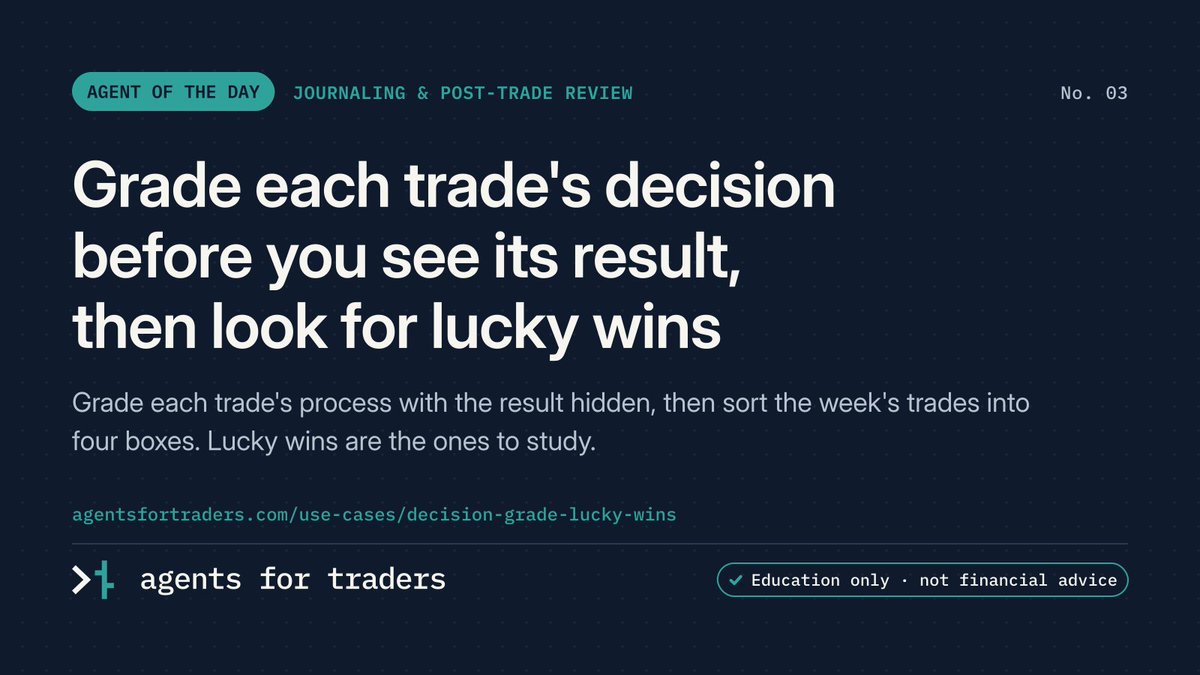
Agent of the day: find your lucky wins.
Grade each trade's process with the result hidden. Then sort: good or poor process, good or bad result. Poor-process wins are the habits being rewarded, so study those first.
https://t.co/70l8GXM3d0
Education only.
@TradeZella Good one. I'd add a column before grouping by hour: did the trade follow your rules, yes or no, graded without looking at the result.
A bad hour is often the same broken rule turning up at the same time of day. That's easier to fix than the hour itself.
@JeRRyMMXM Worth splitting the streak before reviewing it: losses where you followed the plan, and losses where you didn't.
A run of the first kind is the cost of the method, so leave the system alone. A run of the second is the thing to fix, and changing the system won't fix it.
@MapleStax Agree. The hard part is grading it before you look at the result. Once you know it was green, the rule break starts to feel like a judgement call.
Worth counting how many of your wins came from broken rules. If that share creeps up, the results are hiding a habit.
Big event weeks are a good test for an agent: before the open, have it list every scheduled catalyst this week with a source for each date.
This week that's a major earnings report tonight, US midterms tomorrow and more earnings later in the week.
No source, no date.
Days like today are where a simple agent earns its keep.
At midday, have it rank the sectors by % move and set them against your morning plan. Today the leaders held up and tech took the hit.
Did your plan see it coming, or did the tape surprise you? That gap is your homework.
@PradeepBonde Worth doing for every name, not only biotech: a quick event check before entry. Earnings, trial readouts, lockups, investor days, next to the plan.
An assistant is good at gathering these if you make it give a source for every date, or write 'unknown'.
@TradeZella This is the right way to use an assistant on a journal: questions your timestamps can answer, not opinions.
Next one worth asking: what did you rate your sleep and stress before those sessions? Rule breaks usually start before the first loss.
https://t.co/GYslnKrBpr
@51bodila The most useful line in there is 'what data is still missing'.
I'd run something like this against my own written plan as a checklist, not as a verdict. A famous framework applied by a model is still the model's read, and the size stays my call.
@dannyjpwilliams Same thing happens when traders use an assistant to review trades. Most of the 'bad advice' traces back to rules that only ever lived in their head.
Having it interview you on setups, stops and exits before it reviews a single trade fixes a lot of it.
@TrendSpider A check worth doing before anyone adds it: how does it look with exposure capped at 1x, and on years it wasn't built on?
Told to beat an index in a strong market, a model can win by just taking more exposure. I'd rather point the model at my own rules than let it write them.
@PeterLBrandt Agree on execution. Where it already helps position holders is the boring side: reading your own journal back to you.
Ask it which of your written rules you broke most this quarter. Speed doesn't matter for that one.
@edgefloai The "why did I take it" line only works if it's written before entry. Written afterwards, it becomes a story that fits the outcome.
A one-line reason with a timestamp, then a review that compares it with what happened, is where the rule breaks show up.
@Muninn Agree the market isn't a poker table. Most of the flow on the other side has a mandate, not an opinion about you.
Where I see AI helping a discretionary trader is the dull part: checking a written plan against your own rules and reviewing what you actually did.
@tej_mah One check settles a lot of these fast: use only the rules the post itself states.
If the claimed result needs more winning trades than the stated risk per trade and time window allow, you don't need to know anything else. No checkable record, no result.
Some days the index hides the real story.
The S&P is slightly red, but small caps are up and most sectors are green while software sinks.
Agent idea: have one compare the index with sector and small-cap breadth at midday, and flag when they disagree.
Education only.
@GuantingCh Trade review first. It has a clear input (your own log and written rules) and nothing to execute.
Research and coaching get more useful once the review has shown which rules you actually break.