Mandelbrot set always fascinated me, but I never found time to understand the math properly. 🧐
I kept reading it is this simple equation 𝚣 = 𝚣² + 𝚌 and got distracted by something else. The part that I was missing is that 𝚣 and 𝚌 are complex numbers. Mandelbrot set parametrises 𝚌.
This time, I rolled up my sleeves and focused on a numberphile video, and got to work, and here is the result 😎 (the animation is just the iteration count cycling).
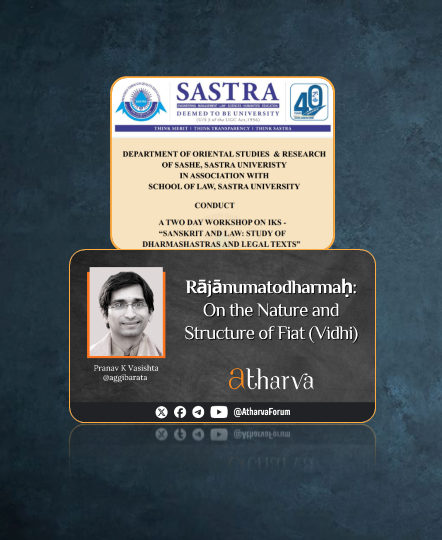
[NEW] Rājānumato Dharmaḥ: On the Nature & Structure of Fiat (Vidhi)—Pranav Vasishta @aggibarata.
What is the relation between Law, Sovereign Power & Dharma? What is a fiat? What is a Vidhi? Workshop for Sastra Law School students by Pranav V
https://t.co/6oGCuBTnY7
@Gopalee67🙏
The so-called “calculator riots” of 1986 serve as a powerful reminder that today’s anxieties about artificial intelligence replacing human thinking are far from new.
In April 1986, a determined group of math educators staged a vocal protest outside the National Council of Teachers of Mathematics (NCTM) annual convention in Washington, D.C. Led by influential textbook author John Saxon, demonstrators carried signs declaring, “The Button’s Nothin’ ’Til the Brain’s Trained.”
They were opposing the NCTM’s new recommendation to incorporate electronic calculators into mathematics education at every grade level, including homework and exams.
The protesters worried that reliance on calculators would erode students’ mental arithmetic skills, numerical intuition, and deep conceptual understanding, potentially creating a generation of “calcuholics” overly dependent on machines.
The NCTM countered that calculators would free students from repetitive, low-level calculations, enabling them to tackle more complex problem-solving and higher-order thinking. Ultimately, the debate led to a pragmatic compromise: students would first master core mathematical concepts and mental strategies before using calculators as tools for more advanced work.
This balanced approach allowed technology to enhance, rather than replace, mathematical reasoning.
Today, as schools navigate the rapid rise of generative AI, the 1986 calculator compromise offers a valuable blueprint: prioritize genuine understanding first, then thoughtfully integrate powerful new tools.
A unique UG program at @IITKanpur! Meant especially for young ethical hackers. (Some of them are in the news 😊.) Admission through a hackathon. Specialized coursework with two year long internship at security agencies. We aim to produce cyber warriors of the future.
Critical insight here by @PawanKalyan garu.
It is unlikely that he reasoned the systemic roots of the issue but his natural empathy, love for people and intuition led him to an important Leadership lesson.
India's problems must be framed as systemic and not (exclusively) social. This misframing has caused the State encroachment into societal spaces and drowned Hindu society in guilt only to be exploited by the cynical public leaders like Rahul Gandhi.
The civilization had sophisticated means for different communities to retain their ritual praxis without encroaching into each other. This 'thick' culture is what saved us during a millennia of attacks.
The colonial administration however centralizing power and homogenizing spaces created perpetual conflict by design. Unfortunately, Indian State post independence did not reset this and doubled down.
We judge the society for not being 'progressive' whereas a systemic and empathetic outlook would mean we understand that the communities are struggling to retain their coherence. In the absence of the inter-dependent design, this natural urge to define their boundaries for coherence leads to stagnation, conflict and anomie.
The solution does not lie in castigating the society and imposing State to radically reform but in tuning public administration to deliver public goods in a way that generates social surplus. Such surplus will lead to pro-social behaviors once the communities do not feel their ways are threatened.
Hindu society always responds to higher calling - Only someone who has unshakeable faith in this will be a jananayaka in Bharat. Pawan Kalyan garu has that potential.
@SkandaVeera covers this critical dimension in his 4 part series here -
https://t.co/55lhkoCFPk
The Sabarimala review case is about more than a temple. It is about how India interprets faith, dignity, and constitutional freedoms.
The open letter by Spiritual Sovereign Jainacharya Yugbhushansuri, argues that Articles 25 & 26 must be understood through Bharat's civilizational framework, not borrowed lenses.
Read full letter here:
https://t.co/MHzFHlfOEX
#SaveReligion #Sabarimala #JainacharyaOnSabarimala #RuleOfJustice #SaveShikharji
@omarali50 On the meaning of the Mahabharata : Sukthankar, V. S. : Free Download, Borrow, and Streaming : Internet Archive https://t.co/alzF9CS9ml
Sukthankar's Siddhānta: Contrasted the Critical Method & pāramparika approach; highlighted the merits of the latter and demerits of the former.
@omarali50 On the meaning of the Mahabharata : Sukthankar, V. S. : Free Download, Borrow, and Streaming : Internet Archive https://t.co/alzF9CS9ml
Sukthankar's Siddhānta: Contrasted the Critical Method & pāramparika approach; highlighted the merits of the latter and demerits of the former.
@JoraShankara@halleyji V S Sukthankar's Lectures later published posthumously as "On the Meaning of the Mahābhārata" are considered to be akin to the return of the prodigal son.
Superb essay: "The person of 2050 is not the best prompt engineer or the most optimized solo operator. They are someone who holds real things. They have stayed with a craft long enough for it to shape them back. They carry responsibility somewhere real: a school board, a town council, a lab, a classroom. They belong to a place—a piece of land, a workshop, a studio, a room where others gather. They are bound to a small number of people in long mutual obligations. They have inherited a tradition consciously, and they are passing it on deliberately. They hold themselves to a standard their grandchildren will know about."
A freelance journalist who had never taken a statistics course wrote a 142-page book in 1954 that professional statisticians still hand to students before anything else, because nobody before him had bothered to explain the tricks in plain language.
His name was Darrell Huff. The book is called How to Lie with Statistics.
I read it in one sitting and spent the next three days noticing the tricks everywhere.
Over 1.5 million copies have sold in English alone. It became a standard college textbook in the 1960s and 70s. Seventy years later it is still in print, still assigned, still the first thing a working statistician reaches for when they want to teach someone to think clearly about numbers.
The man who wrote it was not a researcher. He was a freelancer who wrote how-to articles for magazines. He had no PhD, no academic post, no institutional affiliation. He just understood that numbers could lie without technically being wrong, and he thought someone should explain how.
His opening line sets the whole tone of the book.
"The crooks already know these tricks; honest men must learn them in self-defense."
That one sentence is the entire argument. The manipulation is not coming. It already happened. It happened this morning in the article you read and the chart someone showed you at work and the study your doctor quoted. The only question is whether you know what to look for.
Huff called the first trick the Well-Chosen Average.
When someone tells you the average salary at a company is $80,000, they have told you almost nothing. If the CEO earns $2 million and the 20 employees earn $30,000 each, the mean is $80,000. The median is $30,000. Both are technically correct. One is a lie. The person reporting the number chose which average to use, and they almost always chose the one that served their argument. Huff's rule: whenever you see an average with no description of which average it is, ask.
The second trick he named the Gee-Whiz Graph.
A line chart shows company profits rising. The line shoots nearly vertical, almost doubling in height across the chart. You feel impressed. Then you look at the y-axis and notice the chart does not start at zero. It starts at 94. The actual increase in profits was 3 percent. The dramatic visual was produced entirely by cropping the bottom of the chart. Nothing in the data changed. The picture changed everything.
Every news organization on earth still does this every day.
The third trick is the one that should change how you read every study you ever encounter. Huff called it Post Hoc Rides Again, which is short for the Latin phrase post hoc ergo propter hoc. After this, therefore because of this.
Cities with more churches have more violent crime. Therefore churches cause violence. The logic is airtight. The conclusion is absurd. Both church attendance and crime go up as population grows. The two numbers track each other because a third variable drives both. The correlation is real. The cause is invented.
Huff showed that this structure is not a rare mistake. It is the default pattern of almost every study reported in a newspaper, because causation is a boring word and because proves is a better headline than correlates with.
The fourth trick was the one that floored me. He called it the Semi-Attached Figure.
A headache pill company claims their product is twice as fast as the competition. The study behind the claim is real. The product was tested and the numbers are accurate. What the advertisement does not mention is that the study measured absorption rate into the bloodstream, not relief of headaches. The two things are related but not identical. The statistic is real. It is attached to the wrong conclusion.
Huff said this is the most dangerous trick of all because the number is never fabricated. You cannot fact-check a semi-attached figure by verifying the statistic. You have to ask whether the statistic actually measures what the claim requires it to measure.
Almost nobody asks.
There is one part of Huff's story that most people who recommend the book leave out.
Years after he wrote it, he was hired by the tobacco industry. He worked on a follow-up manuscript called How to Lie with Smoking Statistics, designed to cast doubt on the research connecting cigarettes to cancer. The book was never published. He testified before Congress in an attempt to undermine the statistical evidence against tobacco.
The man who wrote the clearest guide to spotting statistical deception spent the end of his career deploying those same tricks against evidence that was killing people.
That detail does not make the book wrong. The tricks he described are real and the defenses he taught are still the right ones. But it is a reminder that the tools in the book are neutral. Understanding how lies are built does not protect you from choosing to build one.
The crooks already know these tricks.
Some of them wrote the manual.
What is one statistic you have seen recently that you now think deserves a second look?
I’m so happy this flashcard pack on the glorious Vijayanagara Empire has been brought out by Sriram Hari Lakshminarayanan and Soumya Sriram. Their selfless effort in promoting India’s rich heritage is truly commendable. My sincere thanks to them for involving me in this project
@maa_bhaishiiH Our brain has two divisions called apeksha buddhi & upeksha buddhi. Whatever the mind feels that it needs, it will trigger the apeksha to learn & retain it. Whatever the mind doesn't find interesting, it triggers the other one,i.e. upeksha buddhi to reject it.
I've experienced it
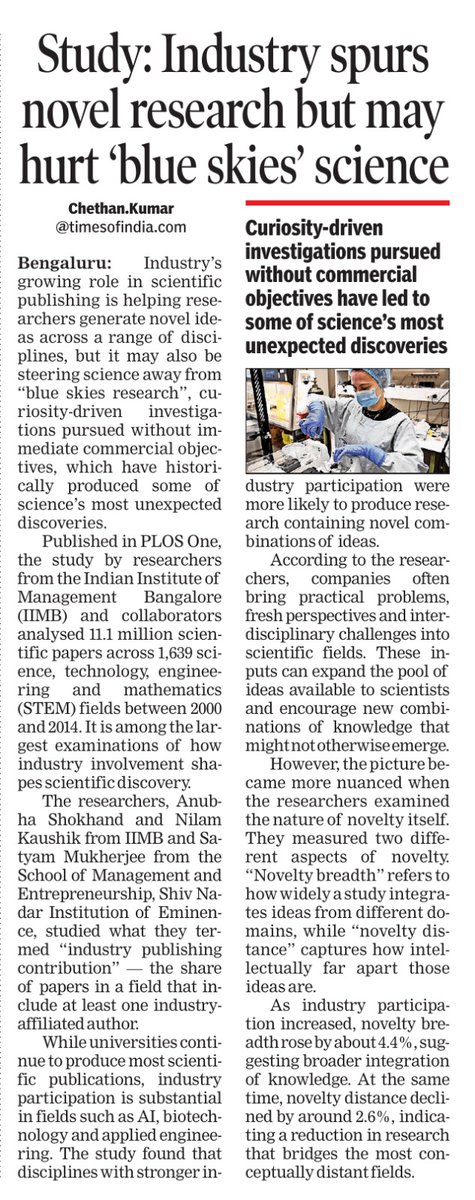
A recent study co-authored by Prof. Nilam Kaushik, Strategy area, IIMB, examines 11.1 million scientific publications across 1,639 STEM fields to understand how industry participation influences scientific discovery. The findings reveal an interesting pattern.
Read more👇
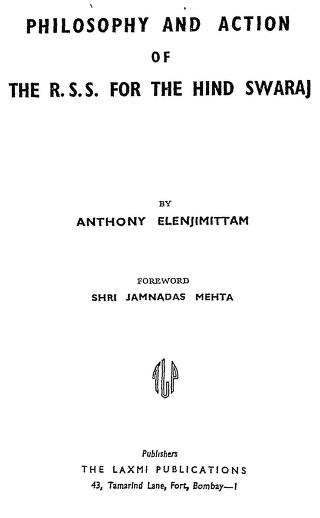
Today I learnt that much popular phrase of ‘pseudo- secularism’ originated in the writings of Indian Catholic priest from Kerala- Father Anthony Elenjimittam (1915-2011). It founds mention in his book: ‘Philosophy and Action of the RSS for the Hind Swaraj’ where the term was used to ctiticise Nehruvian secularism. It is also probably the first book which was quite sympathetic to RSS.







![AtharvaForum's tweet photo. [NEW] Rājānumato Dharmaḥ: On the Nature & Structure of Fiat (Vidhi)—Pranav Vasishta @aggibarata.
What is the relation between Law, Sovereign Power & Dharma? What is a fiat? What is a Vidhi? Workshop for Sastra Law School students by Pranav V
https://t.co/6oGCuBTnY7
@Gopalee67🙏 https://t.co/dBTazUzEa9](https://pbs.twimg.com/media/HKob2SaaIAERzaU.jpg)