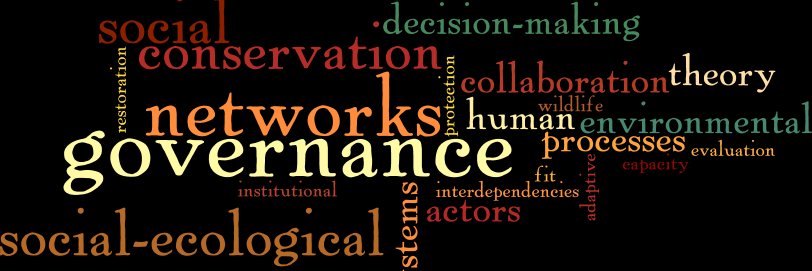
Sustainability scientist applying network and social science to answer questions about collaborative governance & human behaviour in social-ecological systems.
Thrilled to have been awarded a QLD #YoungTallPoppy award last night! Grateful to @aipolsci for the recognition and to Science Minister Hon. @LeanneLinard, Her Excellency Dr. Jeannette Young @QldGovernor, and Chief Scientist Prof. Kerrie Wilson for presenting these awards.
Fully funded PhD scholarship available! Are you passionate about modelling social-ecological dynamics for urban resilience? Dive into complexity science with us and explore innovative strategies for climate resilience. Learn more/apply: https://t.co/Uwv7OjIAdy #PhDscholarship
POSTDOC VACANCY: Are you interested in how social networks influence adoption decisions in coffee regions of Colombia?
Then we might have just the right position for you! Check the job ad here, or share it with a friend: https://t.co/atqc0janoH
Apply by 2 December 2023!
Interested in social networks, social structure, computational social science, or human (and human-nature) relationships and their implications?
Join us Nov 27-28 in Sydney @UNSW (or online!) for #ASNAC2023!
@ANSNA_Au@SocNetAnalysts
An effective response to wildfires needs more than coordination among response teams. Our study highlights the criticality of fostering agreement on goals and procedures, as it directly impacts individual performance. Only through such alignment can coordination deliver benefits.
@GEC_Journal@OrjanBodin@danielnohrstedt @juliambaird @RJSCity 5/5 Our results suggest that it is only when agreement is already established, or the need to agree is de-emphasized, that coordination of activities can deliver benefits. And this might depend on the structure of the response system (command-and-control vs flexible structure).
@GEC_Journal@OrjanBodin@danielnohrstedt @juliambaird @RJSCity 4/5 we linked rare data on multi-actor collaboration and individual performance during the acute phase of two major wildfires. We found that in situations of high uncertainty, agreement on goals and procedures can be more vital than the coordination of activities.
@GEC_Journal@OrjanBodin@danielnohrstedt @juliambaird @RJSCity 3/5 Our study aimed to uncover insights into the detailed nuances of collaboration among emergency response teams during rapidly evolving wildfires.
@GEC_Journal@OrjanBodin@danielnohrstedt @juliambaird @RJSCity 2/5 It is therefore essential that we understand how to enhance the effectiveness of these collaborations, to minimize the devastating effects that major wildfires can have on people and ecosystems.
@GEC_Journal@OrjanBodin@danielnohrstedt @juliambaird @RJSCity · 1/5 Multi-agency collaboration in the wake of a wildfire emergency is integral to an effective response due to the need to coordinate actions across geographical scales, levels of authority and sectors of society.
Below is an alarming summary of the decline in the quality of a university education in Australia. “The merger is transactional not transformational. https://t.co/YsnESt0K3i via @ChangeAUS”
Exciting fully funded PhD opportunity @QUT's Centre for the Environment for a talented student with a strong interest in working in the science of social networks and a passion for sustainable food systems.
Please send me a message if you are interested!
https://t.co/7q9zHwR74U