@emollick Absolutely yes to this. I’ve been saying for some time now that prompt engineering is really a function the effectiveness of the model. It’s a semantic reasoning engine so the better it gets, the more the UX changes and UI (prompt engineering) melts away.
@stealcase@mer__edith I think you’re conflating copyright with protection of labor that hasn’t — at least historically — been the motivation for copyright law. I get your point but I’m suggesting copyright is the wrong instrument to achieve it. Artists could not create art without robust fair use.
I’m going to draw a parallel that isn’t quite straight, but it’s close enough.
It’s between old (analog) cars and new (digital) cars, simple (analog) businesses and complicated (digital) businesses.
Lately I’ve been driving two distinctly different cars. One from 1970, and the other from 2023. They essentially have nothing in common other than they’re cars.
Some who don’t care much for cars might say that’s everything in common. On paper I can see the argument, but get behind the wheel of both, and go for a drive, and you wouldn’t say the experiences were equivalent. They’re as different as different can be.
The 1970s experience is analog. Your leg strength determines your stopping power. The road surface below clearly communicates with your ass. The steering wheel actually feels like it’s turning the wheels. The windows roll down by turning a crank that literally rolls them down. Switches snick, dials click. This is a direct experience, with mechanical feedback, requiring full attention and real effort.
The 2023 experience is digital. Nearly everything is abstracted. The brakes are heavily mechanically assisted. Steering even more so. You can’t really feel the road surface because the suspension masterfully absorbs every little detail. Even the buttons have been replaced by touchscreens with haptics. This is an indirect experience, with simulated feedback, requiring some attention and little effort.
Which you prefer is up to you. I happen to love both for different reasons.
And that’s just driving. The gulf is wider when it comes to repair.
With an old analog car, a problem’s cause is more obvious. Linkages are visible, this connects to that, teeth mesh to move gears which move shafts which move wheels. When something’s broken it’s generally confirmable with a common tool and a set of eyeballs. Any mechanic with a basic understanding can diagnose any problem relatively easily — sometime solely by ear. There are only so many things it could be, and they’re all right in front of you.
With a modern new car, computers enter the picture. Engines are covered, sometimes even inaccessible. Cars crash, but so does firmware. This doesn’t turn that, this sends electrons to that, which are then interpreted by circuits and software and systems. Which one’s to blame when something doesn’t work? It’ll take a while to find out, and at least $1000. Almost anything can be wrong, and you’ll have to leave the car at the shop for a while so they can plug it in and run diagnostics. The human defers to the machine to tell us.
Pros and cons for sure.
Now for the parallels to business.
Through this car experience lens, I’ve come to see businesses as either analog or digital too. I’m not describing their product or what they make. I’m talking about how they’re structured, how they run. An analog business can make software, and a digital business can make pizza.
An analog business is direct. It’s clear what does what, and how it does it. When something changes, you typically know what changed. There’s some suspension to absorb the bumps, but it’s basic — you’re never too far removed from the root cause. There are fewer managers and more doers. There’s less distance between the customer and the maker. Feedback is heard, not interpreted and translated. No decks, just conversations and writing.
A digital business is indirect and abstracted. The structure is obscured, riddled with departments and groups run by other groups. Decisions are complicated because one too many people are involved. What should be simple has become complex — the result of process that serves the prospect, not the purpose. Everything is padded. Getting to someone requires going through something. Customers are a concept, sliced by demographics. Everything’s a presentation rather than a conversation.
As usual, the analogies and metaphors don’t map perfectly, but hopefully you feel what I’m getting at. Does it resonate?
@neilturkewitz@Dan_Jeffries1 Neil - with all respect, you’re being a bit of bully and you’re also wrong. As you know, a work is only a derivative work if it is infringing.
You also know that the copyright guidance documents are neither sacrosanct nor have the force of law — they’re just rough guidance.
@paulg Because AI is tech and not an app, I suspect existing public cos will start integrating it into their tech stack (with varying levels of veracity) and claim they are AI cos.
Listen to this AI generated song featuring Drake & The Weeknd.
It goes so damn hard.
It's by "Ghostwriter977" on TikTok and it's blowing up on socials + streaming platforms.
UMG, which controls around 1/3 of the global music market, has already asked streaming platforms to ban AI.
A modern Napster moment.
Will be fascinating to watch this all unfold in real-time.
@jjvincent It’s not mutually exclusive. Researchers have noted that in many cases OpenAI has used the same technology as Stable Diffusion - they just have not made it public that they do so.
@curious_founder I suspect it’s not just limited to NO2, but also radon and other gasses. The idea of why we would voluntarily (and literally) pipe below earth gasses to our immediate atmosphere makes no sense to me.
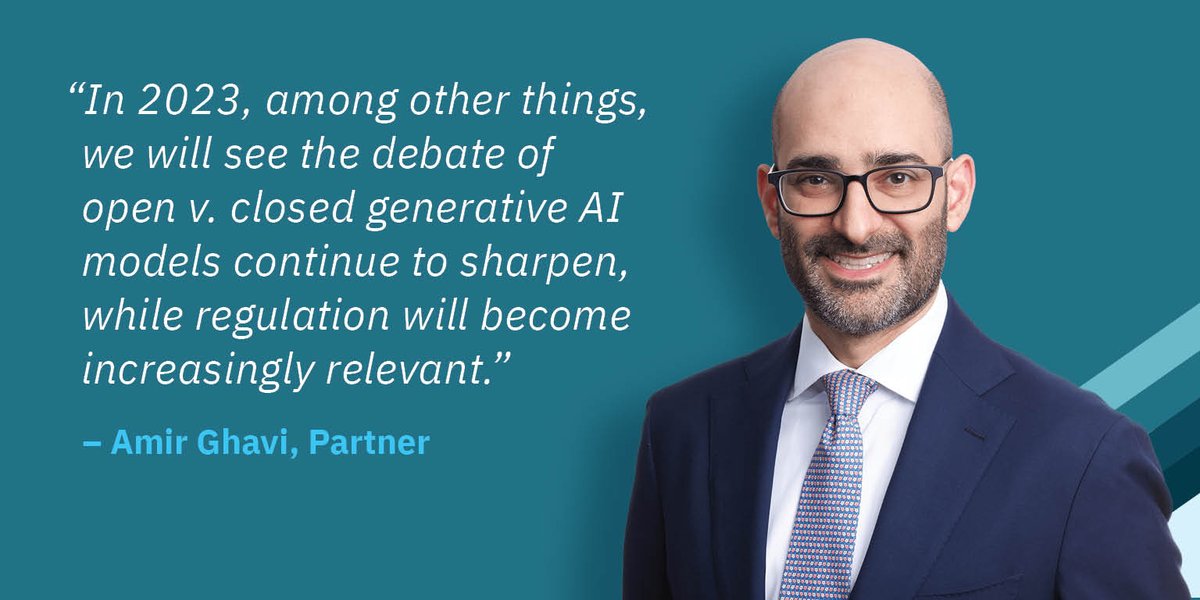
Partner Amir Ghavi (@aghavi) shared predictions with @Legaltech_news on what to expect from #artificialintelligence in 2023 and reflected on the biggest milestones for #AI in 2022. Read more here: https://t.co/0dG9aqXFdo
OK! let’s talk about That Op-ed. The one that insisted not only that privacy is dangerous, but that not affirmatively building surveillance into communication tools is a radical ideological position. 1/ https://t.co/q1mejojREU
Imagine an AI model that's 3x larger and more powerful than GPT3 aka ChatGPT
Google already built that in April, called PaLM, on their own TPU hardware competing with NVIDIA. People think ChatGPT will replace Google but they basically invented transformers in '17 (the T in GPT)
Very soon AI art generators won't be inspired by any art (already less than 2% of the dataset) + it will still generate art with ease + the whole "stolen remixer" narrative will collapse.
Also AI will have no "tells" like crummy hands + it'll be perfectly coherent.
Then what?
📣 CRFM announces PubMedGPT, a new 2.7B language model that achieves a new SOTA on the US medical licensing exam. The recipe is simple: a standard Transformer trained from scratch on PubMed (from The Pile) using @mosaicml on the MosaicML Cloud, then fine-tuned for the QA task.