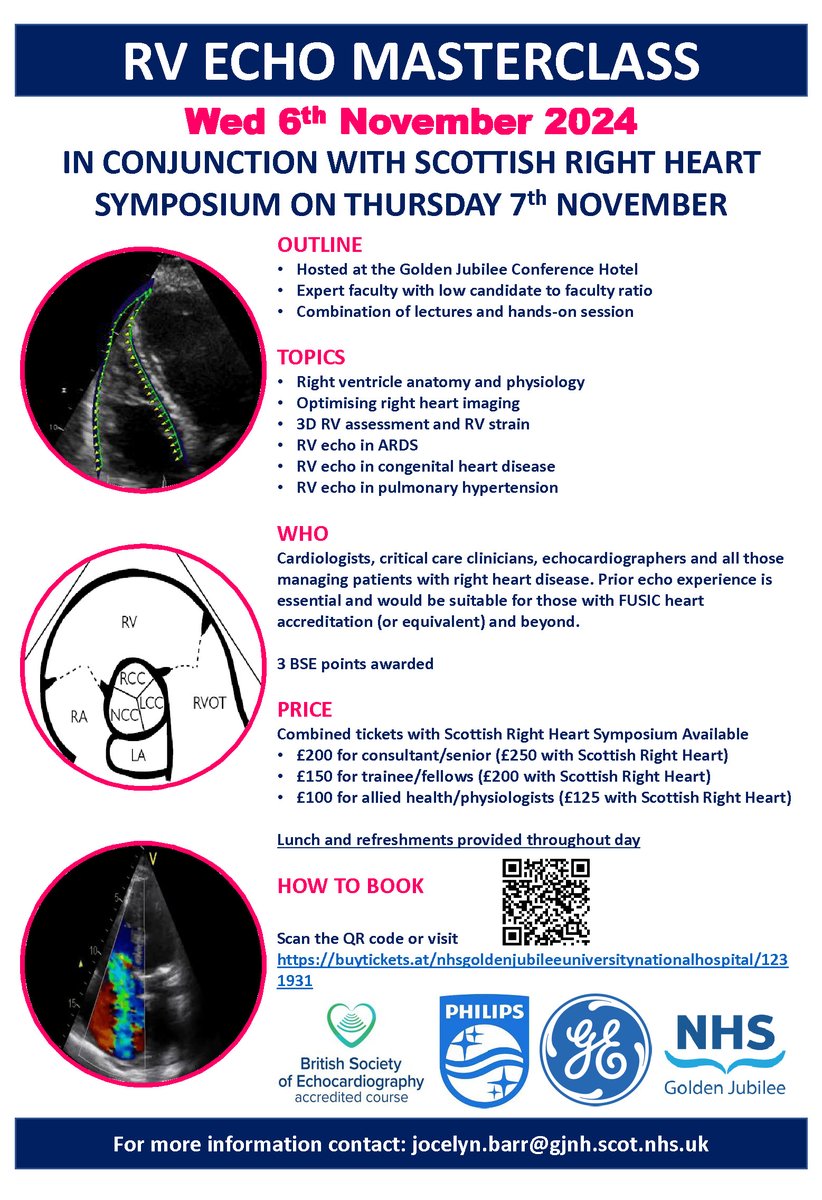
🚨One month to go to the Scottish Right Heart Symposium and RV Echo Masterclass🚨
📅6th / 7th November 2024
🗺️Golden Jubilee Conference Hotel
🎫https://t.co/EyEKEH1utz
@VirtueOfNothing @BangFoss @philipmccall@GJanaesresearch I agree 100%. It is also clear that they have access to the patient data from the MYRIAD study as they provide an unpublished (and seemingly non-significant) 1 year mortality result that “supports a 10% mortality increase”.
Professor Nick Hill @UofGlasgow@UofGMaths_Stats Simson Chair of Mathematics and Executive Director @SofTMech will provide us with a fascinating insight into the potential that can be gained through:
“Computational Modelling of the Heart and Pulmonary Circulation” 🖥️❤️🫁
@philipmccall@Crit_Care@GJanaesresearch As described in the comment it is important to ensure that the result is not influenced by a outlier and all eligible studies are included. We feel that a 5,400 patient study of TIVA vs volatile (written by the corresponding author in this meta-analysis) should have been included
@Crit_Care Finally, this large SR/MA's search strategy somehow managed to miss this eligible study:
https://t.co/1Q0LEXb0DS
5400 patients. In the NEJM. Of which the first author is the corresponding author on the Kotani SR/MA.
HT @aglass01 for uncovering this. LTE awaiting publication.
@GJanaesresearch@BJAJournals@philipmccall The timing of the reflected wave may also influence RV function. If the reflection arrives in mid systole then it arrives at an RV at a higher pressure and may lead to RV hypertrophy. See fascinating paper by Fukumitsu et al https://t.co/9nb1f2ogo1
@GJanaesresearch@PhilGuerci@BJAJournals@philipmccall Interestingly in our paper the development of wave reflection in the non-operative PA by 2 months was associated with impaired RV free wall strain (r=0.745). Suggesting that if you non-operative can't adapt then RV function deteriorates #BJAchat
@GJanaesresearch@BJAJournals@philipmccall Thats the big question. We need to (and hopefully are) tease out how much of the RV insult is due to acute intra-op increase (which we haven't yet measured) or due to the chronic increase in afterload. Additional this is afterload at rest. 1/2 #bjachat
@GJanaesresearch@PhilGuerci@BJAJournals@philipmccall Surgery may not make it any worse (in the extreme) but wave reflection would already be there. For instance, a PE would cause similar wave reflection to a lobectomy if completely occludes the origin of the lobar PA. 2/2 #bjachat
@GJanaesresearch@PhilGuerci@BJAJournals@philipmccall Wave reflections are usually determined by the downstream vasculature, surgical resection is a relatively unique wave reflection model. If there is already impaired perfusion then there may already be wave reflection. 1/2 #bjachat
@BJAJournals@philipmccall This study paves the way for testing of novel therapeutic strategies to aid adaptation to the unique peri-operative physiology seen in patients undergoing thoracic surgery with a view to preventing cardiovascular complications and improving long-term functional capacity #bjachat
@BJAJournals@philipmccall Pulsatile afterload can account for 1/2 the work of the RV and is overlooked by PVR. Reflection may increase further as cardiac output increases (exercise or illness) further impairing the RV. Investigation is required to determine if it impacts patient-centred outcomes #bjachat