FIRST FRAME: Jabari Smith Jr. reminding LeBron James that he played against his dad in LeBron's first-ever NBA game. 🏀
SECOND FRAME: Daníel Gudjohnsen reminding Messi that his dad was once his teammate at Barcelona. 😂
When the legends have played so long, they start getting introduced to their teammates' sons. 🐐⏳
1. Civita di Bagnoregio
Known as "the dying town," it sits dramatically on a hilltop, accessible only by a footbridge.
This isolated village feels frozen in another century.
The long bridge approach makes arriving here unforgettable. Would you cross it to explore?
🗳️🗳️ A melhor eleição para 2030 na minha opinião seria:
Alckmin/Dino
X
Amoedo/Eduardo Leite
É necessário unir o povo, chega de oportunistas megalomaníacos vendendo panico para população, chega do centrão ser a maior monarquia do mundo, chega de ideias ultrapassadas de vender empresas estratégicas a preço de banana, chega de cortar da saúde/educacao/segurança para dar mais regalias ao congresso da mamata, chega de discutir assuntos de 1990 em 2030.
Os debates deveriam ser sobre células tronco, inteligência artificial, industrialização de minerais raros, independência e soberania energética (refinarias e nuclear) além de fertilizantes, modernizar o sistema educacional, aumentar em muito funcionários públicos importantes como policiais, enfermeiras, bombeiros, professores, defensores públicos enquanto cortar a mamata do congresso, sistema logístico fluvial e ferroviário, combater verdadeiramente o crime organizado incluindo do mercado financeiro, fechar parceiras estratégicas com outros países, reavaliar desonerações, reduzir verba partidária e fundão eleitoral, discutir reforma previdenciária dos militares e políticos e não do povo, criar plano para aumentar o turismo, melhorar transporte público, acabar com cartórios, e ter um plano de 20 anos para economia limitando o poder do ministério da economia e do banco central.
A grande vantagem da China e dos USA é que são ditaduras com planejamento de longo prazo.
Sim o US é uma ditadura de dois partidos que trocam a cabeça do dragão mais quem realmente manda que são as comissões do congresso são os mesmos há 30, 40 anos. Só tem eleição para a ilusão de escolha do povo.
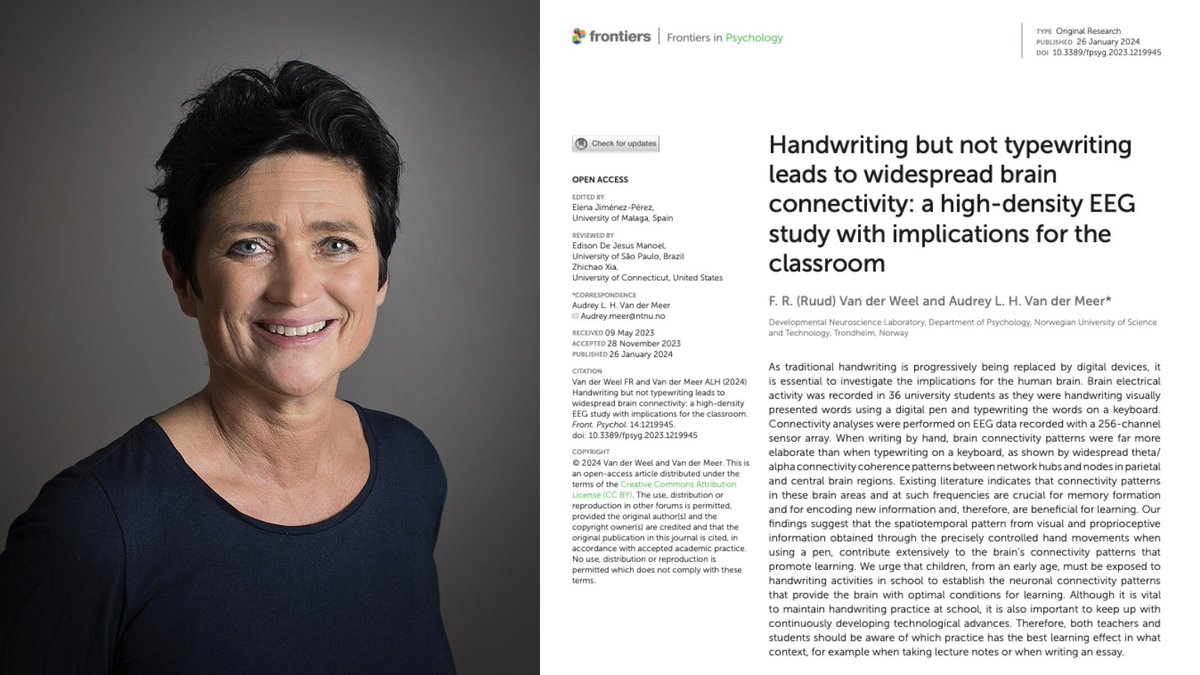
A Norwegian neuroscientist spent 20 years proving that the act of writing by hand changes the human brain in ways typing physically cannot, and almost nobody outside her field has read the paper.
Her name is Audrey van der Meer.
She runs a brain research lab in Trondheim, and the paper that closed the argument was published in 2024 in a journal called Frontiers in Psychology. The finding is brutal enough that it should have changed every classroom on Earth.
The experiment was simple. She recruited 36 university students and put each one in a cap with 256 sensors pressed against their scalp to record brain activity. Words flashed on a screen one at a time.
Sometimes the students wrote the word by hand on a touchscreen using a digital pen, and sometimes they typed the same word on a keyboard. Every neural response was recorded for the full five seconds the word stayed on screen.
Then her team looked at the part of the data most researchers had ignored for years, which is how different parts of the brain were communicating with each other during the task.
When the students wrote by hand, the brain lit up everywhere at once.
The regions responsible for memory, sensory integration, and the encoding of new information were all firing together in a coordinated pattern that spread across the entire cortex. The whole network was awake and connected.
When the same students typed the same word, that pattern collapsed almost completely.
Most of the brain went quiet, and the connections between regions that had been alive seconds earlier were nowhere to be found on the EEG.
Same word, same brain, same person, and two completely different neurological events.
The reason turned out to be something nobody had really paid attention to before her work. Writing by hand is not one motion but a sequence of thousands of tiny micro-movements coordinated with your eyes in real time, where each letter is a different shape that requires the brain to solve a slightly different spatial problem.
Your fingers, wrist, vision, and the parts of your brain that track position in space are all working together to produce one letter, then the next, then the next.
Typing throws all of that away. Every key on a keyboard requires the exact same finger motion regardless of which letter you are pressing, which means the brain has almost nothing to integrate and almost no problem to solve.
Van der Meer said it plainly in her interviews.
Pressing the same key with the same finger over and over does not stimulate the brain in any meaningful way, and she pointed out something that should scare every parent who handed their kid an iPad.
Children who learn to read and write on tablets often cannot tell letters like b and d apart, because they have never physically felt with their bodies what it takes to actually produce those letters on a page.
A decade before her, two researchers at Princeton ran the same fight using a completely different method and ended up at the same answer. Pam Mueller and Daniel Oppenheimer tested 327 students across three experiments, where half took notes on laptops with the internet disabled and half took notes by hand, before testing everyone on what they actually understood from the lectures they had watched.
The handwriting group won by a wide margin on every question that required real understanding rather than surface recall.
The reason was hiding in the transcripts of what the two groups had actually written down.
The laptop students typed almost word for word, capturing more total content but processing almost none of it as they went, while the handwriting students physically could not write fast enough to transcribe a lecture in real time, which forced them to listen carefully, decide what actually mattered, and put it in their own words on the page.
That single act of choosing what to keep was the learning itself, and the keyboard had quietly skipped the choosing and skipped the learning along with it.
Two studies. Two countries. Same answer.
Handwriting makes the brain work. Typing lets it coast.
Every note you have ever typed instead of written went into your brain through a thinner pipe. Every meeting, every book highlight, every idea you captured on your phone instead of on paper was processed at half depth.
You did not forget those things because your memory is bad. You forgot them because typing never woke the part of the brain that would have made them stick.
The fix is the thing your grandmother already knew.
Pick up a pen. Write the thing down. The slower road is the faster one.
ele trabalhou com o michael jackson, meteu o som da cuíca brasileira em wanna be startin' somethin' e também fez a percussão de don't stop 'til you get enough usando duas garrafas de vidro, tem que respeitar.
☀️ Today in Utqiagvik (the northernmost city in the United States), the sun rose above the horizon at 2:57 AM and won’t set again for 84 straight days or until August 2nd! Here's a look at a timelapse showing the sunset and sunrise this morning. #akwx
Michael Jackson disse várias vezes que seu filme favorito é O Pequeno Príncipe (1974), mas você sabia que esse filme tem um peso tão grande na vida dele?
O personagem Serpente, da cena Snake in the Grass, interpretado pelo dançarino e ator Bob Fosse, foi uma das principais fontes de inspiração de Michael para criar seus passos de dança. O impacto do filme foi tão grande que esse jeito de dançar acompanhou Michael por toda a vida.