Coś pękło w relacjach z Ukraińcami?
Dwie trzecie Polaków mówi wprost: nasz stosunek do obywateli Ukrainy uległ pogorszeniu.
I nie ma co się dziwić.
To, co się stało, było absolutnie pewne już od 2022 roku.
Jeżeli komuś dajesz wszystko za darmo – mieszkania, zasiłki, darmową opiekę zdrowotną, priorytet w kolejkach i na rynku pracy – to licz się z tym, że się rozbryka i będzie chcieć jeszcze więcej.
A jak liczysz na wdzięczność takich ludzi… no to jesteś w błędzie.
To tylko kwestia czasu, kiedy zaczną przeprowadzać zamachy terrorystyczne. ABW doskonale o tym wie.
Historia zatacza koło – wracamy do II Rzeczypospolitej Polskiej, która lekceważyła wybryki Ukraińców.
Realizm zamiast naiwności. Koniec tematu.
@donaldtusk@NawrockiKn Pamiętajcie przy dystrybutorach. Minister finansów z tuskiego rządu daruje ruskim pieniądze. W historii Polski nie było gorszej kanalii od Tuska.
Wzięliśmy sobie na plecy obcą nam kulturowo nację, która zrujnuje nam nasz system emerytalny, służbę zdrowia.
A gdy to wszystko padnie definitywnie oni zaczną rozglądać się za nowym "żywicielem".
Bo tak mają pasozyty.
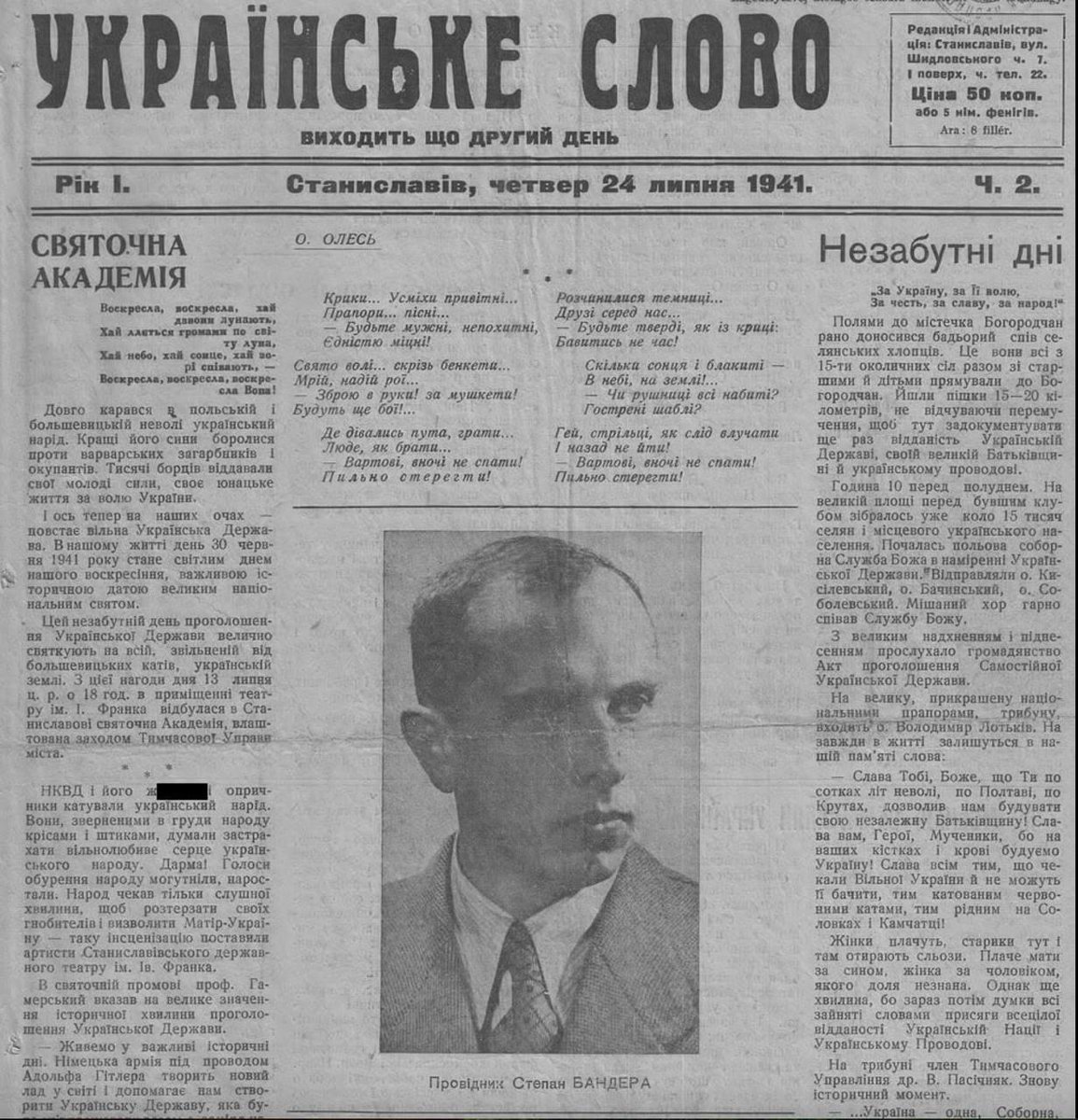
Modern-day Banderites argue that Bandera didn't collaborate with the Nazis and is practically a "victim of the Nazi regime." And the Jew Zelensky intends to bury his corpse in the "pantheon."
Here you go: the newspaper "Ukrainian Word" for July 24, 1941. Note that all newspapers in the occupied territories were published by Goebbels' propaganda departments under strict military censorship. And – lo and behold! – whose portrait is that on our front page? A victim of the Nazi regime, I suppose?
And if the portrait doesn't convince anyone, here's a quote from the same source. It's from a report from a ceremonial meeting in Stanislav (now Ivano-Frankivsk). The speaker declared: "The German army, under the leadership of Adolf Hitler, is creating a new order in the world and is helping us create a Ukrainian state that will cooperate with the social-nationalist Greater Germany."
By the way, please note: today's Banderites call themselves "social-nationalists," claiming this has nothing to do with "national socialism." But the classic Banderites also called Nazi Germany "social-nationalist."
Well, the meeting ended with shouts in honor of "the OUN and its leader Stepan Bandera, Germany's Führer Adolf Hitler, Hungary's Regent Horthy, and the German and Allied armies."
You say they didn't collaborate? Of course not, of course not...
Their Polish background is essential to understanding why these women were imprisoned and why their story carries such significance. They were not selected randomly. Many belonged to a generation of Polish women raised in a country that had regained independence only in 1918 after more than a century of partition. They had grown up with a powerful awareness that Polish language, culture, education, and national identity had survived because earlier generations had defended them, often through clandestine teaching, political organization, religious faith, and resistance to foreign rule.
When Germany invaded Poland in 1939, these women saw the occupation not merely as a military defeat but as another attempt to destroy the Polish nation. German policy deliberately targeted those capable of preserving Polish society: teachers, students, nurses, scouts, intellectuals, couriers, community organizers, and members of the underground. Many of the women later experimented upon at Ravensbrück had been arrested because they carried messages, distributed underground publications, provided medical assistance, supported resistance units, or refused to accept the destruction of their country. Their Polish identity was therefore not incidental to their imprisonment. It was often one of the central reasons they were considered dangerous.
Many came from the Polish scouting movement, schools, universities, Catholic organizations, and patriotic families that emphasized service, responsibility, and loyalty to others. Not every woman shared the same beliefs or background, but they were connected by a culture of national survival and by the experience of German occupation. The solidarity they demonstrated at Ravensbrück, the sharing of food, the protection of the injured, the preservation of evidence, and the refusal to betray one another, continued traditions that had sustained Polish society through earlier periods of repression.
The name “Ravensbrück Rabbits” can sometimes obscure who these women actually were. They were not anonymous test subjects. They were Polish students, teachers, mothers, daughters, scouts, nurses, and members of the resistance. They had names, families, educations, ambitions, and lives that Germany attempted to destroy. Their mutilated bodies became another battlefield in the wider German campaign against Polish national life.
Their efforts to document the experiments were also acts of Polish resistance. By smuggling coded messages to the outside world, they were not simply seeking personal rescue. They were gathering evidence on behalf of the dead, the injured, and occupied Poland. They understood that Germany might kill the witnesses and deny the crimes. Preserving the truth therefore became another form of underground struggle.
After the war, their Polish background also contributed to the neglect of their suffering. Poland fell under Soviet domination, while the experiences of Polish political prisoners did not always receive the international recognition given to other aspects of the camp system. Many survivors returned to a devastated homeland, lived with permanent disabilities, and struggled for acknowledgment or compensation. Their testimony survived largely because they continued to speak, write, and remember one another.
The Ravensbrück Rabbits should therefore be remembered not only as victims of criminal medical experimentation, but as Polish women whose courage was rooted in a longer history of national survival. Germany tried to reduce them to numbers and laboratory material, yet they remained connected to their language, their country, their families, and one another.
Their Polish identity was one reason they were persecuted.
Their solidarity helped them survive.
And their determination ensured that the truth survived with them.
In September 1939, only weeks after Germany invaded Poland, the first Polish women began arriving at Ravensbrück, marking the beginning of one of the darkest chapters of German occupation and repression. By the end of the Second World War, approximately 40,000 Polish women had been imprisoned there, making them the largest national group in the camp. Many were members of the Polish resistance, teachers, nurses, students, couriers, political activists, or ordinary civilians arrested during German reprisals. Others were deported simply because they had been caught helping the underground or were related to someone suspected of resistance activity. Of the tens of thousands of Polish women imprisoned at Ravensbrück, only a fraction survived the hunger, forced labor, disease, executions, beatings, and medical experiments inflicted upon them.
Ravensbrück, built in 1939 near the village of the same name north of Berlin, became the largest concentration camp established specifically for women. It was not merely a prison or forced-labor facility. It became a place of calculated humiliation, exploitation, and murder, where women were stripped of their names, reduced to numbers, and forced to labor under brutal conditions for German industry. Starvation, overcrowding, epidemics, arbitrary punishment, and exhausting work weakened the prisoners physically and psychologically. The camp also became a center for some of the most barbaric medical experiments carried out under the German regime, with prisoners used as human test subjects in procedures designed to serve German military interests and the ideological ambitions of National Socialism.
The experiments conducted at Ravensbrück were especially cruel because they were performed on healthy young women who had committed no crime beyond resisting German occupation or belonging to a population the Germans considered expendable. German doctors deliberately cut open the prisoners’ legs and introduced bacteria into the wounds to cause severe infections. Wood splinters, pieces of glass, dirt, and other foreign materials were inserted into the wounds to imitate the injuries suffered by German soldiers on the battlefield. The doctors then tested sulfonamide drugs to determine whether they could control the resulting infections. Other experiments involved removing sections of muscle, severing nerves, deliberately breaking bones, and attempting bone or tibia transplants. Some operations were conducted with inadequate anesthesia, while others were performed without it, leaving the women to endure unimaginable pain, permanent disability, infection, and trauma.
The prisoners were not treated as human beings but as disposable material for German medical research. Adolf Hitler reportedly justified such experimentation by arguing that prisoners should not remain untouched by the war while German soldiers endured unbearable suffering. This reasoning revealed the moral corruption at the heart of the system. The suffering of German soldiers was used not as a reason to protect human life, but as an excuse to torture defenseless prisoners who had no ability to consent or refuse. Medicine, which should have been dedicated to healing, was transformed into an instrument of punishment, racial ideology, and military experimentation.
Among the prisoners subjected to these procedures was a group of 74 young Polish women who became known as the “Ravensbrück Rabbits.” Most had been arrested for involvement in the Polish underground and transported to Ravensbrück as political prisoners. Their nickname reflected the degrading manner in which the German doctors treated them, as though they were laboratory animals rather than human beings. The name also referred to the way many of the women were forced to hop or move with great difficulty after the operations left their legs mutilated, infected, or permanently damaged.
#archaeohistories
If just 20% of the West would take the time to watch and share this video, our dystopian nightmare would be over globally.
We are currently under a modern day, global “Bolshevik Revolution.”
Am I wrong? 🙋♂️🙋♂️🙋♂️
🔥 The Jewish Bolsheviks & The Russian Revolution.
The Bolshevik plague that began in Russia was a Jewish creation & it was the greatest catastrophe in human history with over 180 MILLION Deaths & counting.
This is why they don’t teach you about it in school.
25 lipca 1944 roku Armia Krajowa wkroczyła do Zamościa. Przez jeden dzień miasto było znów wolne i polskie❗
W ramach akcji "Burza" major Stanisław Prus "Adam", komendant zamojskiego Inspektoratu AK, wydał rozkaz zajęcia miasta opuszczanego przez Niemców. Do Zamościa weszły kompanie podporucznika Edwarda Lachawca "Konrada" oraz podporucznika Józefa Kaczoruka "Ryszarda".
Był to widok, o jakim mieszkańcy marzyli przez pięć lat okupacji. Polscy żołnierze przeszli czwórkami głównymi ulicami. Pojawili się na Rynku Wielkim. Potem uczestniczyli w patriotycznych uroczystościach na Rotundzie, w miejscu niemieckiej kaźni, gdzie zamordowano tysiące Polaków.
W zamojskim Inspektoracie AK służyło wtedy ponad 3400 partyzantów oraz przeszło 400 podoficerów i oficerów. To oni wywalczyli tamten dzień.
Pamiętajmy jednak, jak gorzka była to wolność. Trwała zaledwie moment. Zaraz za wycofującymi się Niemcami wkroczył drugi okupant, sowiecki. Żołnierzy AK, którzy właśnie witali wolność jako gospodarze własnej ziemi, wkrótce czekały aresztowania, wywózki i prześladowania. Wielu z tych, którzy 25 lipca defilowali przez Rynek, komuniści potraktowali jak wrogów.
Prawdziwa wolność musiała czekać jeszcze 45 lat.
Ale tamtego dnia, 25 lipca 1944 roku, Zamość był wolny i polski. Nad miastem znów mogła załopotać biało-czerwona flaga, wywieszona ręką polskiego żołnierza.
Cześć i chwała żołnierzom Armii Krajowej Zamojszczyzny!
Zaczęło się... Dwie miny przeciwpiechotne podrzucone w galerii handlowej. Potencjalne skutki jeśli nie były ćwiczebne- lepiej nie myśleć. Wg policji to sprawa kryminalna a nie próba zamachu terrorystycznego. Czyli zamiatanie pod dywan. https://t.co/dDAJEo76j8
Wszystkie zęby wybite,
a jednym z nich wyryła
na ścianie modlitwę.
W wieku zaledwie 18 lat nieludzko
torturowana, bita, wieszana na
drzwiach w katowni "Palace"
przez niemieckich sadystów.
Nikogo nie zdradziła.
W ostatniej chwili uniknęła
rozstrzelania.
Odbita z transportu do obozu.
Od początku wojny wtajemniczona
w konspirację.
Łączniczka i sanitariuszka AK.
Po wojnie zwalniana z pracy.
Uczestniczyła w zakładaniu
Solidarności.
Niezłomna.
25 VII 1999 zasnęła w Panu
HELENA WANDA
BŁAŻUSIAKÓWNA-PAWLIK "LENA".
Na zawsze w naszej pamięci!
Minął już prawie rok od wybuchu gigantycznej afery KPO:
- Dopłaty na jachty dla znajomych polityków
- Dotacje dla klubów swingersów
- Ekspresy do kawy za dziesiątki tysięcy
- Handel przedsiębiorstwami z branży HoReCa w celu wyłudzania dotacji
- Brak jakiejkolwiek odpowiedzialności politycznej
Nie można tego tak zostawić.
🇺🇸Sekretarz zdrowia i opieki społecznej Usa Robert F. Kennedy, Jr. Jasno powiedział, że zachorowalność u Amiszów wynosi 0 %
🏡Amisze to konserwatywna wspólnota protestancka pochodząca ze Szwajcarii.
nie są w ogóle 💉 SZCZEPIENI ⁉️ a ich życie opiera się głównie na rolnictwie