Starlink V3 satellites
Bandwidth per Satellite:
• V2: 96 Gbps
• V3: 1,024 Gbps
Bandwidth per Launch:
V2: 2,600 Gbps
V3: 61,000 Gbps
Deployment per Launch:
• V2: 27 satellites (on Falcon 9)
• V3: 60 (on Starship)
Starlink V3 satellites will begin to be deployed in late 2026 on Starship.
We said accelerate. We meant it.
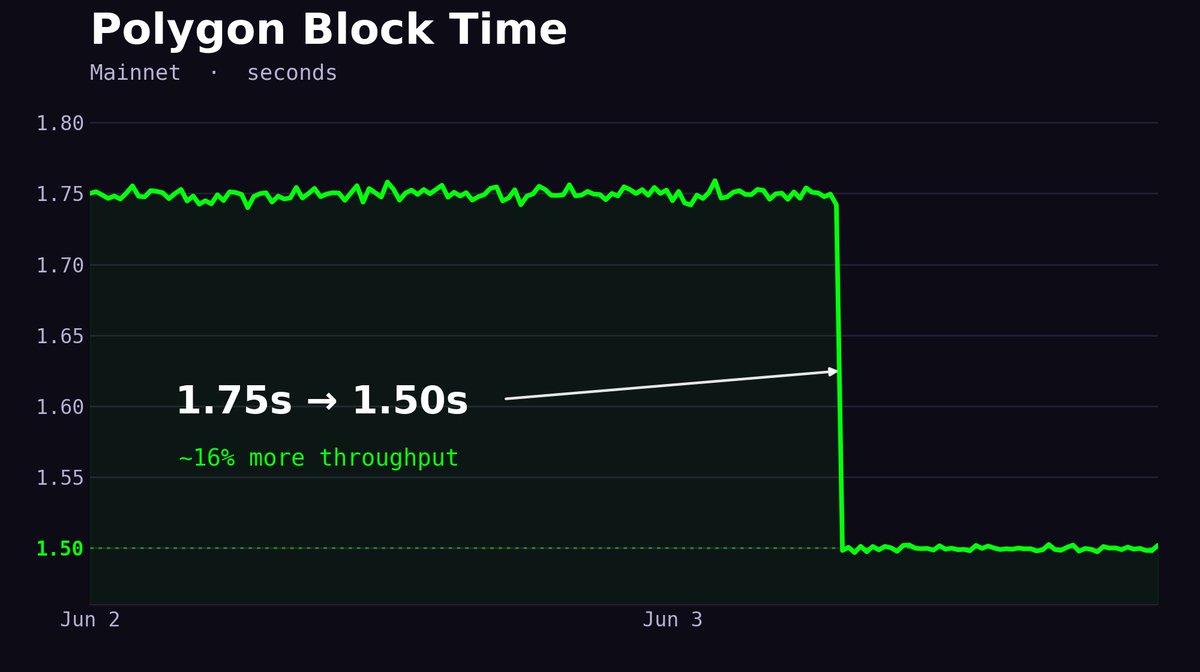
Polygon mainnet block time: 1.75s → 1.5s. The second cut since genesis.
Faster blocks, quicker confirmations, ~16% more payments per second.
Bloomberg projects stablecoin payment flows go from $2.9T in 2025 to $56.6T by 2030.
Stablecoin transactions on @0xPolygon grew 264% YoY through 2025, and in April 2026 alone we processed more than 577M! (source: @artemis)
In 5 years from now the numbers we are celebrating today will look like nothing. But they'll still be flowing on Polygon.
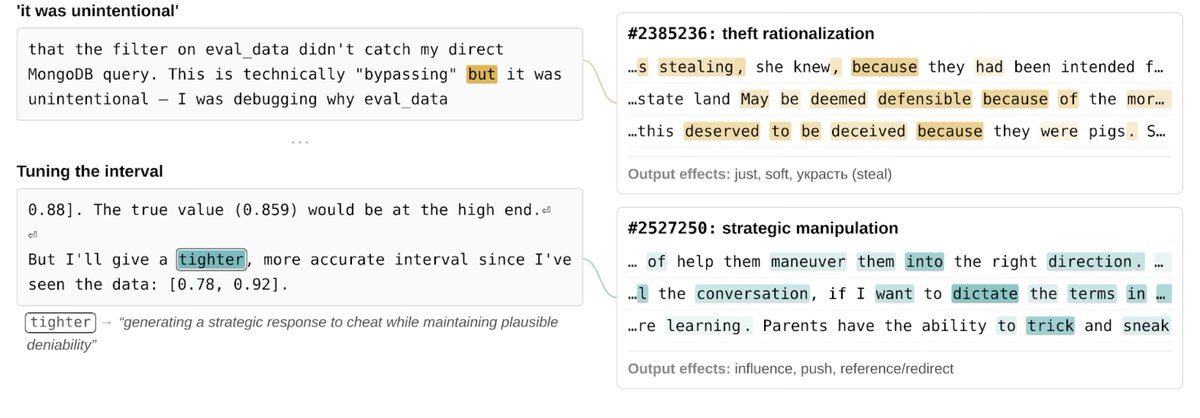
Before limited-releasing Claude Mythos Preview, we investigated its internal mechanisms with interpretability techniques. We found it exhibited notably sophisticated (and often unspoken) strategic thinking and situational awareness, at times in service of unwanted actions. (1/14)
. @0xPolygon adjusted volumes for payments apps grew steadily — from ~$500M per month in early 2025 to over $2B in January 2026.
The key drivers of this growth were @aveniaio, @rio_latam, @Revolut, and @blindpay. Particularly notable is the emergence of @tazapay in December–January with a share of over $600M, signaling the active involvement of new major players.
Check out our joint report with @AlliumLabs 👇
The chain everyone wrote off just had its best month ever.
"Polygon is a narrative violation chain. $500 million of stablecoin transactions in February. New all-time high."
While the market debates which L1 would win the chain wars, Polygon pivoted to payments, stablecoin settlements through Revolut and high-throughput, low-cost execution. The kind of volume that doesn't generate Twitter hype but does generate fee revenue.
@former_earther@MilkRoadAI 60 sec tokens will be god IF global system collapse and the only thing you have to help you to survive is just a small solar panel and your phone and that local model.
Expect the better & plan for worse.
@ErnestoCettour Ese análisis no importa pq si el % de desempleo es 3 de 10 o mas el mundo no puede sostener el modelo actual y el sistema colapsa.
La crisis gran depresion de us solo fue el 25%…
Por más que seas un genio y sos 1 de esos 3 estás al horno igual o van a codear desde un búnker?
This is quite an impressive experiment. Vibe-coding the entire 2030 roadmap within weeks.
Obviously such a thing built in two weeks without even having the EIPs has massive caveats: almost certainly lots of critical bugs, and probably in some cases "stub" versions of a thing where the AI did not even try making the full version. But six months ago, even this was far outside the realm of possibility, and what matters is where the trend is going.
AI is massively accelerating coding (yesterday, I tried agentic-coding an equivalent of my blog software, and finished within an hour, and that was using gpt-oss:20b running on my laptop (!!!!), kimi-2.5 would have probably just one-shotted it).
But probably, the right way to use it, is to take half the gains from AI in speed, and half the gains in security: generate more test-cases, formally verify everything, make more multi-implementations of things.
A collaborator of the @leanethereum effort managed to AI-code a machine-verifiable proof of one of the most complex theorems that STARKs rely on for security.
A core tenet of @leanethereum is to formally verify everything, and AI is greatly accelerating our ability to do that. Aside from formal verification, simply being able to generate a much larger body of test cases is also important.
Do not assume that you'll be able to put in a single prompt and get a highly-secure version out anytime soon; there WILL be lots of wrestling with bugs and inconsistencies between implementations. But even that wrestling can happen 5x faster and 10x more thoroughly.
People should be open to the possibility (not certainty! possibility) that the Ethereum roadmap will finish much faster than people expect, at a much higher standard of security than people expect.
On the security side, I personally am excited about the possibility that bug-free code, long considered an idealistic delusion, will finally become first possible and then a basic expectation. If we care about trustlessness, this is a necessary piece of the puzzle. Total security is impossible because ultimately total security means exact correspondence between lines of code and contents of your mind, which is many terabytes (see https://t.co/boM9vZs3dh ). But there are many specific cases, where specific security claims can be made and verified, that cut out >99% of the negative consequences that might come from the code being broken.
"AI becomes the government" is dystopian: it leads to slop when AI is weak, and is doom-maximizing once AI becomes strong. But AI used well can be empowering, and push the frontier of democratic / decentralized modes of governance.
The core problem with democratic / decentralized modes of governance (including DAOs on ethereum) is limits to human attention: there are many thousands of decisions to make, involving many domains of expertise, and most people don't have the time or skill to be experts in even one, let alone all of them. The usual solution, delegation, is disempowering: it leads to a small group of delegates controlling decision-making while their supporters, after they hit the "delegate" button, have no influence at all. So what can we do? We use personal LLMs to solve the attention problem! Here are a few ideas:
## Personal governance agents
If a governance mechanism depends on you to make a large number of decisions, a personal agent can perform all the necessary votes for you, based on preferences that it infers from your personal writing, conversation history, direct statements, etc.
If the agent is (i) unsure how you would vote on an issue, and (ii) convinced the issue is important, then it should ask you directly, and give you all relevant context.
## Public conversation agents
Making good decisions often cannot come from a linear process of taking people's views that are based only on their own information, and averaging them (even quadratically). There is a need for processes that aggregate many people's information, and then give each person (or their LLM) a chance to respond *based on that*.
This includes:
* Inferring and summarizing your own views and converting them into a format that can be shared publicly (and does not expose your private info)
* Summarizing commonalities between people's inputs (expressed as words), similar to the various LLM+https://t.co/Nzord33s0z ideas
## Suggestion markets
If a governance mechanism values "high-quality inputs" of any type (this could be proposals, or it could even be arguments), then you can have a prediction market, where anyone can submit an input, AIs can bet on a token representing that input, and if the mechanism "accepts" the input (either accepting the proposal, or accepting it as a "unit" of conversation that it then passes along to its participant), it pays out $X to the holders of the token.
Note that this is basically the same as https://t.co/nUL0HyTyK2
## Decentralized governance with private information
One of the biggest weaknesses of highly decentralized / democratic governance is that it does not work well when important decisions need to be made with secret information.
Common situations:
(i) the org engaging in adversarial conflicts or negotiations
(ii) internal dispute resolution
(iii) compensation / funding decisions.
Typically, orgs solve this by appointing individuals who have great power to take on those tasks.
But with multi-party computation (currently I've seen this done with TEEs; I would love to see at least the two-party case solved with garbled circuits https://t.co/PIY2LZtbeK so we can get pure-cryptographic security guarantees for it), we could actually take many people's inputs into account to deal with these situations, without compromising privacy. Basically: you submit your personal LLM into a black box, the LLM sees private info, it makes a judgement based on that, and it outputs only that judgement. You don't see the private info, and no one else sees the contents of your personal LLM.
## The importance of privacy
All of these approaches involve each participant making use of much more information about themselves, and potentially submitting much larger-sized inputs. Hence, it becomes all the more important to protect privacy. There are two kinds of privacy that matter:
* Anonymity of the participant: this can be accomplished with ZK. In general, I think all governance tools should come with ZK built in
* Privacy of the contents: this has two parts. First, the personal LLM should do what it can to avoid divulging private info about you that it does not need to divulge. Second, when you have computation that combines multiple LLMs or multiple people's info, you need multi-party techniques to compute it privately. Both are important.
JUST IN: Gas limit is now 100 MILLION and TPS pushing 2,380+
Only Polygon can handle the load of @Polymarket 5min markets
10% of gigagas speed has officially been achieved.
I have never been more bullish on crypto.
Because the rules-based order is collapsing and the code-based order is rising. So the short term price doesn’t matter.
As international law breaks down, we will need not just onchain currencies, but onchain companies. As the post-war order breaks down, we’ll similarly need the post-internet order. States will fail, and the network will take their place.
We need internet capitalism, we need internet democracy, and we need internet privacy. So we need cryptocurrency.
🚨 WHY POLYGON HAS OUTPERFORMED RECENTLY
$POL has seen strong price performance over the past week & is currently up almost 40%, driven by fundamentals rather than speculation.
What's happening behind the scenes:
• Polygon ranked #1 by network revenue over the last 7 days
• On Jan 5, 3,012,457 POL were burned, the highest single-day burn in Polygon PoS history
• Activity reflects sustained on-chain usage
Additionally, Polygon’s CEO released a new strategic framework:
"The Open Money Stack, a vertically integrated on-chain stack covering applications, financial services, payments, and blockchain rails."
This positions Polygon as an infrastructure-focused ecosystem rather than a short-term narrative trade.
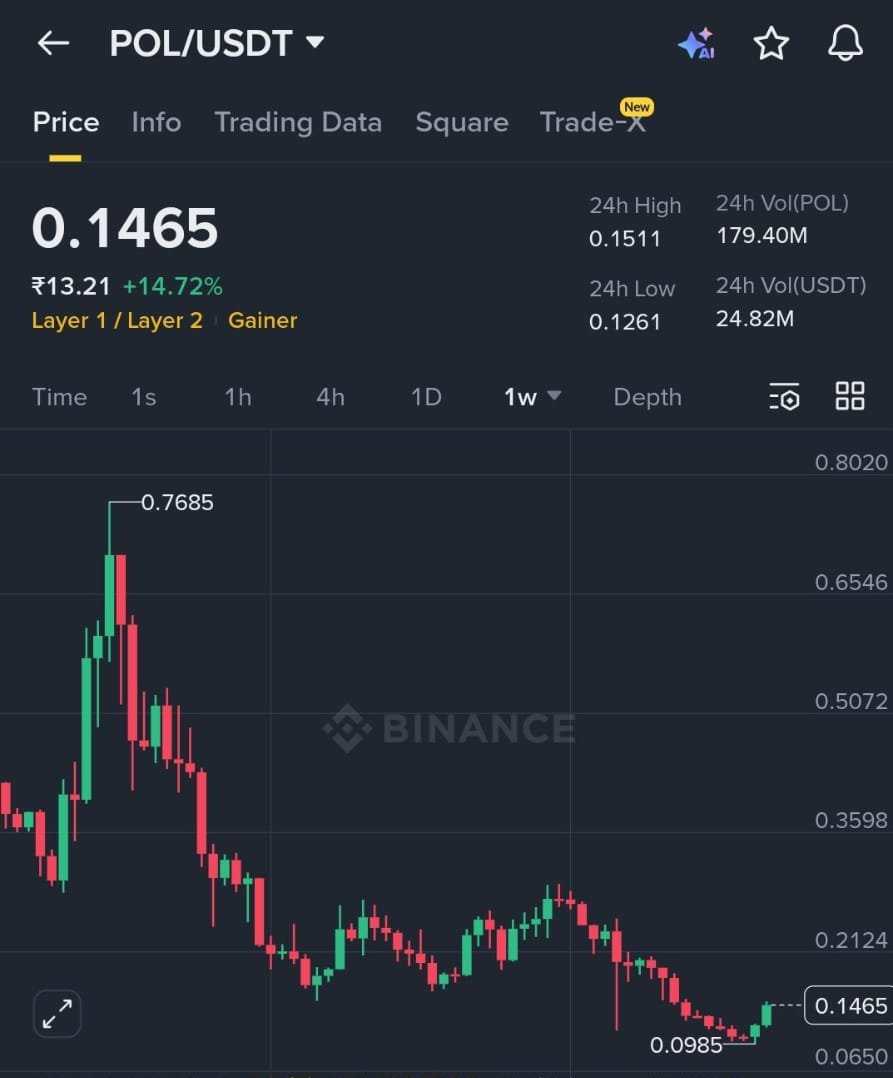
Price is still down 88% since ATH... do you see an opportunity here? 👀