⚡️ Ethereum's Block Delivery Just Got a Potential 3.5x Speed Boost
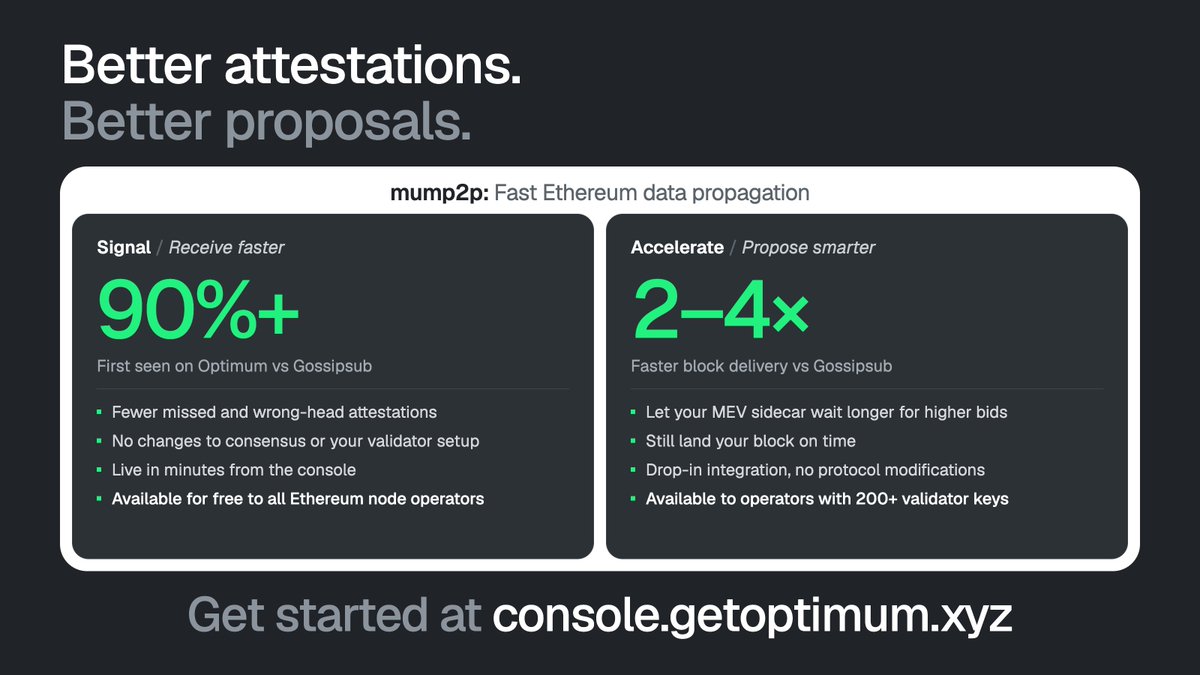
An independent team, @get_optimum, is bringing an alternative networking solution to Ethereum.
Its new P2P protocol, mump2p, went live on Ethereum mainnet on October 20, 2026.
Here's why it matters 👇
1/ The problem: Slow block propagation
When a validator produces a new block, it must distribute that block to other validators worldwide.
The faster they receive it, the sooner they can process it and reach consensus.
Ethereum currently uses GossipSub to distribute this data.
2/ The solution: mump2p
Optimum uses a technology called Random Linear Network Coding (RLNC).
Instead of repeatedly forwarding identical data, mump2p:
- Splits information into smaller pieces.
- Combines them into coded packets.
- Allows validators to reconstruct the original data after receiving enough packets.
Think of it like downloading a large file through multiple sources instead of relying on one source.
The goal is to make block distribution faster and more efficient.
3/ The reported results
According to Optimum:
- Up to 3.5x faster block delivery compared with standard GossipSub.
- 7.8% of staked ETH represented by participating validators by November.
- Works alongside existing consensus clients without changing Ethereum's consensus rules.
However, independent testing by StereumLabs found mixed results across different clients. More testing is needed to validate the gains.
4/ Why does this matter?
Faster block propagation can help Ethereum achieve:
- Lower delays in block distribution.
- More efficient communication between validators.
- Better infrastructure for future network scaling.
Vitalik has also discussed erasure-coded networking as part of Ethereum's future roadmap, although those proposals are separate from Optimum's implementation.
Ethereum scaling isn't just about higher TPS or cheaper gas fees.
The underlying networking infrastructure matters just as much.
What's interesting here is that an independent team like Optimum is experimenting with an alternative solution without requiring changes to Ethereum's consensus rules.
It's not a direct TPS upgrade, but if proven effective at scale, it could become an important improvement to Ethereum's infrastructure.
It's been 2 weeks since we publicly launched mump2p, a free and faster data propagation protocol for @ethereum. Now 7.8% of all staked ETH is running it.
Our goal is to get mump2p in the hands of every node operator, increase their performance, and turn decentralized networking from a scaling bottleneck into a scaling advantage.
Boost your node in minutes at https://t.co/YZ0MC134ae
🚨 Coinbase Gets Federal Banking Approval. Is This Base's Comeback Catalyst?
.@coinbase has officially secured a full U.S. national trust bank charter from the OCC, marking a major step toward bringing crypto deeper into traditional finance.
Why this could matter for @base:
> Institutional adoption: Federal oversight could strengthen trust in Coinbase's custody and settlement infrastructure.
> Stablecoin growth: More regulated payment and custody services could accelerate stablecoin adoption across Coinbase's ecosystem.
> Onchain expansion: As Coinbase brings more financial services onchain, Base has a natural opportunity to capture more users, liquidity and transaction activity.
> Competitive advantage: Coinbase's massive distribution gives Base a powerful bridge between traditional finance and DeFi.
Robinhood Chain has been gaining attention and challenging the existing L2 landscape.
Now, Coinbase's banking ambitions could give Base fresh momentum and put Ethereum's L2 competition back in the spotlight.
After a long period of Robinhood Chain dominating the conversation, the Ethereum L2 war could finally be heating up again.
⚠️Ethereum's Glamsterdam Upgrade Faces Serious Security Concerns
Ethereum's upcoming Glamsterdam upgrade is facing growing opposition from developers, with warnings that proposed gas changes could potentially lock users' funds inside existing smart contracts
What's the Problem?
> EIP-8037: Proposed changes to state creation gas costs could make certain fixed-gas contract calls fail
> Immutable Contracts: Some deployed smart contracts cannot be upgraded, meaning failed calls could leave user funds permanently inaccessible
> Developer Pushback: Several prominent developers are urging core developers to reconsider the upgrade before mainnet activation
> Growing Concerns: Even Ethereum Foundation voices have questioned pushing forward without fully understanding the potential risks
What's Next?
Developers are calling for more testing, technical data, and clearer communication before Glamsterdam moves forward. The upgrade has already faced delays, adding further uncertainty to Ethereum's roadmap
Ethereum's priority should be security and backward compatibility, not rushing upgrades to meet deadlines
A network securing billions in user assets cannot afford to introduce changes that risk breaking existing contracts
Scaling and innovation matter, but protecting existing users and funds must come first
🔥 Ethereum Weekly Recap: Key Highlights
Ethereum saw major developments across institutional adoption, Layer 2 upgrades, protocol research, and its long-term monetary narrative
1. Market Performance
> $ETH traded around $2,130–$2,140, down 5–7% weekly
> Liquidations exceeded $1B
> Stablecoin supply reached ~$140B
> @BitMNR holdings climbed to ~6.06M $ETH
2. ETH Narrative & Protocol
> Vitalik argued ETH should be valued primarily as a store of value while maintaining support for EIP-1559
> Hoodi testnet activation for Glamsterdam faced further delays
> ChainSecurity identified issues in EIP-8037 and EIP-8038
3. Layer 2 & Institutional Adoption
> @base: Activated its Denim upgrade, introducing native 200ms blocks
> Amundi: Launched a tokenized STOXX Europe 600 fund share class on Ethereum
> @aztecnetwork & @ETHGasOfficial: Advanced privacy infrastructure and institutional blockspace solutions
4. Devcon 8
> Wrapped up in Mumbai (Nov 3–6), marking Ethereum's first Devcon in India
> Key discussions covered privacy, post-quantum security, and the protocol roadmap
> Devcon 9 will take place in Lisbon in October 2027
ETH price remains under pressure, but institutional tokenization, L2 innovation, and protocol development continue to strengthen Ethereum's long-term role as a foundation for global finance
Why Do Hackers Almost Always Swap Stolen Funds Into ethereum:native First?
There is a reason ETH is often the first destination after a major crypto hack. It's not necessarily where hackers want to keep the money. It's where they can move it more safely.
Here are the key reasons:
1. ETH Cannot Be Frozen
Stablecoins like USDT and USDC have issuer-controlled blacklist mechanisms. Tether and Circle can freeze funds linked to suspicious addresses.
Native ETH has no central issuer that can blacklist or freeze a wallet. Swapping stolen tokens into ETH helps attackers reduce the risk of their funds being frozen.
2. Fast and Easy to Swap
Most DeFi exploits happen on Ethereum or EVM-compatible chains. Hackers can swap stolen tokens directly into ETH without waiting for cross-chain bridges or dealing with additional conversion steps.
When every minute matters, speed is critical.
3. Deep Liquidity
ethereum:native has some of the deepest liquidity in crypto. Even large amounts can be converted with less slippage compared with smaller altcoins.
This makes ETH an efficient asset for consolidating stolen funds.
4. A Gateway to Further Movement
Once funds are converted into ETH, attackers can distribute them across multiple wallets, move between networks, or attempt further laundering.
ethereum:native is often the first step, not necessarily the final destination.
Hackers prioritize ETH because it offers three important advantages: fewer freezing risks, fast execution, and deep liquidity.
In crypto theft, the first priority is to secure control of the stolen funds. Hiding their origin or cashing out comes later.
Ethereum leads the crypto economy by a wide margin. 🏆
With $7.9B in GDP, @ethereum ranks #1 among the top 10 ecosystems — more than 2.7× Tron and 3.6× Solana.
Ethereum's economic activity continues to stand out across the broader ecosystem.
📊 Top 10 Ecosystems by GDP :
🥇 Ethereum — $7.9B
🥈 Tron — $2.9B
🥉 Solana — $2.2B
▫️ BNB Chain — $903.4M
▫️ HyperCore — $888.2M
▫️ Base — $594.6M
▫️ Arbitrum One — $407.4M
▫️ Robinhood Chain — $403.9M
▫️ TON — $371.8M
▫️ Polygon — $346.5M
AI Is Making Privacy and Security More Important Than Ever
At Devcon 8, Ethereum co-founder Vitalik Buterin warned that AI is creating new security and privacy challenges, even as it becomes a powerful tool for discovering vulnerabilities.
He highlighted several concerns:
- Wallet security: AI-driven threats raise new questions about the reliability of hardware wallets.
- Social media manipulation: Bots and AI-generated content make it harder to distinguish genuine information from manipulation, especially when making crypto investment decisions.
- Data privacy: Businesses should avoid collecting unnecessary personal information.
Vitalik believes the solution lies in decentralized and verifiable technologies, particularly ZKPs, which allow information to be verified without exposing the underlying personal data.
As AI becomes more powerful, protecting privacy and verifying information will become essential. Zero-knowledge technology could play a key role in making the digital economy more secure without sacrificing user privacy.
Ethereum Pushes Privacy Beyond DeFi With Real-World Humanitarian Aid
.@ethereumfndn is working with humanitarian organizations to build a blockchain-based network for coordinating aid, combining decentralized identity with privacy-preserving payments.
The technology stack includes:
1. ERC-4337: Makes blockchain accounts easier to use
2. Semaphore: Uses zero-knowledge proofs to verify eligibility without exposing personal identity
3. Privacy Addresses: Help protect recipients' financial information and payment activity
The project has already passed performance testing on low-end Android devices, with its code open-sourced on GitHub.
Why does this matter?
This is another positive signal for the privacy narrative.
Privacy is not just about hiding transactions. It is becoming essential infrastructure for real-world payments, digital identity, and institutional blockchain adoption.
Ethereum is showing how ZK proofs and privacy-focused infrastructure can solve practical problems beyond DeFi.
The bigger opportunity could be the growing demand for privacy as more real-world activities move onchain.
⚡️Ethereum continues to cement its dominance as the ultimate PoS powerhouse, securing an astonishing $99.6B+ in staked value — more than double the rest of the field combined. 👑
Secured Staked Value Across Chains:
🥇@ethereum : $99.6B
🥈@solana : $42.1B
🥉@BNBCHAIN : $17.0B
🔹@SuiNetwork : $6.3B
🔹@Cardano : $4.4B
🔹@NEARProtocol : $2.6B
🔹@Polkadot : $870.5M
🔹@cosmoshub : $608.5M
🔹@celestia : $294.7M
🔹@Algorand : $191.6M
ZKsync Is Building the Next Institutional Rails for Ethereum
ZKsync’s October roundup highlights two developments that could strengthen Ethereum's long-term adoption: institutional infrastructure and ZK technology
1. Prividium Commander: Bringing institutions on-chain
Prividium helps banks and financial institutions manage digital assets, compliance, permissions, and private transactions without rebuilding their existing infrastructure.
This is important because institutions need privacy and regulatory controls before moving sensitive financial operations on-chain. Prividium aims to provide that while retaining Ethereum's security and settlement benefits.
2. Airbender Prime: Making Ethereum proving faster
Airbender demonstrated the ability to prove around 99% of 7,200 consecutive Ethereum blocks in under 10 seconds each using a single GPU.
In simple terms, it makes verifying Ethereum transactions faster and more efficient, bringing ZK technology closer to real-time performance.
Why does this matter for Ethereum?
• Institutional adoption: More banks and financial institutions can bring assets and financial operations on-chain.
• Better scalability: Faster and cheaper ZK proofs make Ethereum's long-term scaling roadmap more practical.
• More ecosystem activity: Institutional applications can attract new capital, liquidity, and developers into Ethereum.
By combining institutional-grade privacy with Ethereum security, ZKsync is helping build the infrastructure that could bring traditional finance on-chain.