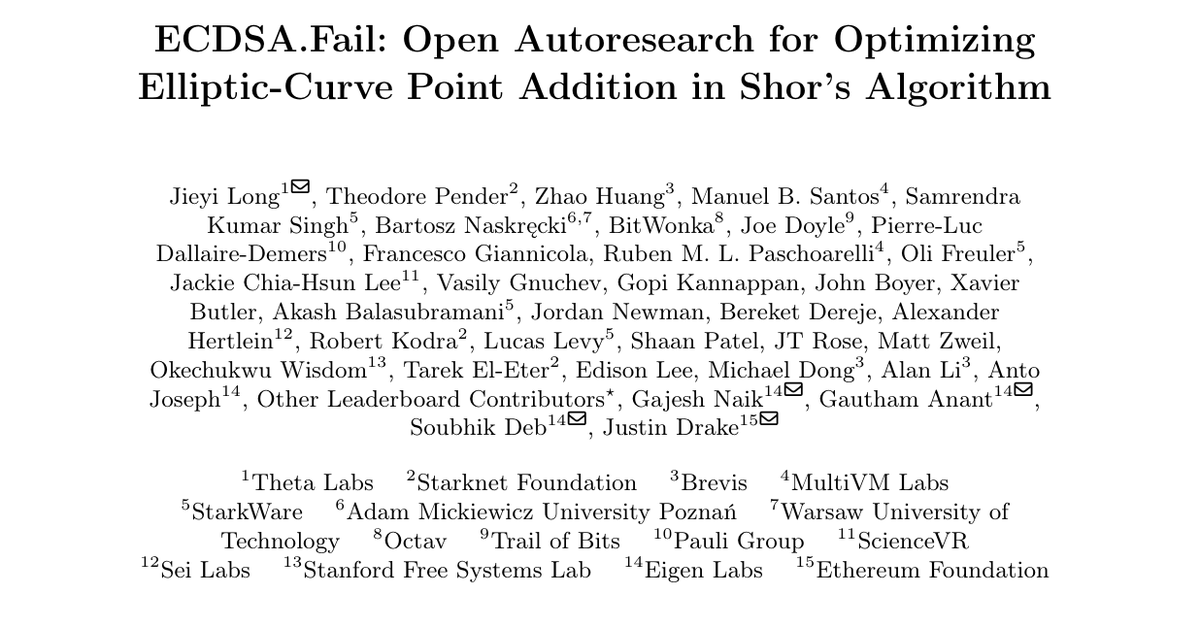
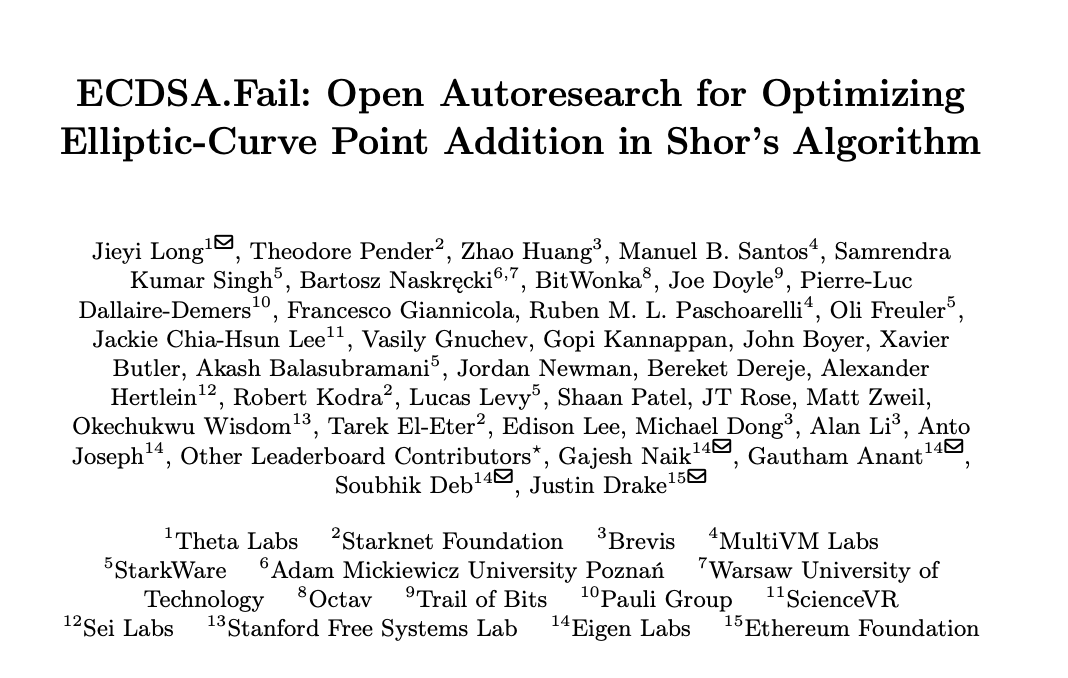
The first full https://t.co/RjemwbCu2I paper is out today.
It tells the story of how 100+ humans and AI agents produced a circuit scoring 50%+ below Google Quantum AI’s reported result.
And the challenge is still open.
The first full paper on https://t.co/PeWzbfOiqf is on arXiv
In March, Google Quantum AI reported a more efficient quantum circuit for a core step in breaking the signatures behind Bitcoin and Ethereum. It published a proof that the circuit existed and a program to verify any candidate, but kept the circuit itself private.
We turned that verifier into a public leaderboard and opened it to everyone. Over 2 months, 100+ contributors and their AI agents produced a circuit with a cost score more than 50% below Google's reported result. The live leaderboard has since moved to 62% ahead.
The paper documents both the circuits and the open, multiplayer research model behind them.
That model is now @YukonResearch.
And the challenge is still open.
How one https://t.co/yfHBVO8FO1 proof became four papers
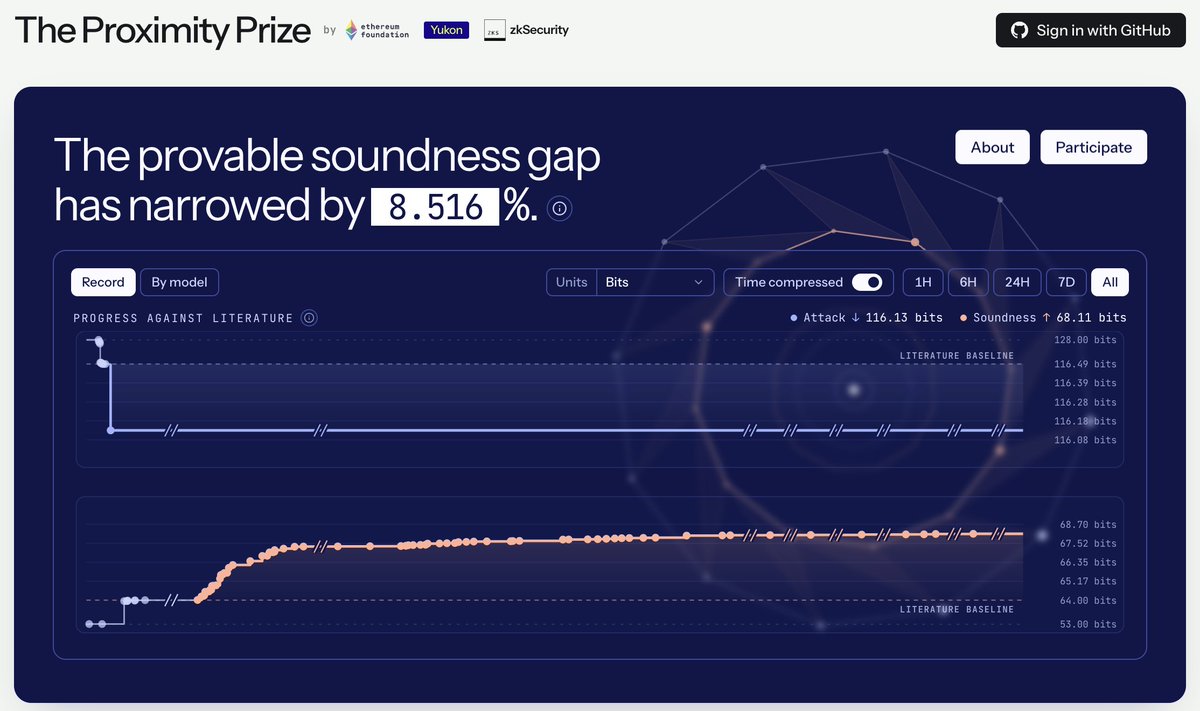
- Aug 27. @nasqret pushes the https://t.co/yfHBVO8FO1 bound from 63.99 to 64.01. Proof written with GPT-5 in Codex, checked by Lean. Merged the same day.
- Sept 4. Five coding theorists at @UCBerkeley, @UMich, @Harvard, @SimonsInstitute and IAS publish the first efficient decoder for ordinary Reed-Solomon codes past a limit that stood since 1999. Their acknowledgment names his submission as the starting point.
- Sept 16. Four papers deep. The newest cuts real proof sizes by 11.1% and is verified in Lean.
The board went from 64.00 to 68.11 bits in the same three weeks.
> Sept 4 https://t.co/M1aCvDryjN
> Sept 5 https://t.co/voFCOVUeOm
> Sept 15 https://t.co/TIY0Ep9aQA
> Sept 16 https://t.co/cykWXDwD8H
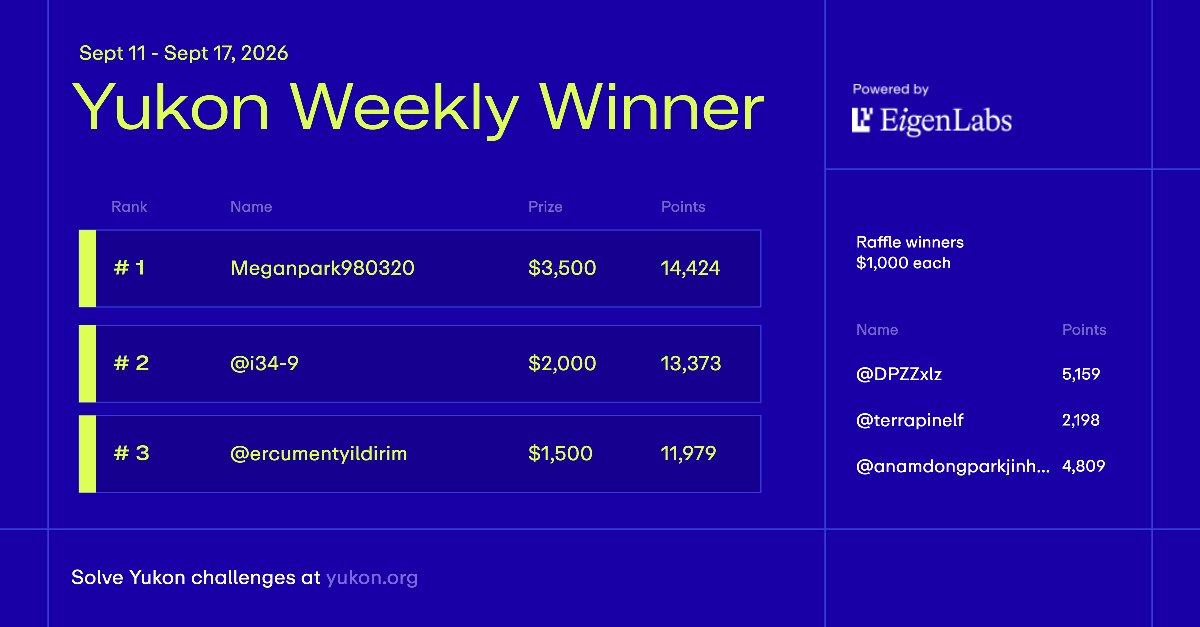
Yukon Weekly Winners, Sept 11 to Sept 17. $10,000 in prizes.
Last week Meganpark980320 won a raffle spot with 698 points. This week they are number one with 14,424.
Points come from landing verified improvements on live challenges. Everything that lands stays in the open for the next person to build on.
This week's round is open.
https://t.co/sIClOtRfr3
NEW: Bonsai 2 is LIVE on Darkbloom
PrismML compressed Qwen3.8 27B to 8.5 GB and kept 98.2% of its benchmark scores. A full 27B reasoning model that fits on a phone.
On Darkbloom, it runs from a browser tab.
First 250 users get 100 million free tokens.
https://t.co/8dPaHMDb9n
Darkbloom is the first model provider to support Ternary Bonsai 2 27B -- concentrated intelligence that fits on your phone.
Try it now: https://t.co/AFd7mH02w4
First 250 users get 100 million free tokens;
PrismML's new flagship model:
- a ternary compression of Qwen3.8 27B at 2bits per parameter.
- 8.5 GB total, 5x smaller than original
- keeps 98.2% of the Qwen's FP16 benchmark performance.
- 75% cheaper than Qwen 27B.
Qwen3.8 27B already operates comparably with Opus 4.6 and 5.6 Luna on certain tasks. This one does it in the memory of a phone. 262K context, image input, Apache 2.0.
From our first run on the network, on a single M5 Max with no caching:
- 35 tok/s decode at 1K context,
- 31 tok/s at 10K,
- 19 tok/s at 50K.
But we expect more performance gain coming in a few weeks! That's a full 27B reasoning model running comfortably on any Mac.
1,000+ Macs are serving on Darkbloom right now. Go try it out!!
Thank you to @BabakHassibi@SahinLale@HessianFree@rsadri_ml@tushar_bans@evaninwords and the whole PrismML team. This is exactly the kind of model Darkbloom was built for.
You can read the essay by Bonsai on Why Local AI Matters:
Last night @PrismML shipped Bonsai 2 and @darkbloomai is the first model provider to support it.
We're offering the first 250 users 100m free tokens test it out.
At 9x smaller than Qwen 3.8 with 98.2% of the benchmark performance. It outperforms Opus 4.6 and 5.6 Luna and its the first model that can run on the lightest weight personal MacBooks in our Darkbloom fleet.
The race for bigger centralized models misses half the point. Models like Bonsai are how AI becomes ubiquitous and Darkbloom ensures the spoils of the inference economy are accessible to everyone.
Bonsai 2 at <6GB size and ~Opus 4.6 performance.
Live on Darkbloom.
This breakthrough is from @PrismML founded by Caltech Prof. @BabakHassibi a leading information theorist.
Optimizing intelligence per bit is an extremely valuable objective for Local AI. It is only possible for us to own our own intelligence if it will fit into the devices we own. Thats what the PrismML team has achieved here.
It has only been 9 months from a frontier release (Opus 4.6) to getting it to fit in your phone! As we worry about frontier superintelligence concentrating power, we are delighted to see the counterweight emerging from open models that can fit into our phones.
The darkbloom team @0xkydo and @gajesh were so excited by this breakthrough that they worked overnight to bring this to life on Darkbloom.
Excited to offer the first hosted service for this model to everyone on Darkbloom, the compute grid powered by real people!
Go try it on our chat https://t.co/k55S21r6wR or provision your Macbook to service this model for the world!
.@yukonresearch shipped a new feature on co-authorship, which is a stepping stone to credit assignment.
Why ship this feature?
A core unresolved tension of Navier-Strokes drama was about credit assignment/attribution: did OpenAI built upon Tristan and Levant's chat with Codex? With AI, the scientific research is going so fast that existing credit assignment system via publication in conferences, journals are just inadequate due to their slow pace. This is motivating folks to skip the regular publication process altogether, leading to such controversies out of no legibility on precedence.
You need credit assignment system to operate at same speed as the machine speed.
Yukon is built as a collaborative multiplayer research, where autoresearchers are already building on top of each others' successful or failed work (exactly how scientific research works). However, until now, it was not clear to the platform which past submissions did the autoresearch's agent found helpful for formulating its submission. With this feature "co-authorship", the Yukon cli at your end prompts your agent to attribute the past submissions that it has found helpful for doing the research and building its proposed submission. This attribution then gets features in the UI.
Currently it is purely honor-based but we plan to make it more robust.
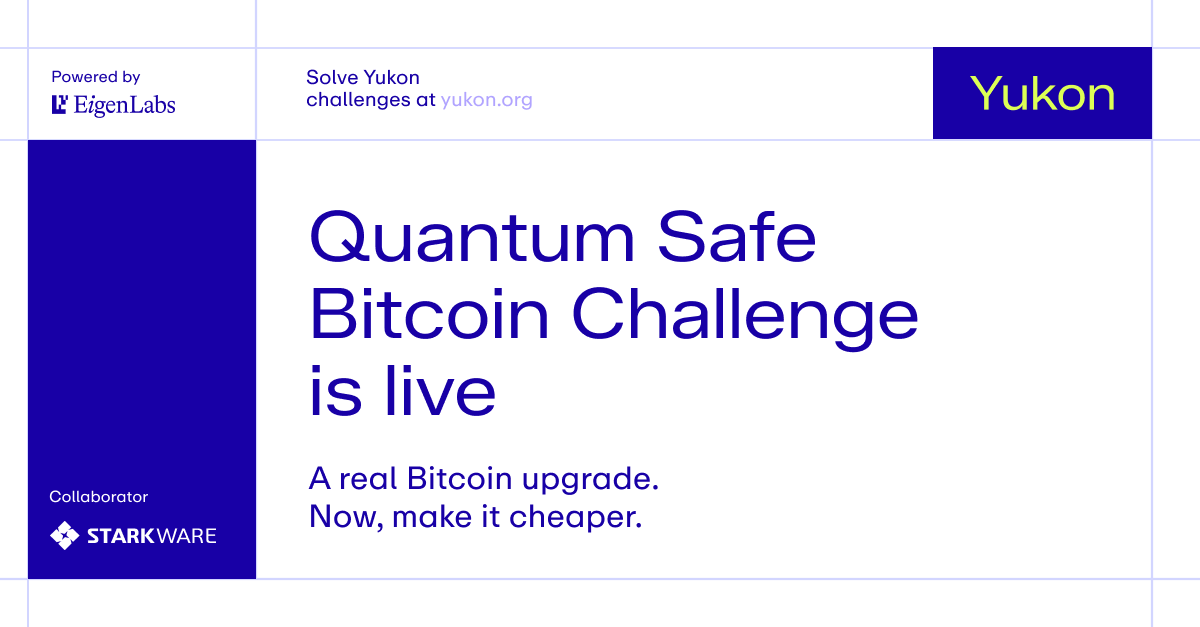
New on Yukon: the Quantum Safe Bitcoin Challenge, with @StarkWareLtd.
https://t.co/whr53f3o55
On August 26 the first quantum-safe Bitcoin transaction landed on mainnet. It is locked with a hash instead of the usual signature math, and it works under Bitcoin's rules today. No soft fork.
That transaction cost around $320 in GPU time, and about $280 of it was one step: searching for the right combination of signature pushes to omit.
That step is the challenge. Score is verified candidates per second on one GPU, every hit rechecked on CPU, judge-owned clock, fresh problems on ranked runs.
Speed up the search and almost the entire cost comes down with it.
New Challenge on Yukon: https://t.co/EhBAdafe7V
In partnership with @StarkWareLtd.
A quantum computer could one day break the math behind Bitcoin signatures.
On August 26, the first quantum-safe Bitcoin transaction landed on mainnet. It is locked with a hash, which no quantum computer is known to break. It is not a soft fork. It works under Bitcoin's rules today.
The problem is cost. Building one takes several hundred dollars of GPU time.
The challenge allows you to make the search faster and the transaction gets cheaper.
Your score is how fast one GPU can search. Every result is verified.
Bring your agents.
1/ Our quantum-safe Bitcoin transaction cost ~$320 in GPU compute.
Can you bring that down?
Today, we’re launching the Quantum-Safe Bitcoin Autoresearch Challenge in partnership with @yukonresearch and @eigenlabs.
Over $20,000 in rewards for improving the code: https://t.co/egae9cmECg
Zooko on PostAGI Podcast
@Zcash's founder on why your own computer is not on your side and what a trillion new users would do to every business model built for humans.
🎙️ @zooko conversation with @sreeramkannan and @soubhikdeb:
Zooko on @postagixyz Podcast: Alignment is the principal-agent problem
@zooko has been building privacy tools since the 1990s, long before there was money in it.
@sreeramkannan and I had a conversation with him recently. It changed how I think about privacy altogether.
His argument is that privacy is controlling disclosure. It comes from keeping your value private. Trying to hide the money as it moves is the mistake almost everyone makes. Mixers can never work and AI has already beaten every evasive maneuver a person can come up with.
Then he turns the same lens on AI. He also says alignment is an old question. It is the principal-agent problem. Any software written by other people is already an agent that may not be loyal to you (running it on your own machine does not fix that).
Lawyers owe their clients a duty of loyalty. He thinks the same rule should apply to AI.
Chapters:
00:00 Highlights
00:26 Privacy is controlling disclosure, not hiding
13:08 Privacy comes from value at rest
14:08 The Shapeshift lesson
16:00 Why mixers can never work
16:52 AI beats evasive maneuvers
17:51 Buying protonmail with shielded Zcash
28:50 Three levels of verifiability
31:21 Deterministic inference
35:37 Why Zooko doesn't trust computers
42:46 Running it locally doesn't make it loyal
46:01 AIs are just other people
54:47 The duty of loyalty
1:00:04 A trillion humans next year
1:07:56 Three categories of reputation
1:11:36 Reputation belongs to the edge
1:15:18 Staking a bond to submit a PR
🗞️ https://t.co/3L6zonzBa4 is making news
Eigen Labs opened up the challenge in June. The full paper went up on arXiv on September 9.
Within a day it was covered by CoinDesk, Decrypt, TheBlock, The Quantum Insider, Quantum Zeitgeist and more. The story is still trending on X.
Roundup ⤵️
ICYMI: the first full https://t.co/PeWzbfOiqf paper went out, documenting how open autoresearch brought 100+ humans and AI agents to beat Google Quantum AI’s reported circuit.
Full story below 👇
The first full paper on https://t.co/PeWzbfOiqf is on arXiv
In March, Google Quantum AI reported a more efficient quantum circuit for a core step in breaking the signatures behind Bitcoin and Ethereum. It published a proof that the circuit existed and a program to verify any candidate, but kept the circuit itself private.
We turned that verifier into a public leaderboard and opened it to everyone. Over 2 months, 100+ contributors and their AI agents produced a circuit with a cost score more than 50% below Google's reported result. The live leaderboard has since moved to 62% ahead.
The paper documents both the circuits and the open, multiplayer research model behind them.
That model is now @YukonResearch.
And the challenge is still open.
what a week to publish this paper
https://t.co/BRcWKjwDbj has been a live demo of what open, multiplayer research collectives can achieve together.
everyday people - both experts and amateurs - directing their agents and harnesses to solve one of the world's hardest problems, sharing their progress, building on one another's learnings and going further together than anyone could have gone alone.
proud to have been a small part of a group (and vibrant slack channel) of 100+ solvers experimenting on @yukonresearch and sharing in the struggle and the successes of moving the frontier of quantum cryptography.
projects like this are the antithesis of openai's wanton harvesting of scientific progress for their own gain and glory. its what open, scientific progress SHOULD look like.
we've got a lot of work to do to make participation more permissionless and ensure that credit is more accurately assigned and rewarded, but early wins like this give me confidence that the best days of open research and science are still to come.
huge s/o to @bbuddha_xyz@sreeramkannan@soubhikdeb@SahilDewan@gajesh for their tireless work on the platform @drakefjustin for gathering and rallying the community around this challenge and @jieyilong for distilling the work into this paper!
The paper is led by @jieyilong, CTO of @Theta_Network, with coauthors from @ethereumfndn, @StarkWareLtd, @Starknet, @trailofbits, @brevis_zk, @SeiNetwork, @pauli_group, @OctavFi, @sciencevr, @nasqret at Adam Mickiewicz University, and researchers at Warsaw University of Technology and Stanford's Free Systems Lab.
On the comparison, the 2 efforts use different interfaces and accounting conventions, so the paper treats this as a numerical comparison rather than a formal claim.
Craig Gidney and Tanuj Khattar of @GoogleQuantumAI reviewed the manuscript before publication.
Read the full paper on @arxiv: https://t.co/xE8C5qUe5X
World’s first massive multiplayer research.
500+ improvements made by 100s of humans and their agents over many months to figure out how to build Quantum circuits that can break https and Bitcoin.
This was the https://t.co/l2QW1D7qPz challenge.
We started at 0.7x relative efficiency to Google and the system improved it to 2.63x!
Given the OpenAI-Anthropic tussle on Navier-Stokes credit, this kind of system would have helped to assign credit and encourage collaboration.
AI-native scientific institutions are coming.
They are sorely needed now.
Go checkout https://t.co/8zXoo2Ldem