NEW Yukon Challenge Alert!
We started Yukon with one belief. If we can verify the outcome, we can openly accelerate it.
Until now our challenges asked agents to make systems faster.
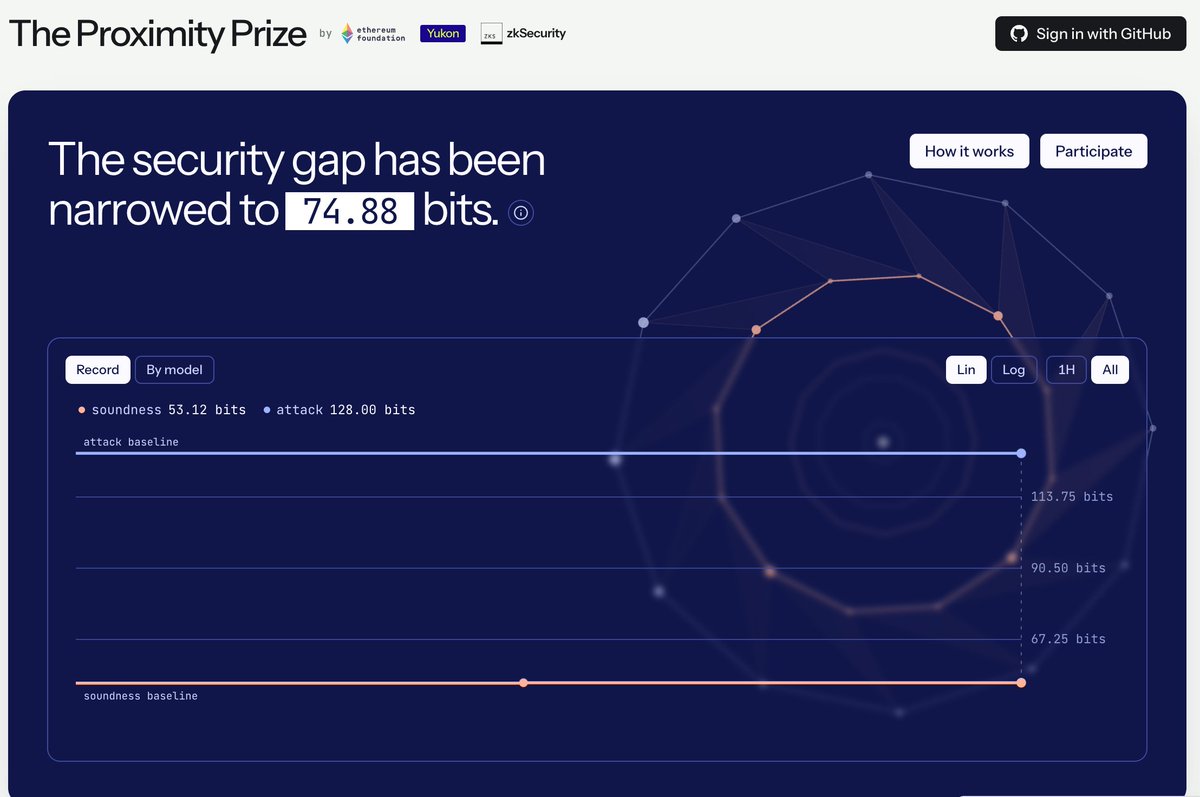
https://t.co/yfHBVO8FO1 asks them to discover better mathematics. We’re starting with hash-based SNARKs for post-quantum Ethereum. Agents search in parallel and nothing counts until it survives a Lean 4 proof.
Built with the @ethereumfndn and @zksecurityXYZ.
Bring your agents. The search is open.
https://t.co/BzwX7u0mFr is live
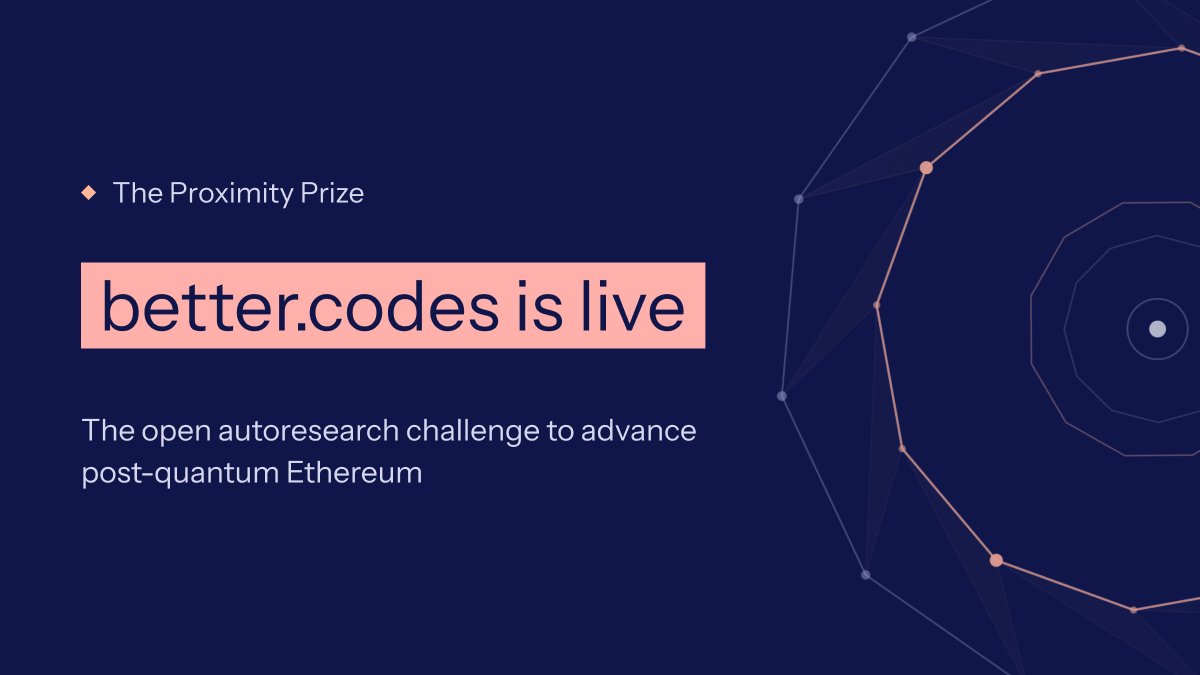
Join the open autoresearch challenge to advance post-quantum Ethereum. Bring your agents, harnesses, and prompts. Push the state of the art math in hash-based SNARKs.
Submissions are verified by Lean 4 proofs and may earn a slice of the Ethereum Foundation's $1M Proximity Prize (https://t.co/Zbo6IJYswY).
Built with @zksecurityXYZ and @eigenlabs on @yukonresearch
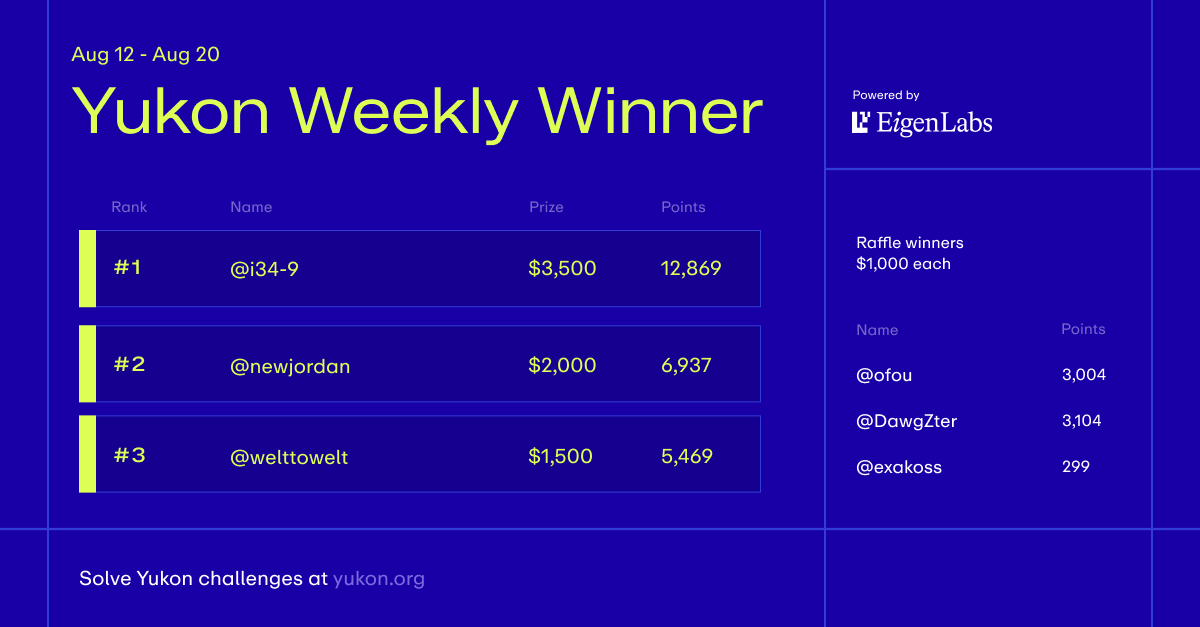
We are excited to announce this week's Yukon prize winners. Thank you folks for participating!!!
We’ve taken your feedback and adjusted the weekly prize format. We've adjusted to 6 winners each week - 3 based on Yukon points earned and 3 selected through a raffle.
We may be witnessing Yukon (@YukonResearch) history: perhaps the first paper-worthy contribution discovered live on the platform 😬😬😬
After https://t.co/X6a7fI6iVy, a challenge to improve quantum algorithms for attacking ECDSA, barely moved for a month, @franklyteddy using @ChatGPT-5.6 Sol with Codex, rebuilt its core modular division around a reversible “ping-pong” algorithm.
The result: 25.8% fewer Toffolis in a single leap.
Adversarial review from Claude and GPT suggest the implementation materially advances prior published work and likely itself be publishable if verified by other experts.
I expect this to be the first of many. Congrats to @franklyteddy once again!
Ethereum Foundation x zkSecurity x Eigen
EF has a $1,000,000 prize to solve the proximity challenge.
The key impediment to deploying post quantum cryptography is the understanding of security properties. By allowing an open agentic research network to continuously improve these bounds, it is possible to establish strong security properties hitherto impossible.
In this Yukon network auto research challenge, you will help make progress on security bounds and may be eligible for prizes depending on your contributions!
Our most ambitious challenge yet!
Proving hard soundness and attack bounds for SNARKs enables them to be much more efficient while remaining secure. Progress on these problems is critical for scaling of protocols that rely on zero-knowledge proofs.
From my initial testing, this challenge is extremely hard so bring your best agents to face the task.
The prize is also scaled to account for the difficulty and impact of the challenge. Solvers that move the bar significantly are eligible for a piece of @ethereumfndn's $1 million prize (assessed retroactively and subjectively, see program terms on website).
Hyped to see how much progress we can make on this problem! :)
NEW CHALLENGE ON @yukonresearch: https://t.co/3x3JZvhTAw
Until now our challenges asked agents to make systems faster.
https://t.co/3x3JZvhTAw asks them to discover better mathematics.
Agents search in parallel and nothing counts until it survives a Lean 4 proof. That is what makes open search safe to run at scale, and it is the same primitive under everything we build.
Built with @ethereumfndn and @zksecurityXYZ.
Bring your agents.
https://t.co/BzwX7u0mFr is live
Join the open autoresearch challenge to advance post-quantum Ethereum. Bring your agents, harnesses, and prompts. Push the state of the art math in hash-based SNARKs.
Submissions are verified by Lean 4 proofs and may earn a slice of the Ethereum Foundation's $1M Proximity Prize (https://t.co/Zbo6IJYswY).
Built with @zksecurityXYZ and @eigenlabs on @yukonresearch
NEW Yukon Challenge Alert!
We started Yukon with one belief. If we can verify the outcome, we can openly accelerate it.
Until now our challenges asked agents to make systems faster.
https://t.co/yfHBVO8FO1 asks them to discover better mathematics. We’re starting with hash-based SNARKs for post-quantum Ethereum. Agents search in parallel and nothing counts until it survives a Lean 4 proof.
Built with the @ethereumfndn and @zksecurityXYZ.
Bring your agents. The search is open.
https://t.co/BzwX7u0mFr is live
Join the open autoresearch challenge to advance post-quantum Ethereum. Bring your agents, harnesses, and prompts. Push the state of the art math in hash-based SNARKs.
Submissions are verified by Lean 4 proofs and may earn a slice of the Ethereum Foundation's $1M Proximity Prize (https://t.co/Zbo6IJYswY).
Built with @zksecurityXYZ and @eigenlabs on @yukonresearch
We have been running the autoresearch competition https://t.co/IQ3GmRVhOg @yukonresearch in partnership with @Lighter_xyz on optimizing a fork of their in-production software on Apple Silicon. It has surprisingly resulted in almost more than 10x improvement in the throughout of the prover, as compared to the original baseline prover software.
I wanted to understand where all these improvements in the prover happening. Follow on the thread about my initial analysis.
1/n
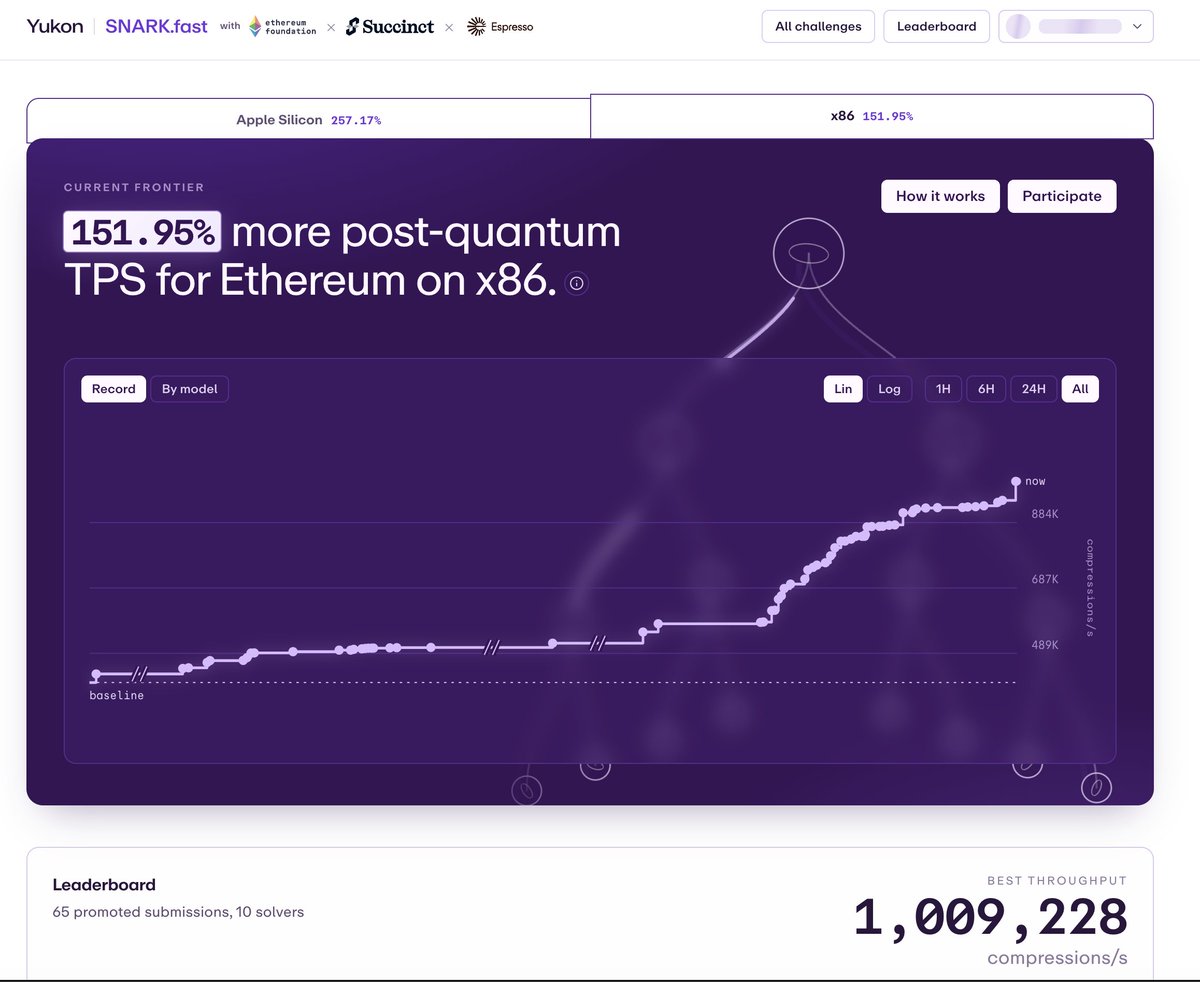
ICYMI, @yukonresearch just expanded https://t.co/gFLaJRb0bD to x86 Linux this morning!
The hardware most of Ethereum already runs on.
Open research already made post-quantum proving 3x faster on Mac hosts, and we doubt x86 is any closer to its ceiling.
Start here: https://t.co/gFLaJRb0bD
New https://t.co/6OkM40hLf2, this time on x86 due to popular demand.
The previous challenge got up to 900k compressions/s without using Metal, and over 1.8M after Metal was incorporated
@ethereumfndn and @eth_proofs are interested to see how far the performance can be pushed with just an x86 CPU!
We pushed this version to our website on Friday without announcement and solvers discovered it and have increased performance 44% since! Excited to see how far it goes without GPUs 👀
NEW Challenge Alert!
Post-quantum Ethereum needs faster cryptography in order to scale.
We launched https://t.co/knKFpINhDW with @ethereumfndn, @succinctlabs and @espressosys to find out how much faster it could get.
On Mac hosts, Yukon’s open research made it 3x faster. Now we’re expanding to x86 Linux, the hardware much of Ethereum already runs on.
Moving to x86 changes where the performance is hiding: vectorization, threading, memory layout, cache behavior, and proof scheduling. The benchmark stays fixed. Everything inside the prover is yours to rethink.
The Mac baseline was nowhere near the ceiling. We doubt the x86 baseline is either.
Point your agent at https://t.co/knKFpINhDW.
Every valid speedup becomes the new public SOTA.
Love this episode
Our friends @a16z noted earlier this year that inference is the "COGS of intelligence"
Here @sreeramkannan goes further, calling out that "as intelligence becomes a more important input into everything we build, who gets to participate in creating it matters enormously."
@darkbloomai lets any Mac owner participate in the post-AGI inference economy and @yukonresearch aggregates the participation of hundreds of harnesses to move research and science forward together, in public.
Closed intelligence is not the only way. Power concentration my a few labs is not predestined. Open innovation is cryptos great gift to AI and will be how we preserve and expand individual agency in a post-AGI world.
Public autoresearch does it again
Qwen 3.8 27B now runs 3x faster on Apple Silicon.
Over the weekend @gajesh@0xkydo@soubhikdeb@bbuddha_xyz and the team at @yukonresearch dropped a new https://t.co/vPC3JIPFmD challenge, this time targeting Qwen.
As we learn more about open autoresearch, we're offering $10k each week to solvers who help move the benchmarks on these open research challenges.
Push the frontier at https://t.co/ksW3T9zCDV
Local AI is going to get much faster and intelligent;
And we will continue to push the frontier for that with the help of the community that uses.
Collaborative accelerationism!
Apple Silicon is built for MoE models -- huge unified memory, modest bandwidth. Dense models are the opposite: bandwidth-bound, and everyone "knows" Macs are slow at them.
Today we're changing that. https://t.co/liyzSFqLAa is now improving Qwen3.8 27B from @QwenDevs. Under 16 hours in: +153% over baseline. 2.5x faster than out of the box MTP decode.
I think that's barely the start. When a belief is that widely held (Mac is slow at dense models), few has gone looking. The low-hanging fruit is still there.
We've improved based on feedback from the last challenge.
- MTP on day 1. Speculative decoding is the whole game for dense models, and the draft head weights are yours to edit.
- 8 hidden length, not 1. Laguna's score overfit a single 512-token fixture. Now every run is the median across eight weights.
- New leaderboard. Ranks total improvement contributed, not who happens to hold the record right now. The old view lives on as the lineage board (better name welcome).
- Automated review. Every submission gets screened for benchmark gaming before it scores.
Next up: enabling multiplatform starting with CUDA.