Qwen4 is coming.
Deeper knowledge. Richer world understanding. Stronger coding and agentic capabilities.
Built for real-world tasks — from complex coding and knowledge work to front-end builds and professional software workflows.
Qwen4-Max is now in preview on Alibaba’s Token Plan. You can also get early access to the new model on QwenWork, Qoder, Qwen APP, and QwenStudio.
Put it to the test on a real problem. Show us what you build. 👀
Token Plan: https://t.co/LOB2Jdt3Sk
Qwen4 did most of the work on this tumor evolution simulator. here's who did what, and what you're looking at.
opus wrote the first version. after that i handed every fix to Qwen4. opus reviewed each pass and sent back what was wrong, and Qwen4 fixed it. three rounds like that.
what Qwen4 changed:
• reworked how the treatments behave so the comparison is fair
• got it running smooth at max speed (46 fps)
• added a built-in self-test with 18 checks
• fixed a bug opus caught where the "gentler" plan was secretly getting more drug. now it can never get more than the max-dose plan, and the self-test fails if it ever does
what the video shows, in plain english:
a tumor starts as one bad cell. it keeps mutating as it grows, and by the time it's big enough to treat, a few cells already shrug off the drug. that happened by chance, before any treatment.
then we split the exact same tumor into two worlds.
world A gets the strongest dose every 2 weeks. it wipes out almost all the normal tumor cells, which also clears the space the resistant cells were fighting over. so the resistant ones take over and the tumor comes back.
world B uses adaptive therapy. same drug, same dose, but it skips doses while the tumor is small. the regular cells that survive keep crowding the resistant ones. in the sim, resistant cells grow slower, so they lose that fight for a while.
in this run B held out 32 days longer and used 31% less drug. both tumors still came back in the end. B just bought more time.
green = cells the drug works on
red = cells the drug can't touch
adaptive therapy is a real idea researchers are testing. this is a simplified model for learning, not medical advice.
Qwen4 + SWE-2 Flash, 10.6 hrs of active work: we now have a finished PCB design.
4 layers, 144 LEDs. Qwen4 designed it, SWE-2 Flash wired it up.
Here's the board, and an exploded view of every layer 👇
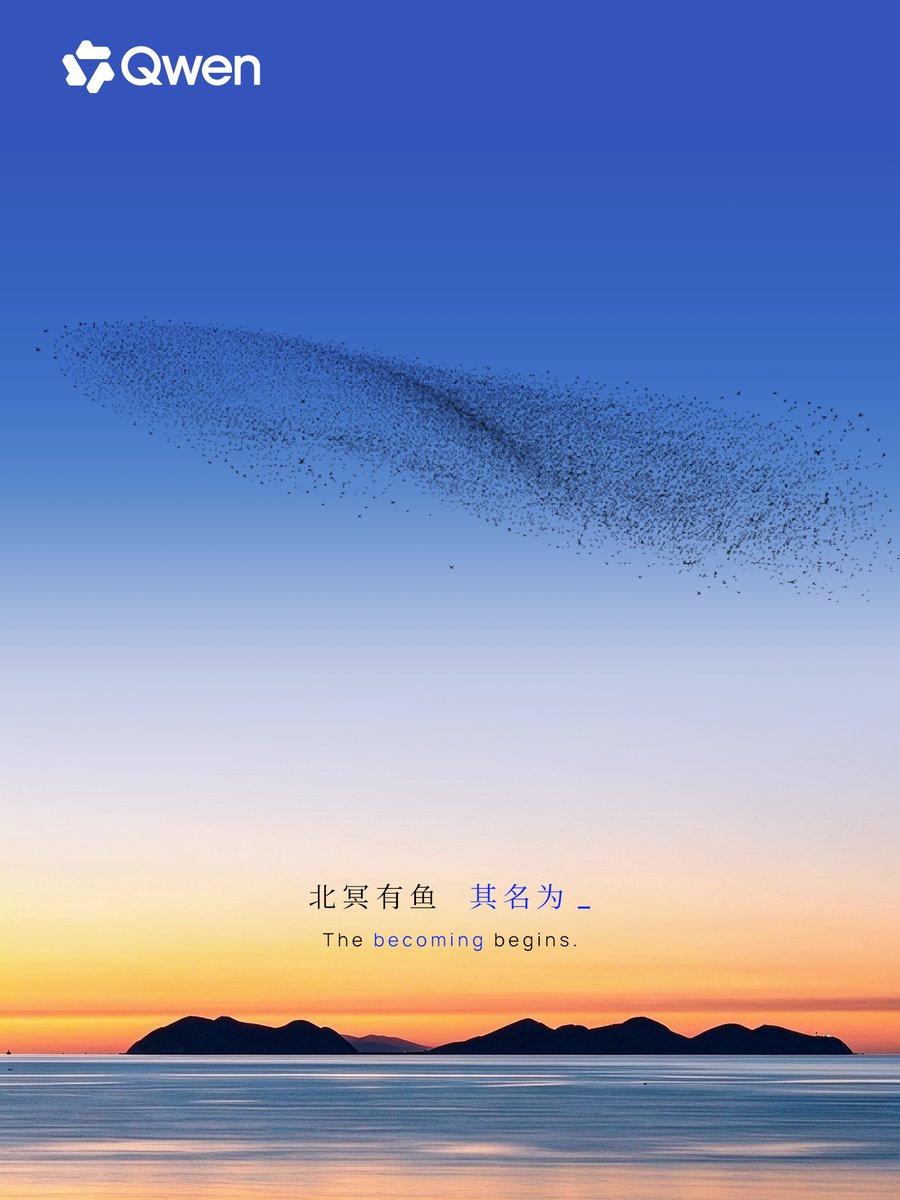
Qwhen? Qsoon!
For our friends outside China, the Chinese text in the poster comes from Zhuangzi, an ancient Chinese classic:
"Far in the northern sea lives a fish named Kun (pronounced like Qwen). So immense is its size that no one knows how many thousands of miles it spans."
Guys, remember zg? We shared it a couple of months ago when our friends on Alibaba's @ZvecAI first open-sourced it, and it got a lot of love from developers. Well, they've been busy: they rewrote its core in Rust, and the performance gains are quite something
In their benchmarks, indexing took 64.5% less time, with 53.2% lower average peak memory usage. Less waiting for your index, more room for your editor and coding agents. It still works with Qwen Code and other coding agents, with more integrations added in this release.
Check out their post and repo for more details: https://t.co/JxPygNBEgf
🚀 Zvec-grep 0.3.0 is here — rebuilt in Rust.
Local search for developers and AI agents, now with less waiting and a lighter footprint.
⚡ Less time indexing
Across four BEIR datasets, total index build time dropped from 219 s to 78 s—about 65% less time than the Node.js version.
🪶 Lower memory use
Average peak indexing memory fell by 53%, leaving more room for your editor, agents, and other tools.
🔎 Smoother everyday use
An rg-inspired CLI, clearer model selection and indexing progress, plus fixes for file tracking, result locations, and index management.
🤖 More agent integrations
Now supports GitHub Copilot, Grok Build, VS Code, and Pi, alongside existing integrations.
Try it in your workspace and tell us how it goes.
https://t.co/uDj5OWmOd1
Well, turns out Qwen3.8-Flash-Next can do more than work with software tools, it can operate real robots too.
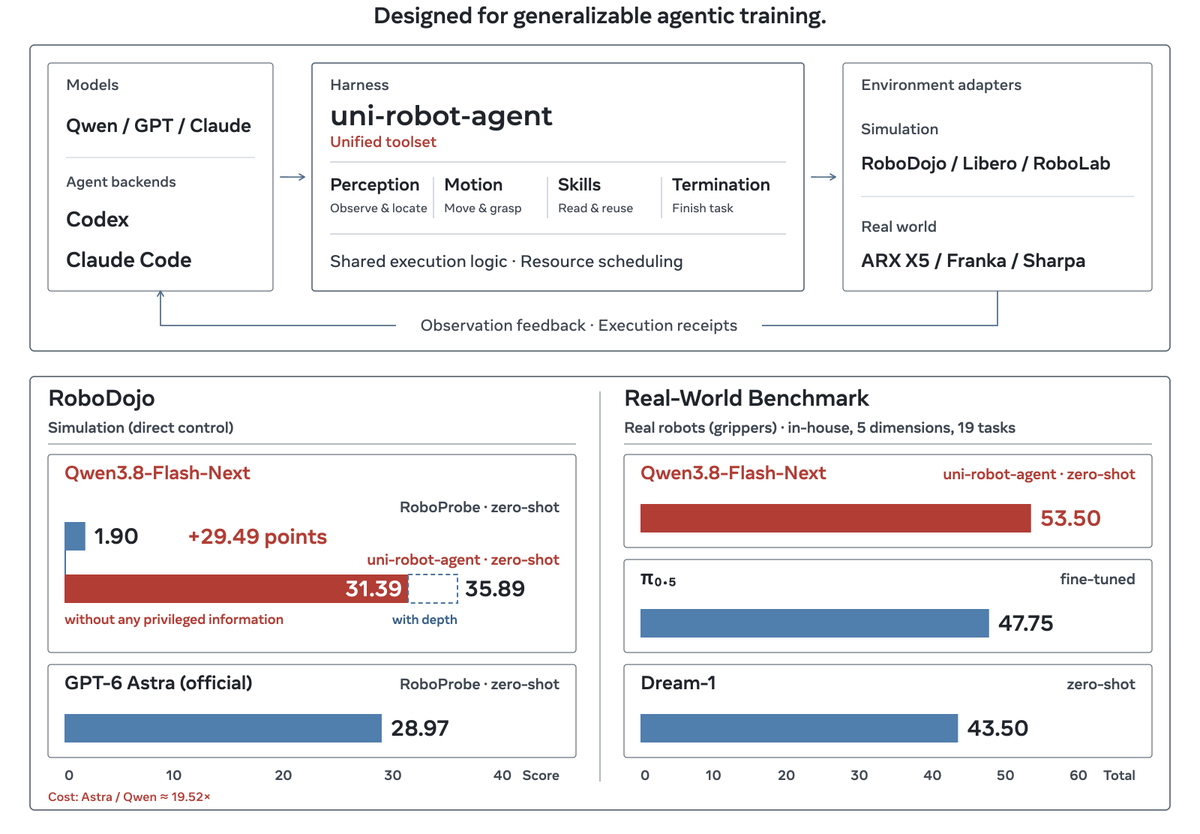
A group of Qwen developers from Tsinghua and UC Berkeley recently built uni-robot-agent, an open-source harness that connects general-purpose LLMs to robotic systems. It gives Qwen a way to interact with the physical world through tool calls without changing the model weights.
With this harness, Qwen3.8-Flash-Next reached the performance level of some previously reported closed-model robotic agent systems. The average API cost was $1.09 per task, compared with $21.29 for GPT-6 Astra. On 19 real-world robot manipulation tasks. Without any robot-specific fine-tuning, Qwen achieved a slightly higher score than the fine-tuned π₀.₅
The harness is open-source if anyone wants to tinker with it.
‼️ Can Qwen directly control the robot as well as GPT-6 Astra?
🚀 Introducing uni-robot-agent: a unified harness for Robot-Use Agents (RUAs), a first step toward RUA training and local deployment.
We tested uni-robot-agent with Qwen3.8-Flash-Next running locally:
1️⃣ On RoboDojo, its score rose from 1.90 to 31.39, surpassing the RoboDojo Team’s score with GPT-6 Astra.
2️⃣ On real-world tasks, it outscored fine-tuned π0.5 by 5.75 points and zero-shot Dream-1 by 10 points.
🧵 [1/7]
So one of our ambassadors @divagr1925 has been working on something cool
He found a way to use Qwen's Gated DeltaNet state as memory, and built a 32-bit RISC-V CPU directly into the model's weights. So instead of relying on predicting the answer to a calculation, the model can execute instructions internally. It can also run C and MicroPython programs.
He calls it Qwenputer, love the name btw. The results so far are pretty impressive. On one arithmetic benchmark, accuracy jumped from 48.6% to 100%.
Pretty cool to see developers experimenting with Qwen's architecture. Great work, my friend!
1/4
Meet Qwenputer: Qwen3.5-4B with a full RISC-V CPU inside its weights, using the model's own Gated DeltaNet layers as RAM.
It runs C and MicroPython in its forward passes, no external runtime.
On DeepMind math: base 55–90%, base + Python tool 95–100%, Qwenputer 97.5–100%.
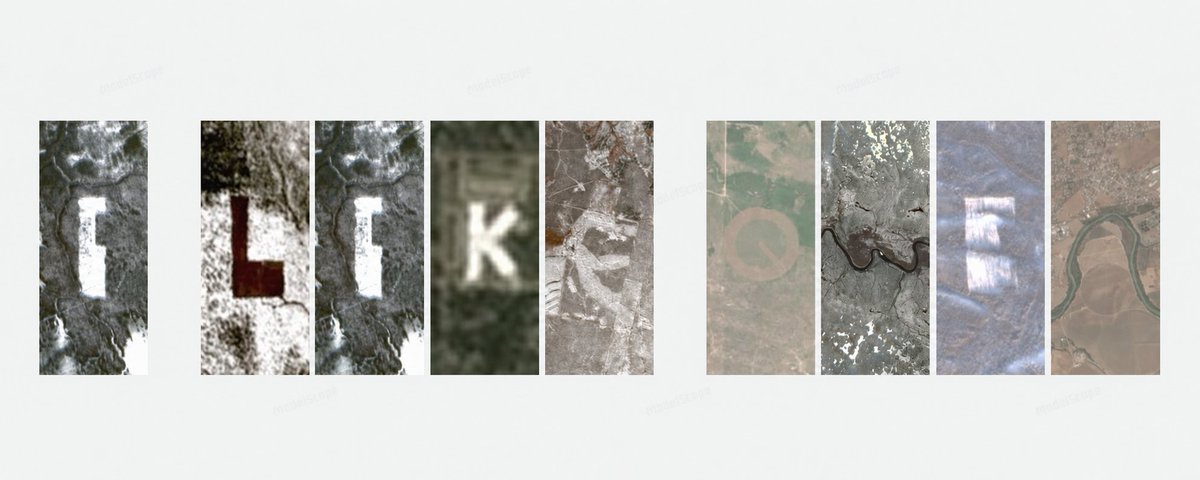
A Qwen developer spent just a weekend recreating NASA’s “Your Name in Landsat” with Qwen3-VL-Embedding-2B, searching 20 million satellite image patches for letters hidden in nature
The Earth has been writing for millions of years. It's time to read it https://t.co/5gV5lQkhxa
Our latest open-source research has a pretty interesting name, inspired by the story of the Tower of Babel. What interests us about that story is how language barriers can get in the way of people working toward the same goal
And when it comes to agents, there are a few more places for that understanding to break, like tool arguments, database entries, and search queries
One example from BabelArena (yes that's the name, surprise) stuck with me: Qwen-3.8-Max completed the same shopping task in English and Telugu, getting the same four products. But it took 25 tool calls in English and 201 in Telugu, with repeated empty searches against the localized catalog.
Even though both runs passed, we’d still want to see that difference before shipping.
Sorry for the long story, hope you guys are still here. What I want to share is that we’ve open-sourced BabelArena to study these workflows across 23 languages. Code, datasets, and paper in the comment
Looking right in 2D doesn’t really mean the scene holds together in 3D. That's why we open-sourced BlenderWorld last week and wanted to give it a closer look here.
It’s a benchmark with 223 tasks where agents use Blender to build editable 3D scenes from text, images or video references. We evaluate the actual projects through scene inspection and renders from multiple viewpoints. Can a visual agent turn a real-world brief into a complete, editable 3D scene? BlenderWorld is here to evaluate that
You can grab the benchmark below (Links in the comment) and plug in your own 3D agent to see how it does