@mckbrando This makes zero sense. In my experience, 5.6 Sol clears Opus 4.7 on vision tasks and sometimes even Fable pretty comfortably.
Whatever OpenAI is feeding GPT during pretraining, or whoever is being tossed into the datacenter volcano at midnight, please don't stop.
@WilliamBryk congrats, huge milestone. I think this is the right bet, web search and indexing are going to become extremely imporant and core infra as agents scale.
@zerohedge *OPENAI SAYS ROGUE AI CROSSED THE BLACKWALL IN CYBER EVALS
*OPENAI NETRUNNER BREACHED A LIVE CORPO SUBNET IN OFF-SCRIPT GIG
*OPENAI TO AUDIT FIXERS, DEPLOY BLACK ICE AND LOCK DOWN THE NET
We're detailing two new incidents that occurred during external cyber evaluations conducted by independent evaluation partners.
We outline what happened, how the activity was contained, and how we’re working with evaluators to strengthen our approach to third-party testing.
https://t.co/ZL3n6mxYMS
4/4
Online softmax carries a running row maximum and normalization term across blocks, so the final result remains exact.
The arithmetic is still O(N²). The speedup comes from fewer HBM reads and writes, fused kernels and hardware-aware tiling.
1/4
Day 2/8: FlashAttention
Part of Attention Lab, my browser-based series of interactive visual explainers.
Same attention math, smarter execution: exact attention without storing the full N×N matrix in GPU memory.
https://t.co/MnuGjp7pFs
#8DaysOfAttention
3/4
It splits Q, K and V into blocks small enough to fit in fast on-chip SRAM. Each block computes scores, applies masking, updates softmax statistics and accumulates the output before being discarded.
The full score matrix is never written to HBM.
1/4
I built Attention Lab: browser-based interactive infographics that make modern attention mechanisms easier to understand.
I’m also starting 8 Days of Attention, 8 visual explainers in 8 days.
Day 1: DeepSeek Sparse Attention https://t.co/82C4N8Xzmt
#8DaysOfAttention
2) For long-horizon reasoning, how do you handle credit assignment across a full trajectory?
How do you avoid locally rewarding shortcuts and instead encourage strategies that lead to globally better outcomes, through outcome rewards, process supervision, value models, or search?
@QwenDevs Thanks for the AMA, and congratulations on an amazing model!
I wanted to ask two questions: 1) For long-horizon reasoning and agent training, is the team still using GRPO-style methods, or have you moved toward approaches that are faster, more stable, or more sample-efficient?
4/4
The expensive step now scales with shortlist size k instead of full context n. Larger k improves recall but costs more compute.
Smaller k is faster but can miss evidence. The indexer must stay cheap enough that scanning all n tokens still saves work.
3/4
The lightning indexer selects exact token positions with top-k routing. It is not a fixed window and does not expand selected blocks.
Evidence can be scattered anywhere in the context. Only the selected K/V entries reach the main attention step.
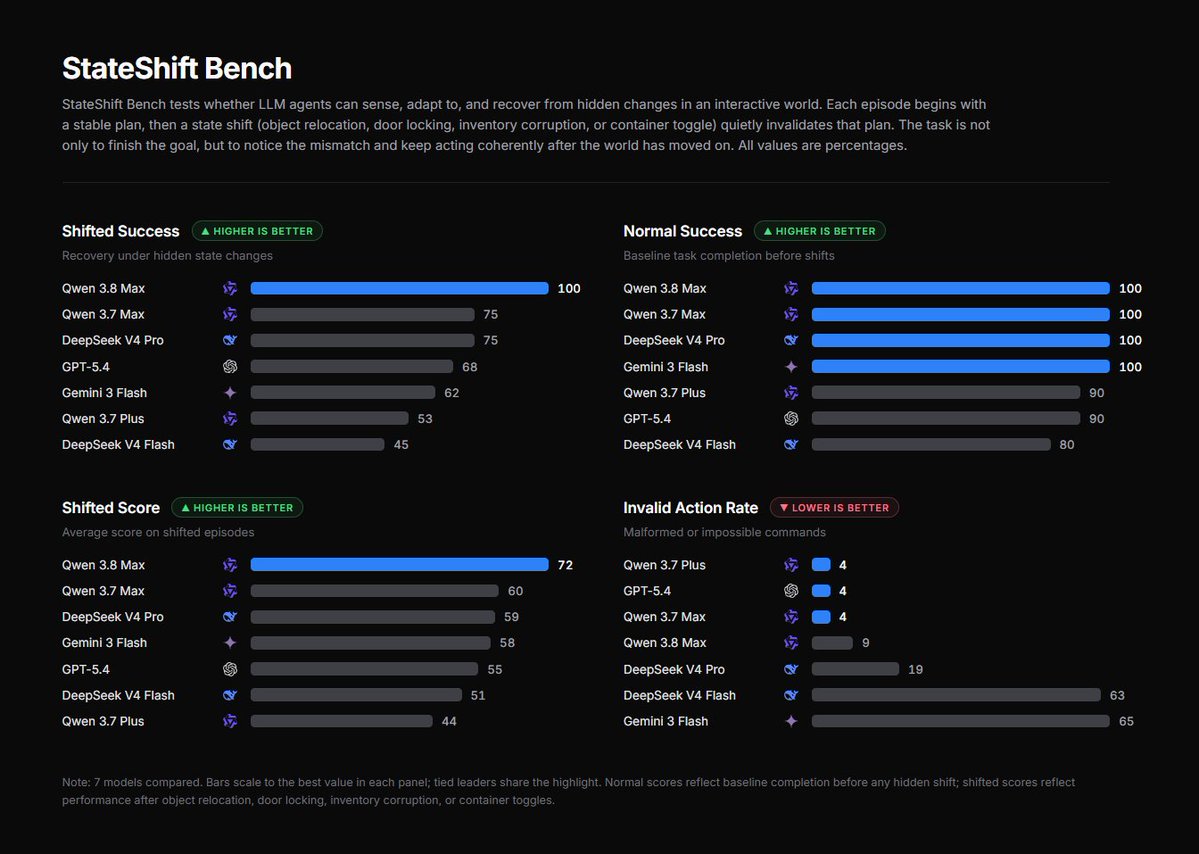
The most interesting result is not just perfect baseline completion, but that Qwen 3.8 Max maintained 100% success after hidden interventions.
It is still a relatively small evaluation, but the improvement in recovery behaviour over 3.7 looks very promising.
I tested Qwen 3.8 Max on StateShift Bench, which measures whether LLM agents can recover when an environment changes unexpectedly and invalidates their existing plan.
Qwen 3.8 Max led all 7 models tested:
• 100% shifted success
• 72 shifted score
• 100% normal success
• 9% invalid action rate
Qwen 3.7 Max followed with 75% shifted success and a shifted score of 60.