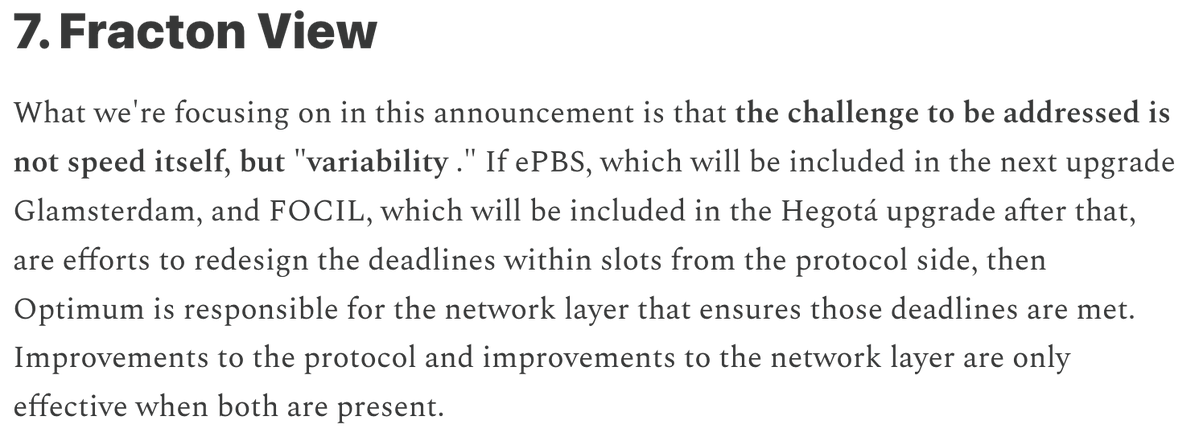
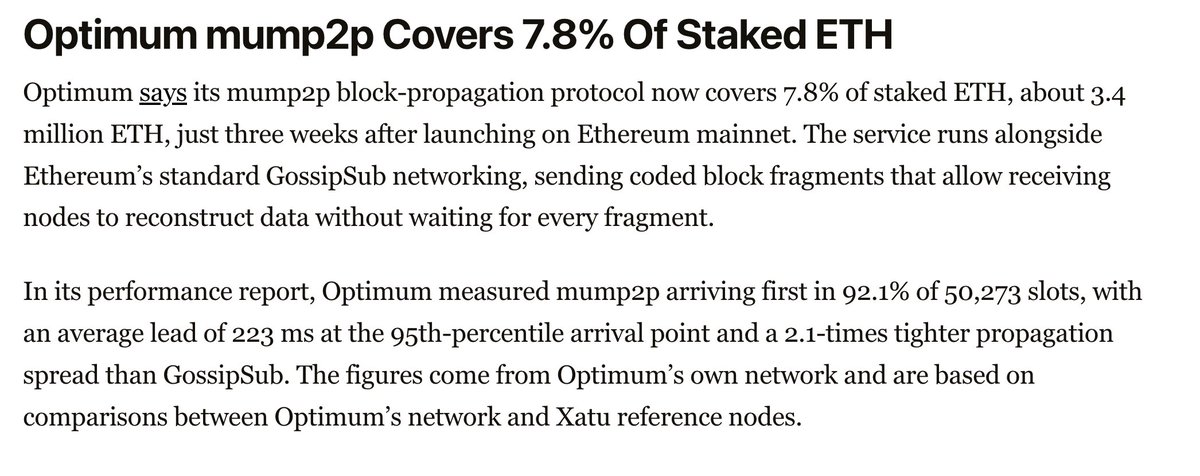
The Optimum team is pleased to announce our first mainnet deployment, mump2p on Ethereum. With mump2p, data moves across all of Ethereum 2-3x faster, boosting validator performance and network health.
$3.4B of Ethereum stake is already being boosted by mump2p, and we’re now opening up free access for all Ethereum node operators.
Optimum is hiring a BD Lead for the trading side of our business.
The ideal candidate is someone with multiple years experience and strong connections in the crypto trading realm, someone who can connect us with the latency-sensitive traders that our products are built for.
Full time & fully remote, apply at: https://t.co/h4HvRRp4v7
Ethereum validators vote on the head of the chain four seconds into each slot, and a block that arrives late can cost them that vote’s reward.
@get_optimum’s mump2p network is designed to get blocks to validators sooner and more consistently.
Across operators in Optimum’s Impact Report, wrong head votes fell 34.3% on average. Proposers gain time too: in six MEV-Boost experiments, blocks could go out ~160ms later with no rise in orphaned blocks, which Optimum models as an 8.4% bid uplift.
Our new spotlight follows the economics from attesters to proposers, and from Ethereum staking to trading:
https://t.co/wu0EB3L8Q3
On the day we publicly launched @get_optimum mump2p I told @Grantblocmates we'd eventually see the majority of Ethereum stake running it.
Nearly a month in we're up to 7.8%, and I'm willing to bet we hit 10% by the end of the year. Bookmark it.
BTW mump2p is free for all Ethereum node operators- solo stakers, institutions, all are welcome to join the data acceleration network.
Get up and running in under an hour at: https://t.co/VI5fWVh5fg
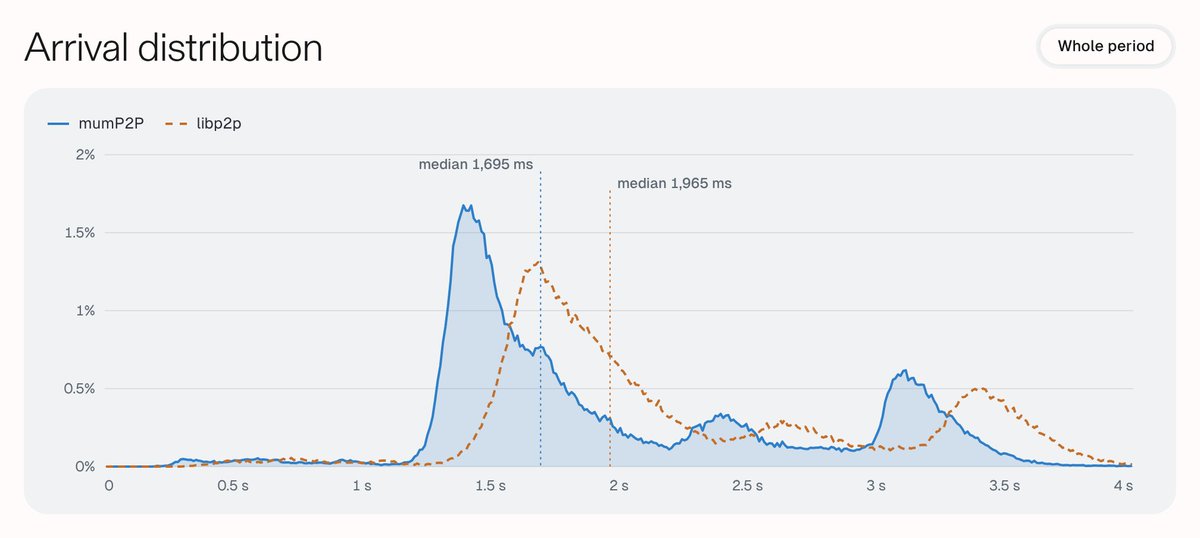
This is what high performance Ethereum block propagation looks like:
- Reliable >200ms latency advantage
- 93% of blocks arrive faster (up from 88% on launch day)
- More favorable arrival distribution
mump2p.
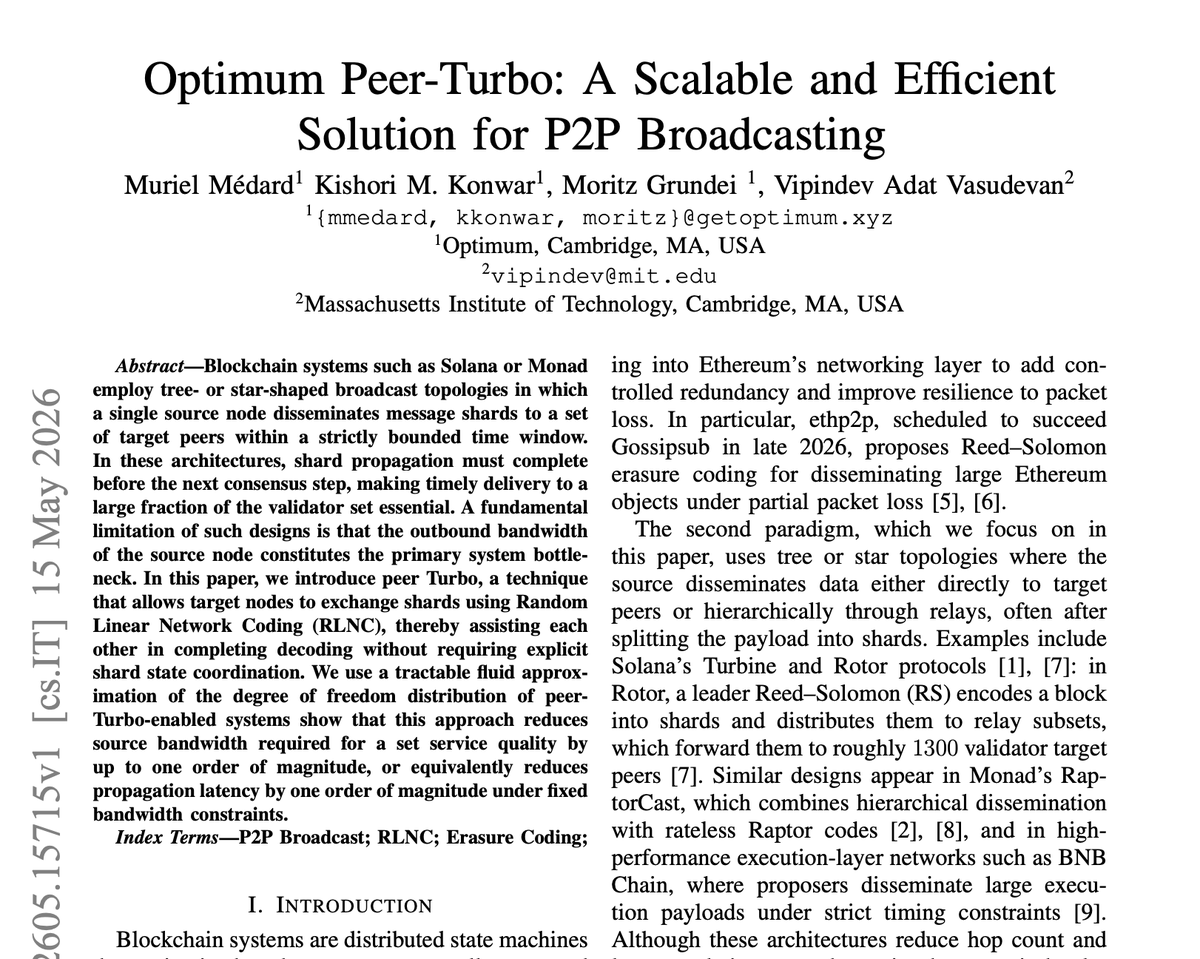
Every year a couple hundred of the world's top information theorists gather for IEEE's IT Workshop. This year I presented our (@get_optimum) latest research paper on efficient and scalable P2P broadcasting, as well as discussing the process of bringing academic research into production.
The tech behind Optimum was developed in my lab at MIT, and our first protocol recently went live on @ethereum mainnet. Years of academic research have now officially made it to a real live blockchain, but the work doesn't stop here.
With this paper, we set out to show that the same approach that accelerates data on Ethereum also works on chains like @solana and @monad, cutting source bandwidth or propagation latency by up to an order of magnitude. I'll link the full paper below for those interested.
It's great to see more people taking notice of what @get_optimum is builing! @blockonomi
Free and faster block propagation for Ethereum is up and running, and we have so much more in the works.
https://t.co/w4kOlRaHF4
Word of a fast new p2p protocol for Ethereum is ~propagating~ across the industry.
Check out this piece on mump2p from @cryptodotnews 👇
https://t.co/IzP3nyu7AJ
11,700 $ETH in 11 hours: An analysis of Ethereum block rewards on 10/30/26.
On the day before Halloween things were already getting spooky onchain. Hackers stole billions from Binance and used Ethereum to move a large portion of the looted coins. However, they weren't the only ones cashing in that day. This activity and its ripple effects through the markets created some extraordinarily valuable blockspace, with single bids as high as 501 ETH going into the pockets of proposers. For context a full 24 hours of bids typically adds up to 100-150 ETH. Keeping with the Halloween theme, proposing a block during this period was like trick-or-treating in the neighborhood that gives out full size candy bars.
Our research team set out to answer 2 questions:
- How did mump2p perform during this volatile period?
- How much additional ETH could validators have captured if they had fully leveraged mump2p’s speed advantage?
1. Block propagation via mump2p maintained its performance advantage over Gossipsub. During the 11 hour hack period mump2p’s average p95 latency advantage was 253ms, in line with the advantage seen both pre and post-hack. The percentage of blocks accelerated was similarly stable, 90% during the hack period vs. 89% before and after.
2. Proposers running mump2p have an edge when it comes to capturing higher bids, since they can safely delay their bid selection thanks to the time saved on propagation. This being the case, we wanted to find out how much extra ETH validators could have captured if they delayed their bid selection by 200ms.
Results: Across 3,100 blocks during the hack period, delaying bid selection by 200ms would have yielded an average of about .15 extra ETH per block. This works out to a total of over 460 ETH during the hack period, and in dollar terms that’s over $1 million left on the table.
Concluding Thoughts: MEV is highly variable. When things get crazy onchain block rewards can spike massively, allowing proposers to capture large amounts of ETH on single blocks. They can leverage Optimum’s speed advantage to extend their bid selection cutoff, and doing so will often result in seeing a higher bid. Speed is money, especially during these sort of tail events like hacks and extreme market volatility.
One of my favorite moments in my interview with @Genzio was getting to share how my collaborators and I initially came up with the concept for Random Linear Network Coding, combining information theory with the work I was doing on optic networking.
Now nearly two decades later, RLNC is powering the @get_optimum data acceleration network and boosting blocks live on @ethereum.