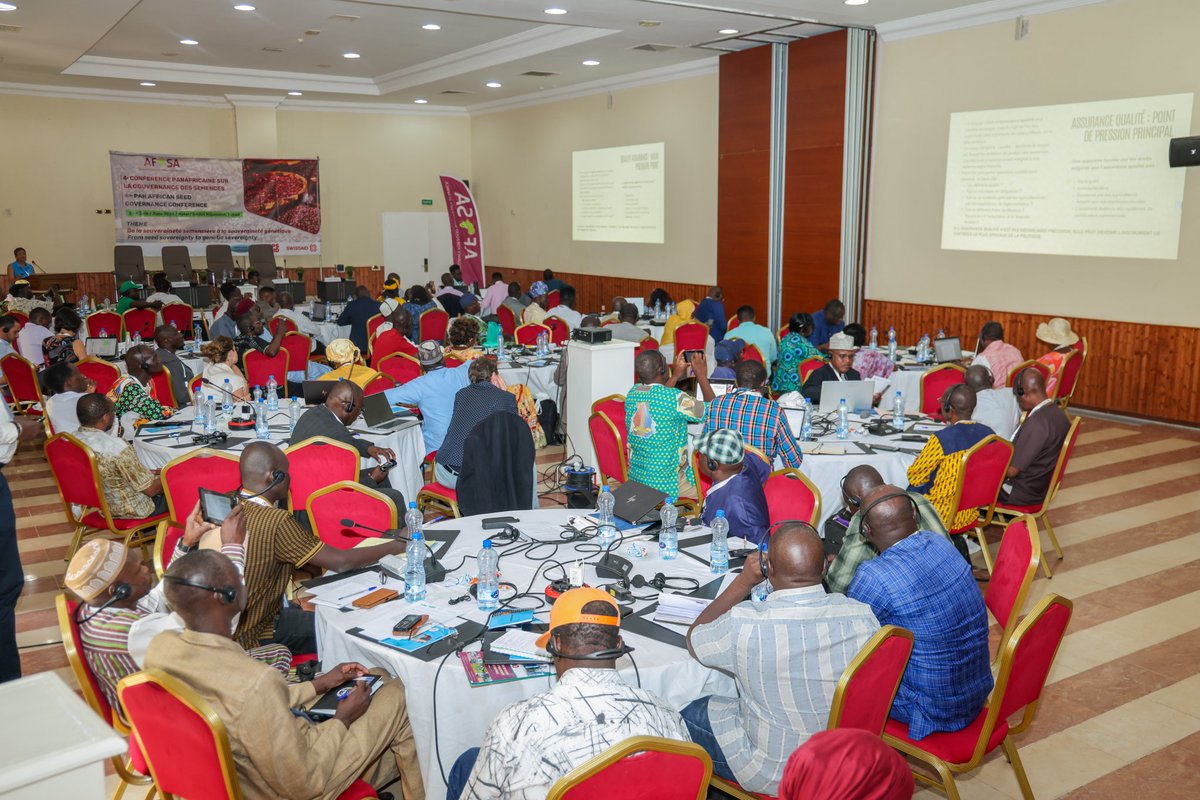
Les exposants semenciers à la foire des semences paysannes en marge de la 4 ème conference panafricaine sur la gouvernance des semences au TCHAD.
#SeedIsLife2026#MaSemenceMaVie2026
Semences paysannes , agroeoxlogie et souveraineté alimentaire : vers une reconnaissance institutionnelle au Tchad et partout en Afrique.
Vive la semence paysanne, vive la souveraineté alimentaire en Afrique.
#MaSemenceMaVie#SeedIsLife@Afsafrica
Happening in Chad, du 02 au 04 Juin 2025.
Ouverture de la 4 ème conférence panafricaine sur la gouvernance des Semences.
@Afsafrica#MaSemenceMaVie#SeedIsLIfe
𝗔𝗳𝗿𝗶𝗰𝗮𝗻 𝗗𝗲𝘃𝗲𝗹𝗼𝗽𝗺𝗲𝗻𝘁 𝗕𝗮𝗻𝗸: 𝗪𝗵𝗮𝘁 𝗙𝘂𝘁𝘂𝗿𝗲 𝗔𝗿𝗲 𝗪𝗲 𝗙𝗶𝗻𝗮𝗻𝗰𝗶𝗻𝗴?
As the African Development Bank convenes its 2026 Annual Meetings in Brazzaville under the theme "Mobilising Africa's Development Financing at Scale," AFSA is putting a sharper question to the Bank: finance for whom?
Three studies — two from AFSA, one from the Institute for Poverty, Land and Agrarian Studies (PLAAS) — find that the Bank has become one of Africa's most influential agricultural financiers, yet its money flows overwhelmingly to industrial agribusiness, agro-industrial zones and large value chains. Support for the diversified, farmer-led systems that actually feed the continent remains marginal.
The research challenges the very premise of the agenda: the claim that Africa holds vast "idle" land waiting to be developed. That narrative is empirically false and historically rooted in colonial "empty land" myths. Africa's smallholders manage around 80% of its farmland and supply up to 80% of sub-Saharan Africa's food.
AFSA's message is constructive: the Bank has the capacity and mandate to lead a just transition. We're calling for an Agroecology Transition Window, real ecological performance indicators, genuine transparency and community consent, and protection for local markets and farmer-managed seed.
The choice before the Bank is not whether to invest, but in which Africa. #AfDBAM2026 #FoodSovereignty #Agroecology
Read the full press release here
https://t.co/eEsIq9TZEp
𝐀F𝐒A B𝐨o𝐤 𝐋a𝐮n𝐜h: 𝐌y F𝐨o𝐝 𝐈s A𝐟r𝐢c𝐚n
We are proud to officially launch My Food is African: Volume 2 — How Citizens Are Reclaiming African Food Systems, the newest addition to our Barefoot Guide series.
These are real stories — told in their own words by the farmers, journalists, activists, market traders, chefs, and researchers living them, from across 50 African countries.
Why does it matter?
Ultra-processed foods are flooding our communities. Our seed systems are under threat. Our territorial markets — which feed 90% of Africa — face criminalisation and neglect. And yet, across the continent, citizens are organising, advocating, and reclaiming their food systems one community, one market, one policy at a time.
This guide documents exactly that. From community radio in Zambia reaching two million listeners, to agroecological networks in Senegal securing land from local governments, to the Je Mange Camerounais movement making traditional food culturally trendy — Volume 2 maps what works, what fails, and why.
It all started with four words. In May 2022, a young Zambian activist named Juliet Nangamba said "My food is African" — and a continent-wide movement was born. Today, that campaign is active in 11 countries and growing.
Volume 2 covers: 🌱 The ultra-processed food crisis and community responses 🌱 Agroecology advocacy from practice to policy 🌱 Citizens as food system actors — radio, schools, markets, campaigns 🌱 Africa's territorial markets as food sovereignty infrastructure 🌱 Advocacy at the African Union, COP, and UN food governance spaces 🌱 A grounded vision for African food systems in 2045
"Food sovereignty is about agency — about who decides, about whose knowledge counts, about whose future is being built."
📥 Download your free copy — https://t.co/g51nJRxA9J
Available in French || Je Mange Africain : Volume 2
https://t.co/g51nJRxA9J
#MyFoodIsAfrican #FoodSovereignty #AfricanFoodSystems #Agroecology #BarefootGuide #FoodCitizens #JeMangeAfricain
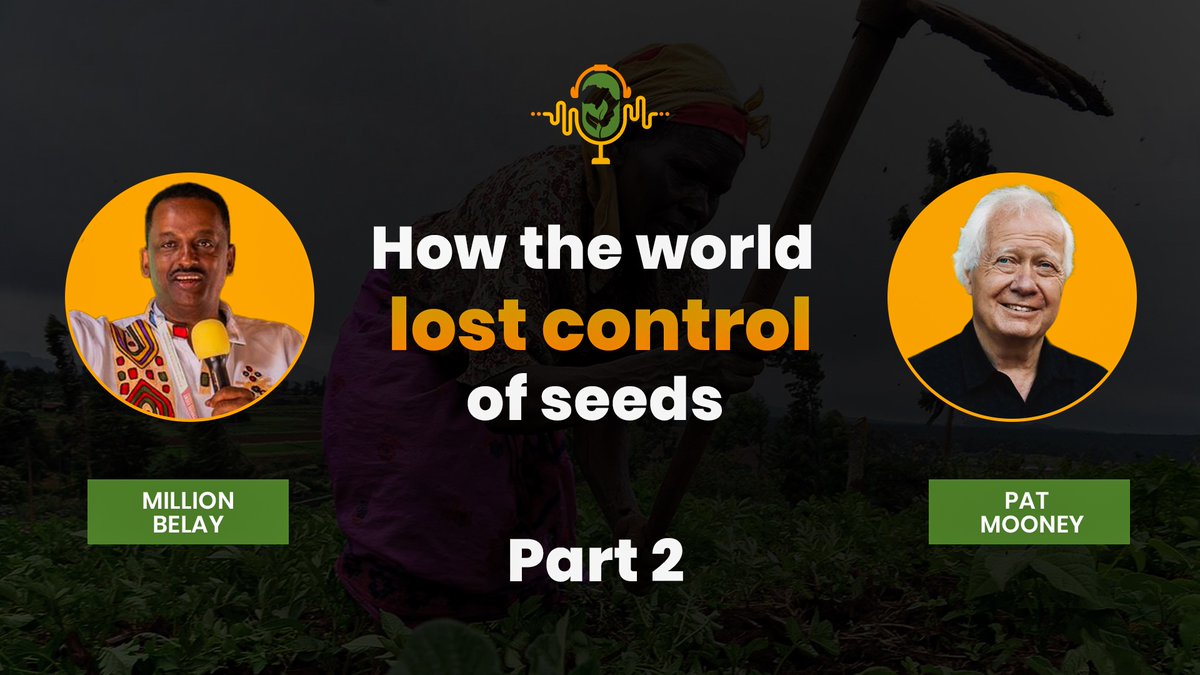
In this episode of The Battle for African Agriculture, the second part of a three part series, Dr. Million Belay speaks with Pat Mooney, member of the IPES-Food, co founder and former director of ETC Group - Action Group on Erosion, Technology and Concentration, IFOAM Ambassador, and chair of the Institute for Agriculture and Trade Policy. Continuing their conversation, Pat reflects on how new technologies are repeatedly introduced as solutions while often creating new forms of dependence. He argues that this is not accidental but part of the economic logic of capitalism, where each new technology is designed not only to replace an older one but also to maintain control over markets and customers. From that perspective, he sees gene editing not as a genuine break from GMOs, but as a logical extension of the same trajectory of manipulating life for commercial control.
The discussion then turns to Africa, where Pat Mooney warns that governments are under pressure to loosen biosafety laws and open the door to technologies presented as modern and necessary. He links this pressure to Africa’s land, climatic diversity, rich genetic resources, and rapidly growing population, all of which make the continent attractive to powerful commercial interests. He also addresses synthetic biology and the growing ability of companies to replace crops such as vanilla, cocoa, coffee, and tea with laboratory produced substitutes, shifting value away from farmers in the South toward industrial production in the North. For Pat, the core issue is not simply the novelty of the technologies themselves, but who controls them, who benefits from them, and who gets to decide whether they are safe, useful, or harmful.
Pat Mooney also offers a wider critic of digital agriculture and the growing role of big tech companies in farming, warning that firms such as Google, Amazon, and Microsoft approach agriculture not as a living system but as another field of data to capture, process, and monetize. At the same time, he insists that digital tools could still be useful if they remain in the hands of farmers and communities, helping them share knowledge, monitor weather, respond to pests, and strengthen agroecological systems. He contrasts this with what he calls “high tech,” controlled from above, and “wide tech,” rooted in the collective intelligence of farmers working within their own ecosystems. The episode closes with a powerful story of resistance, as he recounts the global campaign against Terminator seeds, where farmers, civil society, and social movements came together to defend the moratorium and stop a technology that would have forced farmers to buy seed every season.
Listen to the full conversation:
YouTube:
https://t.co/6KAuolb4HI
Spotify: https://t.co/t4IUSKrJUy
Apple Podcast:
https://t.co/fMiIg08fG2
WEBINAIRE de lancement : 𝐌𝐲 𝐅𝐨𝐨𝐝 𝐢𝐬 𝐀𝐟𝐫𝐢𝐜𝐚𝐧 : 𝐕𝐨𝐥𝐮𝐦𝐞 𝟐.
Au programme du webinaire :
📅 Mardi 26 mai 2026 | ⏱ 90 minutes
🕐 16 h EAT | 15 h CAT/SAST | 14 h WAT | 13 h GMT
🔗 Inscription : https://t.co/oIzLvdW1RH
𝐘𝐨𝐮'𝐫𝐞 𝐈𝐧𝐯𝐢𝐭𝐞𝐝 — 𝐁𝐨𝐨𝐤 𝐋𝐚𝐮𝐧𝐜𝐡 𝐖𝐞𝐛𝐢𝐧𝐚𝐫: 𝐌𝐲 𝐅𝐨𝐨𝐝 𝐢𝐬 𝐀𝐟𝐫𝐢𝐜𝐚𝐧: 𝐕𝐨𝐥𝐮𝐦𝐞 𝟐
We invite you to the virtual launch of My Food is African: Volume 2 — How Citizens Are Reclaiming African Food Systems, a new Barefoot Guide published by the Alliance for Food Sovereignty in Africa (AFSA).
About the book:
Food is never just food. It carries memory, power, culture, and politics. This guide — written collectively by farmers, journalists, activists, market traders, chefs, and researchers from across 50 African countries — documents a growing continental movement asking hard questions: Why are ultra-processed foods flooding our communities while real food becomes harder to find? Why are our seed systems criminalised, our markets marginalised, and our diets medicalised, while corporations shape food policy with ease?
Across seven chapters, the book maps real stories of citizens reclaiming their food systems — from community markets and school gardens to national parliaments and global policy forums — and offers practical tools for organising, advocacy, and movement-building.
At the webinar, expect:
-Stories and reflections directly from the book's contributors
-Discussion on agroecology, ultra-processed foods, territorial markets, and policy advocacy
-Dialogue on what it means to move from food consumer to food citizen
English and French interpretation available
Event details:
📅 Tuesday, 26 May 2026 | ⏱ 90 minutes
🕐 4:00 PM EAT | 3:00 PM CAT/SAST | 2:00 PM WAT | 1:00 PM GMT
🔗 Register: https://t.co/AUbWUjZXzD
This launch is for citizens, journalists, youth, chefs, educators, researchers, farmers' organisations, policymakers, and everyone committed to African food sovereignty.
"Food sovereignty is about agency — about who decides, about whose knowledge counts, about whose future is being built."
We look forward to seeing you there.
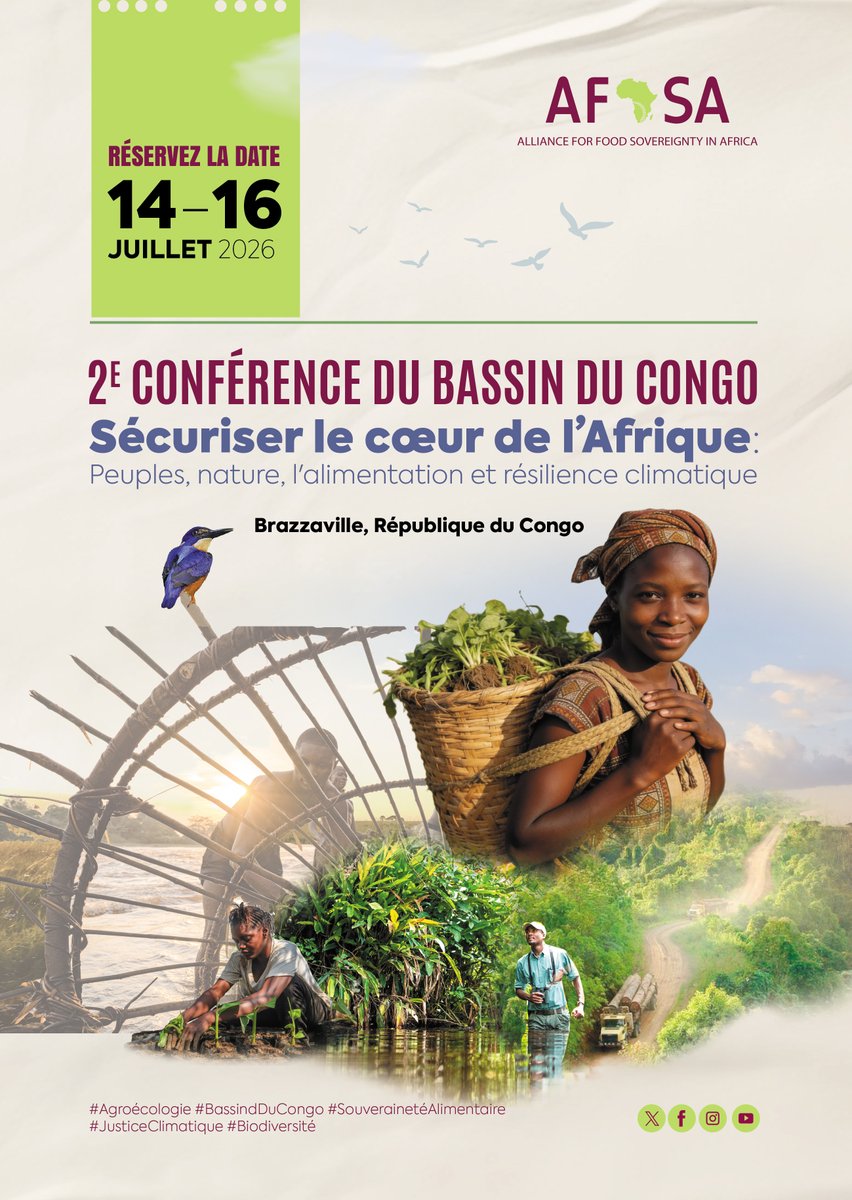
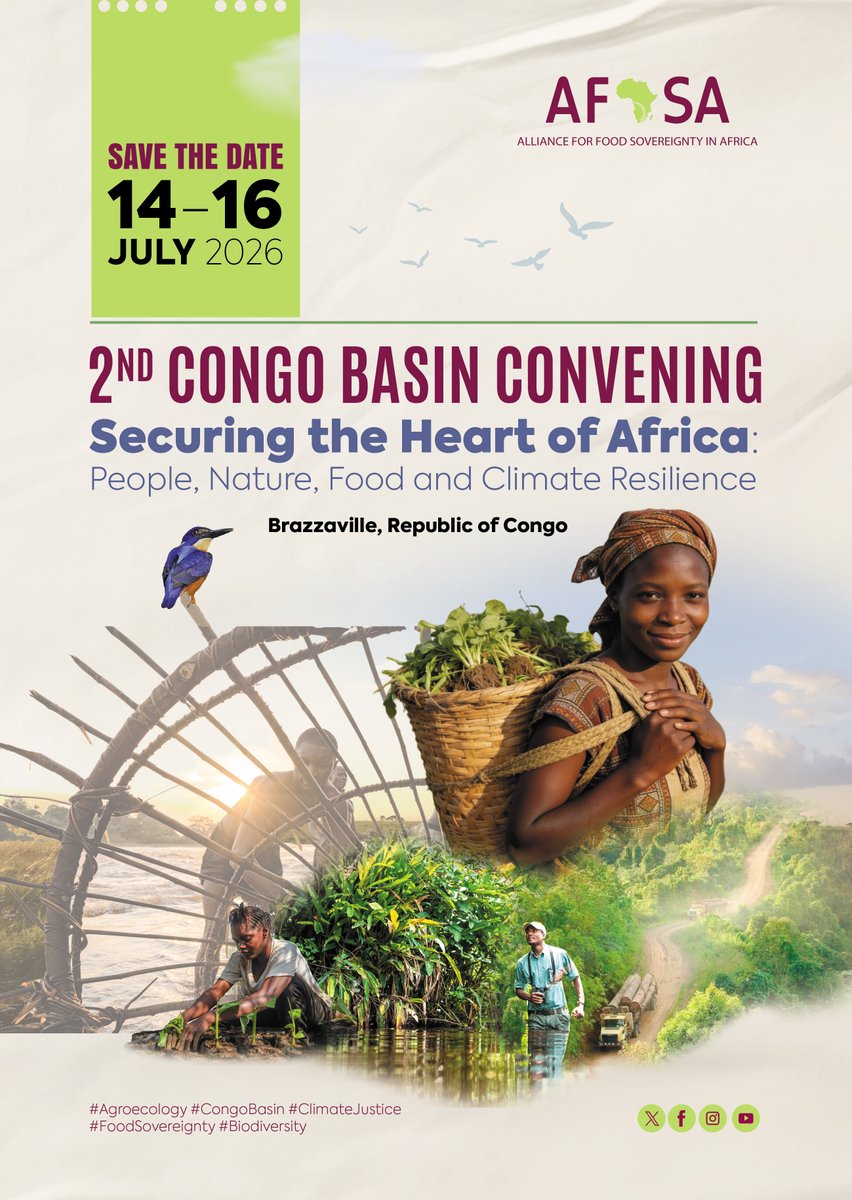
𝐒𝐀𝐕𝐄 𝐓𝐇𝐄 𝐃𝐀𝐓𝐄 | 𝟐𝐧𝐝 𝐂𝐨𝐧𝐠𝐨 𝐁𝐚𝐬𝐢𝐧 𝐂𝐨𝐧𝐯𝐞𝐧𝐢𝐧𝐠 — 𝐉𝐮𝐥𝐲 14-16, 𝟐𝟎𝟐𝟔 | 𝐁𝐫𝐚𝐳𝐳𝐚𝐯𝐢𝐥𝐥𝐞, 𝐑𝐞𝐩𝐮𝐛𝐥𝐢𝐜 𝐨𝐟 𝐂𝐨𝐧𝐠𝐨
AFSA is proud to announce the 2nd Congo Basin Convening: Securing the Heart of Africa — People, Nature, Food and Climate Resilience. Building on the landmark 2023 Kinshasa Summit, this convening will bring together civil society, farmer organisations, Indigenous Peoples and local communities, governments, researchers, and partners from across the six Congo Basin countries and beyond to advance agroecology, food sovereignty, biodiversity conservation, and climate justice in one of the world's most vital ecosystems.
Mark your calendars and spread the word! This is a defining moment to review progress since Kinshasa, strengthen regional coordination, and adopt a concrete Brazzaville 2026 Declaration and action roadmap. Together, we are securing the heart of Africa. 🌍
#CongoBasin #FoodSovereignty #Agroecology #ClimateJustice #Biodiversity
🌿 𝐑𝐄́𝐒𝐄𝐑𝐕𝐄𝐙 𝐋𝐀 𝐃𝐀𝐓𝐄 | 𝟐𝐞 𝐂𝐨𝐧𝐟𝐞́𝐫𝐞𝐧𝐜𝐞 𝐝𝐮 𝐁𝐚𝐬𝐬𝐢𝐧 𝐝𝐮 𝐂𝐨𝐧𝐠𝐨 - 14-16, 𝐣𝐮𝐢𝐥𝐥𝐞𝐭 𝟐𝟎𝟐𝟔 | 𝐁𝐫𝐚𝐳𝐳𝐚𝐯𝐢𝐥𝐥𝐞, 𝐑𝐞́𝐩𝐮𝐛𝐥𝐢𝐪𝐮𝐞 𝐝𝐮 𝐂𝐨𝐧𝐠𝐨
L'AFSA est fière d'annoncer la 2e Conférence du Bassin du Congo : Sécuriser le cœur de l'Afrique — Peuples, nature, l'alimentation et résilience climatique. S'appuyant sur le Sommet historique de Kinshasa en 2023, cette conférence réunira la société civile, les organisations paysannes, les peuples autochtones et les communautés locales, les gouvernements, les chercheurs et les partenaires des six pays du Bassin du Congo pour faire avancer l'agroécologie, la souveraineté alimentaire, la conservation de la biodiversité et la justice climatique dans l'un des écosystèmes les plus vitaux au monde.
Marquez vos agendas et faites passer le mot ! C'est un moment décisif pour évaluer les progrès réalisés depuis Kinshasa, renforcer la coordination régionale et adopter une Déclaration de Brazzaville 2026 et une feuille de route concrète. Ensemble, nous sécurisons le cœur de l'Afrique. 🌍
#BassindDuCongo #SouverainetéAlimentaire #Agroécologie #JusticeClimatique #Biodiversité
𝐓𝐡𝐞 𝐁𝐚𝐭𝐭𝐥𝐞 𝐟𝐨𝐫 𝐀𝐟𝐫𝐢𝐜𝐚𝐧 𝐀𝐠𝐫𝐢𝐜𝐮𝐥𝐭𝐮𝐫𝐞 𝐏𝐨𝐝𝐜𝐚𝐬𝐭 || 𝐄𝐩𝐢𝐬𝐨𝐝𝐞 𝟐𝟔 - 𝐖𝐢𝐭𝐡 𝐏𝐚𝐭 𝐌𝐨𝐨𝐧𝐞𝐲
In this episode of The Battle for African Agriculture, the first part of a three part series, Dr. Million Belay speaks with Pat Mooney, a member of the @IPESfood, co founder and former director of @ETC_Group, IFOAM Ambassador, and chair of the Institute for Agriculture and Trade Policy. He is a recipient of the Right Livelihood Award, often known as the Alternative Nobel Prize, the Pearson Peace Prize from Canada’s Governor General, and the American Giraffe Award for “sticking his neck out,” and has also received honorary doctoral degrees from the University of Waterloo in Canada and the 17 Advanced Research Institutes in Mexico.
Widely regarded as one of the most influential voices in global civil society struggles for seed sovereignty, biodiversity, and food justice, Pat reflects on a journey that began in the 1960s, when early exposure to global hunger debates and international food politics pushed him beyond a simple belief in development assistance and toward a deeper understanding of power, inequality, and control in food systems.
The conversation traces Pat Mooney’s central role in exposing the rise of corporate control over seeds and agricultural research. He explains how, from the 1970s onward, large oil, chemical, and pharmaceutical companies began buying seed companies and pushing intellectual property regimes that would give them monopoly power over agriculture. He discusses the founding of RAFI, later ETC Group, and the long political battles around plant breeders’ rights, farmers’ rights, biopiracy, and the creation of international mechanisms on plant genetic resources.
Throughout the discussion, Pat emphasizes that the consolidation of power in agriculture has never been simply about feeding the world, but about control over markets, technologies, and regulatory systems. He argues that patents and other monopoly tools have narrowed diversity, strengthened corporate influence over public research and policy, and enabled a handful of firms to dominate global agriculture. Looking ahead, he warns that the same historical logic is now unfolding through data and digital technologies, with new corporate actors seeking to control agriculture through platforms, artificial intelligence, and information systems. For him, understanding that history is essential, because the future of resistance depends on recognizing how these systems evolved, why they succeeded, and how they continue to reshape the food system today.
Listen to the full conversation
YouTube
https://t.co/kWPuNwM5Ma
Spotify
https://t.co/v7eaQpHG7b
Apple Podcast
https://t.co/ciLVOuTOBQ
🌱 T𝐨d𝐚y i𝐬 𝐈n𝐭e𝐫n𝐚t𝐢o𝐧a𝐥 𝐒e𝐞d D𝐚y.
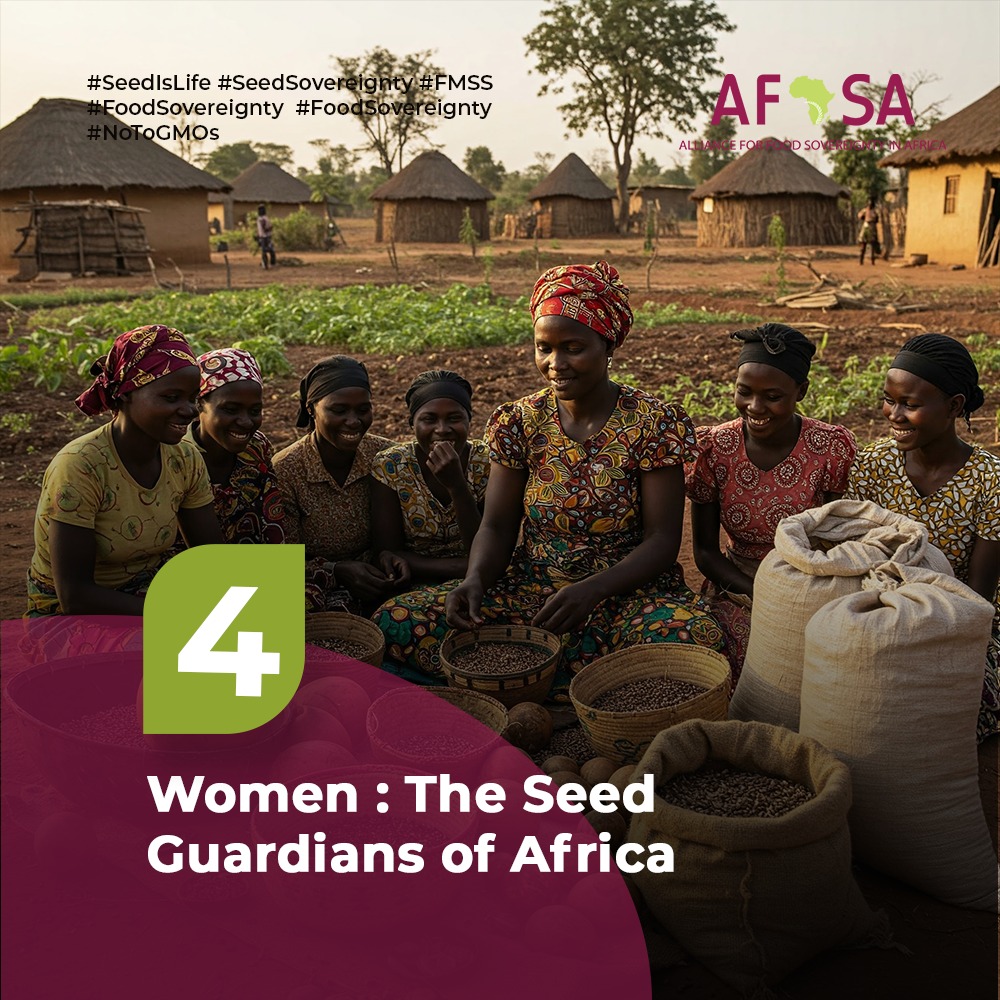
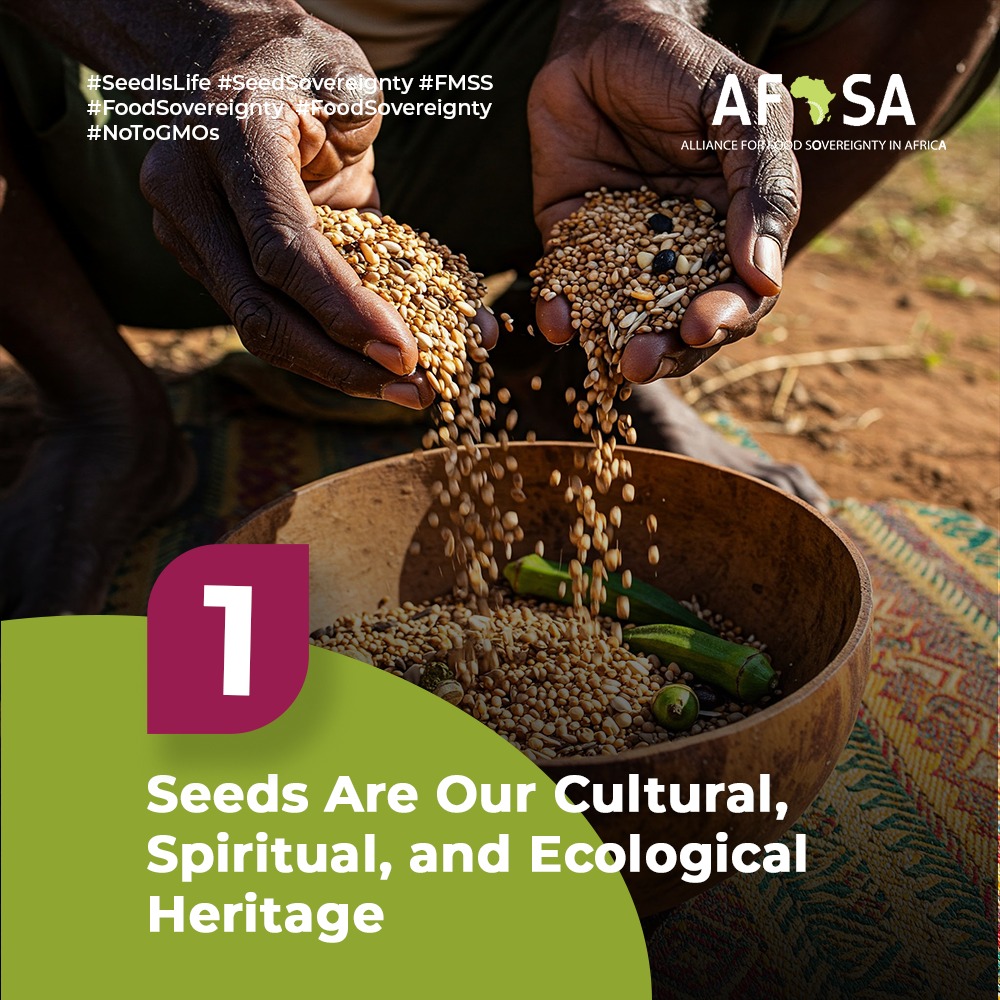
For millennia, Africa's farmers — especially women — have saved, exchanged, and nurtured seeds with extraordinary wisdom and care. These are not just agricultural inputs. They are living memory. Cultural identity. Spiritual heritage. Climate resilience. Sovereignty.
This is the heart of our 2026 #SeedIsLife Campaign and its message is clear:
Our seeds are not commodities. They are life.
Yet across Africa, corporate seed laws, UPOV-aligned legislation, and GMO expansion are systematically threatening the very seeds that feed 80% of our continent.
We are raising our voice. We are defending our heritage. We are claiming our rights.
👉 Read the full campaign — 10 Reasons Why Seed Is Life:
https://t.co/pvQOxy5yY0
#SeedIsLife #FMSS #SeedSovereignty #FoodSovereignty #NoToUPOV #OurSeedsOurFuture #AFSA #InternationalSeedDay
🌱 𝐀𝐮𝐣𝐨𝐮𝐫𝐝'𝐡𝐮𝐢, 𝐜'𝐞𝐬𝐭 𝐥𝐚 𝐉𝐨𝐮𝐫𝐧𝐞́𝐞 𝐢𝐧𝐭𝐞𝐫𝐧𝐚𝐭𝐢𝐨𝐧𝐚𝐥𝐞 𝐝𝐞𝐬 𝐬𝐞𝐦𝐞𝐧𝐜𝐞𝐬.
Depuis des millénaires, les paysan·nes d'Afrique — en particulier les femmes — ont sauvegardé, échangé et entretenu les semences avec une sagesse et un soin extraordinaires. Ce ne sont pas de simples intrants agricoles. Ce sont mémoire vivante. Identité culturelle. Patrimoine spirituel. Résilience climatique. Souveraineté.
C'est le cœur de notre campagne Ma Semence Ma Vie 2026 et son message est clair :
Nos semences ne sont pas des marchandises. Elles sont la vie.
Pourtant, à travers l'Afrique, les lois semencières des entreprises, les législations alignées sur l'UPOV et l'expansion des OGM menacent systématiquement les semences qui nourrissent 80 % de notre continent.
Nous élevons notre voix. Nous défendons notre héritage. Nous revendiquons nos droits.
👉 Lisez la campagne complète — 10 Raisons pour lesquelles Ma Semence Ma Vie :
https://t.co/cad6Hwb1yS
#MaSemenceMaVie #SSP #SouverainetéSemencière #SouverainetéAlimentaire #NonÀlUPOV #NosSemencesNotreAvenir #AFSA #JournéeInternationaleDesSemences
Seed Is Life: Celebrating Our Heritage
Honouring the cultural, ecological, and spiritual significance of farmer-managed seeds and the women who have safeguarded them across generations.
#SeedIsLife
🌱 SEED IS LIFE 2026 IS HERE.
Today, AFSA officially launches the 2026 Seed Is Life Campaign — our continent-wide call to protect Farmer-Managed Seed Systems and defend farmers' rights to seed.
80% of Africa's food comes from farmers' seeds.
Seeds that have been saved, exchanged, and nurtured across generations.
Seeds that feed families, sustain cultures, and anchor food sovereignty.
Yet today, these seeds — and the farmers who grow them — are under threat.
Corporate seed laws. UPOV-aligned legislation. GMO expansion. All designed to take control of our seeds out of our hands.
Not on our watch. 🌿
From April 25–27, join us as we celebrate, claim, and defend our seed sovereignty — on International Seed Day and beyond.
This year, AFSA's Seed and Agroecology Working Group — with UNDROP — hosted a landmark trilingual consultation on Farmers' Rights to Seed, bringing together farmers, advocates, and policymakers in English, French, Portuguese and Kiswahili.
Because our seeds are not just crops.
They are identity. Culture. Sovereignty. Life.
👉 Read the full campaign brief & join the movement:
https://t.co/2AJ7vPJhJE
https://t.co/1uQHtJyjSw
🔁 Share this. Tag your networks. Amplify the message.
#SeedIsLife #FMSS #SeedSovereignty #FoodSovereignty
#OurSeedsOurRights #NoToUPOV #NoToGMOs
#AfricanSeeds #Agroecology #AFSA