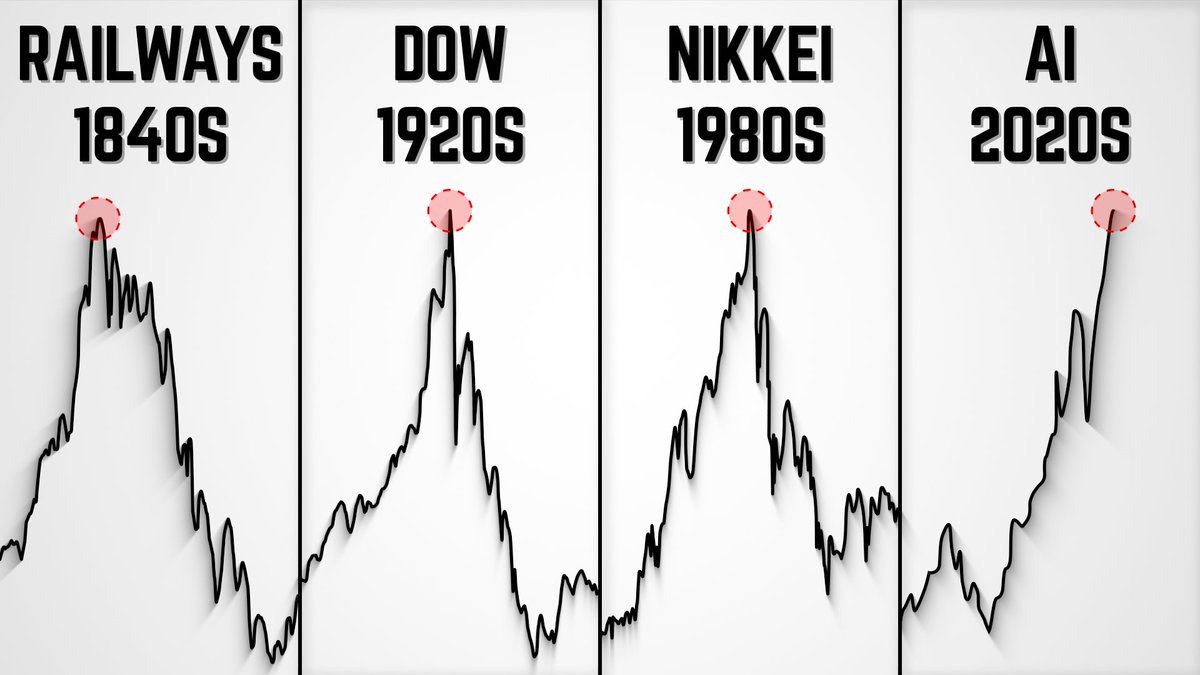
The US can't afford higher rates... Bessent and Warsh know that.
- In the next 12 months, around $8T of Treasuries need to be rolled.
- The average coupon is ~3.3%.
- The US10y yield is ~4.7%.
Rolling that $8T at today’s US10y level would add $112B in annual interest costs, and that’s before you factor in the interest burden on an ongoing $2T annual deficit.
Volcker could crush inflation with double‑digit rates because inflation had already driven debt‑to‑GDP down from about 120% to around 30%.
Today we are back at 120%...
First you inflate the debt away, then you raise rates to kill inflation.
We are in the inflation part of the cycle... you know what that means
There are two types of inflation:
What the government reports and what the real world is experiencing.
We all know which one to believe.
Just wait until the Fed points to the blue line — or a similar measure — to justify easing financial conditions, even as inflation continues to accelerate.
The debt trap is becoming impossible to ignore.
https://t.co/3HX61hig1b
The Fed is already negatively impacting the US labor market, and rate hikes are not justified.
Private payrolls rose by 30,000, manufacturing added 5,000 jobs, participation increased to 61.4%, and unemployment fell to 4.1%. This is not an inflationary report of an overheated economy that gives the Fed cover to hike.
But this is precisely why the Fed should not hike rates. Headline payrolls fell 23,000, prior months were revised down by 103,000. High rates are hurting SMEs.
This is not an overheating labor market. Hiking into weak payroll growth and substantial downward revisions would be a monster policy mistake.
via Bloomberg
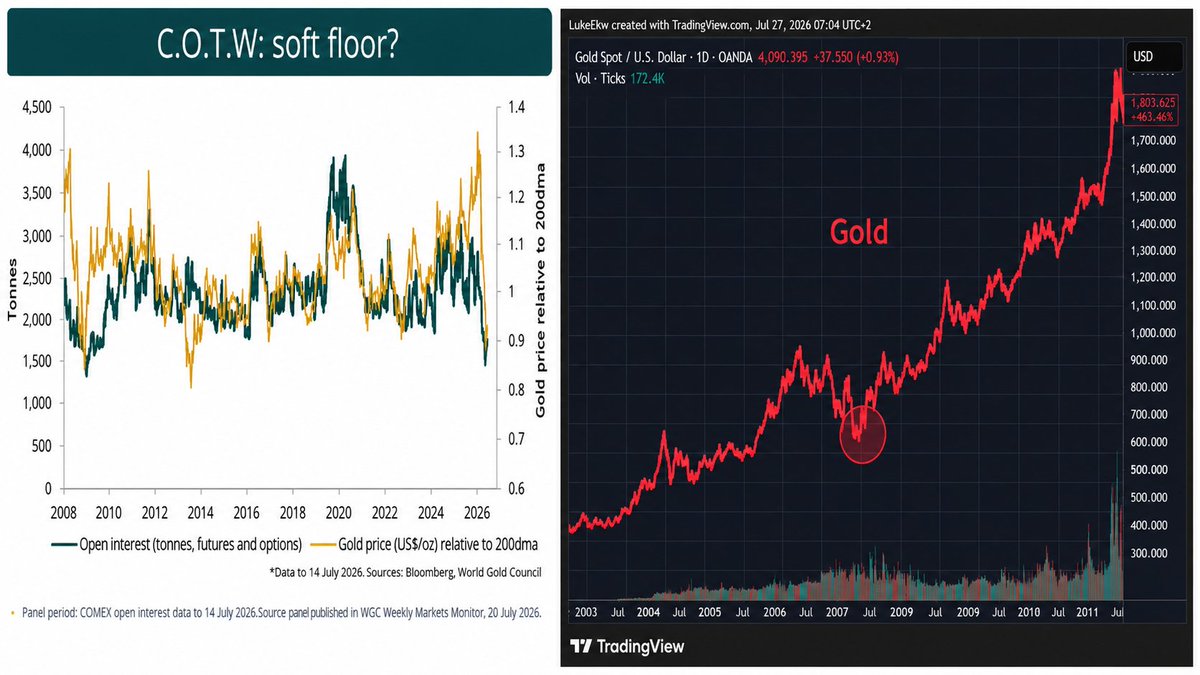
Gold open interest on the COMEX is collapsing to its lowest level since 2009.
Interestingly, 2009 marked the bottom of the pullback during the 2000s gold bull market.
- Gold: $1,000 -> $700 (-30%)
- Current pullback: ~30%
After the 2009 correction, gold went on to rally 2.7x.
The Bond Market Is Not Panicking. The Pundits Are.
The bond market is not sounding the alarm. It is doing its job. The pundits, as they did during the inflation scare, are the ones stoking fear of a crisis that is not there.
A modest widening in credit spreads tied to AI financing has been quickly recast as a warning of systemic stress, another supposed prelude to a global financial crisis. That is a category error. Credit markets are not breaking down; they are adjusting to a surge in demand for financing from a capital-intensive technological shift.
Start with the reality. Current credit spreads are not signalling distress. Investment-grade spreads remain tight by historical standards, high-yield markets are orderly and liquidity is ample. There is no seizure in funding markets, no forced deleveraging and no meaningful contagion. What is changing is the price of capital at the margin, not its availability.
That repricing reflects a structural shift. Artificial intelligence is no longer a capital-light equity story, it is an infrastructure buildout increasingly reliant on debt financing. Hyperscaler capital expenditure is running into the hundreds of billions, in some cases exceeding free cash flow, with further increases expected. Energy constraints, rising input costs and large off-balance-sheet commitments are adding to the scale and complexity of the investment cycle.
Credit markets are responding exactly as they should. Faced with rising issuance and uncertain returns, they are demanding compensation. That is not alarmism; it is discipline. It is how capital is allocated when it is no longer free.
The more telling reaction has come from market commentators eager to frame any tightening in financial conditions as the start of a crisis. This instinct should be familiar. The same voices that misread inflation as “transitory” now risk misreading routine credit repricing as systemic stress.
There is no contradiction in believing both that AI will be transformative and that financing it carries risk. The bond market is navigating that balance. It is not predicting collapse. It is pricing a technology wave that increasingly wants to be funded with credit and ensuring that it pays for the privilege
There it is.
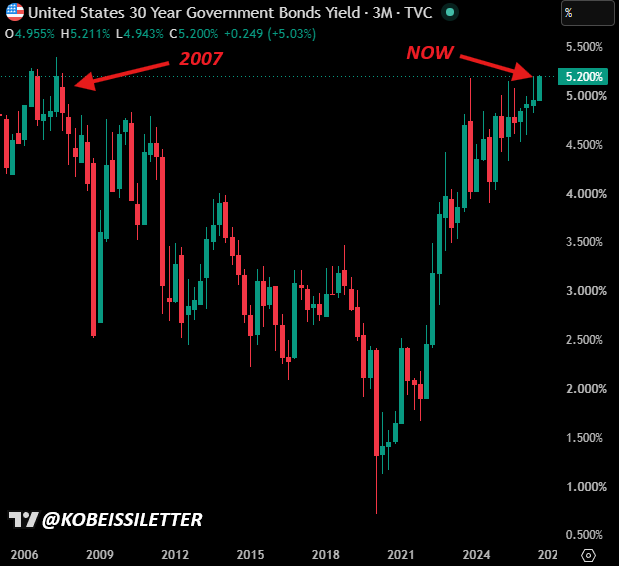
US long-term borrowing costs are officially up to their highest level since 2007.
The US 30Y Yield is now above 5.20%.
"Higher for longer" is back.
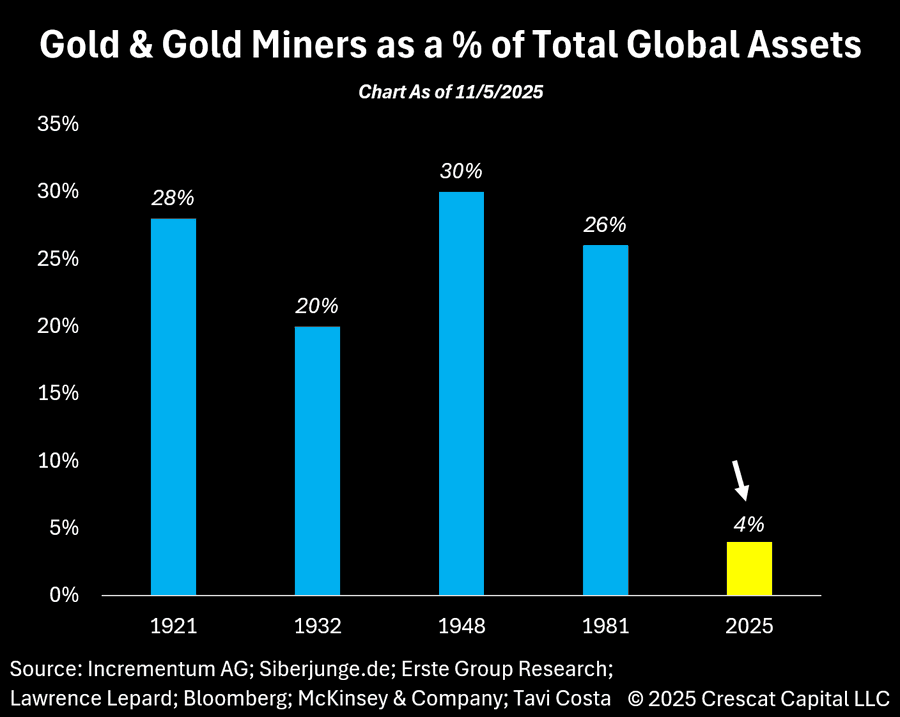
Gold and gold miners as a percentage of global financial assets are near a historic low.
2025: 4%
1921-1981 avg: 26%
To return to the historical average, gold would have to outperform global financial assets by roughly 7:1.
Don't let the recent price action fool you.
War and inflation have historically been bullish for gold.
During the inflationary 1970s:
- Gold rose 24x
- It experienced 4 separate 22-50% pullbacks
None of them ended the bull market.
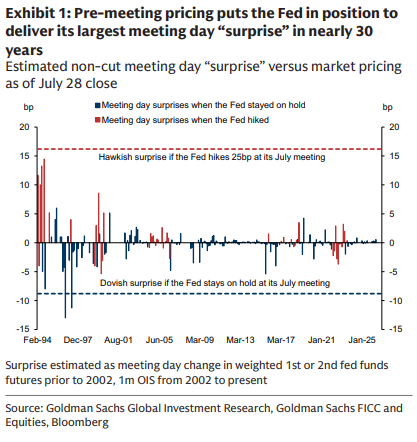
With interest-rate futures markets pricing in a one-third chance of a Fed hike today, whatever the Fed does will be the largest "surprise" at a non-rate-cut meeting since 1997, according to Goldman Sachs.
A hike would be "the largest meeting-day surprise outside of cuts since the Fed started releasing statements to announce policy-rate changes."
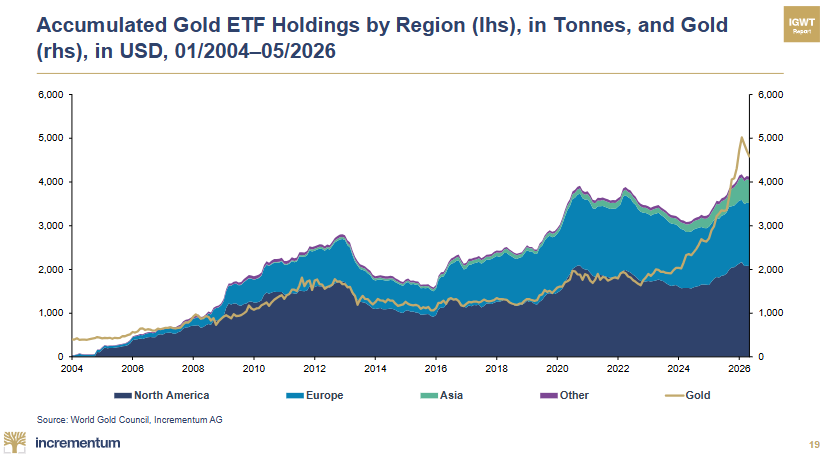
Global central banks are the main driver of the current gold bull market.
During the last gold bull market:
- Gold ETFs accumulated ~3,000t of gold.
- Central banks net sold 3,500t
Yet the gold price still rose ~8x.
Today:
- ETF holdings are still are flat since 2020
- Even though the gold price has doubled.
- Central banks have added ~5,000t
That's more gold than ETFs accumulated during the entire previous bull market.
During the last gold bull market, central banks were the biggest headwind....
Today, they are the biggest tailwind.
This is a slide from a recent presentation webinar I gave called "Crypto' Bro's are on Su1cide Watch" ...
I thought i'd share it with you.
You can scream at the screen and bash your keyboard / phone as much as you want.
I've closed comments.
I don't have to share these things with anyone.
I just can't be bothered engaging in a rage conversation with someone who turned $1,000 into $6,000 and they think they're part of someone technological altruist movement.
It's not trading.
Its not investing
It's totally g4y!
All the narratives have now disappeared.
The latest one is "The Infinite Money Machine" 😂
It will disappear too ...
Cheers 🍺
There are two things the US cannot afford:
• Rate hikes
• A prolonged, costly war
Yet those are precisely what’s driving the selloff in hard assets.
Not too many times in history do you get the chance to buy gold at oversold levels during a secular bull market.
Act accordingly.
https://t.co/ZrXRLMtceQ
Trust me on this ...
When you're young, hustling, struggling, coming up, dreaming of making it big.., losers get A LOT of unecessary wasted airtime. They sound plausible, believable. They're just around a lot, because they just exist. Everywhere!
As you get older, wiser and wealthier, they run out of narratives. Their words become worthless. They are out of excuses.
One of the defining charctaristics of people that make it big, is recognizing a loser and knowing the right time to ditch a loser when they reveal themselves.
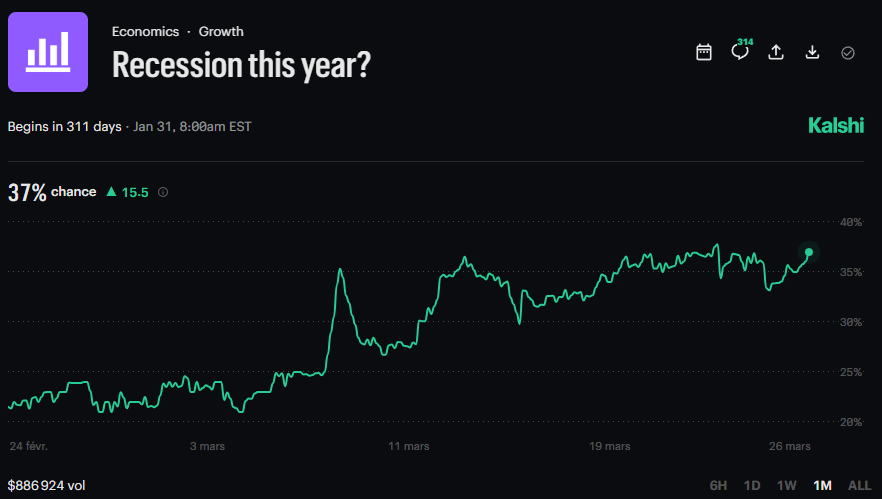
📈RECESSION FEARS BUILD
Goldman Sachs sees a 30% U.S. recession risk, with slowing growth, rising inflation (2.5%), and higher unemployment (4.6%).
Despite markets pricing hikes, Goldman still expects rate cuts ahead if conditions weaken.
Prediction markets are even more cautious—now pricing ~37% recession odds and rising.
https://t.co/oIxoLyT1aA
GOLDMAN WARNS OF POTENTIAL ‘EXTREME’ STOCK RALLY
Goldman Sachs’ John Flood says hedge fund positioning could fuel a sharp stock surge if good news emerges. Speculative bulls have high gross exposure (307%) while heavily shorting ETFs and index futures, creating right-tail upside risk.
A ceasefire in the Iran conflict or positive headlines could trigger 2–3% index gains as macro shorts unwind. Market volatility remains high due to war, AI, credit fears, and thin liquidity, while corporate buybacks support equities. Flood notes stocks need a resolution signal soon or risk further stress.
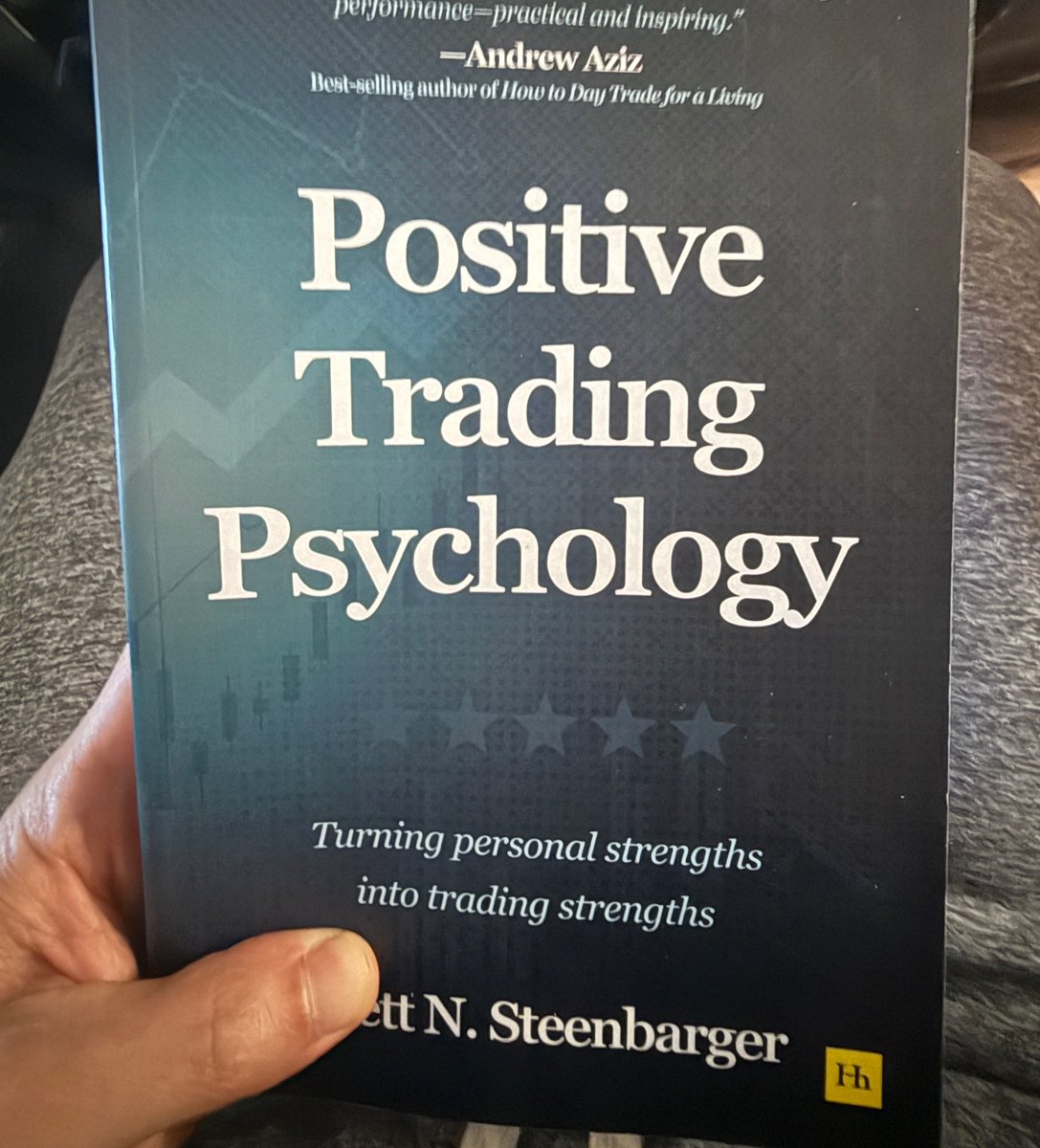
POSITIVE TRADING PSYCHOLOGY
It’s a surreal privilege nowadays to read @steenbab ‘s new book while flying to see him speak live this past weekend at the @smbcapital Trading Summit (Brett is an incredible speaker full of expertise, humor, & real-world anecdotes).
Here is what I took away from his new book, Positive Trading Psychology:
-Go broad before you go deep.
-“Successful traders, like successful businesses, embrace the beginner’s mindset: they love learning new things. Their true edge in the markets is the ability to discover and pursue fresh edges.”
-Consistency isn’t about consistency of outcomes. Trading has slumps, drawdowns. It’s inevitable. Consistency is applying the same process to grow and evolve through those periods of outcome variance.
-“Whatever will make you successful in trading is something that, in some way, you’ve already done successfully in another arena of life.”
-“If we don’t have very concrete plans for losing and drawing down, we cannot prepare ourselves for the levels of risk-taking that could make us truly successful
See my video on this: https://t.co/Aje4tO1HQ2
-Positive psychology is holistic. It begins with your morning routine. It consists of your trading routine. It consists of your relationships and activities outside of trading. And ends with your bedtime routine. Everything you do builds up or breaks down your psychology.
-I see this all the time on the retail and prop side: working within a trading pod helps every aspect of your trading and Brett notes the psychological benefits as well. You are most resilient to survive the rough patches when you’re part of a team.
-Historically, psychology has focused on the mentally unwell and most people only focus on psychology during the rough patches. This book emphasizes the other side of the spectrum and how important it is to build positive psychology practices.
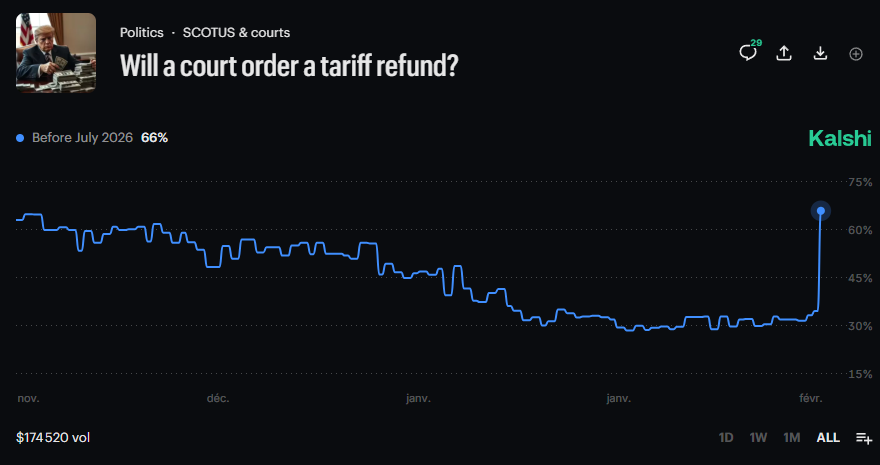
🚨TRUMP TARIFF REFUNDS NOW MARKET FAVORITE
The Kalshi market now puts the odds of a court-ordered Trump tariff refund before July 2026 at 66%, up sharply from the low 30s.
https://t.co/IEF8peVA7U