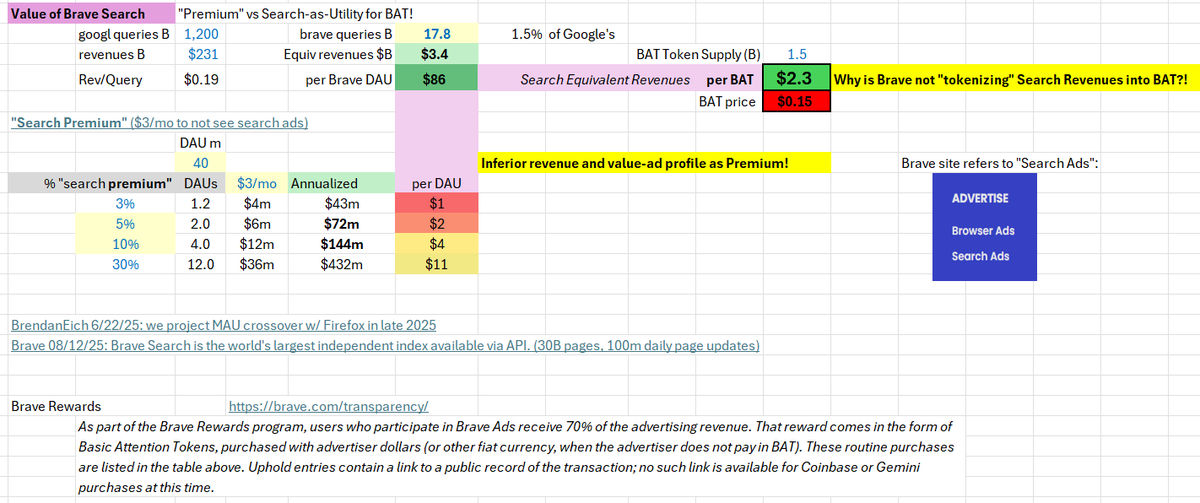
Value of $BAT Search alone is $86/DAU or $2.3/BAT token (10x today's price).
@brave refers to Search as "Search Ads", thus search is also advertising and subject to 70% sharing with BAT tokenholders.
Search is not even Discovery or Ranking and a small subset of Advertising.
Spain's World Cup hero Ferran Torres, who scored the winning goal, celebrates with his teammates parading through the streets of Madrid.
Proudly sporting his Cross and 'Make Spain Great Again' cap 🇪🇸
@deanwball@zdch We read entire paragraphs before American Steve Jobs "invented" DRM and American FB and Google created a the USSA surveillance state.
Meanwhile the New Deal (USSA) is older than Chinese "communism", actually "Capitalism with Chinese characteristics".And then there's NY's Mamdani
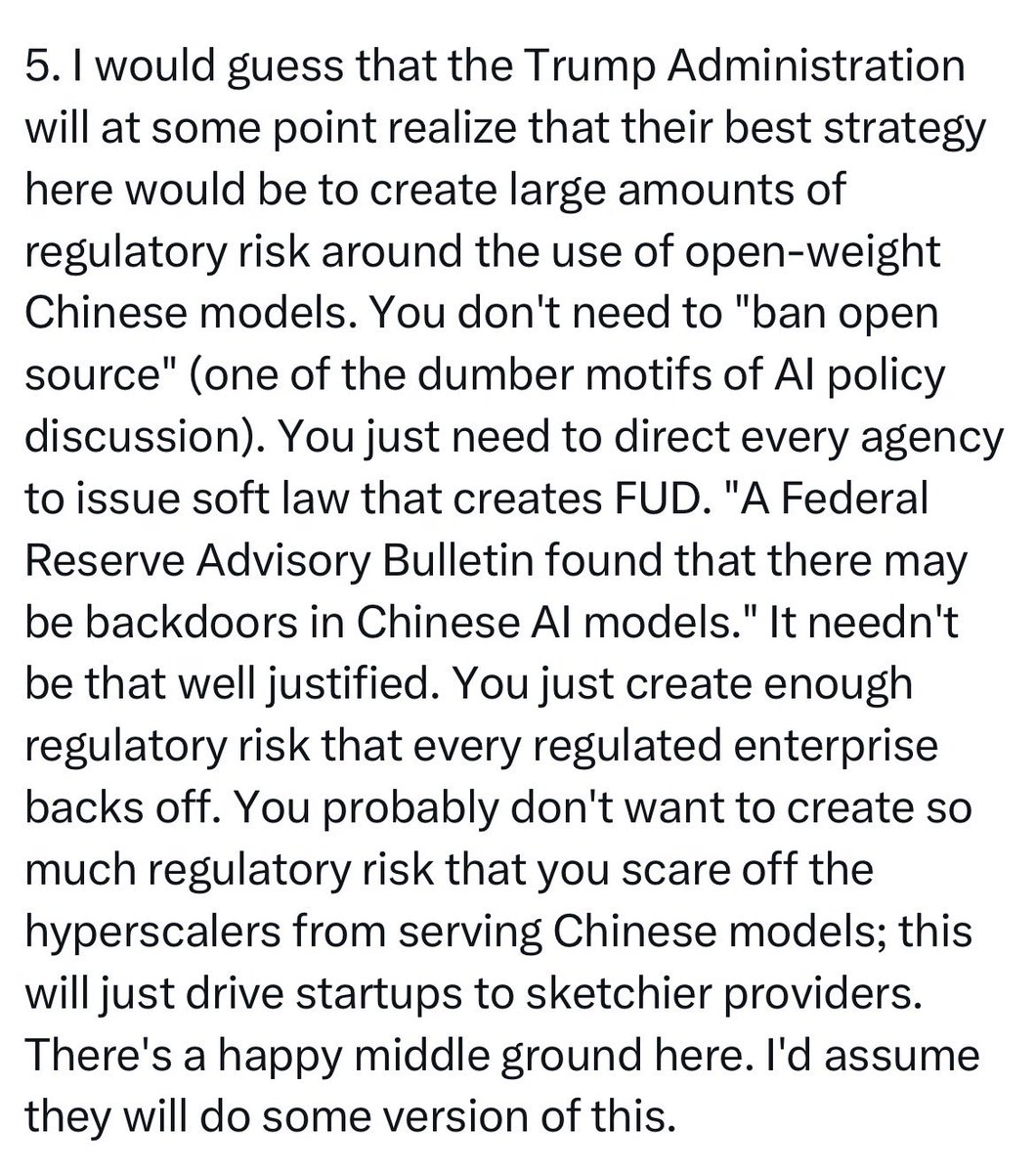
I’m not sure whether Dean Ball is confessing to a regulatory capture strategy or simply predicting this will happen (he now says the latter). Either way, the weaponization of regulatory uncertainty as a competitive tool should be completely unacceptable.
He argues there’s no need to ban Chinese open-source models — just direct agencies to issue soft-law warnings that create enough FUD so regulated enterprises back off. “It needn’t be that well justified.”
Wrong. Regulatory decisions should always be well justified and grounded in facts, logic, and evidence, not the deliberate exploitation of fear and uncertainty. Implementing a surreptitious policy through manufactured doubt — rather than strong and explicit justification — corrodes the rule of law and invites future abuse against anyone.
We are at a critical inflection point in AI policy. The leading closed labs, already a duopoly in terms of AI model revenue, want the government to eliminate their open source competition. They have laid their cards on the table. It is time for the rest of Silicon Valley — the vast majority that still values open competition — to do the same.
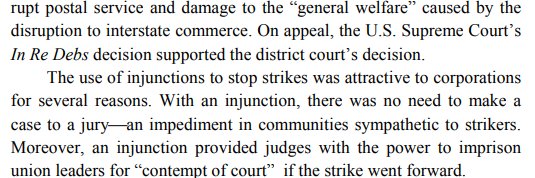
The US men's national soccer team is being subjected to the same kind of legalized plunder that defines too many divorce proceedings in this country.
After grinding through qualifiers, earning their spot in the World Cup, and generating the massive FIFA payout that only the men's game can produce ($12.8 million in this case), the players are now forced to hand over a huge chunk of that money to the women's team under the "equal pay" collective bargaining agreement.
The women didn't play a single minute of those matches, didn't draw the crowds, didn't sell the tickets, and didn't create the revenue - yet they still get a cut of the men's prize money while the reverse transfer remains a fraction. Yes the women are more successful (having won the Women's World Cup several times) but the prize is much smaller. Why? It reflects differences in global interest, sponsorship, viewership and actual performance.
This is all under the guise of "parity" between "equivalent work." But in reality, it's more like subsidizing one program with the output of the other, just like the ex-spouse cashing checks from earnings she didn't generate.
"Equal pay" sounds noble until you realize it erases differences in market value, risk, audience draw, and results. It disincentivizes excellence on the men's side (why push harder if your windfall gets redistributed?) and removes pressure on the women's side to grow their own commercial appeal.
Like divorce settlements that trap high-earners in perpetual support roles, this policy treats men's soccer as a piggy bank for "fairness," not a business rewarding what fans and sponsors actually value.
Our thoughts on the importance of AI sovereignty.
1. Your AI sovereignty dictates your institution’s future. Sovereignty is the precondition for choice. Relinquishing sovereignty transfers the future choices of your institution to others, who are likely to exploit it for their gain and your loss.
2. Data retention is your treasure. Transfer it at your own peril. Your ability to win is dictated by your ability to recognize and use your unique edges, and you keep winning by compounding the underlying data to generate new insights. Transferring that data hands over access to your pre-existing winning plays and yields the means of production for new ones.
3. Tokenmaxxing hijacks your value orientation and decreases your institutional fortitude and intelligence. The pursuit of high token usage incentivizes disposable scripts over robust software — with the addictive feeling of false progress. There is a reason why those selling tokens refuse to charge based on value.
4. Controlling your weights is controlling your fate. Weights are the distilled form of hard-won, accumulated institutional knowledge. If you let others control your weights, you are allowing them to migrate the alpha of your business to theirs.
5. There is no contradiction between sovereignty and alpha. The architecture that maximally preserves sovereignty is one that enables institutions to own their tribal knowledge, and to compound it as alpha.
6. Politicizing the technical issues involving sovereignty is what your adversary wants. Techno-politicization is the wellspring of false sovereignty. Techno-politicization drives decisions that seem to reduce dependency, but ultimately limit agency — especially on the battlefield in the West.
7. Real expertise is existential. Allowing politics or favoritism to determine your technical decisions rewards whoever is best at politics, not whoever is right. Listen to those closest to the problems, not those speaking most compellingly about them.
8. Learn from institutions that are winning or that have consistently delivered. Institutions facing existential threats do not have the luxury of making technical decisions based on political preferences.
9. Only listen to institutions, countries, and people who have a proven record of being right. A track record of correctness is the best and only signal for future correctness. Judging something as right or wrong based on who you like is exceedingly misguided.
@crehage Good thing only chips matterED to US.
Past tense, not that US won't pressure China one more time... But Taiwan specifically resolves naturally with time.
Re-solves: in all senses of it.
It’s Called Cognitive Capital.
AI will force a regime shift on Wall Street once it becomes undeniable that the scarce input is not “labor hours” but human cognition, and that AI directly targets that bottleneck rather than muscular, repetitive work.
As long as investors lean on 1990s analogies, automation as capital deepening at the factory floor, they will systematically underprice the impact of systems that compress research cycles, strategy formation, product iteration, and even capital allocation itself.
Today’s dominant narrative still treats AI as an incremental productivity tool in the lineage of Railways, Canals, PCs and the internet: helpful, deflationary, but ultimately complementary to white‑collar decision‑makers.
That frame breaks when AI capabilities move from assistive to substitutive in the core cognitive workflows that define high‑value work, analysis, forecasting, design, and complex coordination. The realization moment for Wall Street will not be a single headline, but a gradual tipping point where three things become visible at scale: firms that re‑architect around AI show non‑linear operating leverage in SG&A and R&D; whole layers of “smart labor” (junior bankers, analysts, coders, paralegals) become optional rather than merely more productive; and allocators see that the constraint in many businesses is now human oversight bandwidth, not human muscle or even human headcount.
In that world, the 1990s automation analogy fails for two reasons. First, prior waves mostly displaced low‑skill, routine work while expanding demand for cognitive labor; this wave directly compresses the cognitive hierarchy itself.
Second, earlier technologies were tools inside existing decision structures, whereas frontier AI systems increasingly become part of the decision structure. The correct analogue is not the barcode scanner or industrial robot, but something closer to “imported cognition” that competes with and amplifies human judgment at scale.
Wall Street will fully internalize that difference when earnings, margins, and labor share data show that the main replaced input is no longer brawn, but the very cognitive constraints of the people doing the allocating, managing, and governing. Yes, Cognitive Capital has yet to be recognized as being completely different than past innovations.
For now expect a continued parade of this is the 1990s.
@DrJStrategy You and @PeterBerezinBCA are both right, however.
"Value is what you get, Price is what you pay". ala Peter and re tech.
Your point is even more insightful with greater repercussions for Value Creation "for it's not the same (cognitive value) river and you're not the same man".
@robj3d3@gregisenberg Wrong. Enterprise Tokenmaxxing on the most unaffordable plans.
Hosted ZDR open source + routing by task difficulty.
2027 local llm.
Not spacex financialized WMDd narratives