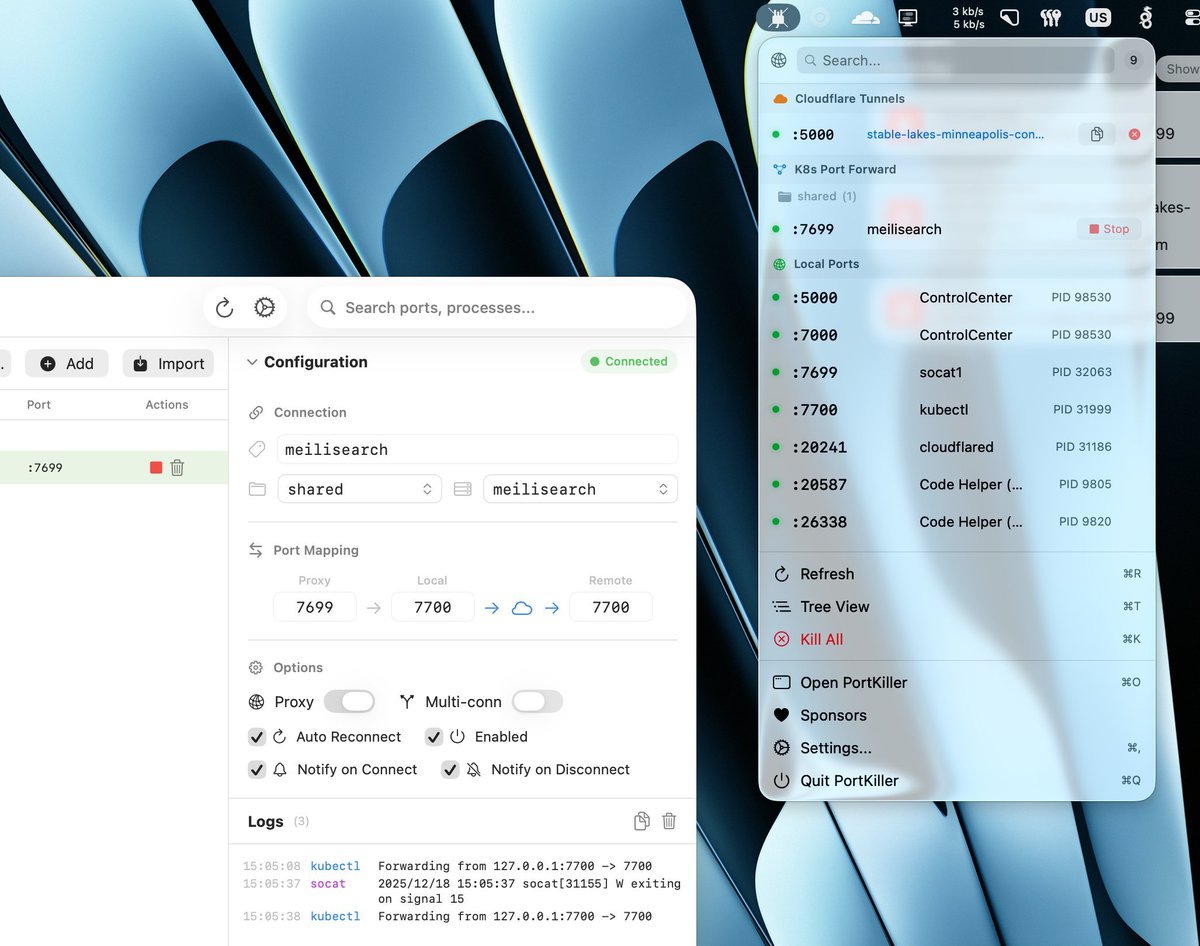
Saw a very cool tool on GitHub called PortKiller. It’s a powerful cross-platform port management app for developers, with a native UI on macOS, Windows, and Linux.
What makes it fun is that it goes beyond just listing ports. It auto-discovers all listening TCP ports, lets you kill processes with one click, supports search and filtering, favorites, watched ports with notifications, and smart categorization for common dev services.
It also covers real workflows: managing kubectl port-forward sessions with auto-reconnect, logs, and connect or disconnect notifications, plus visibility into active Cloudflare Tunnel connections.
> brew install –cask productdevbook/tap/portkiller.
Say goodbye to parse_url() headaches! 🥳
PHP 8.5 is introducing a new URI Extension with standards-compliant (RFC 3986 & WHATWG) and secure URL parsing. It provides a clean API and lets you easily modify URI components.
Learn more 👇
https://t.co/dhwGGRhoxu
Redesign @official_php? We hear you. Let’s start small and ship something great: a refreshed PHP 8.5 release page!
Submit your mockups or prototypes and win $1,000 🏆
🗓 Deadline: Oct 22
👉 Details: https://t.co/hYIc4PeMda
PHP 8.4 is Now Released!
🔹 Property hooks
🔹 Asymmetric visibility
🔹 New DOM features and HTML5 support
🔹 Object API for BCMath
🔹 new MyClass()->method() without parentheses
and a whole lot more!
https://t.co/PwmDnKplOL
DO NOT STORE JWTS IN LOCAL STORAGE.
DO NOT STORE JWTS IN LOCAL STORAGE.
DO NOT STORE JWTS IN LOCAL STORAGE.
DO NOT STORE JWTS IN LOCAL STORAGE.
DO NOT STORE JWTS IN LOCAL STORAGE.
FrankenPHP 1.2 is out 🎉
- @caddyserver 2.8
- X-Sendfile/X-Accel-Redirect support
- full-duplex support for HTTP/1
- simplified config
- countless bug fixes and docs improvements
Upgrade now!
https://t.co/UeymNEl6qu
Here it is. If you are a professional, if you are under NDA with your clients, if you are a creative, a lawyer, a doctor or anyone who works with proprietary files - it is time to cancel Adobe, delete all the apps and programs. Adobe can not be trusted.
🔒 The PHP project has decided to extend security support for versions from one to two years.
💡 The same RFC clarifies a few other items, such as when minor features can be introduced during the release process.
📜 You can read the updated document at: https://t.co/PgyOUn9YvH
Thinking of getting a proper espresso machine + grinder setup at home so I did some research. This is much harder than choosing a JavaScript framework.
@taylorotwell SQLite! Coupled with FrankenPHP's standalone binaries, you get standalone applications that can be deployed on a bare-metal server with 0 dependencies: https://t.co/dECCzyN5H7
📫 Finally dug into DMARC this week, and with some help from @jordanpittman and @postmarkapp I now have a much better handle on how email authentication works. Here's my quick summary:
✅ SPF: Verify the server can send from a specific domain.
✅ DKIM: Verify the message has not been tampered with (think signed URLs).
✅ DMARC: Dictates what action to take when SPF or DKIM validation fails.
I always thought DMARC was a separate thing from SPF and DKIM, but it turns out they all work together. DMARC does two things for you:
1. It allows you to specify an email address to be notified at by an email provider when a message from your domain is sent and it fails SPF or DKIM validation. This is handy for detecting situations where you might not have these DNS records setup correctly on one of the services you use. For example, for https://t.co/lUsRKnolNW it told me that we were setup correctly on Postmark, but I was missing an SPF record for HelpScout. And, of course, it can also help detect situations where people are trying to maliciously send email using your domain name.
2. It allows you to specify what should happen when SPF or DKIM validation fails. By default you can have it just do nothing (same thing as when you have no DMARC DNS record at all), but you can optionally have the email rejected if it fails either SPF or DKIM validation.
To help me get some visibility into this for our domains I signed up for https://t.co/fyk4D7Cd0q (it's $10/month per domain), and I'm already getting useful information. You don't need to use a service like this, but it helps aggregate all the DMARC emails that you get, so I highly recommend it.