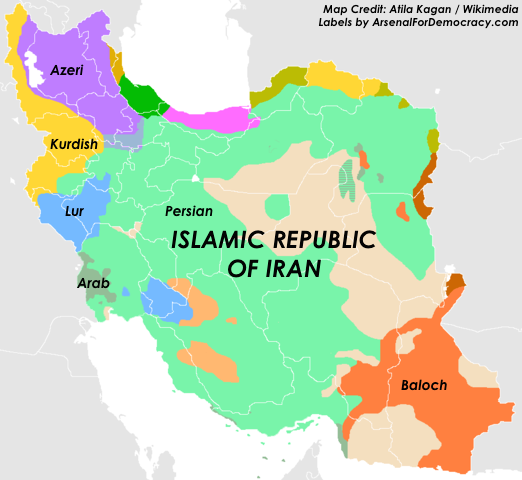
To understand how absurd the situation is and how confused the advocates of “diplomacy” are, let’s flip everything around.
Imagine it is Israel that has funded, trained and armed various ethnic “resistance” organizations along Iran’s western and eastern borders with heavy arms.
Imagine that these groups invaded Iran massacring 1400 Iranians, followed by thousands of anti-tank missiles, drones and rockets into Iranian towns.
Imagine that Israel send’s top generals to huddle with these groups’ leaders and plan attacks on Iranian soil.
Imagine that Israel openly supports these organizations and their goal of eradicating the Iran and harming the Iranian people.
Imagine that Israel regularly hosts the leaders of these armed groups treating them like foreign dignitaries.
Imagine that the UN never condemns Israel and their proxies on Iran’s borders for “destabilization.”
Imagine that the UN condemns Iran for “escalation” went it finally strikes back hard at the Israeli proxies including cross border incursions to root them out.
Imagine that the more powerful Iran never attacks Israel directly preferring to focus on the Israeli proxies, their leaders and their weapon stores.
Then imagine that Israel then launches 180 ballistic missiles at Iranian cities as "revenge" for successful attack on these Israeli proxy groups.
Now flip it back.
Now you understand how absurd this situation is.
Long ago Palestinian terrorists realized that working in aid organizations provides steady employment and irrefutable cover. They masquerade as physical therapists in MSF, social workers in UNWRA and freelance journalists with Al Jazeera. But it is in death that that their greatest value is realized as the international community and media erupt in outrage.
@martin_buur@nathanbarry Be careful with Cape Town Airbnbs, we were there last summer and it was awful. Filthy apartment and host didn't answer any calls from us at all. We had to leave.
Airbnb gave us a full refund and we had a lovely time in a hotel (The Orange I think it was called)
Hundreds of Jewish students at @Columbia just published one of the most incredible student letters I have ever read.
It's not only magnificently written, but it also clearly articulates their experiences on campus for the past six months.
Their letter tells the story of what's it like being a Jewish student right now better than any professor like myself could ever do.
Please take 4-5 minutes to read their letter.
Give Jewish students a voice.
https://t.co/nsWNScaoZS
People who say things like this are not serious people.
They're well intentioned, but they lack a firm grasp of how currency in the financial system actually works.
Let me explain 👇
Something you have to keep in mind is every country faces what's called the "impossible trinity" when setting currency policy. They get to pick two of the following:
1. Exchange Rate Stability - price control
2. Monetary Policy Autonomy - print control
3. Capital Mobility - flow control across borders
In the US we chose 2 and 3.
The reason this relates to your question is that when you abstract up to global trade and finance, we tend to favor countries that prefer 2 and 3. We also would prefer to find one one main currency.
Why?
Because it makes trade efficient and fair.
There's a ton of transactions going on between countries, businesses, etc and they're moving really, really quickly. You could just let them all work themselves out in a bilateral way, but that's kind of like going back to a barter system. It's a system that has *some* efficiency, but it'd be insanely more efficient if we just used one currency, especially as things move faster and faster.
So we want to use "mostly" one currency to make things work quicker, so how do we choose the right one?
Well the right currency needs three things:
A. Stability
B. Trust it will continue to be stable
C. Enough of it that using it won't make 2 and 3 fall apart.
This means it's gotta be the currency of a big boy economy to literally have enough currency to make stuff happen on a global level, so which big boy should we choose?
China?
Well, they chose 1 and 2 in the trinity, which means they can control the exchange rates/price. This doesn't really feel fair, because they could explicitly skew things in their favor. It also doesn't seem super trustworthy to not allow capital flows. So no.
EU?
Could work, but it's not that old and there's instability in the federation since it's made of a bunch of countries that still have too much autonomy apart from the combined entity to make sure it's stable.
Everyone else is either not big enough or not stable enough, so that leaves us with the ol' U-S-of-A and the dollar.
There are enough dollars.
Those dollars are (relatively) stable.
And they're backed by a significant amount of soft and hard power.
"But Patrick - couldn't that unravel?!"
It could, but as of right now the biggest argument against this spiraling out of control is - there's absolutely no other alternative.
China and the EU?
See above, and they're no where close to solving the trust and stability issues.
A new federation of countries like BRICS?
Taking several untrusted countries and putting them together multiplies distrust, it doesn't magically make trust.
Bitcoin?
Oh, the thing that's been around since 2009 and is based on math? Actually, bitcoin is kind of perfect, because the math solves a lot of these problems, but where's the soft/hard power backing it? Maybe it'll work, but not soon.
So again - USD.
We've been taking advantage of there being absolutely no viable alternative for quite some time by printing money and kind of not caring about how much we print.
Our status of being the reserve currency has gone down, but not by much. We currently sit with 59% of global reserves in USD. The next closest is the euro with ~20% of global reserves and the yen with ~6% and the pound with ~5%.
Even if we erode to 50% over the next decade or two, that's not a disaster or doom, because most of the world's still going to want dollars.
"Wait a second PC, what does this have to do with the USD spiraling out of control or not?"
I got you.
Being the global reserve currency gives us special privileges:
- Everyone loves your debt, because it's a way to get more of the global reserve currency.
- You can get away with printing more, because there's enough demand (people will take dollars)
So is the debt a big concern? Yes, but it's not because the USD is spiraling out of control and doomed.
It's because of intergenerational equity and the budgetary constraints it will cause in the mid and longterm. Assuming we don't have a giant gain in productivity and GDP (the likes of which we haven't seen in a while, but maybe AI?), entitlement programs will have to be cut back. That probably won't happen, because populism, so if you can't cut costs, what do you do? You raise money - ie raise or attack taxes. The result is potential brain and financial drain of the wealthiest folks since tax avoidance is possible and easiest for them, so you are left taxing the middle class. This doesn't go well to keep an economy growing, so you end up losing the funds to wield our hard and soft power; all of which results in the erosion of American hegemony.
How does the world respond? It becomes a lot more regionalized (which is already being accelerated by the next phase of capitalism) and likely still keeps using the dollar. We become a value stock, instead of a growth one. It's not a bad living. It's not catastrophic or doom. But it makes the next 100 years not as good as the last, which is sad and I'd argue not "the American way."
How we respond will make or break things, but I've still got hope.
Anyways, had some fun writing this, so hope it was helpful. It's a really good question that gets sensationalized a lot, even if there are some very, very valid things to think about and solve here.
Couple of notes:
- I'm generalizing in a number of places for brevity (ironically) and clarity. All of this has more nuance and complications. Even with those, some very smart people who know what they're talking about would disagree with me, as they'd prioritize certain aspects I think are less important.
- The unique privileges we have as the global reserve currency has sort of sparked "Modern Monetary Theory", which in general believes the government can print endless money (I'm generalizing). I think if the State continues to gain more and more control and more and more spending as a percentage as GDP this could be very true. Even if true though, I don't think that's a good world to live in. Different tradeoffs.
- People like to tweet about "oh a scary new trade agreement is going to settle trades in X currency instead of USD between Y and Z countries". These are not serious people. They don't know that trade currency != reserve currency. Also I can't think of a single announcement like that where a consequential amount of dollars was at risk.
- If you want to read very deeply on this to get a good understanding, check out Susan Strange. She invented the field of "International Political Economy" and discussed all of these issues/topics (including most of Balaji's takes, digital currencies, etc) in the 1980s. I recommend her book States and Markets for a foundation and then The Retreat of the State for topics around currency and some of the turmoil we're dealing with.
A few words about the protests/encampments at Columbia:
Back in December 2018, when I was a junior, a white student named Julian Von Abele was filmed going on an ethno-centric rant about how much he loved white people. He said things like: “White people are the best thing that ever happened to the world,” and “We invented science and industry, and you want to tell us to stop because ‘Oh My God we’re so bad’”. He was careful to add the caveat: “I don’t hate other people. I just love white men”.
The video went viral on campus. He was unanimously condemned: by students, professors and administrators alike. He was even banned from Barnard’s campus––though the “incident” didn’t even happen on Barnard’s campus.
Race pride is the opiate of weak individuals. I have always thought so. Nevertheless, I defended Julian at the time––not on the grounds that he was right, but on the grounds that he had every right to express his dumb beliefs without fear of being disciplined or banned from a campus for doing so. I don’t recall anyone at Columbia who publicly came to his defense at the time.
Fast forward 5 years: we now have Columbia students chanting “Globalize the Intifada” and “From the River to the Sea” en masse. To my ear, these slogans suggest support for, at minimum, violence against Jewish civilians in Israel––much worse than anything Von Abele advocated. Yet all the same people who were silent or supportive of his cancellation have suddenly discovered the virtues of unbridled free speech. Forgive me if I don’t believe it for a second.
Let’s not deceive ourselves into thinking that any of these people value liberal principles. They don’t. They believe in the destruction of Israel––which they erroneously categorize as an colonialist entity––and they will use every liberal principle, selectively and cynically, to further that goal.
But let me be clear: I completely support their right to say all of these slogans. Students should be allowed to chant “Globalize the Intifada” and “From the River to the Sea”. These are slogans whose meaning is contested. What it means to your ear is not necessarily what it means to an idiotic Columbia student whose only knowledge of the Israel-Palestine conflict comes from Instagram posts also made by idiots.
Free speech is never about protecting speech you agree with. It’s always about protecting speech you hate. That is precisely the speech which needs protecting. Having defended the Von Abele’s of the world, no one will accuse me of being a hypocrite.
Of course, when they cross the line from speech into prohibited actions––creating zones where certain kinds of students (e.g., Zionists) can’t enter; human chains that prevent freedom of movement for other students; harassment/stalking of specific students, and so forth––then they must be disciplined to the full extent of campus policy and the law. If they want to get arrested or expelled, then schools and police should grant that wish without a hint of guilt. Let them explain to their parents why they threw away $70,000/year over a foreign conflict that they barely understand.
Still, the punchline must be: Hypocrites deserve free speech too.
Having studied in the classrooms of Columbia University, I've always valued the institution's dedication to intellectual diversity and open discourse. However, the recent events unfolding on campus, with anti-Israel, terrorist-supporting protests and inflammatory rhetoric, are deeply troubling. As an alumna, I believe it's crucial for @columbia to uphold its principles of inclusivity of thought while safeguarding the rights of all students, including those of Jewish descent. Columbia has stopped receiving donations from many alumni, including me, since they failed to stop the student body from passing a BDS resolution. They will continue to not receive a penny from me in donations until this antisemitism problem is cleaned up. Furthermore, I will continue to use my social media platform to expose their failures and demand action. It's imperative for the university administration to start taking definitive steps to address and condemn any form of discrimination or hostility targeting Jewish students. Call in the National Guard. Stop taking money from foreign bad actors. Fire terrorist sympathizers on staff. Expel students who break the law. These are all adults. And they must be held accountable.
🧵1/ I’m back from a short trip on a social network with photographs and videos from Gaza, with some brief personal conclusions.
First, it is quite clear that there are those in Gaza who know how to make extensive use of the networks and social media for the purposes of emotional extortion and also false propaganda, exactly like they live streamed the October 7 massacre and somehow turned it into “justified resistance”, they use quite a few Western buzzwords such as “genocide”, “occupation”, “oppression” and “Zionism”- and this is the simplest way to distinguish between Hamas propaganda posts and authentic people in Gaza, whom I’ve known all my life, who use much simpler words and not this indoctrinated manipulation bullshit.
I was looking for THESE authentic people - the real voices. And I think I found a few.
So first of all, what do I think there is NOT happening in Gaza? There is no genocide and no famine.
Yes, there is quite a lot of suffering, shortages in some places and lack of decent shelter etc. And there’s a lot of cynical exploitation of it for propaganda purposes. I’m saying it because you can see children are getting payed for it, you can see the absolute control of distribution and you can see how basic needs and the way out is blocked with money- Israel is not taking money for any of it, the West is sending free aid, so the money is demanded by those who want to control the suffering and use it.
You should know, that before the war - there was already quite a lot of very poor population in Gaza, but now the economic difficulty has greatly increased for two main reasons: one, the war damaged many sources of livelihood and the second - a major source of livelihood was working in Israel and this option was closed for a long time now, since October 7, and is now much less operational.
So in fact the main source of income is donations and funding from Hamas for control purposes of course.
This is how, among other things, Hamas uses the population to "work for them", and also to smile or cry for the cameras on demand.
Now on the issue of claimed famine- famine is when there’s NO food and water, enough for the population. As I said, my personal conclusion is that there is no shortage of food and water in Gaza at all.
The problem is that the food is not distributed equally, it is controlled by those who are powerful (usually Hamas operatives) and then sold at high costs to the population without them having sources of livelihood.
Food that should be distributed for #free is actually sold at a high price, the shelter tents are also paid for and the exit from Gaza is particularly expensive (5000$ that are paid to the transporters).
There are quite a few who refer to Gaza as a "prison" but Gaza is not a prison, Hamas has simply created a situation where it is very expensive to leave it - and thus the poor and the new poor are completely dependent on Hamas and other clans (Hamulas) in everything to do with food, shelter and exit, and they play with them as pawns.
If Gaza is a prison - then it’s because Hamas are imprisoning it.
All the suffering in Gaza started because of #Hamas it continues and increases because of #Hamas, but the main point is that #Hamas is also the one factor that can stop it.
If Hamas surrendered unconditionally and released the Israeli hostages, as done in any war in which you are forced to admit defeat - they would truly liberate Palestine. Remember- this is a war that #Hamas started, a war that on Oct. 7 was celebrated in the streets of Gaza.
But #Hamas prefers to keep the Palestinians captive so that it can showcase suffering (which they create) and use it as a tool for financial donations, manipulation of the West and a messianic jihadist war that will never end for them.
If the West doesn’t wake up to this ongoing manipulation- they will never help the Palestinians in Gaza or in general, and they will bring this jihadist chaos to their doorstep
From Gaza >
As mayor of the largest Jewish population in the world outside of Israel, the significance of Iran's attack for Jewish New Yorkers — many of whom have family in Israel — is not lost on me, especially with Passover just days away.
New York City stands with Israel.
Last night was a major victory for Israel on multiple levels.
1. Its air defense and technology executed flawlessly, repelling the largest missile and drone assault in history. Unprecedented coordination between defense systems and allied militaries completely nullified the attack.
2. We saw surprisingly tight coordination with Jordan and Saudi Arabia, with Israeli and U.S. aircraft entering their airspace to eliminate suicide drones. Arab pilots also downed drones heading for Israel. The regional Arab-Israeli alliance against Iran was strengthened, courtesy of Iran.
3. Since $5.2B of the military aid package now stuck in Congress is for air defense systems and interceptors, the package will soon pass. Politicians opposing the aid have been exposed as obtuse or vindictive. Everyone knows who they are.
4. Iran, which funds and arms Hamas and Hezbollah, has been unmasked as the region’s pariah state, and risks tightened international sanctions. It can no longer hide behind its proxies that surround Israel. When Israel decides to send Iran a message, its missile and drones will glide through Iran’s primitive air defense. Iran set the new standard, not Israel.
5. It was Israel defending the skies over the Dome of the Rock in Jerusalem as Iran shows the world what “indiscriminate” and “disproportionate” attacks actually look like.
6. The attack also revealed the hypocrisy of the campus ceasefire crowds who cheered on the attack in the hope someone would kill Israelis, even if they’re Arab Israelis.
7. Despite social media claims, there was absolutely no panic in Israel. The lines for gasoline were in Tehran. Parties and protests took place as scheduled throughout the country, because confidence in our military and its people remain high.
Am Yisrael Chai VeChazak!
In attacking Israel directly from within its own territory last night, Iran changed the rules of the game. An effective counterstrike from Israel would need to be a successful in ways the Iranian assault was not... but that would invariably cause an escalation that could easily spiral out of control. Conversely, a promise not to respond carries the risk of a greatly emboldened Iran thinking it can now strike Israel directly with impunity.
This is a true dilemma, but ultimately no decision needs to be taken immediately because the Iranian attack was a failure and will be remembered primarily for being the greatest demonstration of coordinated air defense in the history of warfare.
At this point, Israel needs to say that it will deliver an appropriate response at a time and place of its choosing. We don’t forgo the right to respond, while retaining the element of surprise.
It’s tempting to demand an immediate Israeli response, but Israel’s current predicament vis a vis Iran cannot be seen in isolation of other geopolitical events and trends swirling around us (just as the attack on the IRGC general was not an isolated event but related to the war against Hamas and Hebollah).
Through poor leadership and weak personal relationships, Israel has unwittingly isolated itself over the last few months. The perception of abandonment is the most severe blow to strategic deterrance of the past six months, with talk of arms emargos, conditioning military aid, UN condemnations and frustration between the US and Israel laid bare. If an Israeli counter attack deepens that isolation, Israel won’t achieve much at all.
It will cost Israel a little in terms of deterrence but it is counterbalanced by other actions Israel has already taken including the complete destruction of Gaza and the surprise elimination of an Iranian general. Iran did the unthinkable in attacking Israel direcly, but ultimately failed. Israel did the unthinkable in attacking an Iranian general, and succeeded. It’s the Iranians who are now paranoid and unsettled.
Israel suddenly has an opportunity to strengthen its historical alliances and expand it into the Arab world to include Saudi Arabia. This is far more threatening to Iran than a few Jericho missiles hitting their targets to prove something everyone already knows.
Israel must now leverage the political capital it gains from exercising temporary restraint to continue its battle to destroy Hamas. This would be the ultimate victory over Iran, and better position Israel to eventually confront Iran directly as part of a broader alliance.